Do branded links get more clicks? Possibly, but the famous numbers don't prove it. The "39% more clicks" figure appears on Rebrandly's own marketing pages with no study, sample size or date behind it, and the other widely quoted figures (34%, 2.3x) trace back to vendors the same way. A visible, recognisable domain is a plausible reason for a lift. How big that lift is for your audience, you only find out by testing.
This post follows each claim to its source, says what the evidence supports, and gives you a test you can run in a week. If you want the definition first, what is a branded link covers it. Here the narrower question is the branded links click-through rate claim itself: how much of it is measured and how much is sales copy. Everything below was opened at its source on 2026-10-01, and each statistic carries that access date.
What Vendors Claim About Branded Link CTR
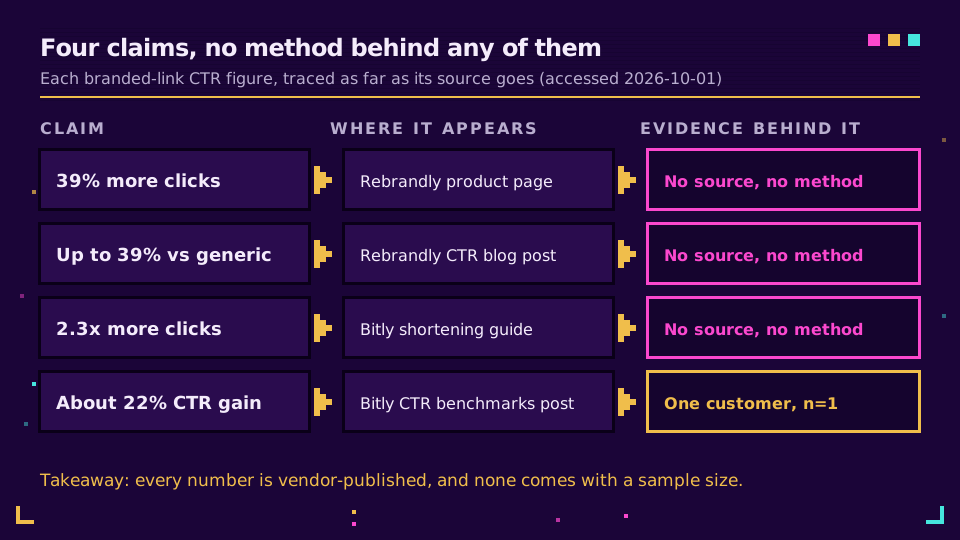
Search for the topic and you get a stack of confident percentages. Four show up again and again. Each one below was opened at its source page and checked for a citation, a sample size and a method.
- "Get 39% more clicks": Rebrandly's branded links page. No source, no method.
- "Up to 39% CTR vs generic URLs": Rebrandly's CTR blog post. No source, no method.
- "2.3x more clicks on average": Bitly's URL shortening guide. No source, no method.
- "About 22% CTR gain": Bitly's CTR benchmarks post. One customer testimonial, n=1.
All four were accessed 2026-10-01. The Rebrandly branded links page says branded links "build trust and get 39% more clicks" and headlines a conversion version of the same number, with no footnote. Its CTR blog post softens the wording to "up to 39%". Bitly's URL shortening guide says custom domains get "2.3x more clicks on average", again with nothing attached. Bitly's CTR benchmarks post goes one better by linking evidence: a single verified customer reporting roughly a 22% improvement after switching from long URLs to branded links in WhatsApp campaigns.
Notice the 22% case compares long URLs to branded short links. Not branded versus generic short links. That's the question most people actually have.
Tracing the 39% Figure to Its Source
Following 39% upstream is a short trip. Rebrandly's older what is a branded link explainer, last updated in October 2023, contains no click statistic at all. The number lives on the sales pages and in the CTR post, and none of them link to research. There's no whitepaper, dataset or methodology note anywhere I looked.
What turns up instead is the echo. A branded-link guide on u2l.ai says "34% more clicks" traces back to "a study popularized by Rebrandly", but gives no method, no sample size and no link to the study. To its credit, the same piece admits the lift is "highly contextual". An SMS vendor's post at messageflow.com relays 39% and 34% as "directional" and cites Rebrandly again, without a method. Both pages were accessed 2026-10-01.
So the citation chain is a circle. A vendor says 39%. A blog says 34% from "a study". A second blog says both. Nobody points at a primary dataset. That's a marketing claim, not a finding. It may even be directionally right, since a vendor with that much click data can see things we can't. But "can see" isn't the same as "published".
What the Evidence Does Support
Strip the percentages and a smaller, sturdier claim is left.
- People read the domain. A visible domain is a trust cue, and cues change click behaviour. An arXiv study of phishing susceptibility (accessed 2026-10-01), run with a real organisation's IT team, found that how a link is presented, masked or raw, changed who clicked. It isn't a branded-versus-generic test and I won't pretend it is, but it supports "presentation matters".
- Shortener domains carry reputation baggage. Short links are a common phishing disguise, which is why users distrust them and why filters treat shared shorteners warily.
- Customer anecdotes exist. The 22% WhatsApp case is one company, but it's a data point.
It does not support a universal multiplier. Lift depends on how well your audience knows your brand, the channel, how long the link is visible, and what the generic link looked like. A household name in a text message and an unknown startup in a LinkedIn comment are different experiments entirely.
There's also a selection problem inside every vendor average. Teams that set up a custom domain tend to segment, write better calls to action and clean their lists. Compare their branded links to everyone else's generic ones and some of the "lift" belongs to the team, not the domain. Only a controlled split removes that.
Where Trust Effects Should Show Up First
If a branded domain helps anywhere, it should help where the URL is visible and the reader has to decide fast.
SMS. The link is plain text, there's no button or preview to hide behind, and carriers filter on it. A domain you own that matches the sender name addresses both the human and the filter. We cover the carrier side in URL shortener for SMS marketing. No primary carrier document was opened for this post, so treat "shared shorteners get filtered more" as widely reported rather than something I verified here.
Social posts and comments. Platforms often show the raw URL in captions and replies. Anyone scanning a feed for scams reads it. This is the other place I'd expect a visible effect, and the one where an unknown brand gains least.
Email. The link usually hides behind a button or anchor text, so the domain matters less to the click and more to deliverability.
Print and QR codes. Printed URLs are typed or scanned, so trust and memorability matter, but I found no data on branded-versus-generic print CTR. If you're printing, the real reason for a domain you own is that you can repoint it after the brochure is in 5,000 mailboxes. That's control, not a click lift.
How to Test Branded vs Generic Links Yourself
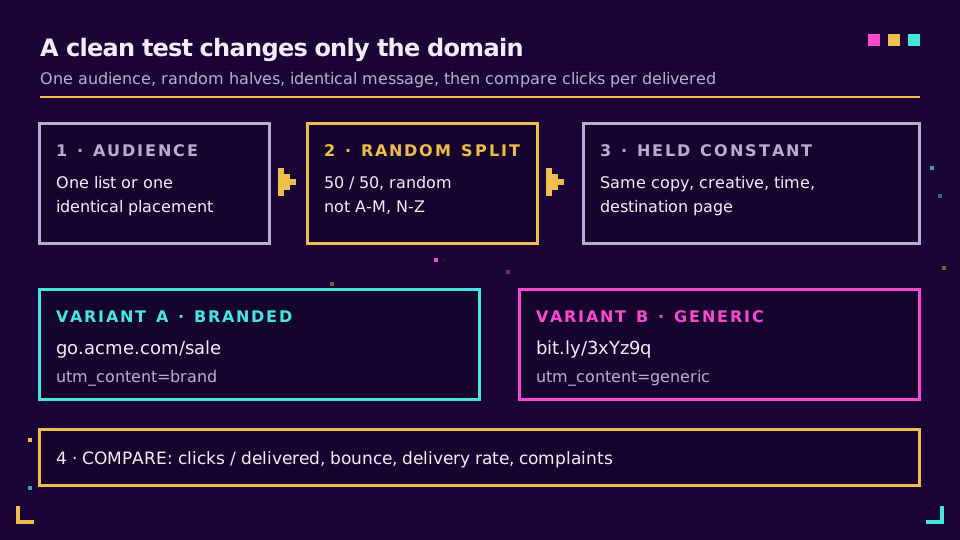
A week of careful testing beats any vendor number because it measures your audience. The design is plain; the discipline is the hard part.
The setup
- Take one audience (one SMS list, one email segment, one set of identical social placements).
- Split it randomly into two equal halves. Random means a random sort, not "A to M and N to Z".
- Same copy, same image, same send time, same destination page.
- The only difference is the short-link domain: your branded one on half A, a generic or platform domain on half B.
- Give each link a distinct
utm_content(for examplebrandandgeneric) so the destination analytics agree with the link analytics. The UTM naming guide keeps those values tidy.
On Elido that means creating two links to the same destination, one on your custom domain and one on a platform domain, and reading clicks per link in analytics. The sends or delivered count comes from your messaging tool, since the link tracker can't know how many people received the message.
Rules that keep the test honest
- Decide the metric, the sample size and the stop date before you send. Peeking daily and stopping when it looks good inflates false wins.
- Test one thing. If you also change the call to action, you've learned nothing about the domain.
- Run it more than once. One send is an anecdote, and I'd want it to hold across two or three. The general method is the same one in our A/B testing guide for landing pages.
How Many Sends Is Enough
Small lists get stuck here. CTR is a rate on a small base, and telling two small rates apart takes thousands of sends per variant. These figures use the standard two-proportion approximation at 95% confidence (two-sided) and 80% power, which I computed myself. Calculators such as Evan Miller's sample size tool (accessed 2026-10-01) use slightly different formulas, so expect small differences.
| Baseline CTR | Detect a 39% lift | Detect a 20% lift | Detect a 10% lift |
|---|---|---|---|
| 2% | ~6,000 per variant | ~21,000 per variant | ~81,000 per variant |
| 5% | ~2,300 per variant | ~8,200 per variant | ~31,000 per variant |
| 10% | ~1,100 per variant | ~3,800 per variant | ~14,800 per variant |
Read it from the claim's side. If the vendor 39% were true for you at a 5% baseline, around 2,300 sends per variant would show it. If the real lift is 10%, you need roughly 13 times that. A list of 1,000 people can't tell a 10% lift from noise, whichever way the numbers fall. If you can't reach the number in the table, pool several sends into one repeated experiment instead of trusting a single small one.
A clean test that finds no difference is still an answer. It tells you the domain isn't what limits your clicks, so you can spend the effort on the message.
What to Measure Besides CTR
Clicks alone can mislead. A link that looks trustworthy can attract curious clicks that bounce, and a link that gets filtered never shows up in the denominator you think it does. Track four numbers per variant.
- CTR: clicks divided by delivered messages (or delivered emails, or impressions for social).
- Post-click quality: bounce rate and conversion on the destination, tied back through the
utm_contentvalue. A lift in clicks with no lift in conversions is a vanity win, which is the same trap what is CTR warns about. - Delivery and spam signals: delivery rate, carrier or provider blocks, complaints, opt-out rate. This is where a branded domain is most likely to pay off.
- Bot and scanner noise: security scanners prefetch links in email and SMS. That can inflate one variant more than the other, so watch for suspiciously instant clicks. More in short link analytics: what to measure.
If you want the whole loop (domain, slugs, tracking, reporting) in one place, setting up branded short links walks it end to end, and the campaigns feature lets you group the two links and their UTMs under one send.
So, Do Branded Links Get More Clicks?
My read after tracing every number: branded links very likely help where the URL is visible, and the vendor percentages are not evidence of how much. Still, put a branded domain in front of any text message or public social post, mostly for control and filtering, and then measure whether the click lift shows up. Don't pay for a plan because a landing page says 39%.
The honest summary looks like this:
- Supported: a recognisable domain is a trust cue, and presentation affects clicking.
- Plausible but unproven: a measurable CTR lift in SMS and social, likely smaller than the headline figures.
- Vendor marketing: any single universal percentage, whether 39%, 34% or 2.3x.
- Yours to find out: the actual number for your audience, through a split test you design before you send.
The big picture of how domain, slug and analytics fit together is in what is link management, and the setup side is in custom domains for short links. Custom domains are a paid-plan feature, so check pricing for the current limits before you plan a test.
Related on the Blog
Frequently asked questions
Do branded links increase click-through rate?
Probably, in some channels, but nobody has published a method-backed number. Vendors quote 39%, 34% or 2.3x, and none of the pages I opened shows a sample size, a control group or a date range. The mechanism (a visible, recognisable domain) is plausible. The size of the lift for your audience is something you have to measure.
Where does the 39% branded link statistic come from?
It comes from Rebrandly's own marketing pages, and I could not trace it any further. Rebrandly's branded-links page and its CTR blog post both state the figure with no citation, study link or method. Third-party blogs then repeat it, sometimes rounding it to 34% or calling it a study.
Are branded links worth it?
Yes, but for reasons that are easier to prove than a CTR lift. A branded domain gives you control (you can repoint it), consistent recognition, and in SMS a better chance of passing carrier filters than a shared shortener. Treat any click lift as a bonus you verify, not the reason you pay.
How do you A/B test branded vs generic short links?
Send the same message, creative and destination to two randomly split halves of one audience, changing only the short-link domain. Give each half its own link with a distinct utm_content, send at the same time, and compare clicks divided by delivered messages. Decide the sample size and the stopping point before you send.
How many sends do I need to test a branded link?
More than most teams expect. At a 5% baseline CTR, spotting a 20% relative lift (5% to 6%) needs roughly 8,000 sends per variant at the usual 95% confidence and 80% power. A 10% lift needs about 31,000 per variant. Small lists can only detect large effects.
Do branded links reduce spam flags and blocked texts?
They can, but the evidence I could verify is indirect. Shared public shorteners are a known filtering signal in SMS, and a link domain you own that matches the sender is the usual workaround. Measure it directly: track delivery rate, complaints and opt-outs per variant rather than assuming it.
Try Elido
Paste a URL, get a working short link
No signup. Link lives for 30 days. Sign up to keep it forever.
Free, no signup required · 2 per day