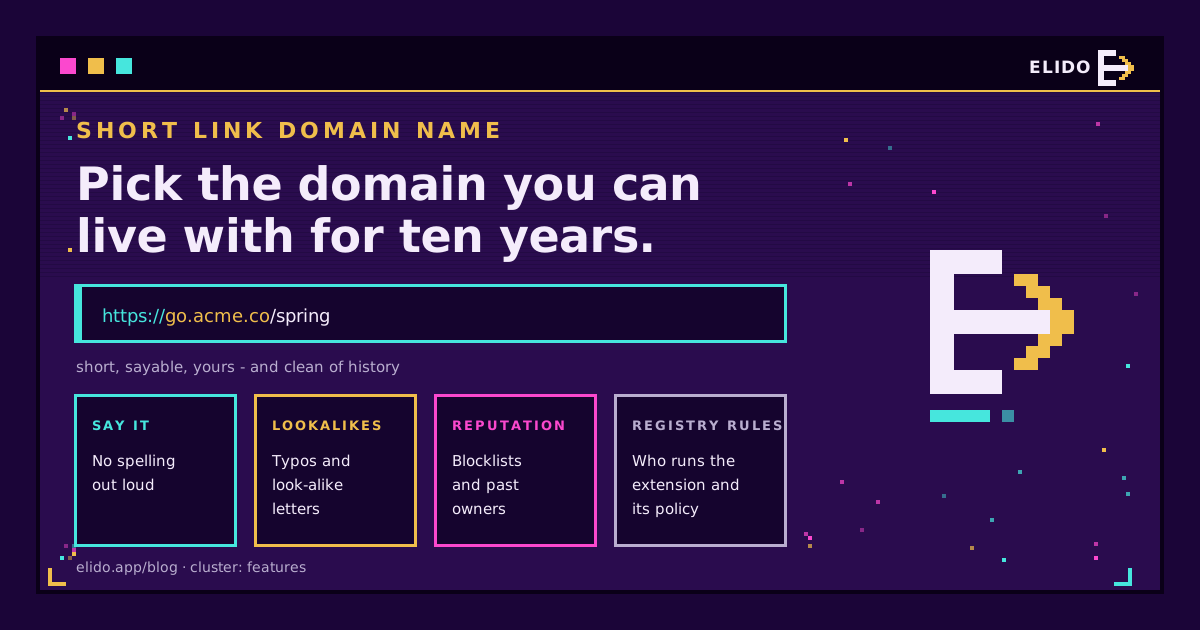
A good short link domain name is short, easy to say, clearly yours, and clean of history. For most brands that means a subdomain like go.yourbrand.com, or a dedicated four-to-eight-character domain on a generic extension you've actually read the rules for. Everything else in this post is how to get to that answer without a mistake you can't reverse, because the domain you pick ends up printed on packaging, baked into QR codes and sitting in thousands of old emails.
Choosing a short link domain name is a one-way door more than people expect. You can change a headline tomorrow. You can't change the domain in a link that's already in somebody's inbox, and the cost of a bad choice shows up months later as lower trust, blocked sends or a registry deciding your name is no longer yours.
If you're still deciding whether to brand your links at all, start with what a branded link is. If you've decided and need the click-by-click setup, setting up branded short links has it. This post sits between the two: how to choose the domain.
Root Domain, Subdomain, or Dedicated Short Domain
You have three structural options, and the right one depends mostly on how long your brand name is.
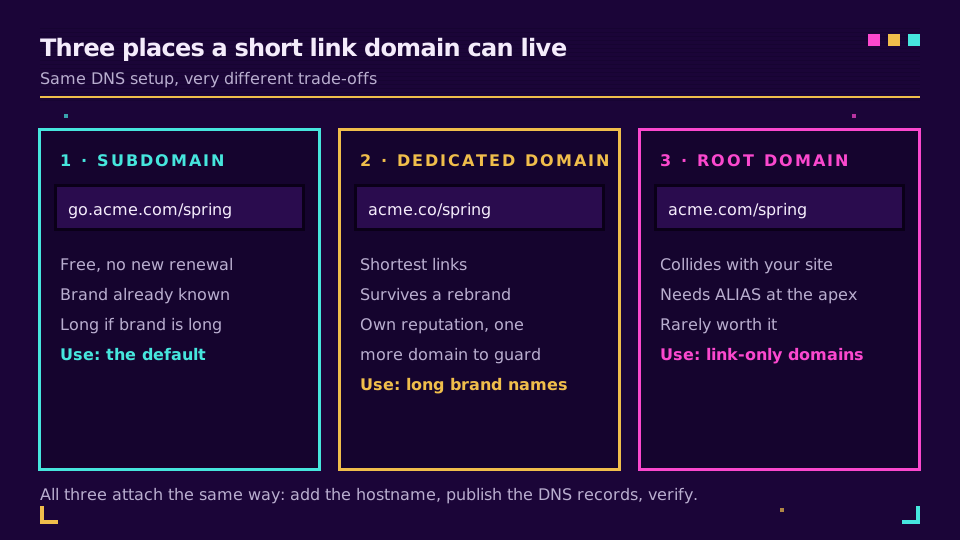
A subdomain of your brand domain (go.acme.com) is the default I recommend. It costs nothing extra, readers already know the name, and it stays under your existing registrar and security controls. The weakness is length: go.globalmarketingsolutions.com/spring isn't short by anyone's definition.
A dedicated short domain (acme.link, acme.co) wins when the main name is long, when you want links to survive a rebrand of the main site, or when you want the link domain's reputation separated from the website's. The price is one more domain to renew, lock and monitor.
The root domain itself (acme.com/spring) rarely makes sense. Your website already lives at that host, so the short links and the site would compete for the same address, and DNS rules forbid a CNAME at the apex, which means you'd need an ALIAS-style record from your DNS provider (RFC 1034 section 3.6.2 explains the restriction). Unless the whole domain exists only to host links, skip it.
On the Elido side, all three attach the same way: you add the hostname in the dashboard, publish the DNS records it gives you, and the domain verifies. The custom domains feature page covers what's supported, and custom domains for short links goes into the DNS record types.
Picking a TLD: Trust, Cost and Registry Rules
The extension carries two separate risks. One is perception: does it look trustworthy to your audience? The other is governance: who controls it, and under what rules? Most advice, including the three guides I read before writing this, covers only the first.
| Extension | What the registry data says | The catch |
|---|---|---|
| .com | The default readers expect | Short, brandable names are mostly taken |
| .co | Country-code domain for Colombia, managed through the country's ICT ministry per IANA | Often read as "company"; renewal pricing varies by registrar |
| .me | Country-code domain for Montenegro, listed under its government | Reads as personal; confirm renewal price |
| .link | A generic extension, not tied to any country, per IANA | Newer, so some readers hesitate; check price |
| .io | Country-code domain for the British Indian Ocean Territory | Its long-term status depends on that territory's standing |
| .ly | Country-code domain for Libya | Libyan registry rules apply to your content |
I pulled the registry column from the IANA root zone database entries for .co, .me, .link, .io and .ly. I didn't copy prices into the table because they change at renewal and differ by registrar. Look at the renewal price, not the first-year promotion.
Country-code extensions come with local rules
A country-code domain (ccTLD) is run by or for a country, so its rules can include things a generic extension would never ask of you. The cautionary tale in this space is old but still the best documented. In 2010 Libya's registry deleted vb.ly, an adult-themed shortener, saying its content broke the registry's rules, and TechCrunch reported the same week that other shorteners on .ly were worried about losing theirs. Most brands will never publish anything a registry objects to. The point isn't that .ly is dangerous. It's that your link domain's survival depends partly on a government's policy page, and you should read it before you print the domain on ten thousand boxes.
The .io case is slower-moving. After the UK and Mauritius agreed on the Chagos Archipelago, The Register reported that IANA's process would start a five-year retirement of a country code if it were removed from the ISO list, and that nothing was imminent. No one should panic. Equally, a link domain is meant to last longer than a product launch, so a domain with a documented exit path deserves a second thought.
Treat free-registration extensions as a separate warning. Freenom, which handed out free .tk, .ml, .ga, .cf and .gq names, stopped taking registrations after Meta sued it over abuse. Domains that cost nothing attract people who don't care what happens to them, and filters learned that.
Length and Typeability
A short link has to survive being said out loud, typed on a phone and scanned off a poster. Test any candidate against these before you pay for it.
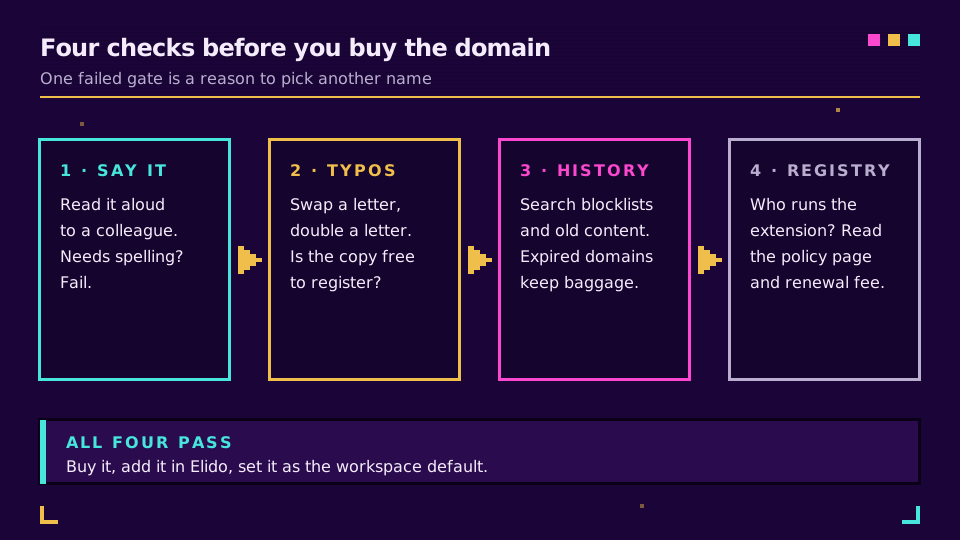
- Say it to a colleague over a call. If you need to spell it, it fails.
- Look for ambiguous characters: the letter l next to the number 1, O next to 0, "rn" that reads as "m".
- Count the full link, not just the domain.
acme.link/springis short;acme-marketing-links.com/springis not. - Skip hyphens. They make dictation awkward and, in my experience, read as spammy to cautious readers.
Length also matters for print. A shorter URL generally produces a less dense QR code, which scans more reliably at small sizes, and how big a QR code should be shows what that means in centimetres. The slug after the domain matters just as much, and what a custom back-half is covers how to keep it readable.
Lookalike and Homograph Risks
Whatever you choose, someone can register a near-copy. Attackers register domains that differ from yours by one swapped letter, a doubled letter, or a character from another alphabet that renders almost identically. Unicode's security report on confusable characters is the reference for how those pairs work.
Two things reduce the risk. Choose a name with a recognisable brand fragment, because lnk.co is easier to impersonate than acmelnk.co. And register the one or two most obvious typo variants yourself if the name is valuable. For the mechanics of how internationalized lookalikes work and how browsers display them, the homograph attack guide goes deeper, and are URL shorteners safe covers the reader's side of the same problem.
Spam Reputation and Email Deliverability
Mail filters and URL scanners look at the domains inside your messages. A domain that has been used for spam, phishing or bulk mailing carries that history, and domain blocklists such as the Spamhaus Domain Blocklist exist to record exactly that.
That has three practical consequences.
- Check history before buying. An expired domain isn't a blank slate. Search for it in blocklists and security lookups, and look at what it used to host.
- Own your domain instead of sharing one. A shared shortener domain carries the reputation of everyone using it. A domain only you use starts with no reputation, which is better than a bad shared one, though it needs a gentle warm-up: begin with a small, legitimate send.
- Be careful what you put on it. Some filters weigh the registered domain rather than the subdomain, so a link domain that gets flagged can cost the site next to it.
Do short links hurt email deliverability walks through what mail providers actually look at. If you want a second opinion on a candidate, Google's Safe Browsing site is where its checks are documented.
DNS and TLS Setup Effort
The domain choice changes setup effort less than people fear. A subdomain needs a CNAME and a verification record. A root domain needs an ALIAS or flattened record that your DNS provider has to support. A dedicated short domain works either way: use a host such as go.acme.link with a CNAME, or the bare domain if your provider supports ALIAS records.
TLS is the part you don't want to hand-manage. In Elido, certificates are issued automatically on the first request after the domain verifies, so there's nothing to renew yourself. Set up a custom domain with TLS in 5 minutes walks through the exact records and the verification states.
If you're weighing a candidate right now, the quickest way to know whether it works is to add it. The custom domains guide lists the records, and you can check plan availability on the pricing page before you commit to a registrar.
A Decision Checklist
Run any candidate through this list. One "no" is a reason to pick a different name, not a reason to argue with the list.
- Does it include a recognisable piece of your brand?
- Can you say it over a phone call without spelling it?
- Is the domain plus a typical slug under about 25 characters?
- Is the history clean, with no blocklist entries and no past spam hosting?
- Have you read the registry's policy page, and does anything in it concern you?
- Is the renewal price, not the promo price, acceptable for ten years?
- Have you secured the obvious typo variants and a registrar lock?
- Does your DNS provider support the record type your chosen structure needs?
If all eight pass, buy it, add it to your workspace and set it as the default so the team stops creating links on the shared domain.
Where This Fits
This post belongs to the features cluster. The cornerstone is what is link management, which ties domains, back-halves, routing and analytics together. After you've chosen, setting up branded short links is the next step.
Related on the Blog
Frequently asked questions
What makes a good domain name for short links?
A good short link domain is short, easy to say aloud, obviously yours, and free of baggage. Four to eight characters before the extension is a sensible target, with no hyphens and no characters that read ambiguously (l and 1, O and 0). It should also have a clean history, which means nobody sent spam from it before you owned it, and a registry whose rules you have actually read.
Should I use a subdomain or a separate domain for branded short links?
Use a subdomain of your main brand domain, such as go.yourbrand.com, when the brand name is already short and you want zero extra cost and instant recognition. Use a separate short domain when your main name is long, when you want links that survive a rebrand, or when you want the link domain's reputation kept apart from your website. Both set up the same way in DNS.
Is .link or .co better for a short link domain?
.co and .link both work, and neither is a clear winner on trust alone. IANA lists .co as Colombia's country-code domain and .link as a generic top-level domain, so .link has no single country's rules attached. Pick on price at renewal, whether the name you want is free, and how the extension reads to your own audience.
Is it safe to use a .io or .ly domain for short links?
It is workable, but both are country-code domains and carry rules you don't control. IANA lists .io under the British Indian Ocean Territory and .ly under Libya, and Libya's registry deleted the adult-themed shortener vb.ly in 2010. For a link domain that will sit on printed packaging for years, a generic extension or a domain in a registry you trust is the lower-risk choice.
Can the domain I pick hurt email deliverability?
Yes. Mail filters and domain blocklists score the domains inside your links, so a new or previously abused domain can push messages toward spam. Check the domain's history before you buy it, avoid extensions that are heavily abused by spammers, and send a small, well-behaved batch first so the domain builds a clean record.
How long should a short link domain be?
Aim for roughly four to eight characters before the extension, and judge the whole link rather than the domain alone. If a person has to read the link out loud, spell it into a phone, or scan it from a printed QR code, every extra character is a chance for a typo. A longer domain is fine if the slug that follows stays tiny.
Try Elido
Paste a URL, get a working short link
No signup. Link lives for 30 days. Sign up to keep it forever.
Free, no signup required · 2 per day