To track an influencer campaign with links, give each creator their own short link for each platform they post on, tag it with UTM parameters, and read the clicks per link in one campaign report. That is the whole mechanism. One shared link means one number, and one number cannot tell you which creator earned it.
Most influencer reporting fails at exactly that point. The brief goes out, three creators post the same URL, and the dashboard shows 4,000 clicks that nobody can divide. This guide covers the setup that avoids it: the link structure, a UTM scheme for creators, branded domains, discount codes, bio links, reporting, disclosure and fraud signals. It builds on UTM naming conventions and the wider social link tracking basics.
One Link per Creator per Platform
Create a separate short link for every creator and every platform they will post on. Mira on Instagram gets one, Mira on TikTok gets another, Jonas on YouTube gets a third. If a creator posts the same offer in a story, a reel and a bio, you can still give those placements their own links when the placement matters.
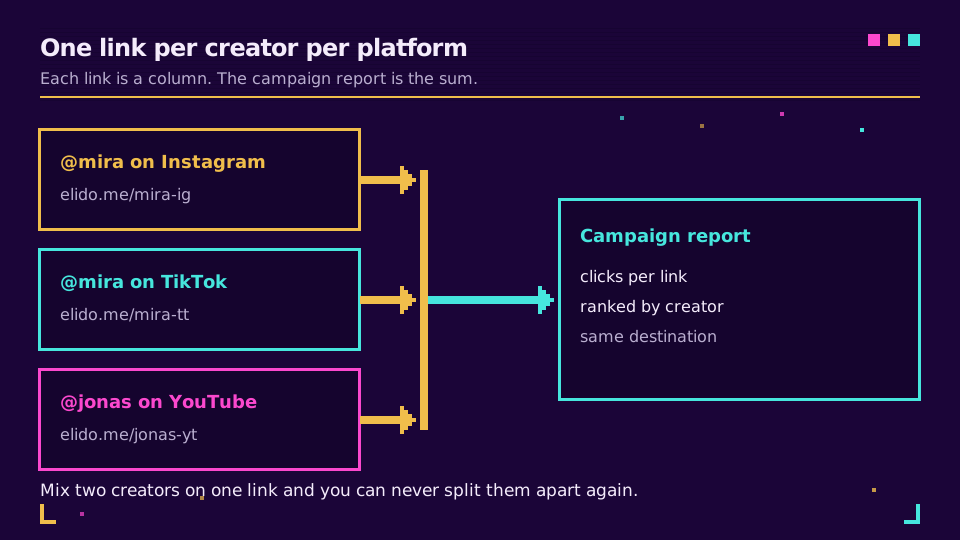
Why per platform and not just per creator? Because the same person converts differently across audiences. A creator whose Instagram sends 900 clicks and whose TikTok sends 60 is two separate deals, and you want to renew only one of them.
Keep slugs readable: mira-ig, mira-tt, jonas-yt. A readable slug lets the creator check they pasted the right link, and it lets you spot a mix-up in a spreadsheet without a lookup table. Elido campaigns group these links so the report shows the sum and the split in one place.
One honest limit: the Free plan holds 25 links in total. Twelve creators on two platforms already use 24 of them, so anything beyond a small pilot needs a paid plan (see pricing).
A UTM Scheme for Creators
Use the platform as utm_source, the word influencer as utm_medium, the campaign name as utm_campaign, and the creator handle as utm_content. Here is a complete example:
?utm_source=instagram&utm_medium=influencer&utm_campaign=spring-launch&utm_content=mira
The obvious alternative is the creator handle as source. It reads naturally, and I understand the pull. The cost shows up in your analytics tool, which groups traffic by source and medium. Google documents these as the core campaign dimensions in its guide to campaign URLs. Fifty creator handles as sources turn your acquisition report into a list of fifty one-row channels. With the platform as source, you see Instagram against TikTok at a glance, then drill into utm_content to rank creators.
Two cautions. First, a custom medium like influencer may not fall into one of GA4's default channel groups, so check where it lands and build a custom channel group if it ends up in "Unassigned". Second, browsers and apps can strip parameters in some contexts, which is one reason the short link's own click count matters. Our post on browsers that strip UTM parameters covers the cases.
If you build links by hand, a UTM builder inside the shortener beats a spreadsheet, because the tags and the slug are saved together and a typo cannot slip into the third creator's link.
Branded Domain for Trust
Creators and their audiences hesitate to tap a link that looks like a random string on a generic domain. A short link on your own domain tells the follower where it goes before they tap. We looked at whether branded links get more clicks in detail, and the honest summary is that the effect is real but modest and depends on the audience.
For influencer work the stronger argument is control. If a creator's link sits on your domain, you can repoint it when an offer ends, and a dead promo does not become a dead link in a post that stays online for years. Setup is covered in branded short links in five minutes.
Branded domains are not on the Free plan. They start on Pro, so a Free-plan pilot would use the shared Elido redirect domain instead. Details on custom domains.
Discount Codes and Links Together
A tracked link and a discount code count different people, and the sensible move is to use both.
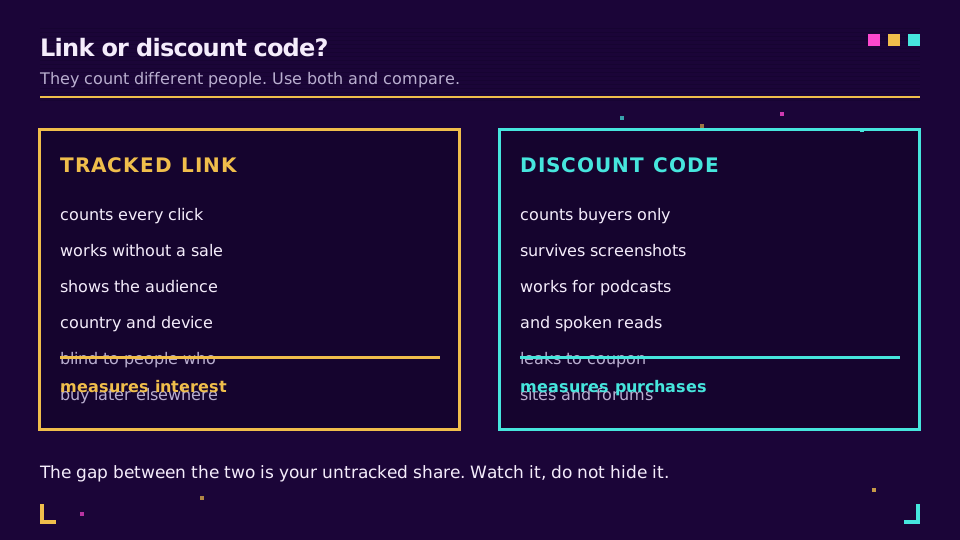
A link tells you who clicked, from where, and on which device. It cannot tell you who bought unless you connect a purchase to it. A code tells you who bought, but only if they typed it. It also works where links do not: a podcast read, a video where the creator speaks the code, or a screenshot passed around a group chat. The catch is leakage, because codes end up on coupon sites.
The combined pattern is simple. Give each creator a unique code and a unique link. Then compare three numbers: link clicks, code redemptions, and total sales in the window. A creator with many clicks and few redemptions may have a weak offer, a bad landing page, or an audience that browses and buys later without the code.
To connect actual revenue to a link, Elido's conversion tracking reads Stripe and Shopify webhooks and credits the sale to the link. It runs on the link ID you pass into checkout, not on a cookie, and it is Pro and Business only. It does not read discount codes, so codes remain a separate count in your store.
Stories, Link Stickers and Bio Links
Placements differ in what survives. A link sticker in a story is a live, clickable URL for 24 hours. A caption link in a feed post usually is not clickable, so creators send people to the bio. The bio link is the most durable placement, and it is also the one most creators already have, which creates a trap: if you ask for your link to replace their existing link tree, you cut their other income and they will resist.
The cleaner approach is a campaign-specific entry inside whatever bio page they use, pointing at their unique link. If they have no bio page, a free-form page works; Elido's Free plan includes one bio page and Pro includes five. Layout ideas live in link in bio ideas, and platform quirks for TikTok bio links differ enough to read separately.
For placements you want to compare, add a second variable. A story link can carry utm_content=mira-story and the bio link utm_content=mira-bio. Keep this to one extra level, or the scheme becomes the next thing nobody can read.
Reporting Clicks and Conversions to Creators
Report two numbers to each creator, never one: clicks on their link, and, where you can measure it, the purchases credited to it. Clicks alone reward cheap attention-grabbing posts. Conversions alone punish creators for a slow checkout they do not control.
Some honest framing helps the relationship. Tell creators up front what you can and cannot see. A click is a request to the short link, not a guaranteed human visit, and a sale made a week later on another device may never connect to the link. Our explainers on attribution models and dark social attribution cover why numbers will not reconcile perfectly. Say so before the first report, not after the first complaint.
Elido shows per-link analytics in the dashboard; you pass the numbers to creators yourself, from a screenshot or an export of your own. Creator-facing logins are not part of the product today. If you pay creators per sale, treat the platform's number as an estimate and agree in the contract which source is the reference.
Disclosure Rules
A tracked link does not replace an ad disclosure, and the creator carries legal exposure, not only you. In the US, the FTC's Endorsement Guides (16 CFR Part 255, published in the eCFR) require that a material connection, such as payment, free product or a commission, is clearly disclosed. In the UK, the ASA expects the same through its rules for influencers; its influencers' guide explains what counts as an ad and how to label it.
Practical points for your brief: ask for the disclosure at the start of the caption or on the video itself, not buried in a hashtag cluster, and use the platform's paid-partnership label when it exists. Put the requirement in the contract, and check posts after they go live. I am not a lawyer; local rules differ, so have counsel review the brief for markets that matter to you.
Fraud Signals
Bot clicks and inflated numbers happen in influencer work because payment is often tied to reach. Elido drops clicks from obvious crawlers and scripted clients, those that identify themselves by user agent, so link-preview bots and scrapers do not inflate the count. That is a floor, not a fraud detector. It will not catch paid click farms or a creator buying traffic.
Watch for these patterns in the per-link analytics:
- A spike in clicks within minutes that does not match the post's views or the creator's usual reach.
- Nearly all clicks from one country that is not the creator's audience, or one device model.
- Little or no referrer data across a large share of clicks.
- High clicks and zero conversions across a creator with otherwise normal engagement.
None of these proves fraud alone. A repost by a big account also makes a spike, which is why you compare against the post's own views first. When several signals line up, ask the creator for the platform's audience analytics before you argue about the invoice.
Starting small
Pick three creators and one platform each. Create three links, tag them with the scheme above, and write the disclosure line into the brief. Run it for two weeks, compare link clicks with code redemptions, and only then scale. If you are tagging links for the first time, the Amazon affiliate link guide shows a related case where the tag must survive the redirect.
Ready to set it up? Start with a Free workspace and make your first three creator links.
Related on the blog
Frequently asked questions
How do you track influencer campaigns with links?
Give every creator a separate short link for every platform they post on, tag each with UTM parameters, and read clicks per link in one campaign report. The link is the only thing that ties a click to a person, so never share one link between two creators.
Should utm_source be the creator or the platform?
Use the platform for utm_source and the creator handle for utm_content. Analytics tools group reports by source and medium, so a hundred creator names as sources shatter your channel view, while one source with a hundred content values stays readable.
Are discount codes better than tracked links for influencers?
Neither is better, they measure different people. A link counts every click, buyers or not. A code counts only buyers who type it, but it survives screenshots and spoken reads. Run both and treat the difference as untracked sales.
Do influencers have to disclose links in sponsored posts?
Yes, when there is a material connection such as payment, free product or a commission. The FTC Endorsement Guides in the US and the ASA and CAP Code in the UK both expect a clear, prominent disclosure, and a tracked link does not replace it.
How do you spot fake clicks on an influencer link?
Look for a spike that does not match the creator's view count, almost all clicks from one country or device, no referrer, and clicks with zero conversions. Elido already drops obvious crawler user agents from the click count, but it does not detect paid click farms.
Can you track influencer links on the Elido free plan?
Partly. The Free plan has 25 links in total, 500 tracked clicks a month and no branded domain, so it covers a small pilot. Branded domains start on Pro, and conversion tracking is Pro and Business only.
Try Elido
Paste a URL, get a working short link
No signup. Link lives for 30 days. Sign up to keep it forever.
Free account required. The free plan includes 25 links in total. Already have an account? Log in