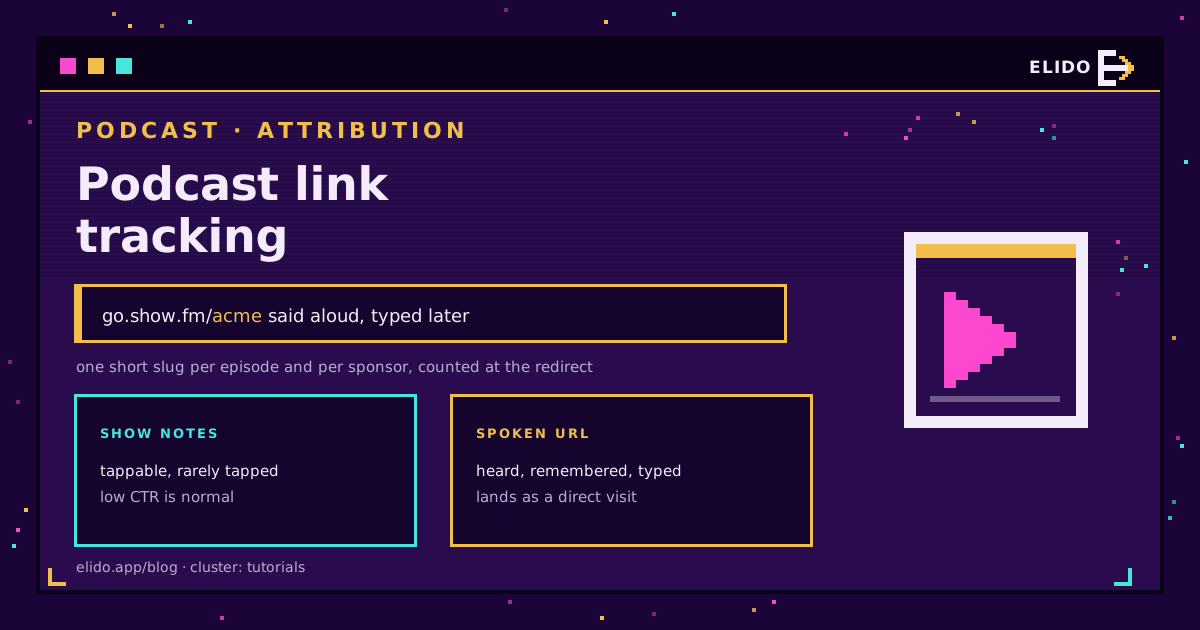
Podcast link tracking comes down to three things. Give every episode and sponsor its own short link. Say a short vanity URL out loud for the people who can't tap anything. Then read the numbers as a floor, never a ceiling. Show-notes clicks are low by nature, and host-read URLs tend to arrive as direct traffic unless you count them at the redirect.
Audio is a hard medium to measure. There's no pixel in an ear, no referrer when someone types an address from memory, and apps decide how your links look. The IAB's podcast measurement guidelines exist because downloads, not actions, were the original unit. Links are how you get from "downloaded" toward "did something".
This guide covers the setup I'd use for a show or a sponsor campaign: branded short links, per-episode slugs, codes, QR for video, and an honest reading of the results.
Show-Notes Links: Track Every Episode Separately
Put one short link per episode in the show notes, and one per sponsor inside that episode. Same destination, different slug. That way a click tells you which episode and which ad produced it, and you don't have to untangle one shared link afterwards.
A naming pattern that holds up: show.fm/ep42-acme, where the episode number comes first so the list sorts itself. Add UTM parameters at the destination, with the podcast as the source and the episode as the content, so your web analytics agree with the short-link counts.
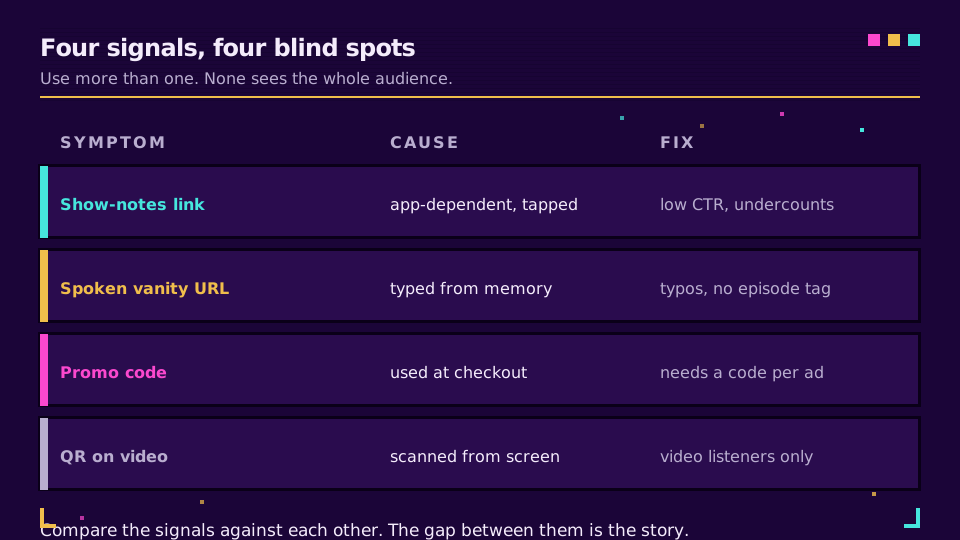
Expect low click-through. People listen with a locked phone, and most never open the episode page. I'd rather tell a sponsor that up front than watch them panic at a 0.4% rate on a number nobody had calibrated. Compare episodes with each other and the pattern becomes useful, even when the absolute figure looks small.
Spoken Vanity URLs: Make Them Easy to Say
A spoken URL has to survive being said once, at conversation speed, and typed later. A vanity URL on a branded domain does that job: go.yourshow.fm/acme is something a host can say naturally and a listener can type.
Rules that keep it typeable:
- Keep the slug to one short word, ideally the sponsor name or offer.
- Lowercase only, no hyphens, no symbols, no digits that sound like letters.
- Avoid pairs that sound alike, such as
1andone, ortoand2. - Say the full address once and spell it only if it's unusual.
A custom domain matters more here than almost anywhere. A random shared-domain slug can't be spoken, and a short branded one can be. In Elido, branded domains start on paid plans; the Free plan has none, so a Free account can create links but not on your own domain. Compare plans before you plan a sponsor series around spoken URLs.
Why Host-Read URLs Show Up as Direct
Someone hears the URL, opens a browser, and types it. No referrer is sent, so web analytics files the visit under direct. That's the classic dark social problem, with a voice instead of a messaging app.
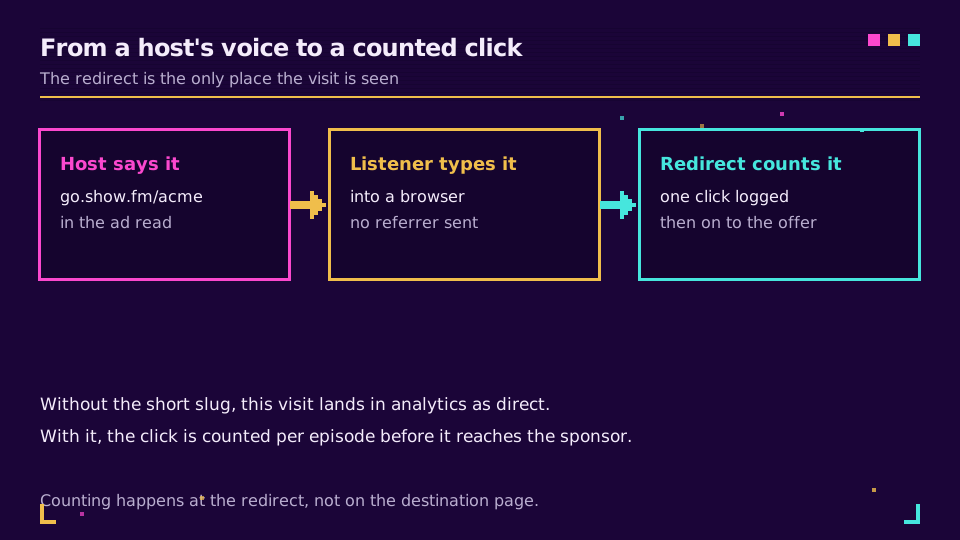
The fix is to count at the redirect. The click is logged when the short link resolves, before the visitor reaches the destination, so it doesn't depend on a referrer or a script on the sponsor's page. Elido's click analytics are on every plan, including Free, with 90 days of history on Free, one year on Pro and two years on Business, per the pricing matrix.
One caveat I'd flag honestly: typed slugs are only attributable to the slug itself. If the same slug runs in five episodes, you can't separate them. Give each placement its own slug, or add the episode into the spoken word, such as /acme42.
Promo Codes Versus Links
Links tell you who clicked. Codes tell you who bought. They disagree, and that's fine.
A listener might hear the ad, search the brand a week later, and use the code at checkout. No link was clicked, yet the code caught the sale. The reverse happens too: someone clicks, browses, and buys without the code. Running both gives you two partial views, and the gap between them is a rough measure of untracked listening.
Practical setup: one code per episode or per sponsor read, short and easy to say (SHOW20), and the same wording on the landing page so it's visible when the link lands. If the sponsor owns checkout, agree in writing how they'll report code use back to you.
Why Podcast Apps Strip or Hide Links
Apps render show notes in their own way. Some show clickable links, some show plain text, and some tuck notes behind a tap. A few restyle or shorten URLs. You can't control any of it, and the behavior changes between apps and versions, so I won't claim a rule that holds everywhere.
What you can do is design for the worst case. Keep the link short enough to read as plain text, put it near the top of the notes, and never make the show-notes link the only route. The spoken URL and the code are your fallbacks when the app swallows the link.
QR Codes in Video Podcasts
Video changes the picture. A viewer watching on a TV can't type a link or tap one, but they can scan. Put a dynamic QR code on screen during the sponsor read, pointing at that sponsor's short link, so the scan is counted like any other click. Our guide to tracking QR code scans covers the mechanics, and offline campaign tracking has the broader pattern.
Keep it on screen long enough to scan, make it large, and say the vanity URL as well. QR reaches only the people watching, so don't extrapolate its scans to your whole audience. Basic QR codes are available on every plan, and branded QR needs a paid plan.
Reading the Numbers Honestly
Here's how I'd read a campaign without fooling myself:
- Treat counted clicks as a floor. Some listeners will always find the sponsor another way.
- Compare like with like: episode against episode, same placement, same slug style.
- Put the three signals side by side: link clicks, code redemptions, and a post-purchase "where did you hear about us" question.
- Don't use show-notes click-through as a quality score for the show. It measures the habit of tapping, not the value of the ad.
- Check the clicks for bots. Some podcast apps and crawlers fetch links automatically, which can inflate counts; check what your tool filters before you quote a number.
For what else is worth tracking once clicks come in, see short link analytics: what to measure. If your episodes also feed short video, the same logic applies to a YouTube Shorts trackable link.
Google's own documentation on custom campaigns explains how campaign parameters are read, which is useful when you tag the destination side of each sponsor link.
Setting It Up in Elido
The setup is short. Connect a branded domain, create one link per episode and sponsor with a clear slug, tag the destination, and read the per-link analytics after each release. Tags and folders (available on all plans) keep a season of links sorted. Start with a handful of links on the Free plan, which includes 25 links, then move to a paid plan when you need your own domain for spoken URLs. Name your first link after the episode and go from there.
Related on the blog
Frequently asked questions
How do you track clicks from a podcast?
Give every episode and every sponsor its own short link, put it in the show notes, and say a short vanity version aloud. Each link logs clicks at the redirect, so you can compare episodes. Listeners who type the spoken URL are counted too, because they pass through the same redirect.
Why are my podcast show notes links barely clicked?
Most listening happens while driving, training or doing chores, with the phone locked. Few people open the episode page at all, and fewer tap a link. A low show-notes click-through rate is normal for audio, so judge it against other episodes, not against email or social benchmarks.
What is a podcast vanity URL?
It's a short, easy-to-say address on a domain you own, like go.yourshow.fm/acme, that redirects to a longer sponsor or landing page. Because it's meant to be heard and typed, it should be lowercase, short, and free of hyphens and look-alike characters.
Should I use a promo code or a link for sponsor attribution?
Use both. A link catches people who click, a code catches people who buy later through another route. Neither sees everyone, so the gap between the two is a useful estimate of how much listening never turns into a tracked click.
Do podcast apps allow clickable links?
It depends on the app and on how it renders show notes. Some show full links, some shorten or restyle them, and some bury notes behind a tap. Don't assume a link is visible, which is why a spoken URL and a code stay useful.
Can I put a QR code in a video podcast?
Yes. A dynamic QR code on screen lets viewers scan from a TV or monitor with their phone. It only reaches people watching the video, so treat its scans as one channel among several.
Try Elido
Paste a URL, get a working short link
No signup. Link lives for 30 days. Sign up to keep it forever.
Free account required. The free plan includes 25 links in total. Already have an account? Log in