Engineering articles
How a URL shortener actually works under load: redirect latency budgets, cache hierarchies, ClickHouse analytics pipelines, idempotent APIs, and the infrastructure choices behind Elido's edge. These are engineering deep-dives with real numbers from our production systems, written for developers who want to build on a link platform or just enjoy systems design. If you evaluate vendors by their architecture pages, start here.
 Engineering
Short Code Generation: Base62 vs Hash vs Random Codes
Short code generation base62 vs hash vs random: exact keyspace math, birthday-bound collision odds, retry patterns, and which approach fits your shortener.
10 min read Engineering
Redirect Chain and SEO: How Many Hops Is Too Many?
A redirect chain is two or more redirects in a row. See what Google documents about hops and crawl budget, how to trace chains with curl, and flatten them.
10 min read Engineering
Verify Webhook Signatures: HMAC-SHA256 in Node, Python, Go
How to verify a webhook signature with HMAC-SHA256: raw body, constant-time compare, replay window and secret rotation, with Node, Python and Go.
11 min read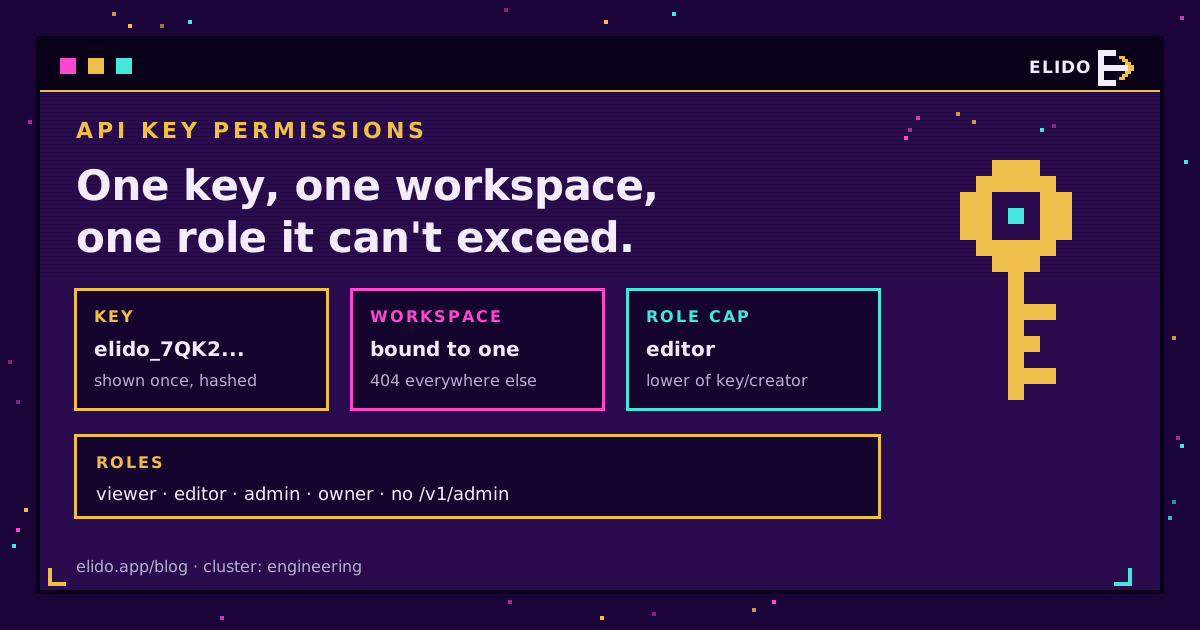 Engineering
API Key Permissions: Least Privilege for Link Tools
API key permissions for link tools, done right: workspace-bound keys, role caps, peppered hashes, per-key rate limits, rotation and safe handoff to n8n or Make.
10 min read Engineering
Canonical vs 301 Redirect: How to Pick the Right Signal
Google calls both strong signals, but a 301 redirect is the strongest and removes the old URL; a canonical keeps both live. Which fits four duplicate-URL cases.
10 min read Engineering
Maximum URL Length: The Real-World Character Limit
There is no maximum URL length in the spec. The real ceiling is the lowest limit in the chain your link crosses: browser, server, inbox, or QR code.
8 min read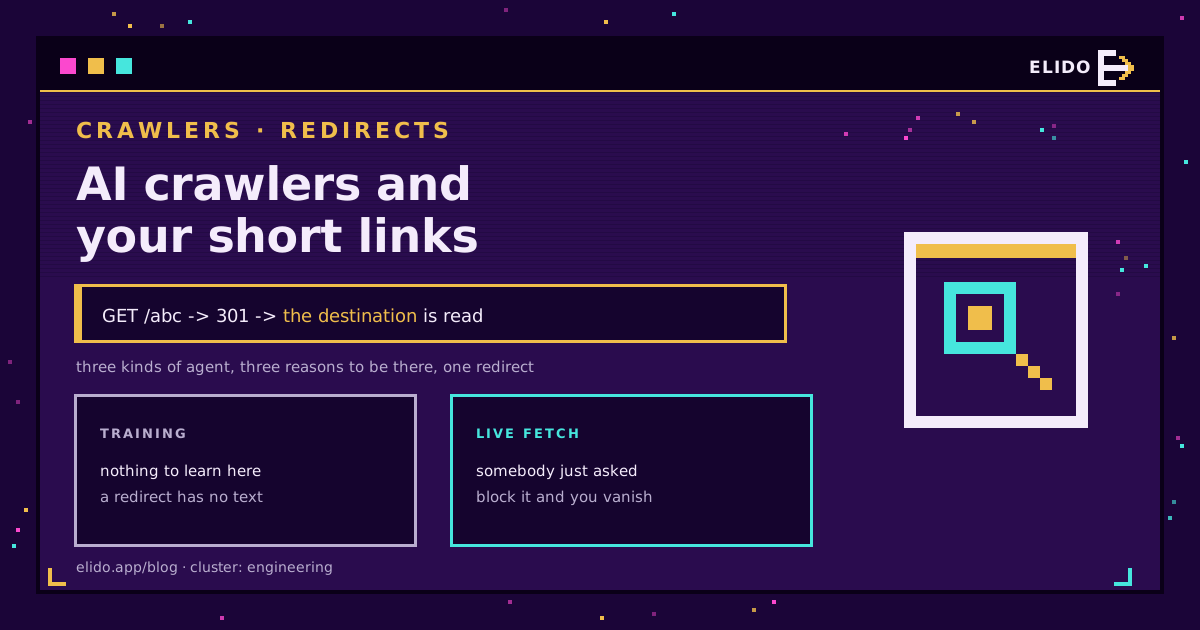 Engineering
AI Crawlers and Short Links: What the Bots Actually Do
Training crawlers, live fetchers and search bots all hit your redirects. Which ones follow a 301, what they cost your click counts, and which to let through.
6 min read Engineering
URL Encoding Explained: Which Characters to Escape
URL encoding replaces a character with a percent sign and two hex digits so it cannot be read as URL syntax. Which characters need it, and where it breaks.
7 min read Engineering
Redirect Loop: How to Trace and Fix Too Many Redirects
A redirect loop bounces the browser between URLs until it quits. Trace the redirect chain in one command, name the rule that disagrees, and fix it for good.
11 min read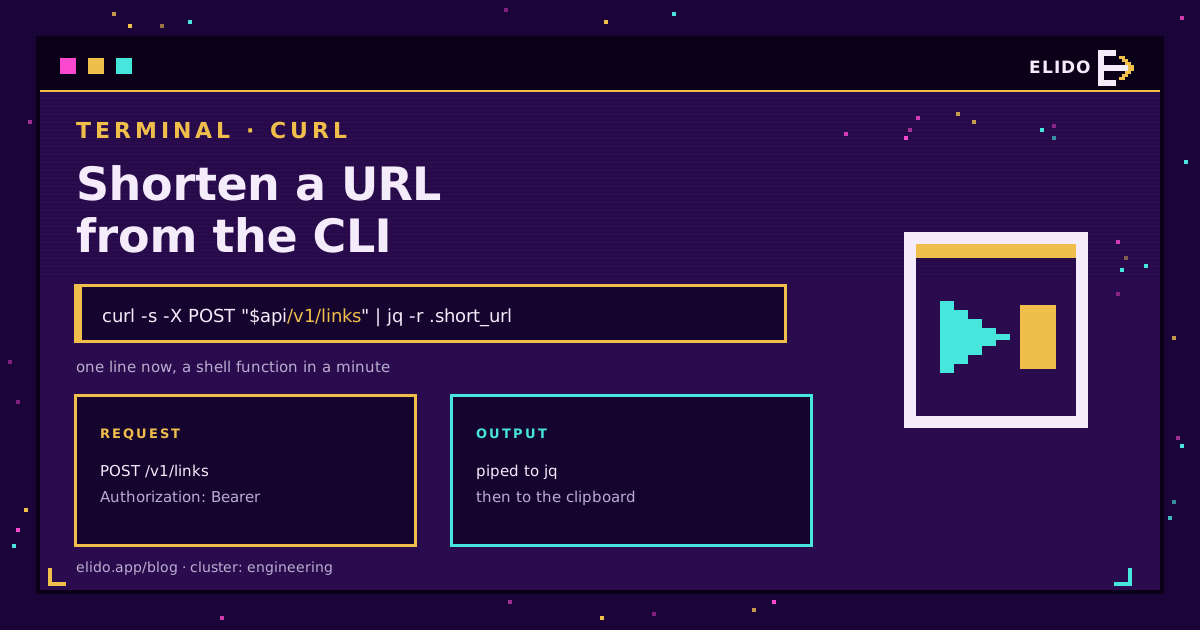 Engineering
URL Shortener CLI: Shorten Links From the Terminal
Shorten a URL from the command line with curl and jq, wrap it in a shell function, copy to the clipboard, and shorten a whole file with xargs in parallel.
5 min read Engineering
Why Your Short Links Get Blocked in Slack and Teams
Short links get blocked in Slack and Teams when a shared shortener domain fails a security check like Safe Links. Why it happens, and the branded-domain fix.
5 min read Engineering
Agentic Commerce Links: What AI Agents Get From Yours
AI agents don't click short links like people do. What Elido returns to a known AI agent, which visits get counted, and what commerce protocols leave to you.
6 min read Engineering
GA4's AI Assistant Channel: What It Tracks and Misses
GA4's new AI Assistant channel breaks out ChatGPT, Gemini, and Copilot traffic - but excludes Perplexity and isn't retroactive. What it tracks, and the gaps.
6 min read Engineering
Do Firefox and Brave Strip UTM Parameters? What Survives
Firefox strips a short list of tracking IDs, not utm_ parameters. What Firefox, Safari and Brave actually remove, what they block, and how to measure the loss.
6 min read Engineering
Bitly API Alternative for Developers: What to Look For
A Bitly API alternative for developers: where Bitly's rate limits and plan gating bite, and what a dev-first shortener API should give you instead.
4 min read Engineering
Free URL Shortener API: Code Examples That Run
A free URL shortener API with runnable curl, JavaScript, Python, and Go examples, plus the honest part: what free tiers gate and what production needs.
5 min read Engineering
Open Redirect Vulnerabilities and How to Prevent Them
An open redirect vulnerability lets an attacker bend a trusted link to a malicious site. How the bug works, why it powers phishing, and the server-side fix.
6 min read Engineering
How to Build a URL Shortener: Architecture and Code
How to build a URL shortener that survives production: short-code generation, the redirect path, caching, click tracking, abuse defense, and what to maintain.
9 min read Engineering
Types of URL Redirects: 301, 302, 307, 308, and More
The types of redirects explained - 301, 302, 303, 307, 308, meta refresh, and JavaScript - what each does, how it affects SEO, and which one to use.
6 min read Engineering
301 vs 302 Redirects: Which One Should Short Links Use
A 301 is a permanent redirect that passes ranking signals; a 302 is temporary and usually does not. What that means for short links, SEO, and caching.
8 min read Engineering
URL Shortener API: Rate Limits, Retries, Idempotency
How to call a URL shortener API in production: token-bucket rate limits, which status codes to retry with backoff, and idempotency keys that stop duplicates.
8 min read Engineering
Do URL Shorteners Hurt SEO? The Mechanics That Matter
Do URL shorteners hurt SEO? Reputable ones do not: Google passes ranking signals through redirects. What 301 vs 302 changes, and the four real risks.
8 min read Engineering
Short Link Monitoring with Sentry and Datadog: Who Does What
Short link monitoring with Sentry and Datadog: which Elido events become Sentry issues, what Datadog receives, and how to watch redirect latency yourself.
9 min read Engineering
How Do URL Shorteners Work? The Mechanics Explained
How do URL shorteners work? Store a slug-to-destination mapping, look up the key on each click, return an HTTP redirect. The mechanics, end to end
11 min read Engineering
Dub.co Migration to Elido: What the Importer Really Does
A Dub.co migration at code level: the API calls Elido's importer makes, which fields it carries over, what it skips (folders, archived links) and its limits.
6 min read Engineering
Fire-and-Forget Click Ingestion: Analytics Off the Hot Path
How fire-and-forget click ingestion keeps a URL shortener's redirect fast: async emit at the edge, batched writes, offsets committed after the insert, trade-offs.
8 min read Engineering
Edge POPs vs DNS-only routing: which fits a URL shortener
DNS picks where a request goes; an edge POP cache decides whether it has to go there at all. When each fits a shortener, with distance math and cache TTLs.
8 min read Engineering
URL Redirect Cache: How Our Two-Tier Cache Works Today
How a URL redirect cache works end to end: in-process L1, shared Redis L2, the origin, real TTLs, how edits purge both tiers, and what browsers cache.
9 min read CornerstoneEngineering
Sentry/GlitchTip across 12 Go services on the hot path
How Elido shipped a shared sentryinit package giving every Go service the same panic + 5xx auto-capture, staying zero-alloc on edge-redirect's hot path.
13 min read Engineering
Why we use ClickHouse for click analytics (and not Postgres)
Click data is append-only, write-heavy and analytical-query-shaped. Why columnar wins, the schema we ship, and what we hit at 90 days of Postgres
14 min read Engineering
Redirect Latency Budget: How Elido Targets p95 Under 15ms
The real edge-redirect architecture behind a 15ms p95 cache-hit target: LRU, a shared cache, gRPC origin and async clicks, plus what we have not measured.
7 min read Engineering
Elido on k3s: What the Helm Chart Deploys and Doesn't
A concrete walkthrough of the Elido Helm chart on one k3s node: secrets, ingress, install, first user, upgrades, plus the licence and what the chart leaves out
6 min read CornerstoneEngineering
Manage Short Links as Terraform with terraform-provider-elido
terraform-provider-elido is the only Terraform provider in the URL-shortener space. How the link lifecycle and drift detection work, plus v0.1.0 trade-offs.
13 min read