If you are shopping for a Bitly API alternative, you have probably hit one of two walls: rate limits that throttle your automation on the plan you can afford, or a feature you need sitting behind a tier you do not want to buy. This is a developer's guide to what actually matters in a shortener API - limits, idempotency, webhooks, SDKs - and how the switch works in practice.
It sits in the engineering cluster. For the request shape and auth basics that all of these share, the free URL shortener API guide is the primer this builds on.
Where the Bitly API Bites
Bitly's API is capable, and for low-volume use it is fine. The friction shows up at scale. Rate limits run from roughly 1,000 requests a month on the lowest tiers to 150,000+ higher up, with per-minute and per-hour ceilings layered on, documented in the Bitly API reference. On a cheaper plan those ceilings throttle exactly the automated jobs an API is for.
The second wall is gating. Group and organisation structure, some analytics endpoints, and higher call volumes live in higher tiers, so the version of the API you can justify budget for is often not the version your integration assumed. Neither is a flaw exactly - it is how the pricing is built - but both are why teams start looking. Rebrandly's own teardown of the Bitly API reaches the same read on where the limits pinch.
What a Dev-First Shortener API Should Give You
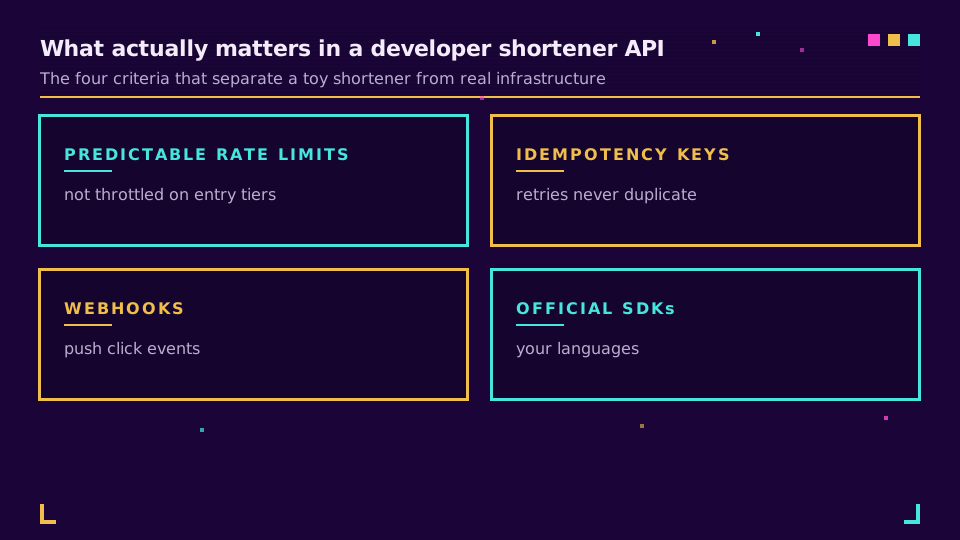
Strip away the branding and a good shortener API comes down to four things.
- Rate limits you can plan around. Documented per-window ceilings, workspace-scoped, that are not so tight on entry tiers that a batch job trips them. Predictable beats high-but-opaque.
- Idempotency keys. Send a stable key per logical request and a retry after a timeout returns the original link instead of minting a duplicate. Without this, every retry is a risk.
- Webhooks. Push click events to your endpoint rather than making you poll an analytics API on a timer.
- Real SDKs. Official libraries in the languages you use, so you are not hand-rolling auth and pagination.
The rate limits and idempotency deep-dive covers why the second point matters more than the raw request ceiling: a retry-safe API at 10,000 requests beats a fragile one at 100,000.
The Migration Is Smaller Than You Think (Except One Part)
The API call barely changes. Bitly's create-link call and most alternatives are the same shape: authenticate with a bearer token, POST a long URL, read the short link out of the JSON. Swapping providers is mostly a new base URL, a new token, and matching the field names.
# Bitly
curl -X POST https://api-ssl.bitly.com/v4/shorten \
  -H "Authorization: Bearer $BITLY_TOKEN" \
  -H "Content-Type: application/json" \
  -d '{"long_url": "https://example.com/page"}'

# Elido - same shape, plus an idempotency key
curl -X POST https://api.elido.app/v1/links \
  -H "Authorization: Bearer $ELIDO_API_KEY" \
  -H "Idempotency-Key: 5f3e-once" \
  -H "Content-Type: application/json" \
  -d '{"destination_url": "https://example.com/page"}'
If you are calling it from code, the Python walkthrough shows the retry and idempotency patterns you want around either call.
The part that is not small: your existing links. A short link only keeps working if you control the domain it lives on. Links on bit.ly cannot be moved - that domain is Bitly's. Only branded links on your own domain can be repointed to a new provider without breaking. So the migration question is really "how many of my live links are on a domain I own?" - and the answer decides how clean the switch is. The Bitly migration playbook walks the domain and redirect steps.
Picking One
The honest shortlist for a developer API is Short.io, Rebrandly, Dub, and Elido - each exposes a real API with SDKs. Short.io and Dub lean developer-first on price; Rebrandly leans branded-domain automation. Where Elido differs is the combination the others do not centre: idempotency and webhooks as defaults, plus EU data residency, so click data stays in the EU region rather than transferring out. If your stack has a compliance line as well as a technical one, that pairing is the reason to look at it - and you can build against the API on the free plan to test the fit before committing.
Whatever you pick, judge it on limits and idempotency, not the marketing. Those are the two things that decide whether your integration is boring and reliable or a source of 2am pages.
Read the Cornerstone Series
This sits in the engineering cluster. Start from the free URL shortener API guide, then the rate limits and idempotency deep-dive. The live reference is the API docs.
Related on the Blog
Frequently asked questions
What is a good Bitly API alternative for developers?
Look for a shortener whose API gives you sane rate limits that are not aggressively throttled on low tiers, idempotency keys so retries do not create duplicates, webhooks for click events, and official SDKs. Short.io, Rebrandly, Dub, and Elido all expose developer APIs; the right one depends on your rate-limit needs and whether EU data residency matters.
Why do developers move off the Bitly API?
Two reasons come up most: rate limits that throttle automated workflows on cheaper plans, and features gated behind higher tiers so the API you can afford is not the API you need. The move is usually toward a shortener with clearer limits and idempotency built in, so batch jobs are safe to retry.
Is migrating off the Bitly API hard?
The API call itself is nearly identical - POST a destination URL, read back a short link - so swapping the endpoint and auth is a small change. The real work is the links already live on bit.ly: those cannot be moved. Only branded links on a domain you own can be repointed to a new provider without breaking.
What are the Bitly API rate limits?
They vary by plan, roughly from about 1,000 requests a month on the lowest tiers up to 150,000+ on higher ones, with per-minute and per-hour ceilings on top. The practical issue is that lower tiers throttle hard, which is what breaks bulk or automated jobs and pushes teams to look elsewhere.
Try Elido
Paste a URL, get a working short link
No signup. Link lives for 30 days. Sign up to keep it forever.
Free, no signup required · 2 per day