Agentic commerce is the shift from a human clicking to an AI agent acting. The agent discovers options, decides, and increasingly authorises payment, driven by a goal instead of a click. That quietly breaks assumptions your links rely on. An agent resolves a URL as data, usually with no browser, no cookie, and no referrer, so a link that depends on any of those, or a destination that shifts unpredictably, can break the agent's path or vanish from your analytics. The links you put into content an agent reads have to be stable, machine-resolvable, and tracked at the redirect.
This is an engineering-cluster read that sits next to answer engine optimization, which is about getting cited by AI in the first place. Once an agent is acting on your content, the question becomes whether your links survive being followed by a machine.
What Agentic Commerce Actually Is
In 2026 this is a stack of protocols, not a single standard. OpenAI and Stripe's Agentic Commerce Protocol issues a scoped, single-use payment token for a specific merchant and amount. Google's Agent Payments Protocol launched with 60-plus partners and moved under the FIDO Alliance in April 2026. Card networks added their own layers with Visa Intelligent Commerce and Mastercard Agent Pay.
They differ in the details, but they share a shape: an agent, acting for a person, moves through discovery and payment without a human touching a mouse. What none of them do is make your links resolvable or your traffic measurable. That part is still yours, and it is the part most teams have not adjusted for.
Why Your Links Have to Change
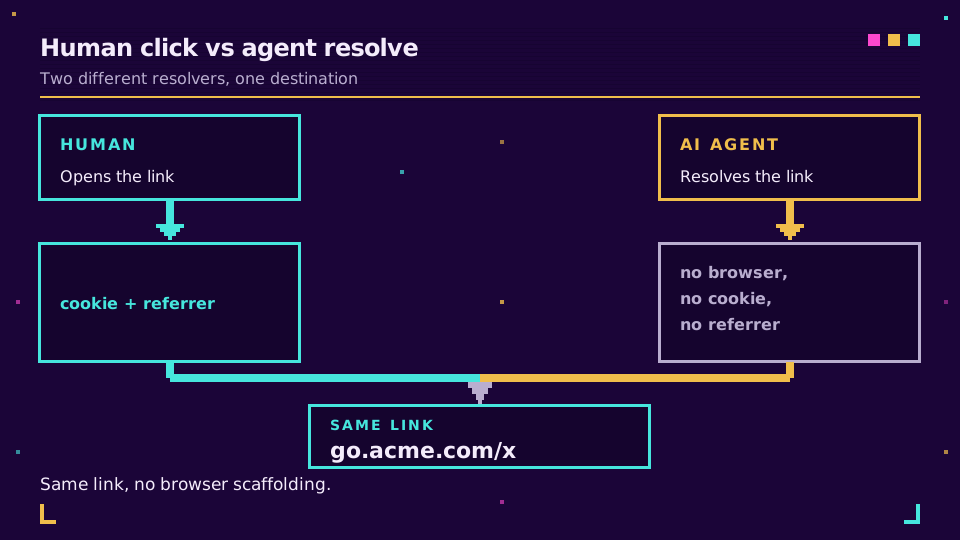
Three browser assumptions quietly underpin most link setups, and an agent honours none of them.
- No cookie. An agent does not carry the cookies a page tag needs, so cookie-based attribution records nothing for an agent visit.
- No referrer. An agent often arrives with no referrer header, so referrer-based channel classification files it as direct or drops it, the same blind spot behind dark social.
- A stable destination matters more. A human notices a redirect that lands somewhere odd and adapts. An agent follows the resolution it is given; if the destination is unstable or the chain assumes a browser, the agent's path can simply break.
The takeaway is not that agents are hostile. It is that they strip away the browser scaffolding your measurement leaned on, so anything that depended on that scaffolding needs a more durable foundation.
The Short Link as an Agent-Ready Redirect
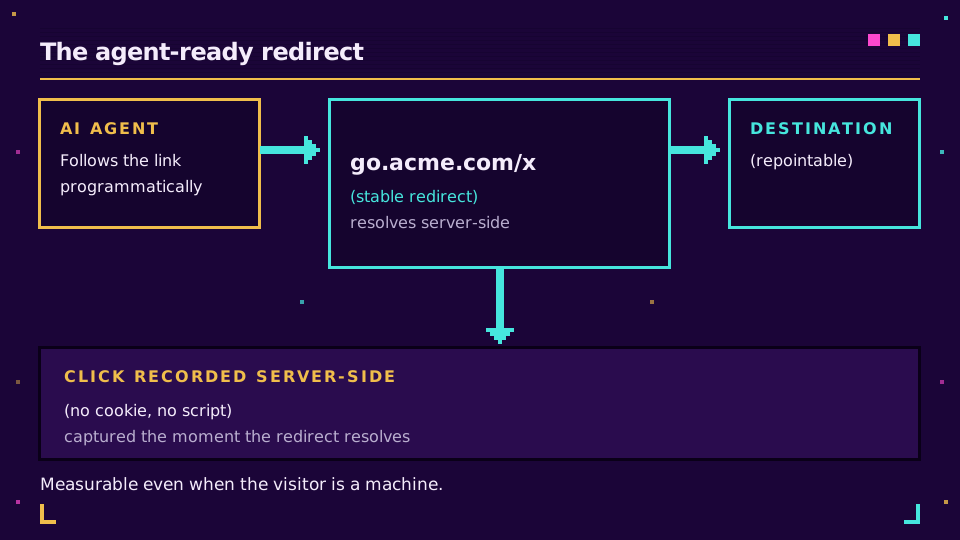
A short link is that foundation, because it does its job before the browser scaffolding would matter. When an agent resolves go.yourbrand.com/x, the redirect resolves server-side and records the event, the destination and the time, at the moment of resolution. That record happens whether a human browser or an agent followed it, with no cookie and no page script involved. The link is a stable, machine-resolvable address you own, and you can repoint its destination without changing the address the agent was given.
That is also why a short link pairs naturally with an MCP integration: an agent working through a tool interface can create and resolve links as first-class actions, and every one is measurable by default. Put your agent-facing links behind a redirect you own and the machine-driven visit stops being invisible.
Measuring Agent Traffic
Even with the payment protocols in place, you still need to know an agent came through, and referrer-based analytics will not reliably tell you. Record the click at the redirect, where the resolve is captured server-side regardless of cookie or referrer, and reconcile that against your other analytics. It is the same server-side principle that makes cookieless attribution work, applied to a visitor that is not even a person.
This also complements what GA4's AI Assistant channel does and does not capture: a maintained list of named assistants helps, but it cannot see an arbitrary agent resolving a link. A redirect you own does not depend on anyone's list. As agent-driven traffic grows, the sites that can measure it will be the ones whose links were built to be followed by a machine, not just a browser.
Read the Cornerstone Series
This sits in the engineering cluster. The citation-side companion is answer engine optimization; for the measurement siblings, dark social and cookieless attribution.
Related on the Blog
Frequently asked questions
What is agentic commerce?
Agentic commerce is the model where an autonomous AI agent acts as the buyer's proxy and executes the purchase from a goal rather than a click: it discovers options, decides, and increasingly authorises payment. It is formalised by protocols like OpenAI and Stripe's Agentic Commerce Protocol, Google's Agent Payments Protocol, and card-network frameworks such as Visa Intelligent Commerce and Mastercard Agent Pay.
How do AI agents use links?
Programmatically. An agent resolves a URL as data, often with no browser, no cookie, and no referrer header, then decides what to do next based on where it lands. That means a link an agent follows has to be stable and machine-resolvable: a destination that changes unpredictably, or a redirect chain that assumes a browser, can break the agent's path or make the visit impossible to attribute.
Do short links work for AI agents?
Yes, and they help. A short link is a stable redirect you own: it resolves the same way whether a human browser or an agent follows it, and it records the resolve server-side at the moment it happens. Because the record is made at the redirect rather than by a script on the destination page, an agent visit is captured even though it carries no cookie and runs no JavaScript.
How do I track traffic from AI agents?
Record the click at a redirect you control, because agents usually arrive with no referrer and no cookie for a page tag to read. A short link logs the resolve server-side regardless, so agent-driven visits are counted. This also fills the gap left by referrer-based analytics, which misclassify or miss traffic that does not look like a normal browser session.
What are the agentic commerce protocols?
The main ones in 2026 are the Agentic Commerce Protocol (ACP, from OpenAI and Stripe), the Agent Payments Protocol (AP2, started by Google and now under the FIDO Alliance), and card-network layers like Visa Intelligent Commerce and Mastercard Agent Pay, often used alongside the Model Context Protocol (MCP) for tool access. They handle payment and trust; your links still have to be resolvable and measurable underneath them.
Try Elido
Paste a URL, get a working short link
No signup. Link lives for 30 days. Sign up to keep it forever.
Free, no signup required · 2 per day