Answer engine optimization (AEO) is the practice of structuring content so LLM-backed answer engines select it as a cited source when they generate an answer. You get cited when a page carries a clean, self-contained passage a model can lift almost verbatim: a direct two-to-three-sentence answer, backed by concrete data, published under a named and credentialed author. Do that consistently and engines like Google AI Overviews, ChatGPT, Perplexity, Gemini, and Microsoft Copilot start pulling your words into their responses.
Classic search engine optimization aims to rank a blue link so a person clicks through. Answer engine optimization aims one layer up: to be the source the machine quotes and attributes inside its synthesized answer. The near-synonym you'll meet is generative engine optimization (GEO), a term from a 2023 Princeton paper, and in practice most teams use AEO and GEO interchangeably, with AEO leaning toward the citation-and-retrieval layer specifically.
None of this discards your existing SEO. Google's stated position is that its AI features run on the same index and the same quality signals as normal search, which is also why the tired myths about link tools keep resurfacing. If you've ever wondered whether short links quietly damage your rankings, the answer there rhymes with the answer here: crawlability, clean redirects, and genuine quality are what move the needle, not tricks.
Answer Engine Optimization: A Definition
Answer engine optimization is the discipline of earning citations inside AI-generated answers. An answer engine doesn't just hand back ten links. It retrieves passages from many pages, synthesizes them into a single response, and increasingly footnotes the sources it leaned on. AEO is the work that makes your passage the one it leans on. The whole point is earning AI search citations, not only rankings.
The mechanism underneath is retrieval. When someone asks Perplexity or ChatGPT a question, the system fetches candidate passages, ranks them for relevance and trust, and composes an answer that cites a handful of them. Getting cited by AI is therefore less about a whole-page score and more about whether any single passage on your page is quotable, correct, and attributable on its own.
The stakes are real and growing. AI-referred sessions to publisher sites climbed sharply through 2025, and studies of AI Overviews show classic top-of-page click-through can fall by more than half once an answer box appears. The traffic that does arrive from AI answers skews further down the funnel: fewer clicks, higher intent, more time on the page.
That changes who you're really writing for. A blue-link reader skims a results page and decides which title to click. A model reads the passage itself and decides whether it's safe to quote. The second reader is less forgiving of a vague claim and more rewarding of a sentence that stands on its own. Write for that reader, and the human one is usually served better anyway.
AEO vs SEO: What Actually Changed
AEO builds on SEO; it doesn't replace it. Strong SEO gets a page indexed, crawled, and trusted. AEO adds the structure and clarity a model needs to extract a clean answer and attribute it to you. The practical shift is that the passage, not the whole page, is the unit that gets cited.
| Dimension | Classic SEO | Answer engine optimization |
|---|---|---|
| Goal | Rank a link | Be cited in the answer |
| Unit that wins | The page or URL | The passage |
| Success metric | Position, CTR, sessions | Citations, mentions, AI referral clicks |
| Who reads it | A person scanning results | A model retrieving and synthesizing |
| Format that helps | Depth, keyword coverage | Answer-first passages, data, valid schema |
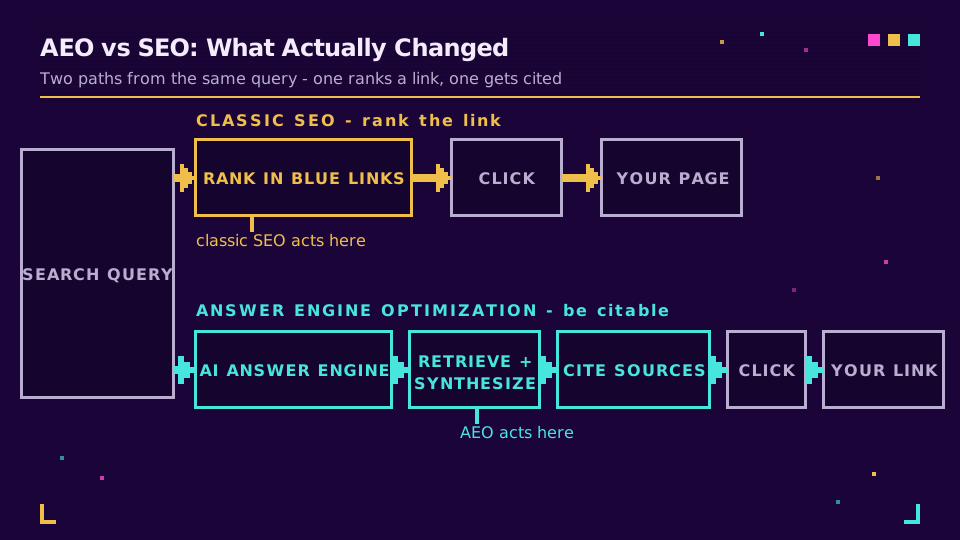
Read the diagram top to bottom. The classic path is short: you rank in the blue links, a person clicks, they land on your page. The AI path forks earlier. The reader asks an answer engine, the engine retrieves and synthesizes across sources, cites the ones it used, and only then does a click reach your link. AEO is the intervention on the "be citable" branch; classic SEO is the intervention on the "rank the link" branch. You want both, because the same crawl and the same index feed each of them.
The Signals That Get You Cited
The evidence from 2025 and 2026 studies converges on a short list of things that raise citation rate. None of them are exotic. Most are the E-E-A-T fundamentals with the volume turned up and the formatting made machine-friendly.
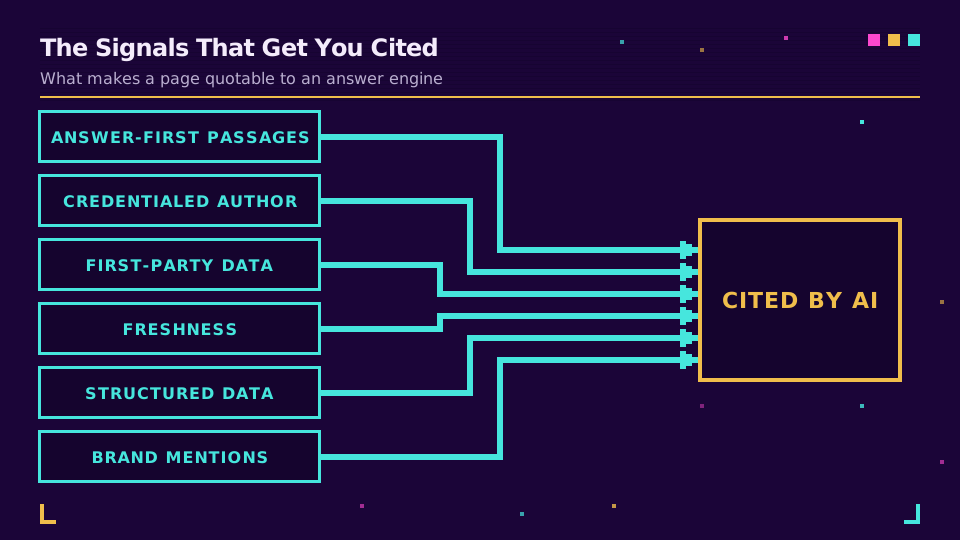
- Answer-first passages. Open each section with a two-to-three-sentence answer to the question that section poses, before context or caveats. This is the single most effective move, because it hands the model a ready-to-quote unit.
- Self-contained sections. A passage should make sense lifted out of the page. Resolve pronouns, restate the subject, and don't lean on a sentence three scrolls up.
- A named, credentialed author. Anonymous "content team" bylines get skipped. A real author with a bio, a photo, and a track record is a trust signal both humans and models read.
- First-party data over recycled claims. Original numbers, tests, and screenshots get cited far more often than the tenth restatement of someone else's stat.
- Freshness. Answer engines lean on recently updated pages, especially for commercial and how-to queries. Real updated dates on genuinely revised content help; backdating does not.
- Familiar formats. FAQ, comparison, and how-to structures map cleanly onto how people phrase questions to an assistant, and they dominate the citation studies.
- Clean crawlability and valid structured data. FAQPage and Article schema that mirrors the visible text reinforces what the page is about.
- Off-page brand mentions. Being discussed across the web, in reviews, forums, and third-party roundups, correlates strongly with getting cited, sometimes more than your own domain does.
- The emerging llms.txt convention. The llms.txt proposal suggests a curated Markdown file that points models at your most useful pages. Adoption is early, so treat it as a bonus, not a foundation, and the dedicated post on what llms.txt actually does and does not do walks through the mechanics in full.
One caution runs through all of it. Google's guidance on AI features in Search is blunt: there are no special optimizations and no secret markup, and the same holds across engines. AEO is still SEO. No robots-only Markdown tricks, no keyword stuffing, no hidden text, because those get you demoted, not cited. The Princeton GEO research paper that named the field reached the same practical conclusion: what wins is quotable, credible, well-sourced content.
I spend most of my week on the redirect path rather than on content marketing, so read this as an engineer's take on the evidence and not an agency pitch. The first time I watched Perplexity quote a three-paragraph answer we'd published almost word for word, and skip the longer guide ranking above it, the passage-not-page mechanic finally clicked for me.
How the engines differ
The signals above raise your odds everywhere, but each engine weights them differently, and knowing the tilt helps you prioritize. Google AI Overviews draw heavily on pages already ranking in the top organic results, so classic SEO is the price of entry there. ChatGPT tends to favor established, authoritative long-form sources and brands it has seen mentioned widely. Perplexity has no fixed knowledge cutoff and reaches for the freshest, best-cited material it can find, which is why a recently updated page with clean sourcing punches above its weight. Microsoft Copilot leans on the Bing index, so Bing visibility matters more than most teams expect. Get the fundamentals right first, then tune for the engine that actually sends you traffic once your analytics tell you which one that is.
Structure Your Page So a Model Can Lift It
Turning the signals into a page is mechanical once you accept the passage as the unit. Write the way an assistant reads.
Frame headings as the questions your audience actually types, then answer in the first sentence beneath. Keep the quotable answer to two or three sentences and put the nuance after it. Attach a number, a date, or a source to factual claims. Models favor passages that carry their own evidence. Add FAQPage or Article schema that mirrors the visible text exactly, and never mark up content that isn't on the page. Keep the technical basics clean too: fast pages, working canonicals, no accidental blocks on the AI crawlers you actually want to allow.
Two formatting habits punch above their weight. Short labeled lists and compact comparison tables are easy for a model to lift whole, so use them wherever a set of options or steps would otherwise hide inside prose. And keep one idea per paragraph. Dense, multi-claim paragraphs are hard to quote cleanly, so a model often skips them for a competitor who broke the same point into separate, self-contained sentences.
Everything past that is ordinary editorial quality. Depth still matters, expertise still matters, and a page that genuinely answers the question better than the alternatives is the one that keeps getting cited after the freshness bump fades.
Measuring AI Referral Traffic With Trackable Links
Here's where a link platform honestly fits, and it's a narrow slot: a URL shortener does not do AEO on its own - AEO is a content strategy, and links are the distribution and measurement layer around it. There are three concrete jobs.
First, measurement. AI answer engines increasingly send referral clicks, but attributing them is messy, since referrers are inconsistent and often stripped entirely. Route the links you place inside citable content through trackable short links and you get a clean, first-party count of what each engine and assistant actually sends. That's ordinary link-click tracking applied to a new traffic source, and the same metrics you'd watch for any campaign apply here: which engine, which passage, and what converts. For revenue specifically, server-side conversion forwarding closes the loop from an AI-sourced click through to a sale. The other half of the picture is what those agents do before any click, which AI crawlers and short links covers.
Second, a stable destination. Content that gets cited can sit in a model's answers for weeks. A short link gives you one canonical, editable target behind the URL you place, so if the destination moves, the cited link doesn't rot.
Third, agents. Through the Model Context Protocol integration, AI assistants can create and resolve links programmatically, which matters as agents start doing real work on your behalf. Our own MCP walkthrough for Claude and Cursor covers the setup, and the tooling built for LLMs and agents documents the wider surface.
If you want to see which AI engines actually send traffic and what it does after the click, break down AI referrals in your link analytics. It's included on every plan, including the free tier you can compare on the pricing page.
AEO Checklist
A quick pass you can run on any page you want cited:
- Does each H2 open with a two-to-three-sentence answer a model could quote as-is?
- Is the byline a real, credentialed person with a visible bio?
- Is there at least one first-party number, test, or example nobody else has?
- Are the updated date and the content itself genuinely current?
- Do FAQPage and Article schema match the visible text?
- Can the AI crawlers you want reach the page, and do canonicals resolve cleanly?
- Are the links inside the page trackable, so you can measure what AI sends back?
Run it, fix what fails, then re-check after your next answer-engine appearance. AEO is iterative. You publish, you watch which passages get pulled, and you sharpen the ones that do.
Related on the blog
- Do URL shorteners hurt SEO?
- How to track link clicks
- Short-link analytics: what to measure
- Elido MCP for Claude and Cursor
- GA4's AI Assistant channel: what it tracks and misses
- AI crawlers and short links: what the bots actually do
- llms.txt explained: what the AI crawler file really does
- Agentic commerce: links built for AI agents
Frequently asked questions
What is answer engine optimization (AEO)?
Answer engine optimization is the practice of structuring content so AI answer engines cite it as a source in their generated responses. It targets the citation-and-retrieval layer of tools like Google AI Overviews, ChatGPT, and Perplexity, rather than the ranked blue links of classic search.
What is the difference between AEO and SEO?
SEO aims to rank a page so a person clicks the link, while AEO aims to get a passage cited inside an AI-generated answer. They share the same index and quality signals, so AEO builds on SEO instead of replacing it. The practical shift is that the unit that wins moves from the page to the passage.
How do you get cited by AI search engines?
You get cited by publishing clean, self-contained passages that a model can quote almost verbatim: an answer-first structure, concrete first-party data, a named and credentialed author, current dates, and valid schema. Off-page brand mentions across reviews and forums also raise the odds of being cited by ChatGPT, Perplexity, or an AI Overview.
Is AEO the same as generative engine optimization (GEO)?
AEO and generative engine optimization (GEO) are near-synonyms, and most teams use them interchangeably. GEO, coined in a 2023 Princeton paper, covers optimizing content for any generative engine, while AEO leans specifically toward earning citations in answer engines.
Does answer engine optimization replace SEO?
No, AEO extends SEO rather than replacing it. Google's own guidance says its AI features need no special optimization beyond standard SEO, so the same crawlable, high-quality pages feed both blue-link rankings and AI answers.
Does llms.txt help with AEO?
llms.txt is an early proposal for a curated Markdown file that points AI models at your most useful pages. Adoption is still limited, so treat it as a small bonus on top of answer-first content and clean structured data, not as a core tactic.
Try Elido
Paste a URL, get a working short link
No signup. Link lives for 30 days. Sign up to keep it forever.
Free, no signup required · 2 per day