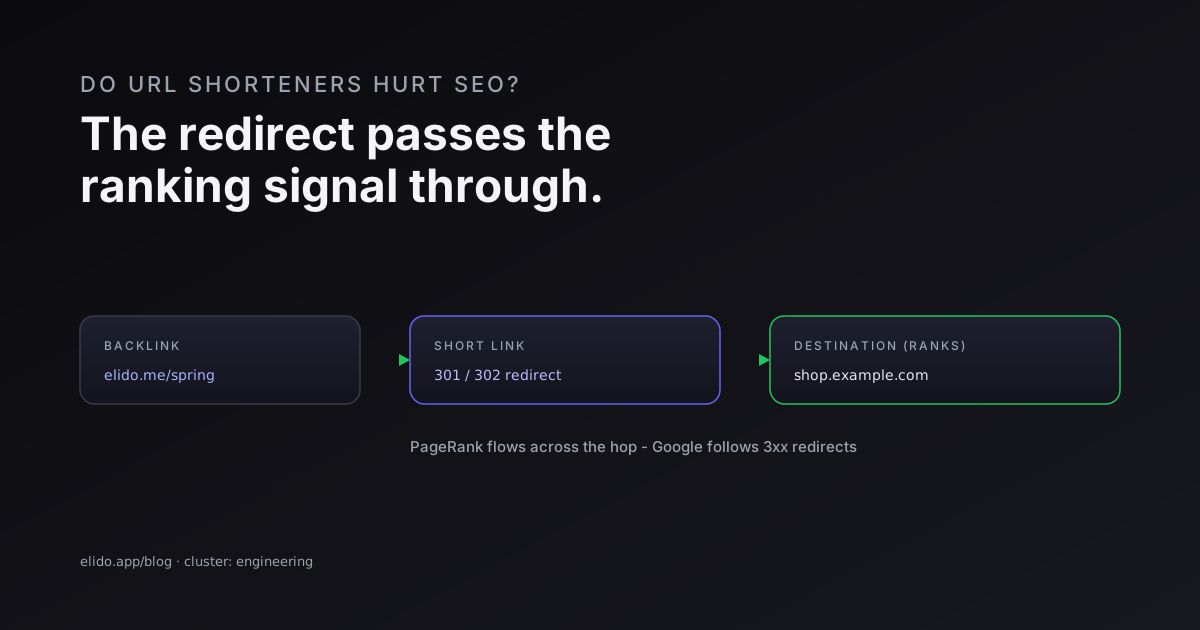
No, a URL shortener does not hurt your SEO - not if you use a reputable one and point it at a clean destination. This is one of the most durable myths in digital marketing, and it deserves a straight answer before the nuance. A short link is an HTTP redirect. Google follows redirects, and it passes ranking signals through them, so the page you actually want to rank keeps its authority.
The myth comes from a real concern with a narrow scope. Shortened URLs can affect SEO in specific, avoidable ways: the wrong redirect type for a link that needs to consolidate signals, a chain of three hops where one would do, a shortener domain that search engines already distrust, or treating the short URL itself as the thing that should rank. Fix those and short links are neutral to positive. Miss them and you can leak a little link equity or confuse a crawler.
To see why, it helps to know what a shortener does on each click. We walked through the full path in how URL shorteners work. The one-line version: the service looks up a slug and returns a redirect to the destination. Everything about SEO follows from that one redirect.
Redirects Pass Ranking Signals, Which Is the Part the Myth Misses
The old fear was that bouncing a visitor through a redirect would "leak link juice" - that the destination would inherit less authority than if you had linked to it directly. That used to be a defensible worry. It is not anymore.
Google has been explicit about this. Gary Illyes confirmed years ago that 30x redirects no longer lose PageRank, and the position has held since; Search Engine Land summarized it as no PageRank dilution when using 301, 302, or any 30x redirect. So when a backlink points at your short link and your short link redirects to your page, the ranking signal flows through to the page. You do not pay a tax for the hop.
That is the headline, and for most people it is the whole answer. A link wrapped in elido.me/spring that redirects to your product page passes its equity to that product page. The crawler arrives at the short link, sees a 3xx status with a Location header, and follows it, carrying the signals along. What it does with those signals depends on the status code, which is the one detail worth understanding.
301 vs 302: What Each Code Actually Tells Google
A redirect's status code is not a formality. It changes how Google treats canonicalization, and that is the only place the 301-versus-302 choice has real SEO weight.
A 301 Moved Permanently (and its sibling 308) tells Google the destination is now the canonical home of whatever was at the short URL. Google's own redirects documentation describes how the indexing pipeline uses a permanent redirect as a signal that the target should be the canonical URL, concentrating signals there. A 302 Found (and 307) passes PageRank too, but it does not hand over that canonical signal - Google reads it as "this is temporary, the original might come back." The formal meaning of each status code is defined in RFC 9110, the current HTTP semantics standard.
Here is where the folklore and the reality split. Most managed shorteners, Elido included, default to a 302 for marketing links. That sounds wrong for SEO until you remember what those links are for. A 302 keeps every click reaching the server, so your analytics stay accurate, and it lets you change the destination later without reprinting anything. We explained that tradeoff in detail in how URL shorteners work. The key point for SEO: a 302 still passes PageRank. The only thing it withholds is canonicalization, and for the typical short link that does not matter, because the destination page already declares its own canonical tag.
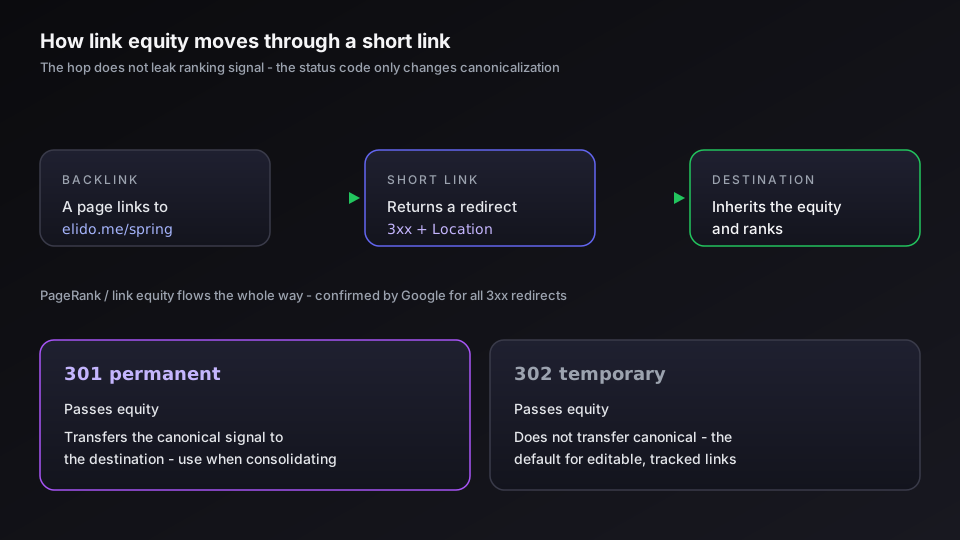
So the practical rule is short. If a crawlable backlink points at a short link and you want the destination treated as the canonical URL - say you are consolidating an old campaign URL into a new evergreen page - use a permanent redirect, or point the editorial link straight at the canonical. If the link is a trackable marketing link where editability and click data matter more, a 302 is the correct default and costs you nothing in ranking signal. The dedicated 301 vs 302 redirects breakdown walks through when each code is the right call for a short link. When both URLs need to stay reachable - a UTM-tagged variant of the same page, say - a canonical tag on the destination does the same consolidation job without removing the old URL from service, and canonical vs 301 redirect walks through which signal fits which case.
When a Short Link Actually Costs You Rank
Short links are not risk-free. The risks are just specific, and none of them are "shorteners are bad for SEO." Four things genuinely cause trouble.
Redirect chains. A short link that redirects to another short link that redirects to the destination is three hops. Google follows chains, but each extra hop wastes crawl budget, slows the visitor, and gives more chances for a link in the chain to break. Keep it to one hop: short link straight to canonical destination. If you are migrating from another provider, flatten the old chains rather than stacking your shortener on top - our Bitly migration playbook covers how to do that without breaking live links.
A shortener domain with a bad reputation. Free public shorteners get abused for spam and phishing, and search engines and safe-browsing lists notice. If your links sit on a domain that is already flagged, you inherit the suspicion - and your emails are more likely to land in spam, which is its own traffic problem. A branded domain you control sidesteps this entirely.
Blocking the destination from being crawled. This one is self-inflicted. If the destination page is noindex, blocked in robots.txt, or behind a wall, no redirect type will save it. The short link is innocent; the target is the problem.
Expecting the short URL to rank. A short link has no content, no title, no body - so it will almost never rank for a query, and it is not supposed to. The destination ranks. If you are pointing short links at a page and watching the short URL fail to appear in search, that is working as designed, not a penalty.
That is the full list. Notice that none of them are inherent to shortening a URL. They are configuration and hygiene problems, and each has a one-line fix.
Branded links on your own domain solve two of the four risks at once - reputation and control - while making your links recognizable in the SERP and in shared posts. If you have not set that up yet, custom domains for short links is a ten-minute job, and the step-by-step branded-link guide walks through DNS and TLS.
Where Short Links Have No SEO Downside At All
Most short links never touch organic ranking in the first place, because of where they live.
Links in social posts, paid ads, SMS, push notifications, and QR codes are either marked nofollow by the platform or never crawled as ranking signals to begin with. A short link in an Instagram bio or a printed QR code on a menu is not passing or losing PageRank, because that context was never feeding Google's link graph. There is no equity to leak. What you get instead is the thing short links are good at: a clean, trackable, brandable URL that fits a character limit and looks like it belongs to you.
This is the everyday case for marketing teams, and it is why the SEO question is usually moot. You are not choosing between a short link and a backlink that would have ranked - you are choosing between a tidy tracked link and a raw, sprawling UTM string that no one can read. The short link wins on usability and loses nothing on rank. For the campaigns where attribution matters, pair it with disciplined UTMs and you get clean reporting on top; we cover that in track UTM parameters end to end.
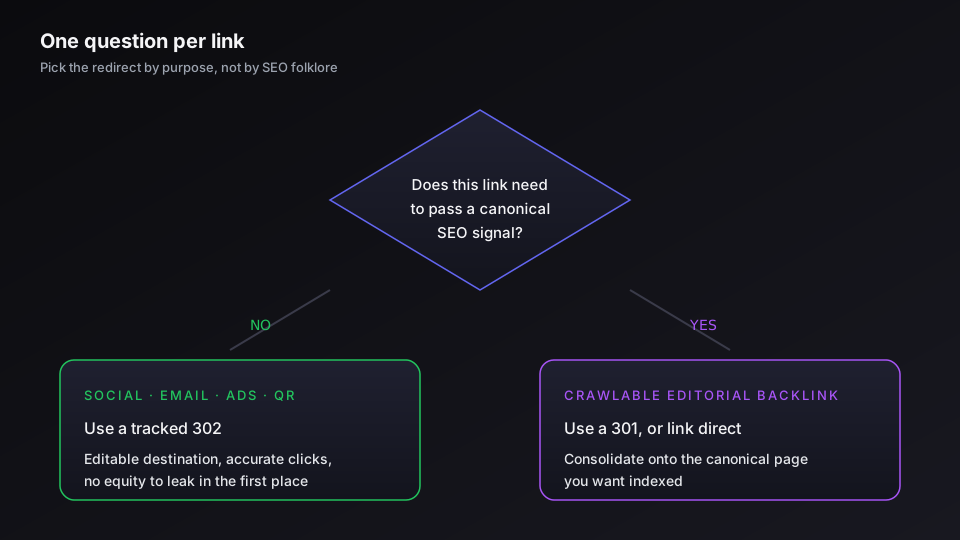
The decision is the same one every time. Ask whether this particular link needs to pass a canonical ranking signal. If it is a social, email, ad, or QR link, the answer is no, and a tracked redirect is correct. If it is a crawlable editorial backlink you want to consolidate onto a canonical page, use a permanent redirect or link straight to the page. Two paths, one question.
An SEO-Safe Short-Link Checklist
Run new links through this before you ship a campaign:
- One hop only. The short link redirects directly to the final canonical URL, with no intermediate shortener.
- The right code for the job. A
302for editable tracked links; a301when you need the destination treated as canonical. - A domain you trust. A branded custom domain, or a provider whose redirect domain is not on a safe-browsing blocklist.
- A crawlable destination. The target page is indexable, returns
200, and declares its own canonical tag. - Stable links. Avoid letting links rot or expire under live traffic - decayed redirects break the chain and the SEO with it. Our link-rot prevention strategy covers detection and cleanup.
Do those five and the SEO question disappears. Short links become what they should be: a reliable, measurable layer between your audience and your pages, with the ranking signal passing cleanly through.
If you want links that pass equity correctly by default, stay editable, and live on your own domain, start with a free Elido workspace and point your first branded link at a page you care about.
Related on the Blog
- How URL shorteners work: the mechanics explained
- Are URL shorteners safe? A balanced answer
- Set up branded short links on your own domain
- Link rot prevention strategy for short URL campaigns
- Track UTM parameters end to end
- 301 vs 302 redirects: which one should short links use
- Canonical vs 301 redirect: how to pick the right signal
- Link cloaking and URL masking: what's safe for SEO
- Link preview not showing? Causes and how to fix it
- Answer engine optimization: how to get cited by AI
Frequently asked questions
Do URL shorteners hurt SEO?
No, reputable URL shorteners do not hurt SEO. A short link is an HTTP redirect, and Google passes ranking signals through 3xx redirects to the destination, so the page you want to rank keeps its authority. The avoidable problems are using the wrong redirect type for a link meant to pass canonical signals, stacking redirect chains, or using a shortener domain with a poor reputation.
Do shortened URLs pass link equity?
Yes. Google has stated that all 3xx redirects pass PageRank, so link equity flows from the short link to the destination. The nuance is canonicalization: a permanent 301 (or 308) tells Google the destination should be treated as the canonical URL, while a temporary 302 (or 307) passes the equity but does not transfer that canonical signal. For most marketing links the destination already self-canonicalizes, so a 302 is fine.
Is a 301 or 302 redirect better for SEO?
For consolidating ranking signals onto a destination you want indexed, a 301 is better because it tells Google the target is canonical. For editable, trackable marketing links - social, email, ads, QR - a 302 is the right default because it keeps every click countable and lets you change the destination later, and it still passes PageRank. Pick the code by whether the link needs to pass a canonical signal, not by SEO folklore.
Does Google penalize shortened URLs?
No. Google does not penalize a page for being reached through a short link, and there is no ranking factor that downgrades shortened URLs. The short URL itself will rarely rank for anything because it has no content - the destination ranks. The only way short links cause trouble is through redirect chains, a flagged shortener domain, or blocking the destination from being crawled.
Are branded short links better for SEO than free shorteners?
Branded short links on your own custom domain do not pass more PageRank than a redirect on a shared domain, but they help indirectly. They build brand recognition in the SERP and in shared links, they avoid the reputation risk of a heavily abused public shortener domain, and they keep redirect behavior under your control. The SEO benefit is reputational and trust-based rather than a direct ranking signal.
Try Elido
Paste a URL, get a working short link
No signup. Link lives for 30 days. Sign up to keep it forever.
Free, no signup required · 2 per day