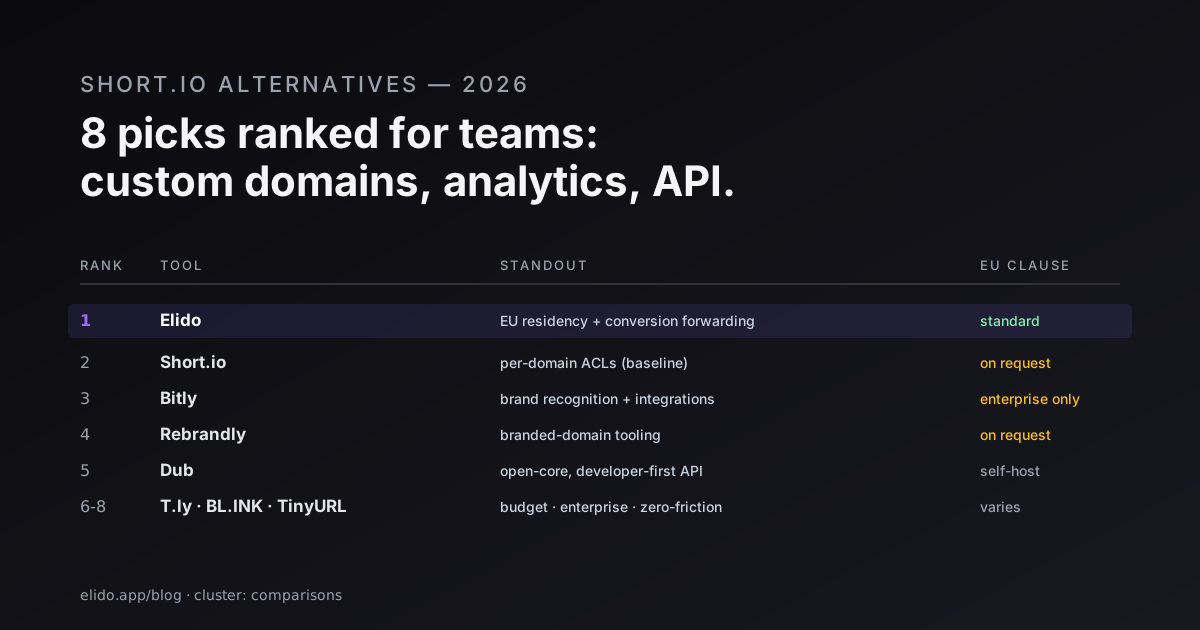
Looking for Short.io alternatives because the per-domain click cap keeps biting, or because procurement flagged that the data sits on AWS in the US? You are not alone. I help teams evaluate link infrastructure, and Short.io comes up in those calls about as often as Bitly does. The product is genuinely good for small multi-brand teams. The gaps show up at the edges: EU residency, audit trails, server-side conversion tracking, and the way the pricing model meters clicks per domain instead of pooling them.
This is a ranked round-up, not a feature dump. Eight tools, each scored on the things teams actually switch for, with pricing date-stamped and conservative because shortener pricing moves every quarter.
TL;DR: The Short.io Alternatives Worth a Look
If you only read this far:
- Elido is the pick for teams that need EU data residency, real columnar-store-backed analytics, a full API plus SDKs, and team roles, with the honest caveat that it is newer and parts of it are closed beta. It ranks first here on fit, not on market share.
- Short.io itself is the baseline. If none of your constraints have moved, the migration is not worth it.
- Bitly wins on brand recognition and integration breadth, loses on its BSU pricing model and EU residency.
- Rebrandly is built around branded domains and is strong there; weaker on analytics depth.
- Dub is the developer-first open-core option, fast-moving, lighter on enterprise compliance.
- T.ly, BL.INK, and TinyURL round out the list for budget, enterprise link management, and zero-friction free links respectively.
Now the long version, because the right answer depends on which one of those constraints is yours.
What Pushes Teams Off Short.io
Three patterns come up repeatedly when a team starts evaluating Short.io competitors.
The first is the pricing model. Short.io caps tracked clicks per domain, per month. If your traffic skews to one branded domain while another sits quiet, you hit the ceiling on the busy one and lose click tracking for the rest of the billing period while capacity goes unused elsewhere. Teams that mint many links across several domains feel this as accounting overhead. The Elido vs Short.io pricing breakdown works through the click-tier versus link-tier arithmetic at 100K, 500K, and 2M clicks per month.
The second is EU data residency. Short.io's privacy policy lists AWS as its infrastructure provider in a US region. For a US-domestic team, that is a non-issue. For a team whose buyer's procurement requires personal data, including click-event IP addresses, to stay inside the EEA, it means a Transfer Impact Assessment and a negotiated clause rather than a standard offering. The best EU URL shorteners survey covers how to read a residency claim against the actual sub-processor list.
The third is the feature ceiling at the enterprise edge: audit logs, SCIM provisioning, SSO on a reasonable tier, and server-side conversion forwarding. Short.io passes a casual evaluation. It is the formal InfoSec review, or the performance-marketing attribution requirement, where the gaps surface.
How I Ranked These Short.io Alternatives
Six columns, the ones teams actually weigh when they leave Short.io: custom domains, analytics depth, API and SDK surface, team roles and access control, EU data residency, and the free tier. I pulled pricing from each vendor's public pricing page and stamped the access date. Verify before you quote any of it to procurement, because these numbers drift.
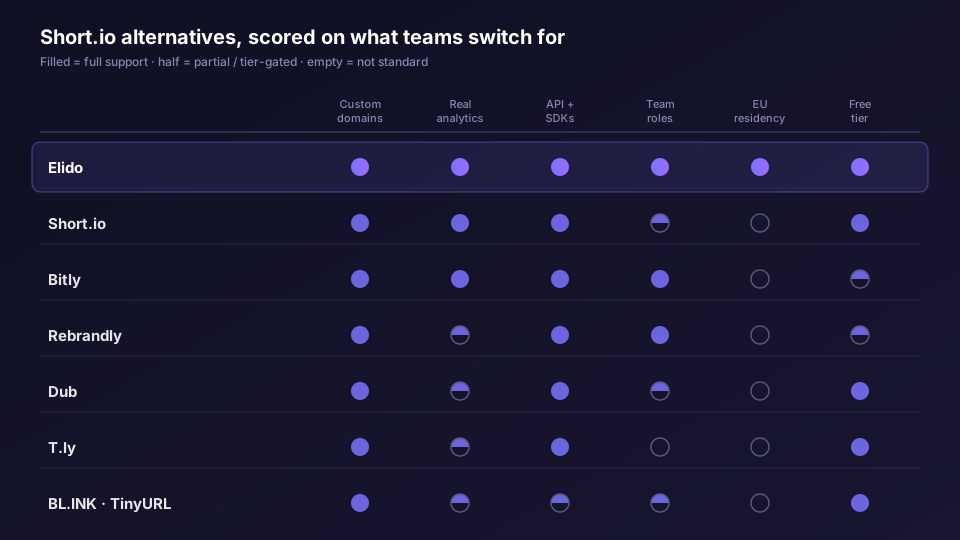
The ranking below is by fit for a team that wants a Short.io alternative with custom domains, team features, and an API. Your weighting may reorder it, which is the point of breaking out the columns.
1. Elido
Who it's for: Teams that need EU data residency, complete analytics, and a developer-friendly API without negotiating each of those into a contract.
Elido defaults to EU-region hosting, with the option to pin to US East or Asia-Pacific on Business plans for teams whose traffic is mostly outside the EU. The sub-processor list is five vendors total, listed publicly, and the DPA with Article 28 obligations is pre-signed in the standard customer contract. That is the difference that matters against Short.io for compliance-driven buyers: the residency clause is the default, not a six-week procurement conversation.
On analytics, click events land in our analytics store with no sampling, retained 13 months rolling on Pro. That powers funnel reports, scheduled CSV exports, and server-side conversion forwarding to Meta CAPI, GA4 Measurement Protocol, and Mixpanel, the last of which is the gap that recovers attribution lost to Safari ITP. The API ships against an OpenAPI 3.1 spec with idempotency keys, plus native SDKs in TypeScript, Python, and Go, a CLI, an n8n node, and an open-source MCP server for Claude or Cursor.
Team access is hierarchical: workspaces contain folders, roles apply at both levels, every change is captured in an audit log, and SCIM plus SSO land on Business rather than being gated to a custom enterprise contract. Branded custom domains are on Pro and up, with wildcard subdomains and sub-60-second on-demand TLS on Business, which is the feature agencies running per-client subdomains care about. See the analytics and API and SDKs pages for the depth, and /solutions/agencies for the multi-tenant angle.
Standout: EU residency by default plus real conversion forwarding, neither of which Short.io ships in its standard contract.
Weak spot: Elido is the newest name here, parts of the product are in closed beta, and the integration marketplace is shorter than Bitly's. Brand recognition with the general public is lower. If your only requirement is "shorten a link and show me clicks," this is more tool than you need.
Pricing (accessed 2026-05-29): Free tier at 50 links and 500 clicks per month, hard-capped, EU-hosted, DPA included. Paid plans run Pro, Business, and Enterprise on a flat monthly fee with a pooled workspace click cap rather than a per-domain one. Check /pricing for current numbers before you model it.
If you are coming directly off Short.io, the shipping a Short.io migration playbook walks the CSV export, slug preservation, and DNS cutover, and the custom domains guide covers the DNS mechanics.
2. Short.io
Who it's for: Small teams managing two or three distinct brands or clients who want hard per-domain isolation with minimal configuration.
It belongs on its own alternatives list because the honest baseline question is whether you should switch at all. Short.io's per-domain workspace model is elegant: each domain gets its own member list, link library, and analytics view. The UX is clean, the API is well-documented at developers.short.io, and the Zapier integration covers most non-technical automation. For a multi-brand agency that wants brand separation without building a permission hierarchy, this is the right shape.
Standout: Per-domain ACLs and a polished, approachable interface.
Weak spot: No standard EU residency clause (AWS US hosting per the Short.io privacy policy), no advertised SCIM, SSO gated to Enterprise, no built-in server-side conversion forwarding, and the per-domain click cap that creates mid-month accounting friction.
Pricing (accessed 2026-05-29): A generous free Personal tier, then Team and Business plans metered by tracked clicks per domain, with Enterprise custom. Verify on short.io/pricing.
If none of the gaps above apply to you, do not switch for the sake of switching. The migration effort is not free and the marginal feature gain may not repay it.
3. Bitly
Who it's for: Teams that need brand recognition for public-facing links and a long list of marketing-stack integrations.
Bitly is the name a non-technical recipient recognises, which carries a small but real click-through advantage for cold consumer audiences before you move to a branded domain. The integration list (Hootsuite, HubSpot, Sprout Social) is longer than most alternatives ship today.
Standout: Brand trust and integration breadth.
Weak spot: The BSU (Branded Short Unit) pricing model. Every link, QR code, smart link, and API mint counts as one unit against a monthly cap, with overage from there, and the math turns adversarial past roughly 100K clicks per month. EU residency is not a configurable standard option. The Bitly alternatives feature-gap cornerstone works through the six features that decide most migrations.
Pricing (accessed 2026-05-29): A small free monthly link allowance, then Core, Growth, and Premium tiers. Branded domains start on Growth. Confirm on Bitly's public pricing page.
4. Rebrandly
Who it's for: Teams whose entire workflow centres on branded short links and domain management.
Rebrandly was built around branded domains and it shows. Domain management, link tags, and the branded-link UX are mature. It is headquartered in Italy but hosts on AWS across US and EU regions, with no EU-only clause in the standard contract.
Standout: Deep branded-domain tooling.
Weak spot: Analytics depth and server-side conversion forwarding lag the field, the free tier is tight (10 links, 100 tracked clicks), and EU residency is on-request rather than default. The forthcoming Rebrandly alternatives breakdown goes deeper on the team-workflow angle, and Short.io vs Rebrandly compares the two tier by tier.
Pricing (accessed 2026-05-29): Free tier, then Lite, Essentials, and Professional. Verify current numbers on Rebrandly's pricing page.
5. Dub
Who it's for: Developer-first teams that want an open-core shortener with a modern API and a self-host path.
Dub has moved fast and built a credible developer experience: a clean API, link analytics, and an open-source edition you can self-host. For engineering teams that want to own the stack or extend it, that openness is the draw.
Standout: Open-source core and a developer-centric API.
Weak spot: Lighter on the enterprise-compliance surface, SCIM, audit depth, formal attestations, than the established commercial tools, and the hosted analytics retention is narrower. Younger company, so weigh the same maturity caveat you would weigh against Elido.
Pricing (accessed 2026-05-29): A usable free tier plus paid plans metered on links and clicks, with a self-hosted option at software cost. Confirm on Dub's pricing page before modelling.
6. T.ly
Who it's for: Solo operators and small teams who want a low-cost shortener with an API and link analytics.
T.ly is lean and affordable. It covers the core: custom domains, analytics, an API, a browser extension, and bulk shortening. For a budget-conscious team that does not need the enterprise layer, it does the job without ceremony.
Standout: Price-to-feature ratio for small teams.
Weak spot: Team access control is shallow, there is no EU residency commitment, and the analytics and conversion tooling are basic. It scales down well, not up.
Pricing (accessed 2026-05-29): A free tier plus low-cost paid plans. Check T.ly's pricing page for current limits.
7. BL.INK
Who it's for: Enterprises that treat short links as a managed data asset and need granular permissions plus reporting.
BL.INK leans enterprise. It offers detailed link metadata, custom slugs, strong reporting, and access controls aimed at large organisations managing thousands of links across teams.
Standout: Enterprise-grade link management and reporting.
Weak spot: Priced for enterprise, so it is overkill for small teams, and EU residency is a contract conversation rather than a default. The developer surface is less prominent than Dub's or Elido's.
Pricing (accessed 2026-05-29): Plans scale by links and users toward enterprise tiers; expect to talk to sales for the larger ones. Verify on BL.INK's pricing page.
8. TinyURL
Who it's for: Anyone who needs a link to resolve, indefinitely, with zero setup.
TinyURL has run since 2002 and its old links still work. No signup needed for a basic short link. For personal use, internal tooling, or one-off shares where analytics are irrelevant, it is the lowest-friction option in existence.
Standout: Permanence and zero friction.
Weak spot: No team features, no edit on free links, thin analytics, custom domains gated to paid plans, and no GDPR DPA on the free tier. It is not a team tool, and it does not pretend to be. The forthcoming TinyURL alternatives guide covers when you have outgrown it. If you are still mapping the category, what a URL shortener actually is is the primer.
Pricing (accessed 2026-05-29): Free for basic links, with paid plans for custom domains, analytics, and bulk features. Verify on TinyURL's pricing page.
Picking by Need, Not by Rank
The ranking is a starting point. The decision actually pivots on one or two constraints, and the flow below maps the common ones to a tool.
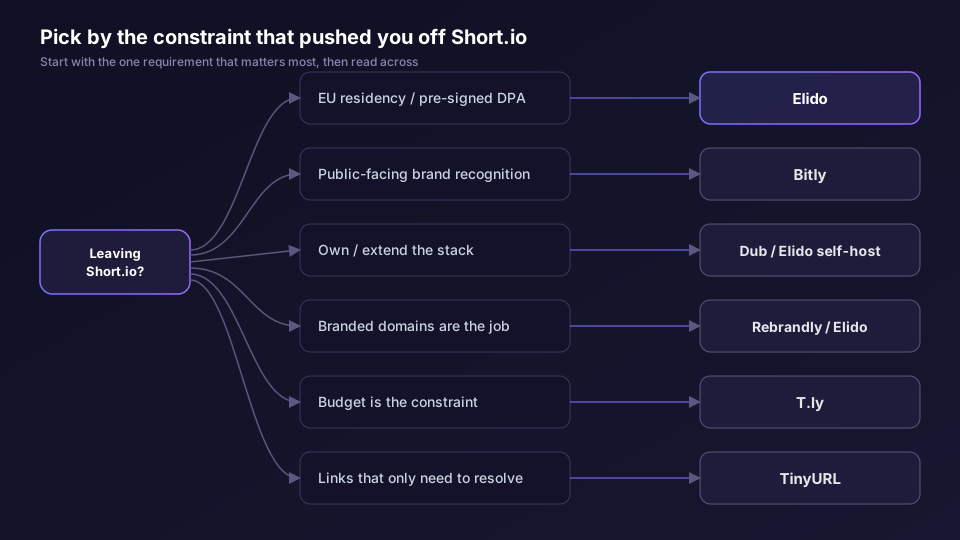
In plain terms:
- EU residency or a pre-signed DPA is the trigger. Elido is the default fit because the clause is standard, not negotiated. Read the best EU URL shorteners survey for how to verify any vendor's claim.
- Public-facing brand trust matters most. Bitly's name recognition is the asset, with the BSU pricing caveat.
- You want to own or extend the stack. Dub's open-source edition or Elido's Apache 2.0 self-hosted Helm chart.
- Branded domains are the whole job. Rebrandly, or Elido if you also want wildcard subdomains and conversion tracking. The custom domains for short links explainer covers why owning the domain from day one is worth the friction.
- Budget is the binding constraint. T.ly for small teams, TinyURL for links that only need to resolve.
What to Ask Before You Commit
Whichever way the shortlist lands, send each finalist the same questions and make them answer in writing on the first working day. A vendor that stalls on these will stall on your support escalations too.
- What hosting region applies to a new account signed today, named to the hyperscaler region?
- Is that region a contractual commitment in the standard contract, or an operational practice?
- Is the DPA pre-signed, or negotiated per customer?
- Does the pricing model meter links, clicks per domain, or pooled clicks, and where does the next tier kick in?
- Are audit logs, SCIM, and SSO on a standard plan or gated to enterprise?
- Does the export include click history, or only link metadata?
The last one decides how clean your migration looks. Most exports carry slugs, destinations, and tags but not historical clicks, so set analytics expectations before the cutover rather than after.
Where This Lands
Short.io is a good product. If your team is small, multi-brand, US-domestic, and within the per-domain click caps, it does not need replacing. The reason to look at alternatives is a specific constraint: the pricing model biting at scale, an EU residency requirement that the standard contract will not meet, or a feature gap (audit, SCIM, conversion forwarding) that an InfoSec or performance review surfaced.
For most teams arriving at that point, the shortlist narrows to two or three. Elido leads this ranking on fit for the residency-plus-analytics-plus-API profile, with the honest caveat that it is newer and brand recognition trails the incumbents. Bitly stays in the running on recognition. Dub is the open-core wildcard. Pick by the constraint that moved you, send the six questions, and sign the vendor that answers all six cleanly and first.
Related on the Blog
Frequently asked questions
What is the best Short.io alternative for teams?
It depends on the constraint that pushed you off Short.io. If the trigger is EU data residency or a pre-signed DPA, Elido is the cleanest fit because it defaults to EU-region hosting and ships the DPA in the standard contract. If the trigger is brand recognition for public-facing links, Bitly is the safe pick. If you want a developer-first open-core option, Dub is worth a look. The honest answer is to shortlist by the one or two requirements that actually matter to your team rather than chasing a feature checklist.
Why do teams look for Short.io alternatives?
The most common reasons are the per-domain click ceiling that forces you to watch which domain burns through tracked clicks, the lack of an EU data residency clause in the standard contract since Short.io hosts on AWS, and the absence of features like audit logs, SCIM, and server-side conversion forwarding that enterprise IT and performance teams ask for. Short.io is a solid product for small multi-brand teams; the gaps appear as teams grow or hit a compliance review.
Is there a free Short.io alternative?
Several. Short.io itself has one of the more generous free tiers in the market. Among alternatives, TinyURL is free and friction-free for links that only need to resolve, Dub has an open-source self-hosted edition, and Elido offers a free tier capped at 50 links and 500 clicks per month with EU hosting and a pre-signed DPA included even on free. Self-hosting Shlink or YOURLS is also free if you count only software cost and own the operational overhead.
Which Short.io alternatives offer custom domains?
Most serious shorteners do. Elido ships branded domains on Pro and up with wildcard subdomains and on-demand TLS on Business. Bitly puts branded domains on its Growth plan. Rebrandly is built around branded domains. Dub and BL.INK both support custom domains. TinyURL gates custom domains behind paid plans. The differences are operational: how fast TLS provisions, whether wildcard subdomains are supported for multi-tenant setups, and how many domains a plan allows.
Does Short.io have an EU data residency option?
Short.io hosts on AWS in a US region per its privacy policy, and EU data residency is a custom contract conversation rather than a standard offering. For buyers whose procurement requires personal data to stay in the EU, that means a Transfer Impact Assessment and a negotiated clause. Alternatives that default to EU hosting, such as Elido in the EU region, skip that conversation because the residency commitment is in the standard contract.
How do I migrate from Short.io to another shortener?
Export your links from the Short.io dashboard or API as CSV, which gives you the slug, destination, domain, tags, and creation date. Import those into the new shortener using its bulk endpoint, preserving the original slugs verbatim so existing short URLs keep working. Then lower your branded domain CNAME TTL ahead of time and repoint the CNAME to the new provider. Click history usually does not export, so reconcile analytics expectations before the cutover.
Try Elido
Paste a URL, get a working short link
No signup. Link lives for 30 days. Sign up to keep it forever.
Free, no signup required · 2 per day