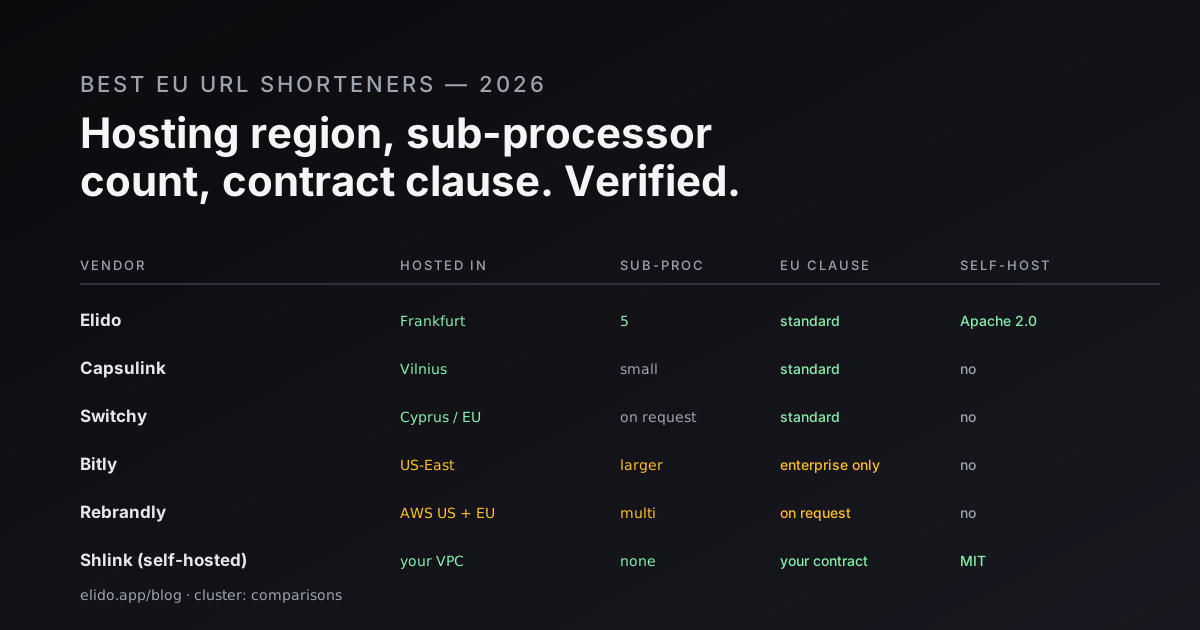
The phrase "EU URL shortener" gets used loosely. Two things should be clear before I survey the market: a vendor headquartered in the EU is not necessarily processing data in the EU, and a vendor that processes data in the EU is not necessarily exposing that as a contractually binding clause. The buyer's question - "can I require, in writing, that personal data on my EU subjects stays inside the EEA?" - collapses these distinctions and expects a yes-or-no answer.
This post is a working compliance read on which URL shorteners actually meet that bar in 2026, what their underlying infrastructure looks like, and how to read a residency claim against the operational reality. I've kept claims to what's verifiable from public sources - pricing pages, sub-processor lists, security pages, standard DPAs available on request. Where a vendor's posture is ambiguous, I've said so.
Yes, Elido is one of the options. I'll be specific about the trade-offs against the alternatives rather than skimming over them.
What "EU shortener" actually means
Three layers, and a vendor can claim "EU" at any of them. They are not equivalent.
Legal entity. The company is incorporated in an EU member state. This is the easiest claim to verify (Companies House, the local commercial registry) and the least operationally meaningful. A vendor headquartered in Berlin that hosts on AWS US-East is in the EU as a corporate matter and outside it as a data-processing matter.
Hosting region. The data is processed on infrastructure located in the EU/EEA. This is the operationally meaningful claim. It's harder to verify directly - you have to read the sub-processor list and identify the hyperscaler region - but it's the claim your DPO actually cares about.
Contractual residency clause. The customer contract or DPA includes a binding commitment that the data will not leave the EU/EEA without notice and consent. This is what procurement uses to satisfy regulator-facing obligations. Without this clause, even a vendor that happens to host in the EU today can route to a US region next quarter without breaching the contract.
A serious EU shortener clears all three. A vendor that clears only the first or second is what gets sold under the "EU-friendly" euphemism.
The GDPR for URL shorteners cornerstone covers the article-level basis for why these distinctions matter; this post focuses on the vendor landscape.
How to read a sub-processor list
Every serious SaaS publishes a sub-processor list. The list is the artefact your DPO will read; it's also the most reliable signal of how the vendor actually thinks about the residency question.
What to look for:
- Hyperscaler regions named. "AWS" alone is insufficient; "AWS eu-central-1" is the usable answer. Same for GCP (
europe-west1) and Azure (westeurope,germanywestcentral). - CDN region behaviour. Cloudflare and Fastly are global by default. The vendor should document whether the EU subset is enforced (Cloudflare's Regional Services is the EU-only data-plane option), or whether the CDN is left in its default global routing posture.
- Email and notification providers. Postmark, SendGrid, Mailgun, Resend - most are US-hosted. If they're in the sub-processor list, transactional email contains EU-subject identifiers (the recipient's email address), and the residency claim has to either include those vendors or exclude transactional email from the claim's scope.
- Payment providers. Often US-hosted (Stripe is the obvious one). For B2B SaaS, this is usually fine - the data shared is the buyer's billing contact, not end-user click data - but it should be disclosed.
- Sub-processor count. Smaller is more readable. A list of five is auditable in an afternoon; a list of forty is a maintenance burden every time the vendor adds one.
The list is the signal. A vendor that won't show you their sub-processor list has nothing to add to the conversation.
The shortlist
What the EU-hosted segment looks like as of writing. I've grouped by deployment model because the contractual implications are different.
Hosted SaaS, EU-region by default
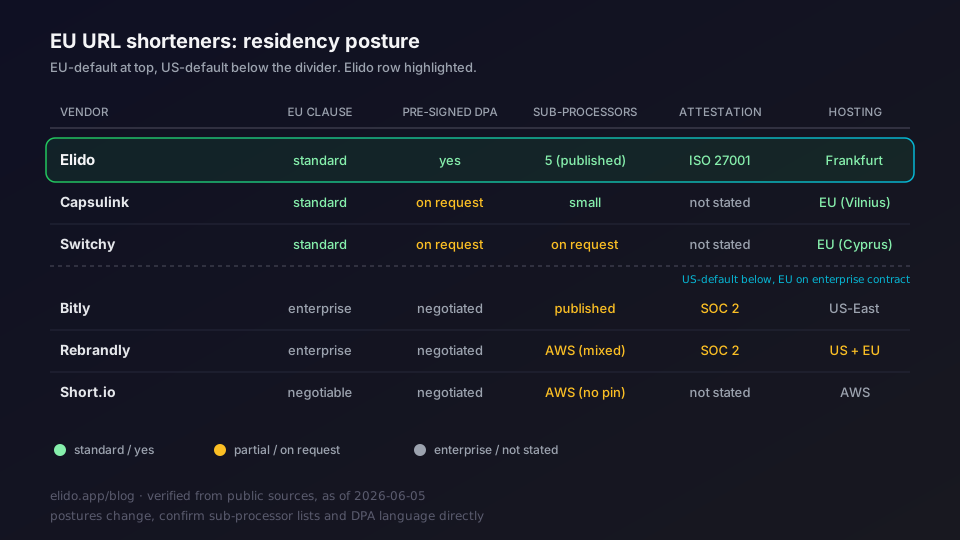
These are commercial shorteners that process customer data in the EU as their default posture, with a contractually documented residency commitment.
Elido. EU region by default. Business+ customers can pin to US East or Asia-Pacific where their traffic profile demands it. Sub-processor list is five vendors total, published at /trust. DPA is pre-signed in the standard customer contract; Article 28 obligations are addressed without negotiation. ISO 27001 certified; SOC 2 Type II in progress (target H2 2026). Self-hosted edition under Apache 2.0 for organisations that want full data plane control. Disclosure: I work for Elido.
Capsulink (capsulink.com). Vilnius, Lithuania-based. Hosting region is documented as EU; sub-processor list is reasonably small. Smaller feature surface than the established commercial shorteners - light on smart-link rule depth and server-side conversion forwarding - but the residency posture is clean for teams whose use case is straightforward link shortening with branded domains.
Switchy (switchy.io). Cyprus-based, EU-hosted. Stronger on the marketing-feature side (CTA overlays, retargeting pixels). The residency clause is in the standard contract; sub-processors are documented on request rather than published.
I've deliberately not listed every shortener that markets to EU buyers - only those where I've personally verified the hosting region and seen a residency clause in the contract. Several other vendors describe themselves as "EU-friendly" while sitting on US infrastructure; the buyer-side discovery process should always include the sub-processor question on the first call.
Hosted SaaS, US-default with EU regions available
The bigger shorteners that operate primarily in the US but have some EU posture.
Bitly is US-hosted as of writing. Their public sub-processors page lists US-East primary. Enterprise customers can negotiate EU residency clauses but it's a custom contract conversation rather than a standard offering. Practical implication: if your buyer requires EU residency in the contract, expect a six-to-eight week procurement cycle on the Bitly side. The Elido vs Bitly post covers the cost-side trade-off in detail.
Rebrandly is headquartered in Italy but hosts on AWS in regions that span the US and EU. The standard contract does not include an EU-only clause; it's available on request for enterprise customers. Same procurement caveat.
Short.io is Estonia-headquartered (a meaningful signal - Estonian companies are GDPR-native by virtue of operating from a member state) but hosts on AWS without a published region pin in the standard contract. The residency conversation is open to negotiation; the default contract doesn't bind it.
I'm describing what's verifiable from public materials. If you're at the procurement stage, ask each vendor's sales team for the standard sub-processor list and the residency clause language directly. Vendors that can't supply both within a working day are signalling something about their procurement readiness.
Self-hosted
For organisations that want the data plane in their own VPC - financial services with regulatory data-locality requirements, public sector buyers, healthcare systems - self-hosting is the cleanest answer to the residency question.
Elido self-hosted. Apache 2.0 Helm chart; bring your own KMS, database, analytics store, and cache. The same code that runs the hosted service runs self-hosted. We document the deployment in the self-hosting playbook and the Helm chart in the public repo.
YOURLS (yourls.org). The veteran self-hosted shortener. PHP-based, MySQL backend. Maintained, but the codebase reflects its 2009 origin - limited smart-link routing, no native server-side conversion forwarding, and the analytics layer is rudimentary. Suitable when your use case is "minimal short-link infrastructure under our control"; not suitable when you want a feature-rich shortener.
Shlink (shlink.io). Modern self-hosted shortener built in PHP/Symfony. Active maintenance, decent feature surface (smart links, custom domains, REST API), MIT licence. The team is based in Spain. A reasonable middle ground if your use case is mid-feature self-hosting and you have the operational capacity to run it.
Kutt.it (kutt.it). Open-source TypeScript/Node shortener, can be self-hosted. Lighter feature surface than Shlink; the hosted version exists but is operated by an individual rather than a commercial entity. Suitable for very small teams.
The trade-off pattern across the open-source options: feature surface is materially lighter than the hosted commercial alternatives. If your evaluation criteria include smart-link rule depth, server-side conversion forwarding, branded-domain wildcards, SSO/SCIM, or a pre-signed DPA, the open-source path leaves you building those yourself. If your criteria are purely "minimal control over short links in our own VPC", they're solid.
What to ask vendors
The fastest way to size a shortener's residency posture is the discovery call. Eight questions, one working day, written answers.
- What is the hosting region for new customers signed today? Name the hyperscaler region.
- Is the hosting region a contractual commitment in the standard customer contract, or is it a documented operational practice?
- Is the DPA pre-signed in the standard contract, or is it negotiated per customer?
- How many sub-processors does the standard processing chain include? Name them.
- What is the breach-notification SLA? (Industry norm: 24 hours from awareness to controller notification.)
- What is the data subject erasure SLA, and is it operationally achievable on the click-event store?
- What independent attestations does the vendor hold? When was the last audit closed?
- If the customer requires EU-only processing, what is the contract amendment process?
A vendor that can answer those eight in writing on the first working day is procurement-ready. The vendor that can't is going to consume weeks of your sales cycle and may surface issues at signing that weren't obvious upfront.
The Schrems II caveat
Schrems II (CJEU C-311/18, 2020) invalidated Privacy Shield. Its successor framework - the EU-US Data Privacy Framework, adopted in 2023 - restored a transfer mechanism for participating US organisations. Two caveats matter for shortener selection.
The DPF is voluntary. Not every US-based shortener is certified; check the DPF participant list before relying on it as a transfer basis. As of writing, several major US shorteners are not on the list, which means transfers under the standard contract still rely on SCCs plus a Transfer Impact Assessment.
The DPF is itself the subject of pending litigation. NOYB has signalled an intent to challenge it before the CJEU. A Schrems III judgment is plausible within the next 24-36 months; if it lands, the DPF goes the way of Privacy Shield and US-hosted SaaS that depended on it has to revert to SCC-plus-TIA overnight. Buyers planning for that scenario are increasingly contractually requiring EU-only processing in their standard procurement template.
The practical takeaway: an EU-hosted shortener is a hedge against the next Schrems judgment as much as it is a response to the current legal regime. Buyers in regulated industries - German healthcare, French health data via HDS certification, financial services under EBA guidelines - are increasingly making this hedge explicit.
When the question is "EU-hosted analytics", not "EU shortener"
Some teams arrive at this evaluation having decided the shortener itself is fine but the analytics pipeline behind it isn't. The shortener is hosted in the EU; the click events get exported to a US-hosted warehouse for analysis; the residency claim breaks at the export.
The fix is the warehouse and the export pipeline, not the shortener. ClickHouse Cloud has a Frankfurt region; BigQuery and Snowflake both have Frankfurt regions; the export from the shortener has to be configured to land in the EU region rather than the default US region. Elido's analytics export guide covers the configuration; the same applies to BigQuery and Snowflake exports.
If your team is using a hosted CDP (Segment, mParticle, RudderStack), the same question applies - most CDPs have an EU region option that needs to be enabled at workspace creation time and is hard to migrate to retroactively. Get this right at the start of the evaluation; the retrofit cost is real.
Where this lands
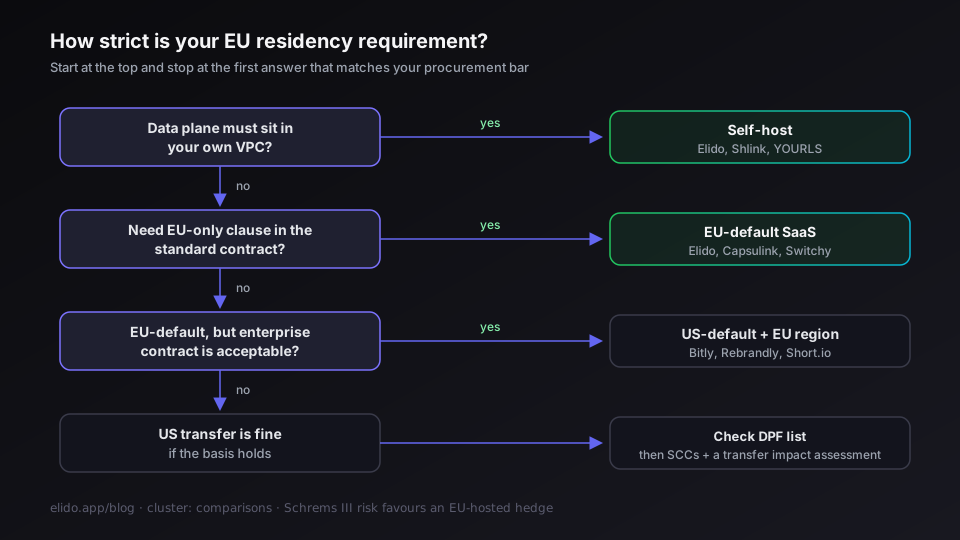
For most B2B SaaS teams selling into the EU, the residency question is going to come up. The buyer's procurement template will include the question; the DPO will read the answer; the vendor that can answer it cleanly in the first call wins time on the cycle. For teams selling into financial services, healthcare, or public sector, residency is sometimes a pass/fail filter, not a soft preference.
EU-hosted shorteners are a small segment of the market. Three commercial options with reasonable feature surface - Elido, Capsulink, Switchy - plus the self-hosted open-source alternatives. The bigger US-default shorteners (Bitly, Rebrandly, Short.io) can usually accommodate EU residency on enterprise contracts, with the procurement cycle cost that comes with custom-contract conversations.
The honest version of "which one should we pick" is: shortlist the three or four that meet your residency, feature, and pricing constraints, send each the eight discovery questions in writing, sign the one that responds first and answers all eight cleanly. That filter is more decisive than any feature checklist - vendors who can't handle the procurement-side rigour aren't going to handle your customer support escalations either.
Read the cluster
This is a sibling post in the comparisons cluster. The cornerstone is Bitly alternatives - the actual feature gap; see also Elido vs Bitly for the pricing arithmetic. For the compliance-side detail behind the residency claim, GDPR for URL shorteners is the cornerstone of the compliance cluster. Procurement-facing artefacts: /trust, /solutions/compliance, /solutions/enterprise.
Related on the blog
- EU data residency for marketing tools: what your DPO actually asks
- Schrems II and tracking pixels: where the DPF leaves you in 2026
- SCIM and SSO for marketing tools: what enterprise IT actually asks
- Self-hosting Elido on k3s - a complete playbook
- Google URL Shortener alternative after goo.gl shut down
- Bitly vs TinyURL: features, pricing, and which to pick
- Free URL shortener with analytics: what you really get
- EU alternatives to US SaaS: a sovereignty guide
- Best URL shorteners: 6 tools ranked and compared
Try Elido
Paste a URL, get a working short link
No signup. Link lives for 30 days. Sign up to keep it forever.
Free, no signup required · 2 per day