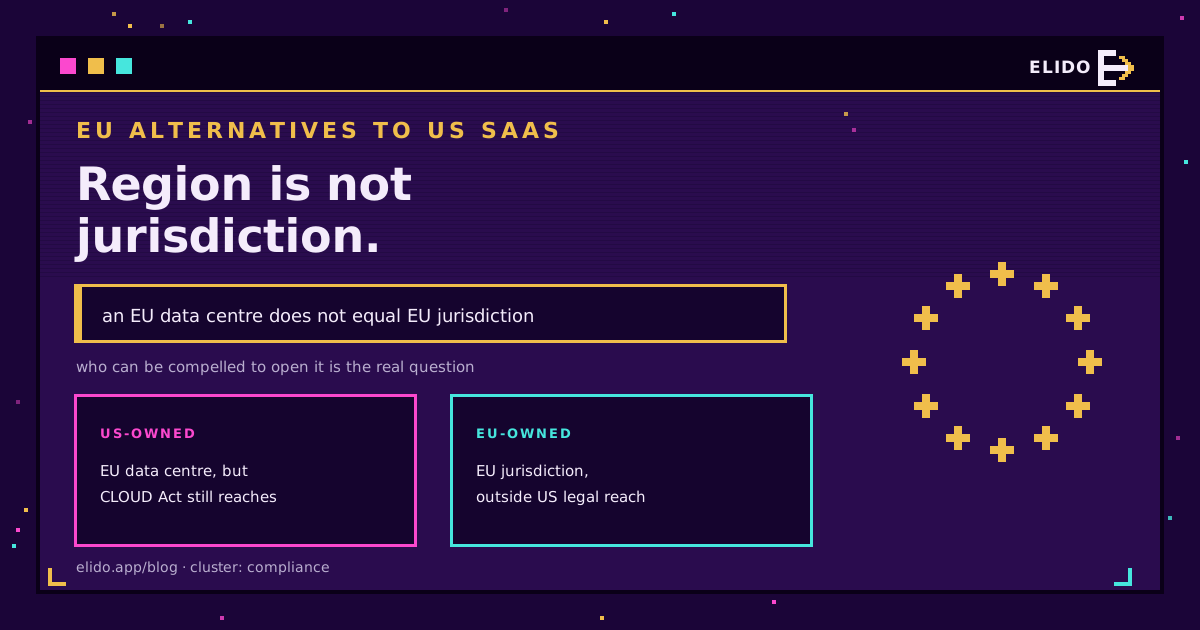
European teams are moving off US SaaS for one hard reason: a legal conflict they cannot reconcile. The US CLOUD Act lets American authorities compel US companies to hand over data wherever it is stored, and GDPR requires you to protect EU personal data from exactly that. You cannot fully comply with both, so for regulated and sovereignty-conscious organisations the question has shifted from "is this tool convenient?" to "who can be forced to open it?"
This guide covers why the switch is happening now, how to tell a genuine European alternative from a US tool with an EU data centre, and the EU alternatives worth knowing by category. It is a compliance-cluster piece, so the legal points are cited and you can take them to your own counsel.
For the framework underneath all of this, the GDPR for URL shorteners cornerstone walks the specific articles that govern EU data, and EU data residency for marketing goes deeper on the contractual side.
Why EU Teams Are Switching Now
The trigger is not a new law. It is that the old ambiguity is gone.
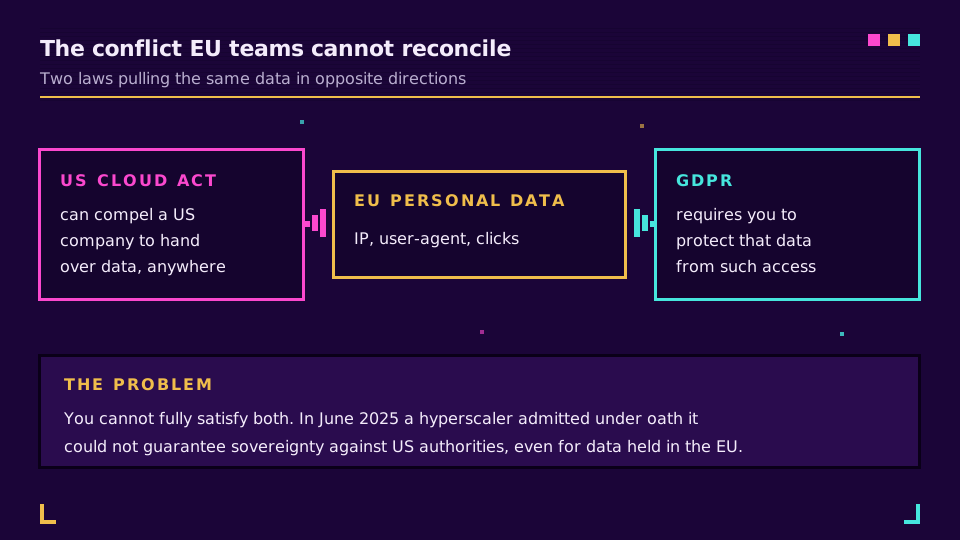
The US CLOUD Act (2018) gives US authorities the power to demand data held by US-headquartered companies, regardless of the country the servers sit in. GDPR, in Chapter V on international transfers, requires that EU personal data keep its protection when it moves or becomes accessible outside the EU. The two obligations point in opposite directions.
For years vendors argued the conflict was theoretical. That ended in June 2025, when a major hyperscaler's French subsidiary confirmed under oath at a French Senate hearing that it could not guarantee data sovereignty against US authorities, even for data held in France under a "sovereign" offering. The admission moved the CLOUD Act from a lawyer's edge case to a board-level risk.
The market has responded. Analysts now put sovereign-cloud spending in the tens of billions for 2026, growing at a rate that only makes sense if this is a structural shift rather than a compliance footnote. Public bodies, healthcare, and financial services are leading, because their regulators were already asking the question.
What Actually Makes an Alternative "European"
This is where most shortlists go wrong. Teams check the data-centre map, see "EU region", and stop. Location is necessary but not sufficient.
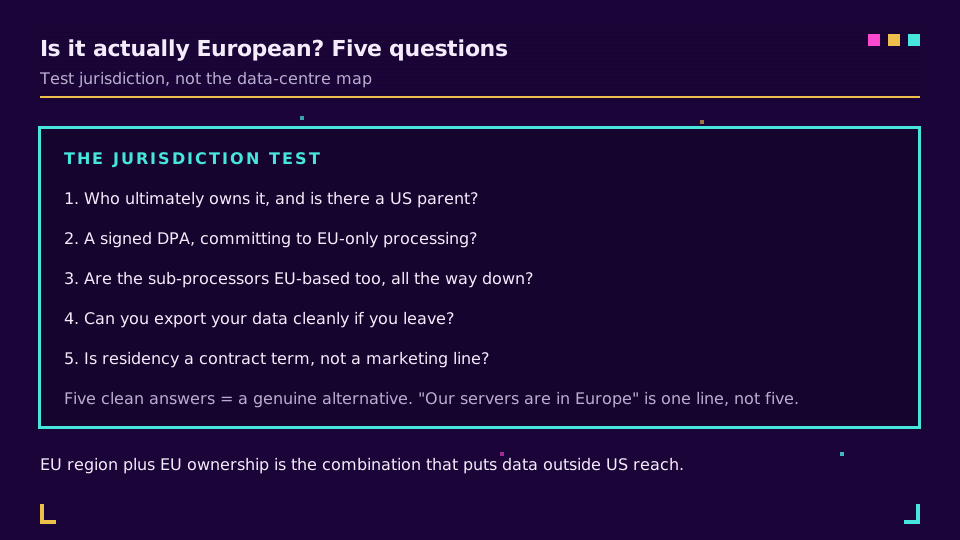
The test that matters is jurisdiction, not geography. Ask five questions of any candidate:
- Where is the company legally established, and who ultimately owns it? An EU entity with a US parent is still within CLOUD Act reach.
- Is there a signed DPA, and does it commit to EU-only processing rather than allowing transfers "where necessary"?
- Are the sub-processors EU-based too, or does the chain route back to a US provider two hops down?
- Can you get your data out in a usable format if you leave, without a professional-services invoice?
- Is the residency a contractual term you can point to, or a marketing line on the pricing page?
A tool that answers those cleanly is a genuine alternative. One that answers "our servers are in Europe" and changes the subject is selling you EU region without EU jurisdiction, and those are not the same purchase.
The EU Alternatives, by Category
The European software market is deeper than it was five years ago. A working shortlist by category, current as of 2026:
Email and calendar. Proton (Switzerland), Tuta, and mailbox.org offer encrypted, EU or Swiss-jurisdiction mail that regulated bodies and ministries increasingly standardise on. These replace the mailbox half of a US productivity suite cleanly.
Web analytics. This is the sharpest case, because multiple EU supervisory authorities have formally ruled Google Analytics non-compliant. Plausible (Estonia), Matomo, and Fathom are cookie-free or self-hostable analytics that collect far less personal data, often removing the cookie-consent banner entirely.
CRM. Pipedrive (Estonia) is the best-known EU-headquartered sales CRM, built for pipeline visibility without routing your customer data through a US platform.
Storage and collaboration. Nextcloud (Germany) powers on-premise file sync, documents, and collaboration for European public institutions, and is the standard answer for teams that want the shared-drive experience under their own control.
Cloud infrastructure. European providers such as Scaleway (France) and IONOS (Germany) offer compute and managed services under EU jurisdiction, several with public-sector security qualifications.
URL shortening and link tracking. Every redirect logs an IP address and a user-agent, both personal data on identifiable people, so a shortener is a data-processing tool, not a neutral utility. Elido is the EU-based option here: EU data residency and a signed DPA on every plan, click data kept in the EU region rather than transferred to the US, and an open-source self-host edition if you want to own the data plane outright.
If your reason for reading this was the shortener line specifically, the best EU URL shorteners roundup ranks that category on residency posture, and is Bitly GDPR compliant works the US-incumbent case in detail. You can start on Elido free with the DPA and EU residency on from your first link.
The Catch: "Sovereign" Offerings That Aren't
The hardest part of this migration is not finding alternatives. It is seeing through the ones that look European but aren't.
US vendors have noticed the sovereignty demand and responded with EU data centres, "EU boundary" products, and locally incorporated subsidiaries. Some of this is genuine engineering. None of it changes the ownership question. As long as the parent is US-headquartered, the CLOUD Act can reach the data, and the June 2025 Senate admission is the vendors themselves confirming it. An EU subsidiary of a US company does not sit outside US jurisdiction just because its invoices are in euros.
So when a familiar US brand offers you a sovereign tier, treat it as a location claim, not a jurisdiction claim. It may reduce latency and satisfy a data-residency checkbox. It does not remove the legal exposure that started this whole conversation.
How to Actually Migrate
You do not have to move everything at once, and you shouldn't. Sequence it by exposure.
Start with the tools processing the most personal data on EU subjects: web analytics, email, and behaviour-tracking tools like link, campaign, and attribution platforms. These carry the clearest GDPR risk and have the most mature EU alternatives, so the first wave gives you the largest compliance gain for the least disruption. Move deeper infrastructure, the parts with real switching cost, in later waves once the high-exposure surface is handled.
For each tool, keep the five-question test from earlier in front of you, get the DPA and residency terms in writing before you commit, and confirm the data-export path works before you cut over rather than after. The migration that goes badly is always the one where nobody checked the exit until it was time to leave.
Read the Cornerstone
This sits in the compliance cluster. The cornerstone is GDPR for URL shorteners: what your DPO actually wants to see. For the procurement-facing summary, the trust page and solutions/compliance are the two artefacts to bookmark.
Related on the Blog
Frequently asked questions
Why are European companies moving away from US SaaS tools?
Because of a legal conflict they cannot reconcile. The US CLOUD Act lets US authorities compel American companies to hand over data regardless of where it is stored, while GDPR requires EU organisations to protect personal data from exactly that kind of foreign access. You cannot fully satisfy both at once, so EU teams in regulated or sovereignty-conscious roles are switching to European-owned tools.
Does hosting a US tool in an EU data centre make it GDPR compliant?
Not on its own. Data location and legal jurisdiction are different things. A US-owned provider is subject to the CLOUD Act even when the servers sit in Frankfurt or Paris, which is why an EU data centre marketed as sovereign is not the same as an EU-owned company outside US reach. In June 2025 a hyperscaler confirmed under oath at a French Senate hearing that it could not guarantee sovereignty against US authorities for data held in France.
What counts as a genuine European alternative?
Look past the data-centre map to ownership and jurisdiction. A genuine European alternative is a company headquartered and legally established in the EU or EEA, with no US parent that the CLOUD Act can reach, a signed DPA, EU data residency in writing, and a clean data-export path if you leave. EU region plus EU ownership is the combination that matters.
Is there an EU alternative for URL shortening and link tracking?
Yes. Elido is an EU-based URL shortener and link-management platform with EU data residency and a signed DPA on every plan, including the free tier. Click data on EU users stays in the EU region rather than transferring to the US, which removes the transfer analysis that a US-based shortener leaves on your desk.
Where should we start when migrating off US SaaS?
Start with the tools that process the most personal data on EU subjects: analytics, email, and anything that tracks user behaviour like link and campaign tools. Those carry the clearest GDPR exposure and usually have mature EU alternatives, so you get the largest compliance improvement for the least disruption before tackling deeper infrastructure.
Try Elido
Paste a URL, get a working short link
No signup. Link lives for 30 days. Sign up to keep it forever.
Free, no signup required · 2 per day