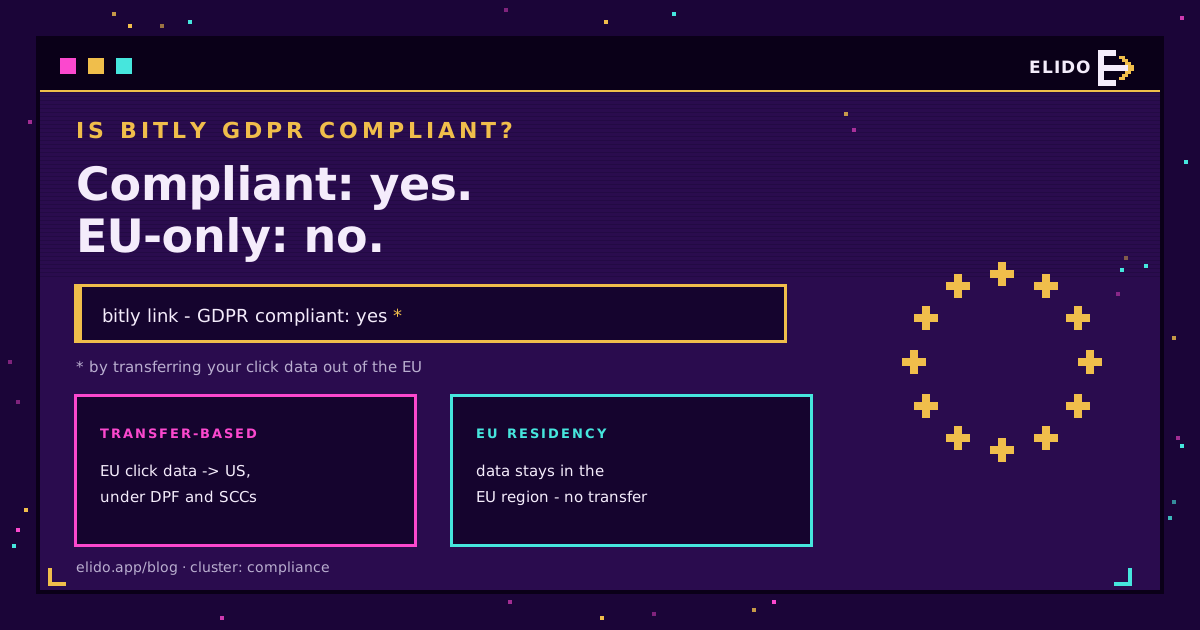
Yes. Bitly is GDPR-compliant in the sense that matters to a procurement checklist: it publishes a Data Processing Agreement, transfers data under Standard Contractual Clauses, holds an active EU-US Data Privacy Framework certification, runs an EU entity in Berlin, and answers data-subject requests under Articles 15 to 21. If the box on your vendor form reads "GDPR compliant: yes/no", the honest answer is yes.
The harder question - the one your DPO asks after the checklist - is where your click data actually lives. Bitly's compliance rests on moving EU personal data to the United States and covering that transfer with a legal instrument. That is lawful today. It is not the same as EU data residency, and for some buyers the gap between those two things decides the contract.
This is a compliance-cluster read, so the article numbers are cited and the sources are linked so you can take them to your own counsel. For the framework behind all of it - what the GDPR asks of any shortener, not just Bitly - the GDPR for URL shorteners cornerstone walks Articles 3, 6, 28, 30, 32, and 35 one at a time.
The Short Answer, and the Asterisk
Bitly has done the compliance work that a serious vendor is expected to do. Reading its privacy policy (accessed 2026-07-17), the machinery is all there:
- A Data Processing Agreement, incorporated into the Terms of Service.
- Standard Contractual Clauses for transfers outside the EEA.
- An active EU-US Data Privacy Framework certification, plus the UK Extension and the Swiss-US Framework.
- An EU establishment: Bitly Europe GmbH in Berlin, with a named data protection officer (DataCo GmbH).
- A data-subject-rights process, split across
[email protected]for US matters and[email protected]for EU matters, covering access, rectification, erasure, restriction, portability, and objection. - A stated retention rule: personal data is erased or anonymised on request, or after three years following the last contact with the data subject, whichever comes first.
None of that is in dispute. A vendor with a DPA, SCCs, a Framework certification, and an EU DPO is not "ignoring the GDPR", and any article that tells you otherwise is selling something. The asterisk is not about whether Bitly complies. It is about how it complies - and the mechanism is transatlantic transfer.
Where Your Bitly Data Actually Goes
Bitly's own structure is the clearest statement of this. Bitly Europe GmbH (Berlin) and Bitly Inc. (New York) are joint controllers under Article 26, bound by a joint-controller agreement. Your account data, and the click data flowing through your links, sit inside that joint arrangement, and the arrangement spans the Atlantic by design.
The privacy policy is explicit: personal data "may be transferred outside the European Union and the European Economic Area, including, but not limited to, the United States of America." Every redirect logs an IP address and a user-agent; both can be personal data on identifiable people. So the click stream a shortener records is in scope, and for Bitly that stream is routed into a US-centred processing model.
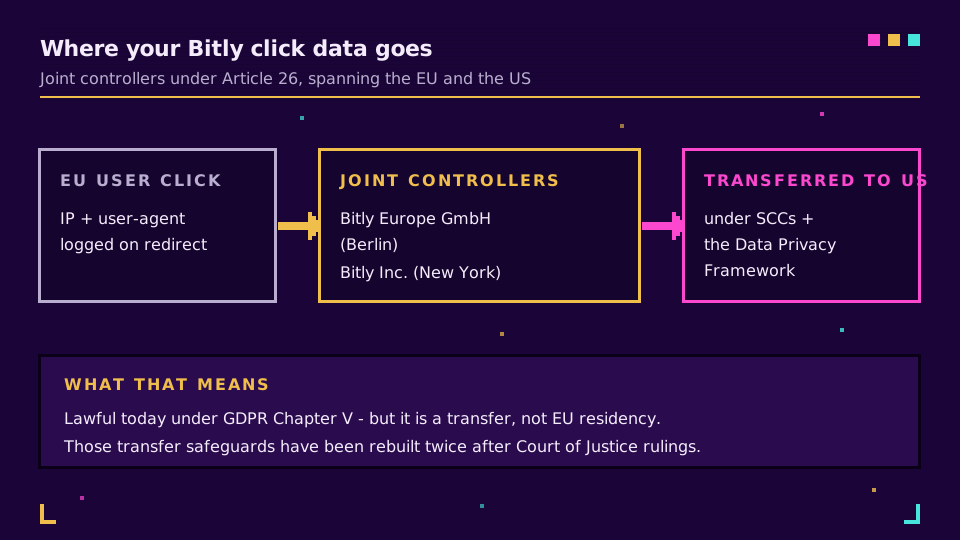
This is lawful. It is also a standing dependency on the legal instruments holding up EU-to-US transfer - and those instruments have a history.
Why "Data Privacy Framework Certified" Is Not the End of It
The transfer safeguards Bitly relies on have been rebuilt twice after the Court of Justice struck them down. Safe Harbour fell in 2015. Privacy Shield fell in Schrems II (CJEU C-311/18, 2020), which also raised the bar for SCCs by requiring a Transfer Impact Assessment for each transfer. The EU-US Data Privacy Framework, adopted by the European Commission in 2023, is the current successor - and the one Bitly is certified under.
Two things follow for a buyer.
First, a certification is a point-in-time claim, not a permanent state. Certifications lapse, get withdrawn, or fall out of compliance. If you are relying on Bitly's Framework status, check that it is still active on the official Data Privacy Framework participant list rather than taking the policy page at its word.
Second, the Framework itself is under legal pressure. Privacy advocates have signalled an intent to challenge it, and a third Schrems judgment is a scenario prudent buyers now plan for. Chapter V of the GDPR - Articles 44 to 49 on international transfers - is the part of the regulation with the least settled ground under it. Building a marketing-attribution stack on the one chapter most likely to move is a risk some organisations accept and others will not.
Compliant Is Not the Same as EU-Only
Here is the distinction that actually decides procurement. "GDPR compliant" and "data stays in the EU" are different claims, and Bitly meets the first without making the second.
For a lot of teams, that is fine. A marketing team shortening links for a public campaign, grounding click analytics in legitimate interest, is well served by a compliant transfer-based vendor. The legal instruments cover them.
It stops being fine when your sector writes residency into the requirement. German public-sector and healthcare data under the social data protection rules, French health data under HDS certification, financial-services data under EBA guidance - these push toward EU-only processing. In those cases a transfer-based posture is not a checkbox, it is an ongoing obligation: you carry the Transfer Impact Assessment, you re-run it when the legal ground shifts, and you document why a US transfer is defensible for personal data you could have kept in the EU. An EU-resident shortener removes that work because there is no transfer to assess.
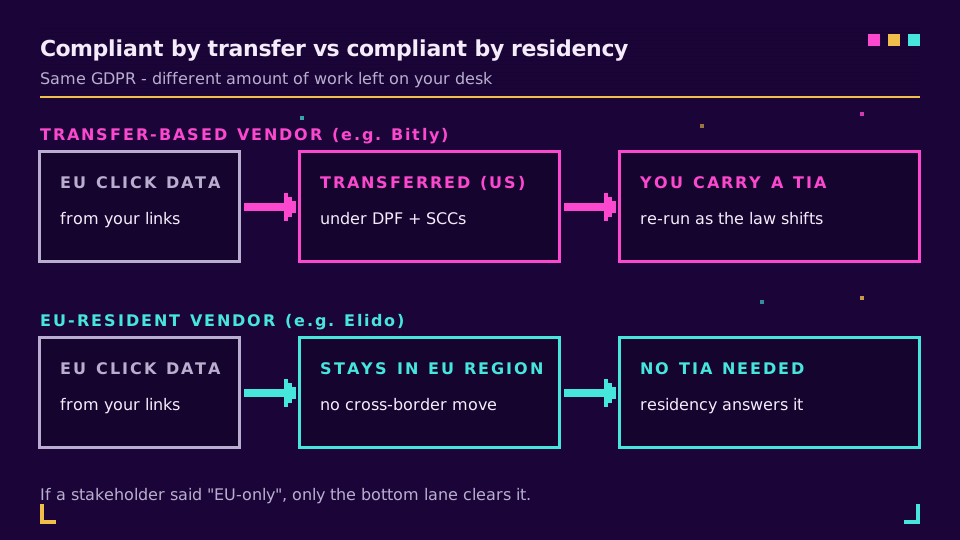
If your requirement is that EU click data never leaves the EU, Elido keeps it in the EU region by default - the residency is contractual and operationally enforced, not a line in a brochure. That is the difference between answering "are we compliant?" and answering "can we prove the data never left?" without a transfer analysis attached.
What to Verify Before You Rely on Bitly
The compliance status is real, so the useful work is narrowing down whether it fits your obligations. Five things to confirm in writing:
- Is your requirement compliance, or is it residency? If any stakeholder has said "EU-only", a Framework certification does not satisfy it. You need a residency commitment instead, and those are different clauses.
- Check the retention default. Bitly's stated rule keeps data up to three years after last contact, so if your controller policy is shorter, that has to be configured rather than assumed.
- Ask for the sub-processor list. A joint-controller structure spanning two continents tends to mean more parties touch the data, and you want to know which of them sit on the click-event path.
- Confirm the Framework certification is active on the government list today, not just referenced in the policy page. Certifications lapse.
- Read the DPA. It is bundled into the Terms of Service, so the sub-processor authorisation model and the erasure SLA are in there rather than in a separate signed document. A DPA that meets Article 28 is the floor, not the ceiling - the cornerstone breaks down what each Article 28(3) clause should say.
For the wider market view of who commits to EU processing and who transfers, the best EU URL shorteners roundup and the deeper EU data residency for marketing piece cover the alternatives. If Bitly's model is the specific thing you are weighing, Elido versus Bitly puts the residency and pricing lines side by side, and the ad interstitials on free Bitly links are a separate reason EU teams have been re-evaluating.
The Bottom Line
Is Bitly GDPR compliant? Yes. It has the DPA, the SCCs, the Data Privacy Framework certification, the EU entity, and the data-subject-rights machinery. Anyone claiming Bitly is flatly non-compliant is wrong.
But "compliant" was never the whole question. Bitly's compliance is built on transferring EU personal data to the United States and covering that transfer with instruments that Chapter V of the GDPR keeps unsettling. If you are a marketer running public campaigns, that is a reasonable trade. If you are in a regulated or sovereignty-conscious seat where EU click data cannot leave the EU, then "compliant via transfer" does not clear your bar - and the fix is not a better DPA, it is a shortener that never makes the transfer in the first place. Decide which seat you are in before you decide the tool.
Read the Cornerstone Series
This sits in the compliance cluster. The cornerstone is GDPR for URL shorteners: what your DPO actually wants to see - start there for the article-by-article framework. For the procurement-facing summary, the trust page and solutions/compliance are the two artefacts to bookmark.
Related on the Blog
- GDPR for URL shorteners: what your DPO actually wants to see
- The best EU URL shorteners, ranked by residency posture
- EU data residency for marketing tools: what your DPO actually asks
- Elido vs Bitly: pricing, features, and EU residency
- Dub vs Bitly: pricing, free plans, and features
- Bitly Assist AI: what it does with your click data
Frequently asked questions
Is Bitly GDPR compliant?
Yes, in the formal sense. Bitly publishes a Data Processing Agreement, transfers data under Standard Contractual Clauses, holds an active EU-US Data Privacy Framework certification, operates an EU entity in Berlin, and honours data-subject requests under Articles 15 to 21. The nuance is that its compliance depends on transferring EU personal data to the United States, which is lawful but is not the same as keeping the data in the EU.
Does Bitly store click data in the EU?
Not by default. Bitly's privacy policy states that personal data may be transferred outside the EU and the EEA, including to the United States, under Standard Contractual Clauses and the Data Privacy Framework. There is no standard EU-only processing commitment in the public terms, so if EU residency is your requirement you have to ask for it specifically.
Does Bitly have a data processing agreement?
Yes. Bitly's DPA is incorporated into its Terms of Service rather than signed as a separate document, and Bitly Europe GmbH and Bitly Inc. act as joint controllers under Article 26 for the data they control. Read the DPA terms directly to confirm the sub-processor authorisation model and the erasure SLA before you rely on them.
Is Bitly certified under the EU-US Data Privacy Framework?
Yes. Bitly has certified to the US Department of Commerce that it adheres to the EU-US Data Privacy Framework Principles, and to the UK Extension and the Swiss-US Framework. You can verify the certification is still active on the official participant list at dataprivacyframework.gov, since certifications can lapse or be withdrawn.
Is Bitly safe for EU companies to use under GDPR?
For general marketing use, yes - the legal instruments are in place. It becomes a harder question when your sector requires EU-only processing (German social data, French health data under HDS, financial services), because a transfer-based posture leaves you carrying a Transfer Impact Assessment that an EU-resident shortener removes entirely.
Try Elido
Paste a URL, get a working short link
No signup. Link lives for 30 days. Sign up to keep it forever.
Free, no signup required · 2 per day