
If you arrived here from a search for "EU URL shortener", you've already made the most important cut in the market. Both Cuttly and Elido hold your link data on European infrastructure. That removes most of the Schrems II paperwork that comes with a US-hosted shortener (Elido's redirect nodes outside the EU still show up in its sub-processor list) - a real differentiator in a market still dominated by US-cloud vendors.
Within the EU-hosted shortener space, where do the two products actually differ, and which fits your team? This post tries to give an honest answer. Cuttly has been running longer than Elido and has a loyal following among EU freelancers, solo marketers, and small teams. It deserves a fair treatment, not a takedown. The goal is to map where each holds up and where each shows its limits.
All Cuttly pricing and plan details referenced below are drawn from the public Cuttly Pro Pricing page. Verify current figures there before using any of this in a procurement conversation. Pricing changes, and I won't pretend otherwise.
TL;DR
- Both Cuttly and Elido store their data in the EU. That shared fact should be the floor, not the ceiling, of your evaluation.
- Cuttly has been in the market since 2019, is bootstrapped and profitable, and has a clean, approachable UX with a genuinely useful free tier (30 new links/month, one custom domain).
- Cuttly's gaps surface at team scale: no published uptime SLA, single-region infrastructure (Gdańsk), no audit log, and no documented SSO path for enterprise procurement conversations.
- Elido's differences are on the controls side: SAML SSO + SCIM at the Business tier, a tamper-evident audit log, and a REST API with an OpenAPI spec. Multi-region edge and database failover are planned, not live, and Elido has no self-hosted edition.
- Free-tier: Cuttly is more generous (30 links/month) than Elido's free tier. For individual use, Cuttly wins on simplicity and cost. For team use past ~10 people, the conversation flips.
- Pricing: Cuttly starts at $12/month (Team plan), enterprise at $149/month. Elido's Pro starts at 3.50 EUR a month (250 links) and Business at 70 EUR a month. Cuttly's free tier is more capable; Elido's entry price is lower, while Cuttly's ~$49 Business plan undercuts Elido's Business.
Cuttly's strengths
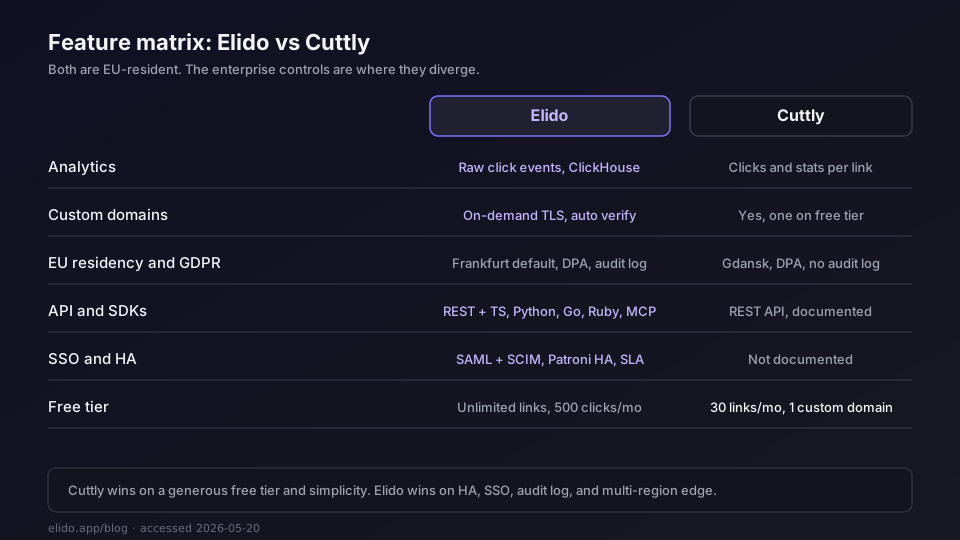
Cuttly is the product it says it is: a clean, EU-resident URL shortener built by a small team in Poland. It has earned its user base honestly.
Start with track record: Cuttly has been running since 2019. In the URL shortener market, longevity is a signal - the operator has survived several rounds of competitors entering and exiting, maintained the infrastructure through EU-wide GDPR enforcement, and stayed profitable as a bootstrapped product. Seven years of uptime is not nothing.
Onboarding is approachable. Cuttly's dashboard is well-designed for the target user: someone who needs to shorten URLs, see click counts, and get on with their day. The UX doesn't ask you to configure a workspace or understand a feature hierarchy before your first link is live. For a solo creator or a two-person marketing team, this simplicity is a genuine advantage.
The free tier is generous too. Cuttly's free plan allows 30 new short links per month and includes one custom domain - one of the most functional free tiers in the market. Most competitors restrict custom domains to paid plans entirely. For a freelancer testing a new branded domain, Cuttly's free tier deserves credit.
QR codes are covered as well. Paid plans include QR generation with logo overlay, colour customisation, and vector export. Well-implemented and available at a lower price point than several competitors.
EU-only infrastructure is a brand promise rather than an add-on. Cuttly is explicit about Gdańsk-based hosting. Not a default-on, opt-in, or enterprise add-on - it is the product's baseline. For teams that want the simplest possible answer to "where is this data?", Cuttly's single-jurisdiction model is straightforward to explain to a DPO.
Elido's wedges
The differences that matter for enterprise or growth-stage teams are mostly about controls, not cosmetics. They surface when your security team runs a vendor review, or when your IT admin needs to deprovision a departing employee at 11pm.
Multi-region edge is planned, not live. Elido does not run a multi-region active-active edge today. Redirects are served by our edge service on a single production host, and multi-region edge locations with nearest-location routing are planned, not live. Cuttly operates from a single location in Gdańsk. For a team whose audience is entirely Polish or Central European, the latency question is negligible either way. The edge redirect architecture document covers how the redirect path is built.
Database availability is a similar story. Elido's production database is a single instance today, with no replicas or automatic failover; high-availability replicas are planned. Cuttly does not publish the details of its database architecture or its recovery time objective either. For a procurement conversation with a finance or healthcare buyer who will ask for uptime commitments and documented RTO/RPO, check both vendors' written answers rather than assuming either has one.
The clearest wedge is SAML SSO with SCIM. Elido ships SAML 2.0 SSO and SCIM user provisioning on the Business tier, which starts at 70 EUR a month. Your identity provider (Okta, Microsoft Entra, Google Workspace) manages the user list; SCIM handles provisioning and deprovisioning automatically. An employee who leaves the company loses access on your IdP deprovisioning event, not on an Elido admin manually closing an account.
Cuttly's enterprise offering does not publicly document an SSO path. At $149/month for the enterprise plan, this is a significant gap. SSO is a standard enterprise procurement requirement, not a differentiator. A team whose IT policy mandates centralised identity management will hit this ceiling on Cuttly before they hit a feature ceiling. The SSO and SCIM features page covers what Elido's Business SSO includes.
Next is the audit log. Elido keeps a tamper-evident audit log of link creation, deletion, destination edits, and team permission changes. For regulated industries (fintech under PSD2, healthcare data stewards, public sector entities subject to audit requirements), the ability to show "user X created link Y pointing to Z at time T, and the destination was modified by user A at time U" is a compliance artefact, not a nice-to-have. Cuttly does not publish an audit log feature at any tier.
Self-hosting is not a differentiator. Neither product has a self-hosted edition; Elido can arrange a deployment in your own infrastructure only under an Enterprise contract. If "vendor holds your data" is itself the problem, neither product fits and YOURLS, Shlink or Kutt are the usual picks.
Developer tooling is the last gap. Elido's REST API is described by an OpenAPI 3.1 spec and works with any HTTP client today. The official Go SDK is published (v0.1.0); the TypeScript, Python and Ruby SDKs are not on their package registries yet. An MCP server for Claude, Cursor, and MCP-aware clients runs hosted and signs in with an API key. Cuttly has a REST API, documented and functional. For a developer integrating link creation into a CI pipeline or a marketing automation workflow, plain HTTP calls work with both. Less a security differentiator, more a developer experience one.
Pricing comparison
| Cuttly | Elido | |
|---|---|---|
| Free | 30 links/mo, 1 custom domain | 25 links, 500 clicks/mo, no custom domain |
| Entry paid | $12/mo (Team plan) | 3.50 EUR/mo (Pro 250) |
| Mid-tier | ~$49/mo (Business) | 70 EUR/mo (Business, includes SSO + SCIM) |
| Enterprise | $149/mo | Custom (contact) |
| EU data residency | Yes (Gdańsk) | EU storage; US/Singapore redirect nodes |
| Multi-region edge | No (single location) | Not yet (planned) |
| HA / SLA | Not published | Single host today; SLA on paid plans |
| SAML SSO | Not documented | Yes, Business tier |
| Audit log | Not available | Yes, Pro+ |
| Self-host | No | Enterprise contract only |
A few notes on the table. Cuttly's free tier is more useful for individual use - 30 links/month is a meaningful allowance. Elido's free tier is more useful for evaluating the analytics platform, since the click analytics work at full resolution, but it caps both sides: 25 links and 500 tracked clicks a month. At the first paid tier, Elido is cheaper (3.50 EUR vs $12). At enterprise, Cuttly's published $149 rate is lower than Elido's custom pricing floor for comparable features, but the comparison gets uneven because Elido's Business plan, from 70 EUR a month, already includes SSO and SCIM that Cuttly's $149 plan does not document.
Who is better off with Cuttly
Individual creators and freelancers who want EU hosting without complexity come first. If you need 30 or fewer links a month, want a custom domain, and the product should just work, Cuttly's free tier is hard to beat in the EU shortener space. There is no compelling reason to pay for a different product at that usage level.
Small EU-based teams fit too, when compliance is about jurisdiction rather than enterprise controls. A 4-person marketing team that needs to satisfy "keep data in the EU" is well-served by Cuttly. No SSO mandate, no audit log requirement - the $12/month Team plan covers this case cleanly.
The same goes for an audience that is entirely EU-based. If your links are clicked predominantly by a Central or Western European audience, the latency difference between Gdańsk and Elido's EU region is not operationally meaningful. Multi-region edge would be overhead rather than a benefit.
Budget-constrained buyers comparing against US-cloud vendors are the last group. If the choice is "Cuttly vs a US-hosted shortener", Cuttly wins on data residency alone. The comparison with Elido is a secondary question.
Who is better off with Elido
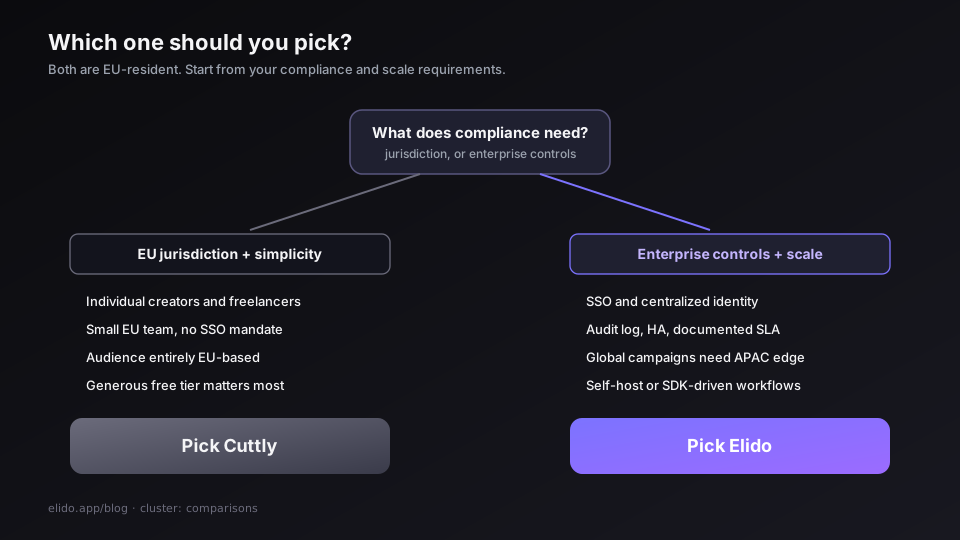
SSO and centralized identity management come first. The single clearest decision signal: if your IT policy mandates SAML SSO for SaaS tools, Cuttly does not have a documented path. Elido's Business plan includes SAML 2.0 and SCIM provisioning. This is not a feature to evaluate; it is a binary requirement.
Global paid acquisition is a weaker case. A performance marketing team targeting APAC audiences cares about redirect latency from the visitor's side of the world. Neither product has a published answer for that today; Elido plans multi-region edge locations but they are not live.
Regulated-industry buyers who need audit trails are a strong fit. Fintech, healthcare, and public sector procurement teams will ask for an audit log, a documented HA architecture, and an uptime SLA. Elido has the audit log and an SLA on its paid plans; HA replicas are planned. Cuttly publishes none of the three at the time of writing.
Developer-driven link management works too. If link creation is in your CI pipeline, your automation toolchain, or your LLM-assisted workflow, Elido's REST API covers it today. A typed Go SDK is published, the hosted MCP server works with an API key, and the TypeScript SDK is not on npm yet.
Self-host requirements are the exception. If your regulatory environment requires that the short-link platform runs on your own infrastructure, Cuttly doesn't cover it, and Elido only does under an Enterprise contract. The self-hosted URL shorteners comparison lists the open-source options.
Migration: moving from Cuttly to Elido
Migration from Cuttly covers three concerns: link data, custom domain DNS, and team handover.
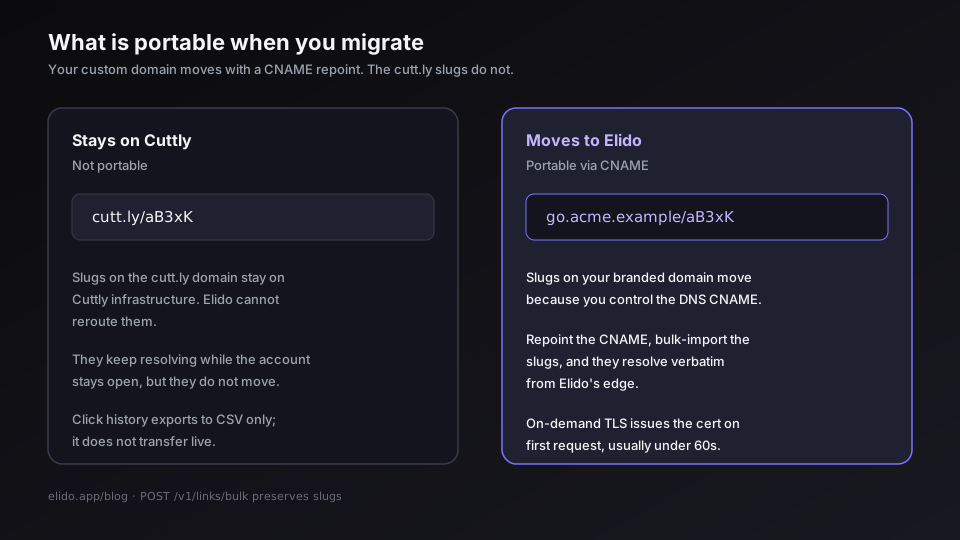
Start with the link export. Cuttly allows exporting your link library as CSV from the account settings. The export includes the short slug, the destination URL, tags, and creation date. Elido's bulk import endpoint at /v1/workspaces/{workspace_id}/links/bulk accepts slug and destination from this CSV and preserves the slugs verbatim, so existing short links continue to resolve on your domain without a grace-period redirect chain.
Then the custom domain DNS handover. If you have a branded domain pointed at Cuttly's infrastructure, the handover sequence is: lower the CNAME TTL to 60 seconds the day before the switch, register the domain in your Elido workspace, and repoint the CNAME once Elido has issued a certificate for it. Elido uses automatic on-demand TLS: the certificate provisions on first request after DNS propagation, which typically takes under 60 seconds. The old Cuttly endpoint continues resolving for your existing links until DNS has fully propagated - there is no window where both fail.
Historic click data stays behind. Click history from Cuttly does not transfer to Elido. Analytics from migration day forward accumulate in Elido's analytics store. Export your Cuttly analytics reports before closing the account if historical click data matters for reporting or attribution comparisons.
Finally, the team cutover. Plan for a one-week overlap where both accounts stay active. New links go into Elido from day one; existing Cuttly links continue to resolve until DNS propagates fully. A 30-minute walkthrough of the Elido workspace before cutover is enough to orient a typical marketing team. For fewer than a thousand links, the full migration is a half-day exercise; for multiple custom domains, budget one day.
FAQ
Is Cuttly really GDPR compliant?
Cuttly's infrastructure is in Gdańsk, Poland - EU jurisdiction, subject to Polish DPA supervision (UODO). This means personal data processed through Cuttly (IP addresses, click metadata) stays within the EEA by default. Both Cuttly and Elido offer Data Processing Agreements covering Article 28 obligations; Elido's is available on request on every plan, including Free. For teams that run a Transfer Impact Assessment on every US-cloud vendor, both products take most of that work off the table, though Elido's non-EU redirect nodes and sub-processors still belong in the assessment. The compliance difference between the two products is not about jurisdiction - both are EU - it's about enterprise controls: audit log, SSO, and documented SLA.
Does Cuttly have an API?
Yes. Cuttly ships a REST API that covers link creation, stats retrieval, and account management. It is documented and functional. Elido's API is also REST, described by an OpenAPI 3.1 spec. Of the official SDKs only Go is published; the other SDKs, the MCP server and a Terraform provider are not on their registries yet, so today both are mostly used through plain HTTP calls.
What happens to old Cuttly links after migrating to Elido?
Links minted on Cuttly's cutt.ly domain remain on Cuttly's infrastructure - Elido has no ability to reroute cutt.ly slugs. Links minted on your custom branded domain (e.g., go.acme.example) can be migrated because you control the DNS CNAME. After repointing the CNAME, those slugs resolve from Elido's edge. The cutt.ly short links that don't use your custom domain will continue resolving from Cuttly for as long as you maintain that account, but they are not portable.
Does Elido's edge complicate EU data residency?
Somewhat. Elido's primary database, analytics store and backups are in the EU, and click rows are stored there with the visitor IP truncated at the edge. But the legal pages disclose redirect nodes in the US and Singapore that process visitor requests, and per-workspace region pinning is not available on any plan yet (planned). For teams where EU-only processing is the hard requirement, Cuttly's single-location model is the simpler answer. See the trust page for the current sub-processor list.
Can I use Elido and Cuttly simultaneously during a migration?
Yes, and it is the recommended path. Keep your existing Cuttly account active, register the same branded domain in Elido, and repoint the CNAME once the Elido certificate is issued. Both platforms serve the correct destination for any slug that exists in both systems during the propagation window. Mint new links in Elido from day one of the overlap period so the team builds habits on the new platform while the old links settle.
Related on the blog
- Best EU URL shorteners: a 2026 comparison
- EU data residency for marketing tools: what your DPO actually asks
- GDPR for URL shorteners: what "compliant" actually means
- SCIM and SSO for marketing tools: what enterprise IT actually asks
- Edge redirect architecture: how Elido gets p95 under 15ms
- Cutt.ly alternatives: 6 better URL shorteners to try
Frequently asked questions
Is Cuttly really GDPR compliant?
Cuttly's infrastructure is in Gdansk, Poland - EU jurisdiction, subject to Polish DPA supervision. This means personal data processed through Cuttly, such as IP addresses and click metadata, stays within the EEA by default. Both Cuttly and Elido offer Data Processing Agreements covering Article 28 obligations; Elido's is available on request on every plan, including Free. The compliance difference between the two products is not about jurisdiction - both are EU - it is about enterprise controls: audit log, SSO, and documented SLA.
Does Cuttly have an API?
Yes. Cuttly ships a REST API that covers link creation, stats retrieval, and account management. It is documented and functional. Elido's API is also REST, described by an OpenAPI 3.1 spec. Of the official SDKs only Go is published; the other SDKs, the MCP server and a Terraform provider are not on their registries yet, so today both are mostly used through plain HTTP calls.
What happens to old Cuttly links after migrating to Elido?
Links minted on Cuttly's cutt.ly domain remain on Cuttly's infrastructure - Elido has no ability to reroute cutt.ly slugs. Links minted on your custom branded domain can be migrated because you control the DNS CNAME. After repointing the CNAME, those slugs resolve from Elido's edge. The cutt.ly short links that do not use your custom domain will continue resolving from Cuttly for as long as you maintain that account, but they are not portable.
Does Elido's edge complicate EU data residency?
Somewhat. Elido's primary database, analytics store and backups are in the EU, and click rows are stored there with the visitor IP truncated at the edge. But the legal pages disclose redirect nodes in the US and Singapore that process visitor requests, and per-workspace region pinning is not available on any plan yet (planned). For teams where EU-only processing is the hard requirement, Cuttly's single-location model is the simpler answer.
Can I use Elido and Cuttly simultaneously during a migration?
Yes, and it is the recommended path. Keep your existing Cuttly account active, register the same branded domain in Elido, and repoint the CNAME once the Elido certificate is issued. Both platforms serve the correct destination for any slug that exists in both systems during the propagation window. Mint new links in Elido from day one of the overlap period so the team builds habits on the new platform while the old links settle.
Try Elido
Paste a URL, get a working short link
No signup. Link lives for 30 days. Sign up to keep it forever.
Free account required. The free plan includes 25 links in total. Already have an account? Log in