
Bitly Enterprise is the dominant shortener in the Fortune-500 marketing stack for a reason. It ships inside Salesforce Marketing Cloud and Adobe Experience Manager natively, it has been the answer to "what link shortener do we use?" at large US organizations for a decade, and it clears a procurement review at most US companies without friction. Vendor familiarity is a real advantage, and this post will not pretend otherwise.
What has changed is the set of questions a procurement or VP-Marketing team asks in 2026. EU data residency requirements are no longer a fringe concern - they show up on standard procurement checklists at European organizations, public sector contractors, and any company with meaningful exposure to German, French, or Dutch regulatory environments. SSO via SAML has become an IT-standard prerequisite, not an enterprise add-on. And a category of buyers - govtech, regulated fintech, on-premise infrastructure shops - has developed a hard requirement for vendor independence that Bitly's SaaS-only model structurally cannot satisfy.
This post maps the buying decision for a reader who already understands URL shorteners and needs to make a defensible choice at the vendor selection stage.
All Bitly numbers are from bitly.com/pages/pricing accessed 2026-05-06. Verify against the live page before presenting any figure to procurement - Bitly's pricing has shifted at least once in the past 12 months.
Who Bitly Enterprise is built for
Bitly's enterprise motion is calibrated for large US-headquartered marketing organizations with established procurement processes. The strengths are specific and real.
Integration depth with US marketing stacks comes first. Native integrations cover Salesforce, HubSpot and Slack, plus Adobe Experience Manager. For an organization whose marketing operations already run on these platforms, a Bitly link is how you track campaign performance end-to-end without standing up a custom integration. The Zapier connector and the Salesforce package have been production-hardened over years; they are not beta-quality integrations.
Then there is brand recognition in procurement cycles. When a Fortune-500 marketing team submits a vendor request, "Bitly" clears procurement review faster than an unfamiliar name. Security teams have existing assessments on file. Legal teams have reviewed the DPA. For organizations that value procurement velocity over marginal feature differences, this is a legitimate argument for staying.
The established Branded Short Units model works at scale. Bitly's BSU-based pricing model (where each link, QR code, or smart link is one BSU, counted against a monthly allowance) is predictable for organizations that mint a stable number of high-traffic links. A brand that runs 200 campaign links a quarter and drives millions of clicks through them pays a fixed cost; the model is efficient for that profile.
Finally, the mobile app and browser extension are mature. The iOS and Android apps are production-quality and widely adopted in marketing teams that need to shorten links outside a desktop workflow. The browser extension has years of iteration behind it.
Where Elido wins on an enterprise evaluation
EU data storage, by default. Elido keeps its primary database, analytics store and backups in the EU. Redirect nodes in the US and Singapore still process visitor requests, and per-workspace region pinning is not available yet (planned). The sub-processor list has 13 entries, published on the trust page. A DPA with Article 28 obligations and EU SCCs is available on request on every plan; it is not pre-signed. Elido is not ISO 27001 certified, and SOC 2 is in preparation with no report yet.
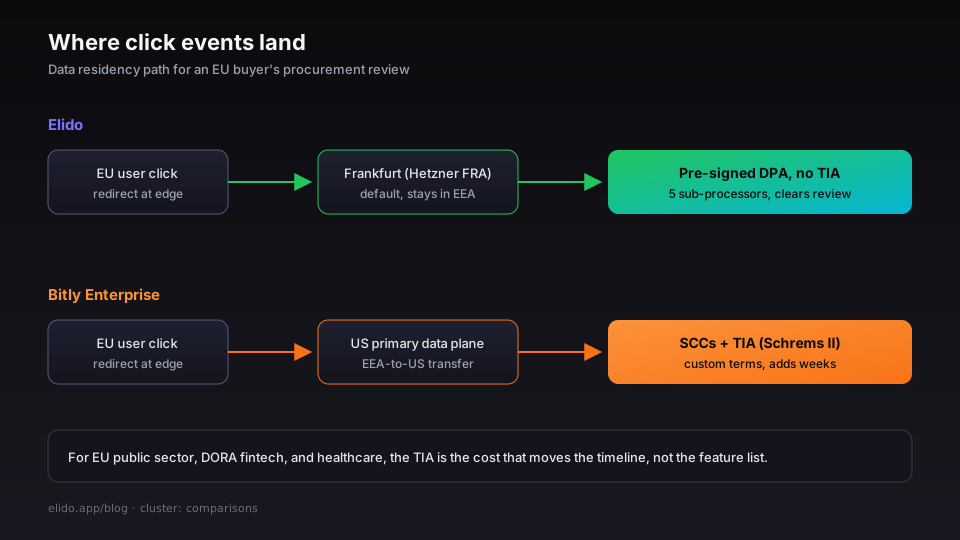
The primary Bitly data plane is US-based. Their DPA supports Standard Contractual Clauses for EEA-to-US transfers, but SCC-based transfers to the US still require a Transfer Impact Assessment under the Schrems II framework for regulated-industry buyers. For EU public sector, fintech under DORA, and healthcare organizations, that TIA adds weeks to the procurement cycle and frequently requires custom contractual terms that Bitly's standard contract does not include.
SSO on Business, not Enterprise. As of May 2026, Bitly's public pricing page lists SSO logins as an Enterprise-tier feature only - Enterprise is custom-priced and requires a sales conversation. The previously noted $200/month SSO add-on is not confirmed on the current public pricing page; that figure was from an earlier competitive review and should be treated as unverified. Elido ships SAML/OIDC SSO via WorkOS on the Business plan at a published price. For a 50-person marketing team that has an IT policy requiring SSO for all SaaS tools, the SSO tier placement alone changes the vendor math substantially.
Self-host option. There's no self-hosted deployment path for Bitly. For organizations in regulated industries - government contractors, hospitals, financial institutions - that prohibit third-party SaaS for link infrastructure, Bitly is structurally out. Elido has no self-hosted edition either; a deployment in your own infrastructure is possible only under an Enterprise contract ([email protected]). Dub.co offers an open-source version but without an enterprise-grade SLA offering. See /en/solutions/agencies for the deployment overview.
Audit log and SCIM. Elido's audit log records every link creation, edit, deletion, and member action with timestamp, actor identity, and before/after state - available on Business and up. SCIM provisioning means deprovisioning a user in Okta or Azure AD automatically removes them from all Elido workspaces. Bitly's audit log availability at enterprise tier is limited; SCIM is not publicly documented on any Bitly plan page as of the 2026-05-06 review.
SDK and MCP integration. Elido's TypeScript, Python, Ruby, and Go SDKs are built against the OpenAPI 3.1 spec; the Go SDK is published (github.com/elidoapp/elido-go), and the other three are not on their registries yet. An MCP server connects Elido to Claude, Cursor, and any MCP-aware AI client, currently in beta and built from source. Until the other SDKs are public, the REST API, the Go SDK and the MCP server are what you can use today. In April 2026 Bitly launched its own MCP server, so the parity here is closer than it was.
Transparent pricing with a published ceiling. Tier pricing for Elido is on the public pricing page. Enterprise is custom, but the Business plan ceiling is published. Enterprise pricing at Bitly is entirely off-page and negotiated. For procurement teams that need a quick internal estimate before engaging a vendor, opaque pricing adds friction.
Side-by-side comparison
| Dimension | Bitly Enterprise | Elido Business / Enterprise |
|---|---|---|
| Data residency | US primary; SCCs for EU transfers | Database and analytics store in the EU; redirect nodes in US and Singapore; no per-workspace pinning yet |
| SSO (SAML/OIDC) | Enterprise tier only (custom pricing; no public add-on price confirmed) | Included in Business plan |
| SCIM provisioning | Not publicly documented on any plan page | Yes, Business+ |
| Audit log | Activity Log; Enterprise tier | Full, Business+ |
| Custom domains | Yes, with on-demand TLS | Yes; wildcard support on Business; automatic on-demand TLS |
| Branded portal (white-label) | No | Yes, Pro+ |
| Analytics depth | Geo, device, OS; scheduled reports | columnar analytics store; click retention by plan (90 days to 2 years); click events to GA4, Mixpanel |
| Price floor for SSO | Enterprise (custom; no published price floor) | Business plan; see pricing page |
| Self-host | No | No edition; Enterprise contract only |
| Native Salesforce / Adobe | Yes (native connectors) | API + Zapier; native Salesforce connector not yet shipped |
| MCP server | Yes (launched Apr 2026) | Yes (beta, built from source) |
| SDK coverage | REST API, limited official SDKs | REST API; Go SDK published, TypeScript, Python, Ruby coming soon; OpenAPI 3.1 spec |
| Mobile app | iOS + Android (mature) | iOS + Android (Phase 11, 2026) |
Bitly pricing figures sourced from bitly.com/pages/pricing (2026-05-06). Verify before quoting to procurement.
When Bitly Enterprise is the right call
Pick Bitly Enterprise when the following conditions describe your organization.
Your marketing stack is deeply integrated with Salesforce Marketing Cloud or Adobe Experience Manager. The native connectors are the strongest argument for Bitly. If your marketing automation runs through SFMC and your campaign link creation is embedded in that workflow, a custom Elido API integration is real engineering work. On paper Elido's API is more capable, but "more capable" is only useful if you have bandwidth to implement it. If you do not, the Bitly native connector is worth its cost.
You are a US-headquartered organization with no EU data residency requirement. Data residency isn't a problem with Bitly if your procurement team isn't asking about it. For US-only organizations with no meaningful EU data exposure, the residency argument for Elido is irrelevant. Choose on features and integration fit.
Brand recognition in procurement is a hard constraint. Some enterprise procurement processes require a vendor to be on a pre-approved list. If Bitly is on that list and Elido is not, that is a real operational constraint, not a feature comparison.
The link profile is a small, stable set of high-traffic links. Bitly's BSU model is efficient when your team mints 100-300 links per quarter and drives high aggregate click volume through them. At that link-creation cadence, BSU ceilings are not the constraint. For the reverse profile - many short-lived campaign links - Elido's per-click billing is the more predictable model, as explored in the pricing-first comparison.
When Elido is the right call
The clearest decision signal is an EU data residency requirement in your buyer's procurement checklist. If your legal team will require a Transfer Impact Assessment for a US-hosted sub-processor, Bitly adds weeks to the procurement cycle and may not pass. Elido's EU-stored database, DPA on request, and published sub-processor list are designed to clear EU procurement reviews with little custom negotiation.
Your IT policy requires SSO for all SaaS tools and your budget is not enterprise-tier. If you're a 20-100 person organization with an IT-security requirement for SAML SSO but not a Fortune-500 budget, Bitly's SSO gating behind its custom-priced Enterprise plan puts it out of reach for most SMBs. SSO comes with the Elido Business plan tier at a published price.
You are in a regulated industry that requires self-hosted deployment. Government contractors, healthcare organizations under HIPAA, and financial institutions under data-sovereignty policies cannot use Bitly. Elido has no self-hosted edition either; a deployment in your own infrastructure is a custom Enterprise contract, so ask about that route before ruling it out.
Then there is the engineering team that needs programmatic link infrastructure. If link creation runs from CI pipelines, internal tools, or AI assistants, Elido's REST API and MCP server (beta) cover it today, the Go SDK is already published, and the other SDKs follow with their public release. The MCP integration means a marketing engineer using Claude or Cursor can query link stats, create campaign links, and list workspaces without leaving their AI workflow.
You want a published price ceiling before negotiating. The Business tier price sits on the Elido pricing page. If your internal approval process requires a quote with a number before you can engage a vendor, starting with Elido removes an early-cycle friction.
Migration considerations
If you are moving from Bitly to Elido, the mechanics are covered in detail in the migration playbook. The short version: Bitly's export (CSV from the dashboard or via the API) includes slugs, destination URLs, creation dates, and tags. On the Elido side, the bulk import endpoint at /v1/links/bulk accepts the original slugs verbatim, preserving your existing short URLs as long as you repoint the CNAME on your branded domain to Elido's edge before running the import.
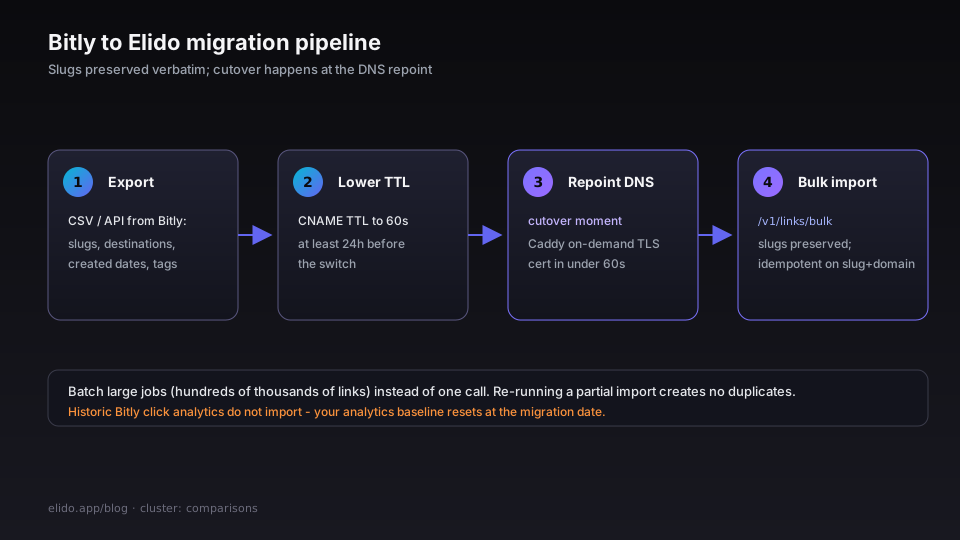
The DNS repoint is the moment of cutover. Lower your branded domain's CNAME TTL to 60 seconds at least 24 hours before the switch. Automatic on-demand TLS then provisions a certificate in under 60 seconds on first request after DNS propagates. Historic click analytics from Bitly don't import. Your analytics baseline resets at the migration date.
For large deployments migrating hundreds of thousands of links, plan a batch import rather than a single bulk call. The endpoint is idempotent on slug plus domain. Re-running a partially completed import won't create duplicates.
I'd still rehearse with a small batch first.
Where the decision actually pivots
Two conditions drive the outcome for most enterprise evaluations.
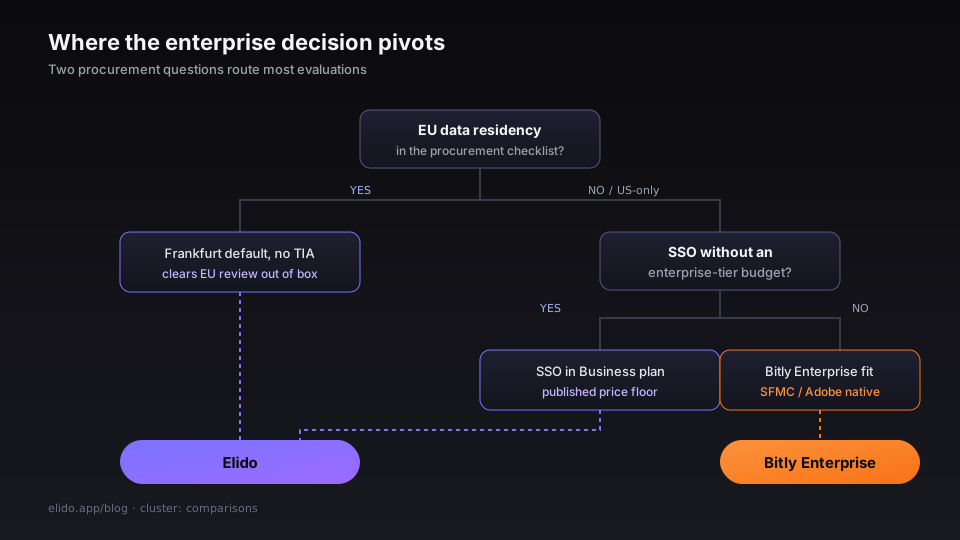
The first is EU data residency. If your procurement checklist has a contractual data residency clause, Bitly requires a TIA conversation and custom contract terms. Elido stores data in the EU, but it does not promise EU-only processing, so read the trust page against your clause. If your organization has no residency requirement, this entire section is irrelevant to your decision.
The second is SSO pricing tier. SAML SSO is now standard IT security policy for any organization running SaaS at scale. The question is which platform puts SSO at a price point that aligns with your team's size. Bitly gates SSO behind its Enterprise plan (custom pricing, sales-led), which effectively requires a Fortune-500 budget; Elido's placement in Business tier changes the accessible pool of buyers.
In short, Bitly Enterprise is a mature, well-integrated product with real strengths for US enterprise marketing stacks. It is not the right answer for every EU-regulated buyer or for organizations that want SSO without an enterprise-tier budget. Elido is built for the SSO and EU-storage constraints, and is a weaker answer for teams that need deep Salesforce or Adobe native connectivity today.
See /en/pricing for current Elido tier numbers, and /en/solutions/agencies for the deployment and white-label overview.
Bitly's 2026 repositioning and AI layer
Bitly spent early 2026 repositioning as an "embedded connection layer" and shipping Bitly Assist, an AI chat over click data. For an enterprise evaluation the AI feature is the one to probe: where Bitly Assist processes EU click data, and whether it appears in the DPA and sub-processor list. The platform remains US-based, so the residency and procurement points above still decide the call.
Related on the blog
Try Elido
Paste a URL, get a working short link
No signup. Link lives for 30 days. Sign up to keep it forever.
No signup needed. Sign up free for 50 links a month.