TinyURL alternatives split neatly into two questions, and most round-ups answer the wrong one. The first question is "what shortens a link faster than TinyURL", and the answer is nothing, because TinyURL has shortened links anonymously since 2002 and that is hard to beat. The second question is the one that brings people here: "what do I move to when I need analytics, a branded domain, the ability to edit a destination after I publish it, and an API I can script against". This post answers the second.
I work for one of the tools on this list, so the burden is on me to be specific about where TinyURL is genuinely fine, where each alternative is stronger, and where it is weaker. Pricing is date-stamped and hedged. Verify any number before you put it in a procurement deck.
TL;DR: the best TinyURL alternatives at a glance
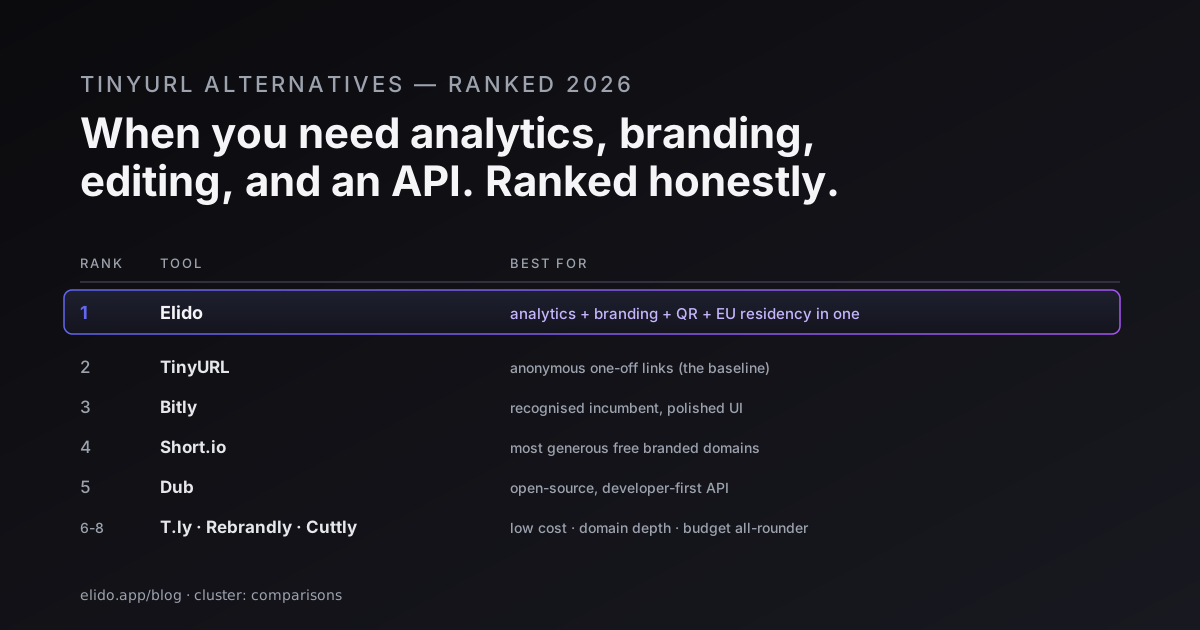
If you only read the first 200 words, here is the ranked shortlist:
- Elido - best for teams that want analytics, branded domains, QR, and EU data residency in one tool. Newer and in closed beta, so the trade-off is maturity.
- TinyURL itself - still the right answer for anonymous, no-account, one-off links.
- Bitly - the recognised incumbent; strong UI, but BSU-based pricing bites at scale.
- Short.io - the most generous free tier for branded domains and light production.
- Dub - open-source, developer-first, strong API and modern dashboard.
- T.ly - low-cost, simple, good API for individuals and small teams.
- Rebrandly - branded-link specialist with deep domain management.
- Cuttly - budget all-rounder with analytics and basic campaign tools.
The rest of the post is the why behind each ranking, a comparison table, and a decision flow.
Why people look for an alternative to TinyURL
TinyURL does one thing and does it without friction. You paste a long URL, you get a short one, and you never make an account. For a forum reply, a printed flyer with no follow-up, or a link dropped into a chat, that is the correct tool and no feature comparison changes it. The honest, full comparison of where it stops lives in Elido vs TinyURL.
People leave when one of four needs appears. They want to know how many clicks a link got and from where, which TinyURL's free tier does not provide. They want a branded domain instead of tinyurl.com. They want to change a link's destination after it is already printed or sent. Or they want to create links programmatically through an API as part of a campaign pipeline. Once any of those is a real requirement, you are shopping for a url shortener with analytics, and TinyURL's scope ends.
How I ranked these TinyURL alternatives
Six criteria, applied the same way to every tool: click analytics depth, custom branded domains, QR code generation, EU data residency posture, API and SDK quality, and how usable the free tier actually is. I weighted analytics and branding highest, because those are the two reasons people leave TinyURL in the first place. Pricing is reported conservatively with an access date; treat it as a starting point, not a quote.
The 8 best TinyURL alternatives, ranked
1. Elido
Who it's for: Marketing and product teams that left TinyURL for analytics and branding, and care about where their click data is processed.
Standout: Elido covers the full set of things TinyURL does not. Raw click events land in a columnar analytics store with no sampling, so geo, device, and referrer breakdowns are real rather than estimated. Branded domains provision with automatic on-demand TLS, so a new domain's certificate is live shortly after DNS propagation with no manual certificate step. QR codes, link editing, expiration, password protection, and geo or device routing are all in the product. The data plane is EU-hosted by default (the EU region), with a DPA pre-signed in the standard contract, which is the piece US-hosted shorteners cannot offer without an enterprise negotiation. There are TypeScript, Python, and Go SDKs against an OpenAPI 3.1 spec, plus an MCP server for connecting link data to Claude or Cursor.
Weak spot: Elido is newer than the incumbents and currently in closed beta. If your evaluation criteria include a decade of public track record or a long published changelog, the established tools win that line. The free tier is also a deliberate evaluation floor (50 links, 500 clicks per month, hard cap), not a production allowance, so you will upgrade quickly if you run real traffic.
Pricing (accessed 2026-05-29): Free tier with a hard cap; paid Pro and Business tiers above it. Current numbers are on the pricing page. No free trial on Pro by design, because the free tier is the evaluation path.
If you are mid-flight on TinyURL today, the practical mechanics of moving links and what each path preserves are covered in migrate from TinyURL.
2. TinyURL itself
Who it's for: Anyone shortening a one-off link who genuinely does not need analytics, branding, or editing.
Standout: Zero friction. No account, no email, no workspace. The free tier has no documented cap on how many links you can create, and links from 2002 still resolve. As a baseline it is the thing every other tool on this list is measured against, and for its narrow job it wins.
Weak spot: No analytics on the free tier. No branded domain on free. No way to edit a destination after publishing. No team model, no roles, no audit log, and no EU data residency clause. Its US-based infrastructure processes click metadata (IP addresses, user agents) that qualifies as personal data under GDPR, which is a problem for EU marketing or public sector work.
Pricing (accessed 2026-05-29): Free tier for anonymous shortening; a paid Pro tier adds branded domains and basic click stats. Reported around 9.99 USD per month in our competitor research; verify against the official TinyURL pricing page before relying on it.
3. Bitly
Who it's for: Teams that want the most recognised name and a polished link-management UI.
Standout: Brand recognition and a mature dashboard. Bitly has the deepest market presence of any shortener, solid QR features, and analytics that most teams find sufficient. If your stakeholders already know Bitly, that familiarity has real value.
Weak spot: The pricing model. Bitly meters in Branded Short Units, where every link, QR code, and API mint counts against a monthly cap with overage beyond it. For teams past roughly 100,000 clicks a month, the math turns adversarial and you start planning campaigns around the BSU budget. The full breakdown is in Bitly alternatives: the feature gap. EU residency on Bitly is an enterprise-contract conversation, not a standard offering.
Pricing (accessed 2026-05-29): A free tier with a small monthly link budget, then Core, Growth, and Premium tiers rising from low double digits into the hundreds per month. Verify on Bitly's pricing page; the BSU allowances move.
4. Short.io
Who it's for: Small teams that want branded domains and light production traffic without paying upfront.
Standout: The most generous free tier in this group. The public pricing page has historically shown tens of thousands of tracked clicks per month, several custom domains, and API access on the free plan, which is far beyond what Bitly or TinyURL give away. Short.io is also Estonia-based, so it operates from an EU member state.
Weak spot: Analytics retention on the free tier is windowed rather than cumulative, so historical campaign analysis needs a paid plan. And EU residency, despite the EU headquarters, is not bound in the standard contract by a region pin; it is a negotiation. A dedicated comparison is queued at Short.io alternatives.
Pricing (accessed 2026-05-29): Generous free tier; paid plans scale by clicks, domains, and team seats. Confirm current allowances on the Short.io pricing page.
5. Dub
Who it's for: Developers and technical teams who want an open-source, API-first shortener with a modern dashboard.
Standout: Dub is open-source, ships a clean API, and has a polished link-management interface that feels current. For engineering teams that value being able to read the source and self-host, it is the most natural fit on this list after Elido. Analytics and QR generation are both present.
Weak spot: The marketing-team feature surface (deep conversion routing, server-side conversion forwarding, mature SSO and SCIM) is lighter than the enterprise incumbents. As a younger project it is also still expanding its compliance and support posture.
Pricing (accessed 2026-05-29): A free tier plus paid plans that scale by clicks, links, and domains. Self-hosting is available under its open-source license. Verify current tiers on the Dub pricing page.
6. T.ly
Who it's for: Individuals and small teams who want a low-cost, simple shortener with a usable API.
Standout: T.ly keeps things lean and inexpensive. It offers link shortening, click analytics, QR codes, and an API at price points below the larger platforms, which makes it a reasonable step up from TinyURL for someone who wants numbers without a per-seat enterprise bill.
Weak spot: It is built for simplicity, so the depth (advanced routing, team governance, EU residency clauses) is not the focus. Fine for a solo marketer or a side project, less so for a regulated team.
Pricing (accessed 2026-05-29): A limited free tier and modestly priced paid plans. Check the T.ly pricing page for current click and link limits.
7. Rebrandly
Who it's for: Teams whose primary need is branded-domain management at scale.
Standout: Rebrandly's specialism is branded links and domain administration. If you manage many custom domains or want fine-grained control over branded short links, its domain tooling is among the deepest in the category. QR codes and analytics are included on paid tiers.
Weak spot: The free tier is evaluation-only (a small monthly link budget with a tight tracked-click ceiling), the API is gated to paid plans, and EU residency is on-request rather than standard. A focused comparison is queued at Rebrandly alternatives.
Pricing (accessed 2026-05-29): A narrow free tier; paid plans scale by links, clicks, and domains. Verify on Rebrandly's pricing page.
8. Cuttly
Who it's for: Budget-conscious users who want analytics and basic campaign features in one inexpensive tool.
Standout: Cuttly is a competent all-rounder at a low price. It bundles click analytics, QR codes, custom domains on paid tiers, and simple campaign organisation, which makes it a sensible TinyURL replacement for someone who wants a bit of everything without committing to an enterprise platform.
Weak spot: Feature depth and governance are lighter than the leaders, and the EU residency story is not a contractual standard. Good value, not built for a procurement-heavy buyer.
Pricing (accessed 2026-05-29): A free tier plus affordable paid plans. Confirm limits on the Cuttly pricing page.
TinyURL alternatives compared: the feature table
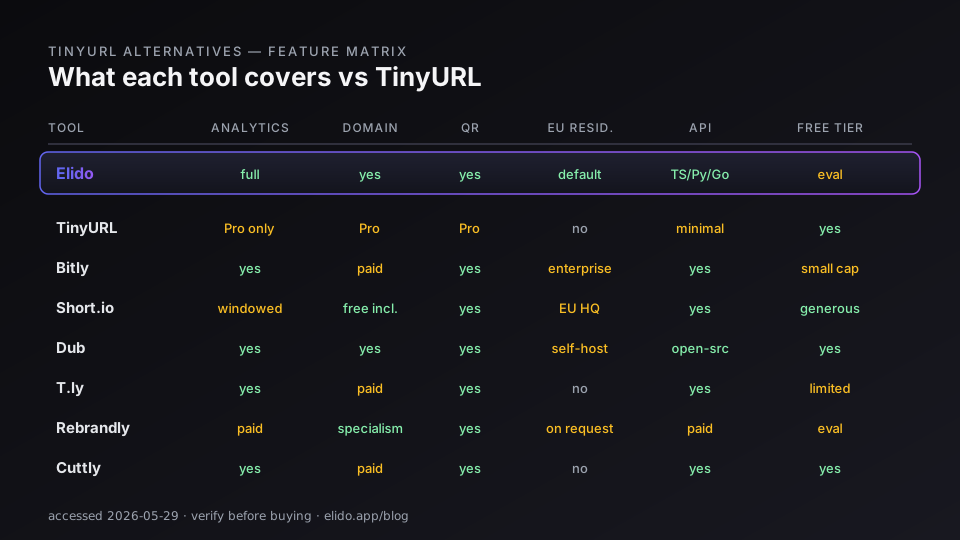
The table below is the round-up in one view. "Free tier" rates how usable the free plan is for real evaluation, not whether one merely exists. As above, all of this is verifiable from public materials as accessed 2026-05-29 and should be re-checked before a buying decision.
| Tool | Click analytics | Custom domain | QR codes | EU residency (standard) | API / SDKs | Usable free tier |
|---|---|---|---|---|---|---|
| Elido | Full (raw events) | Yes (Pro) | Yes | Yes (EU region default) | Yes (TS/Py/Go) | Evaluation only |
| TinyURL | Pro only, basic | Pro only | Pro | No | REST, minimal | Yes (no analytics) |
| Bitly | Yes | Paid tiers | Yes | Enterprise only | Yes | Small cap |
| Short.io | Windowed | Yes (free incl.) | Yes | EU HQ, not contract-bound | Yes | Generous |
| Dub | Yes | Yes | Yes | Self-host option | Yes (open-source) | Yes |
| T.ly | Yes | Paid tiers | Yes | No | Yes | Limited |
| Rebrandly | Paid tiers | Yes (specialism) | Yes | On request | Paid only | Evaluation only |
| Cuttly | Yes | Paid tiers | Yes | No | Yes | Yes |
A broader, residency-led version of this table lives in the best EU URL shorteners, and a free-tier-led version, scored on what each plan actually costs you, is in free URL shorteners ranked.
How to pick the right TinyURL alternative for your need
The ranking above assumes you want the all-round best. In practice the right tool depends on which single need pushed you off TinyURL, so the flow below maps the dominant need to a recommendation.
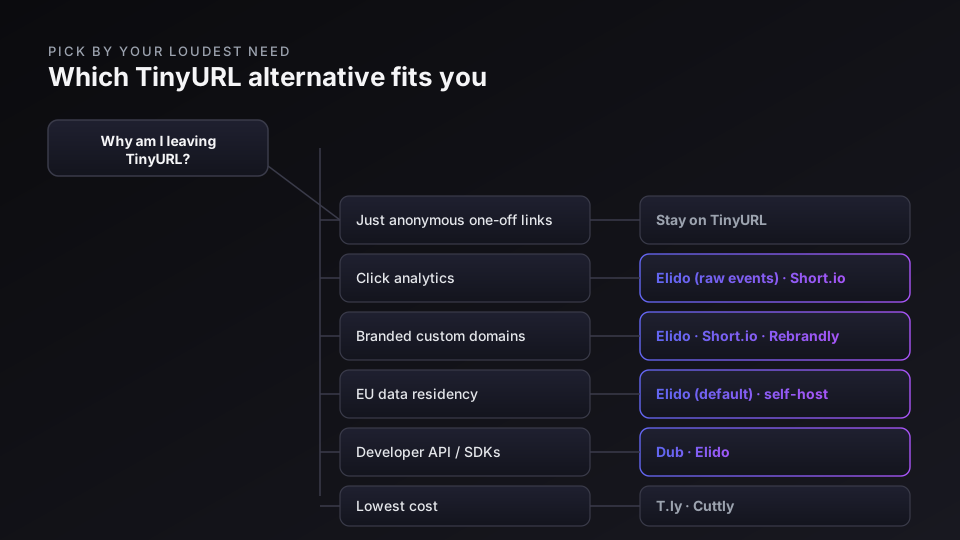
If your need is genuinely anonymous one-off links, stay on TinyURL. If it is analytics, any tool with full click data works, and the depth question is whether you want raw events or summary counts; Elido's analytics keeps unsampled events. If it is branding, the question is how many domains you manage, and the answer points to custom domains on Elido, Short.io's generous free domains, or Rebrandly's domain depth. If EU residency is the driver, the contractually clean options narrow fast and the custom-domains guide plus the EU round-up are the right reading. If a developer API is the driver, Dub and Elido lead, and Elido's API and SDKs cover TypeScript, Python, and Go. If cost is the only driver, T.ly and Cuttly are the value picks.
For marketers specifically, the workflow context (UTM hygiene, campaign attribution, conversion forwarding) is laid out on the marketers solutions page. And if you are still deciding whether you need a shortener at all beyond TinyURL's anonymous links, what is a URL shortener is the primer.
The honest verdict
TinyURL is not the problem people think it is. It is a narrow tool that does its narrow job better than anything else, and if your job is genuinely "make this link shorter and paste it somewhere", you do not need an alternative at all.
You need an alternative the moment the click matters after it happens. When that day comes, the field sorts itself by which need is loudest. For an all-round upgrade with analytics, branding, QR, and EU residency in one place, Elido is where I would start, with the honest caveat that it is newer and in closed beta. For the most generous free branded-domain experiment, Short.io. For developer-first and open-source, Dub. For the recognised incumbent, Bitly, with the BSU pricing math done first. The right answer is whichever one's trade-off you can live with on day one, before the cap bites or the renewal lands.
Related on the blog
Frequently asked questions
What is the best TinyURL alternative in 2026?
It depends on what you outgrew. If you need click analytics, a branded domain, QR codes, and an API in one tool, Elido is the most complete pick, with the caveat that it is newer and in closed beta. If you want the closest like-for-like with a bigger track record, Bitly and Short.io are the safe incumbents. TinyURL itself is still fine when all you need is a fast anonymous short link.
Is there a free alternative to TinyURL?
Yes. Most tools on this list have a free tier, including Elido, Bitly, Short.io, T.ly, and Cuttly. The free tiers differ in link caps, click history retention, and whether you can use a custom domain. Read the limits before you commit, because the cheap plan is where vendors put the squeeze.
Does TinyURL offer click analytics?
TinyURL added analytics on its paid plans, but the depth is limited compared with a dedicated analytics-first tool. If reporting is the reason you are leaving, that is the feature to compare line by line: event retention, referrer and geo breakdowns, and whether the data is sampled.
Can I move my existing TinyURL links to another shortener?
You can create new short links on a new domain and redirect or replace the old ones, but existing tinyurl.com links keep resolving through TinyURL. You cannot transfer the tinyurl.com slug itself. The clean migration is to move to your own branded domain so you are never locked to a vendor again.
Which TinyURL alternative is best for EU data residency?
Elido is built EU-first with data stored in the EU region you choose and a pre-signed Article 28 data processing agreement. Most US-headquartered shorteners process data in the US, which matters if your DPO needs documented EU residency.
Do I need a custom domain to switch from TinyURL?
No, but it is the main reason most people switch. A branded domain like go.yourbrand.com lifts click-through and stops you depending on a shared shortener domain. Every tool ranked above except the bare free tiers supports at least one custom domain.
Try Elido
Paste a URL, get a working short link
No signup. Link lives for 30 days. Sign up to keep it forever.
Free, no signup required · 2 per day