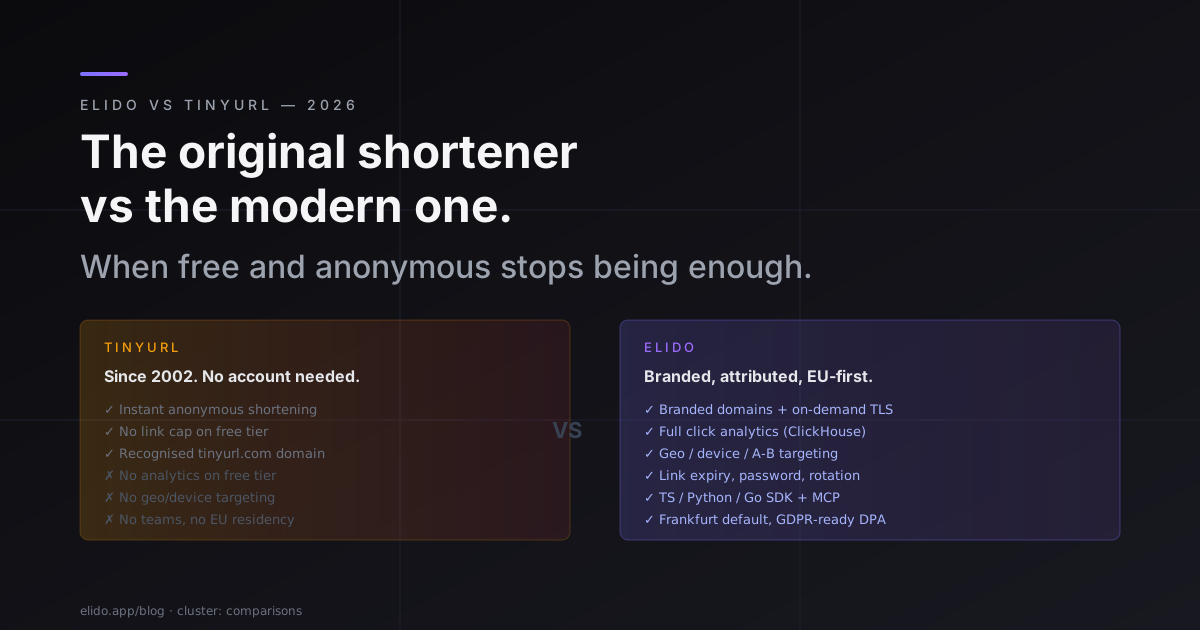
TinyURL launched in 2002. For most of its life it did one thing: take a long URL and give you a short one, no account required. That is still its best feature. If you need to turn a URL into something paste-able in the next 15 seconds, TinyURL works, it's free, and you don't have to hand over an email address.
That scope is also the limit. The question this post answers is where "good enough" stops being good enough - and what the decision actually costs.
All TinyURL pricing and feature references below are from tinyurl.com/app/pricing as verified in the COMPETITORS research (April 2026). Pricing changes; verify before you use any of these numbers in a procurement conversation.
TL;DR
- TinyURL is the right tool for one-off anonymous link sharing with zero friction. It has no analytics on the free tier, no branded domains worth mentioning, and no team features.
- TinyURL Pro ($9.99/month) adds branded domains and basic click stats. It is a real product, not a paywall trick, but the analytics depth and routing capabilities are limited compared to what marketing teams need in 2026.
- Elido covers the scenarios TinyURL can't: campaign attribution, branded short domains with on-demand TLS, geo and device targeting, A/B link variants, link expiration, password protection, EU data residency, and a developer integration story (TypeScript/Python/Go SDKs, MCP server).
- If you're evaluating multiple shorteners at scale, the free URL shorteners ranked post covers the broader field. The pricing page has current Elido tier numbers.
Where TinyURL wins
Three areas where TinyURL is the genuinely correct choice and no amount of feature comparison changes that.
Zero-friction anonymous shortening. You paste a long URL, click shorten, copy the result. No account, no email confirmation, no workspace setup, no API key. For a one-time paste into a chat message, a forum comment, or a printed handout, this is the right tool. Elido requires an account. That overhead is worth it the moment you care about what happens after the click; it's not worth it when you don't.
No link cap on the free tier. TinyURL's free tier has no documented cap on how many links you can shorten. You can shorten a thousand links without paying anything, as long as you don't need analytics. The tradeoff is that anonymous free-tier links use TinyURL's shared domain (tinyurl.com/...), not a branded domain, and click data is unavailable. That is an explicit product choice, not a missing feature.
Brand recognition as a trust signal. TinyURL has been online since 2002. In some communities - particularly older internet users and enterprise recipients who've learned to distrust obscure short domains - a tinyurl.com link carries more recognition than an unfamiliar branded short domain. This is niche, but it's real.
Where TinyURL stops
The competitor research matrix (accessed April 2026) records TinyURL's feature gaps clearly. These are the categories where TinyURL returns an empty cell:
- Link expiration
- Password protection
- Geo targeting
- Device targeting
- Deep links (mobile)
- Dynamic QR codes
- A/B testing
- Link rotation
- Retargeting pixels
- Conversion tracking
- UTM builder
- Webhooks
- Workspaces / teams
- Roles / permissions
- SAML / SSO
- Audit log
- 2FA
- Mobile apps (iOS / Android)
For click analytics, TinyURL's free tier offers nothing. TinyURL Pro adds basic click stats - the competitor matrix marks this as limited (⚠️), meaning the analytics exist but are not full-depth by the standards of what Rebrandly, Short.io, or Elido ship. The specific limitations of TinyURL's analytics dashboard are not independently verifiable without a Pro account; treat the "limited" flag as accurate at the time of research and verify against the current product if this is a decision-making criterion.
Feature table
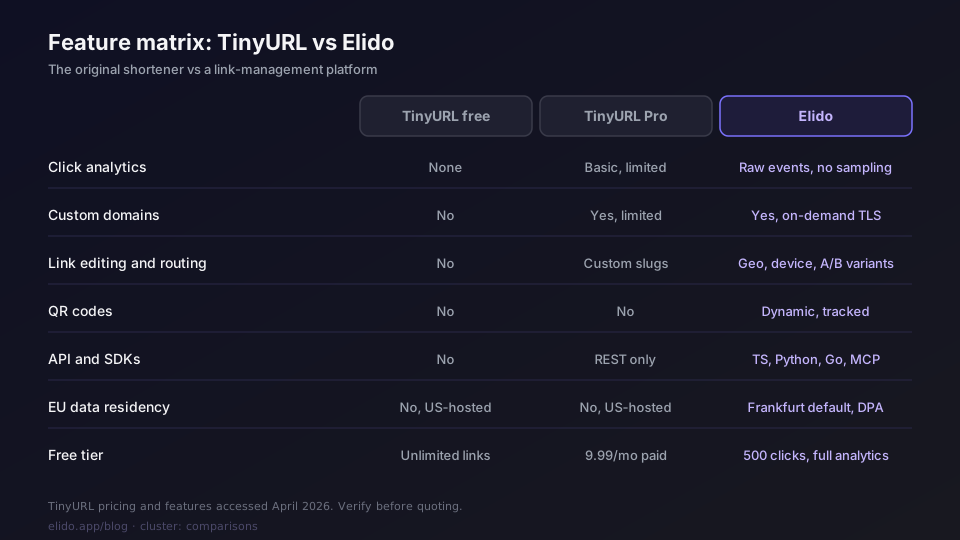
| Feature | TinyURL (free) | TinyURL Pro | Elido Free | Elido Pro |
|---|---|---|---|---|
| Shorten without account | Yes | - | No | No |
| Custom slug | No | Yes | Yes | Yes |
| Branded custom domain | No | Yes (limited) | No | Yes |
| Multiple domains | No | No | No | Yes |
| On-demand TLS for custom domain | - | Unclear | - | Yes |
| Click analytics | None | Basic | 500 clicks | Full (raw click events) |
| Geo / device / OS breakdown | No | Limited | No | Yes |
| Link expiration | No | No | No | Yes |
| Password protection | No | No | No | Yes |
| Geo targeting (routing) | No | No | No | Yes |
| Device targeting (routing) | No | No | No | Yes |
| A/B link variants | No | No | No | Yes |
| Dynamic QR codes | No | No | No | Yes |
| UTM builder | No | No | No | Yes |
| Conversion tracking | No | No | No | Yes |
| Retargeting pixels | No | No | No | Yes |
| Webhooks | No | No | No | Yes |
| Workspaces / teams | No | No | No | Yes |
| Roles / permissions | No | No | No | Yes |
| SAML / SSO | No | No | No | Yes (Business) |
| Audit log | No | No | No | Yes |
| 2FA | No | No | No | Yes |
| TypeScript / Python / Go SDK | No | No | No | Yes |
| MCP server | No | No | No | Yes |
| EU data residency | No | No | No | Yes (default) |
| Self-host option | No | No | No | Yes (Enterprise) |
Notes on verification: TinyURL Pro domain support is marked as limited in the April 2026 research; the exact domain setup flow and TLS provisioning mechanics are not publicly documented in detail. The "Unclear" on on-demand TLS reflects that gap. Do not use the TinyURL Pro column as the basis for a procurement comparison without checking the current product.
TinyURL Pro: what it actually is
TinyURL Pro is $9.99/month. It adds custom branded domains, basic click statistics, and custom back-halves (slugs) on your branded domain. There is also a Bulk tier documented at $99/month in the competitor research, targeted at high-volume shortening.
TinyURL Pro is a real product aimed at individuals and small teams who want a branded short link without the complexity of a platform built for marketing teams. If your requirement is "custom slug on my domain, some click numbers visible in a dashboard, nothing more", Pro is a coherent offering at a low price.
What it is not: a platform for campaign attribution, team collaboration, EU-compliant data processing, or programmatic link management. The analytics depth, the routing capabilities, and the API surface do not match what a marketing team running paid acquisition or a developer managing links programmatically will need. The free URL shorteners ranked post benchmarks Pro against comparable entry-level plans from other vendors if you're doing a price-per-capability comparison.
When TinyURL is the right tool
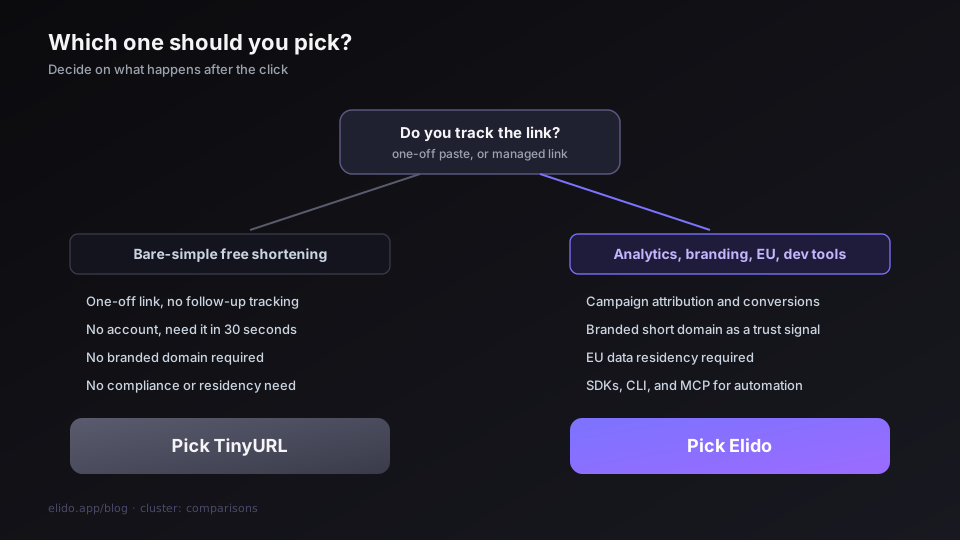
Use TinyURL when all of the following are true:
- You are sharing a one-off link and won't need to track what happened to it.
- The recipient audience doesn't require a branded domain as a trust signal.
- You have no compliance reason to control where the click metadata lives.
- You need the link in the next 30 seconds and creating an account is overhead you won't recoup.
Journalists sharing a source link, developers pasting a reference URL in a Slack message, someone shortening a URL for a physical flyer with no analytics follow-up - these are the legitimate TinyURL cases. No tool beats it at this specific job.
When to switch to Elido
The decision point is almost always one of four triggers.
Campaign attribution. The moment you need to know which link in which email drove which conversion, anonymous shortening fails you. You need a unique slug per campaign, click-level event data, and a way to forward conversion signals server-side when browser-based pixels are stripped by Safari ITP or ad blockers. Elido stores raw click events in our analytics store, retains 13 months of history on Pro, and forwards attributed conversions to Meta CAPI, GA4 Measurement Protocol, and Mixpanel without requiring you to build the forwarding infrastructure yourself.
Brand. A tinyurl.com link in an outbound sales email or a print ad is a missed brand signal. Elido provisions your branded domain with automatic on-demand TLS - a new domain's certificate is live within 60 seconds of DNS propagation, with no manual certificate request step. The features page covers the DNS and domain automation mechanics. For teams managing multiple client domains or subdomains, the Business plan's wildcard domain support means one CNAME entry covers every subdomain variation.
Compliance. TinyURL's infrastructure is US-based. Click events - which include IP addresses and user agent strings, both qualifying as personal data under GDPR Recital 30 - are processed in the US. For EU marketing teams, EU public sector work, or any context where a data residency clause will appear in procurement, TinyURL is not a viable option. Elido's default infrastructure is the EU region. The data plane does not leave the EEA unless your workspace is explicitly pinned to another region. The DPA ships with Article 28 obligations pre-signed in the standard contract; no custom negotiation is needed for most EU buyers.
Developer integration. TinyURL has a REST API, but the surrounding tooling ecosystem is minimal. Elido ships TypeScript, Python, and Go SDKs maintained against the OpenAPI 3.1 spec, a CLI for scriptable pipeline use, and an MCP server (open source, MIT-licensed) that connects Elido to Claude, Cursor, or any MCP-aware client. For a platform engineering team managing link infrastructure programmatically - bulk imports, CI-triggered link creation, LLM tooling that queries click stats - the tooling gap between TinyURL and Elido is the deciding factor. See the pricing page for the tier at which the API and SDKs are available.
The team and collaboration gap
TinyURL has no workspace or team model. There are no roles, no permissions, no audit log, no SCIM provisioning. If two people at your company need to manage the same set of shortened links, TinyURL has no answer. Sharing an account password is not a team workflow.
This matters less than it sounds for the single-person use case TinyURL is designed for. It matters completely the moment a second person needs access, or when your InfoSec team runs an access review and asks which vendor tools your marketing department is using and what the offboarding flow looks like.
Elido's workspace model supports role-based access at both workspace and folder level, audit logging of every link creation and modification, and SCIM provisioning for automated deprovisioning through Okta, Azure AD, or Google Workspace.
The honest summary
TinyURL is not a bad product. It is a well-maintained product with a 24-year track record, doing exactly what it was designed to do. The free tier is genuinely unlimited for link creation, the interface is as simple as a web interface can be, and the brand is recognisable.
The gap is not in polish or reliability. It is in scope. TinyURL was designed for link shortening. Elido was designed for the layer above that: link management, attribution, team collaboration, and EU-first data handling. The overlap is real - both products will shorten a URL - but the scenarios where you need what Elido ships are the scenarios where TinyURL provides no path forward.
Run TinyURL as long as you don't need analytics, branded domains, team features, or compliance coverage. Switch when any one of those requirements appears, because the migration cost is low and the capability gap is not.
For a broader comparison across shorteners, the free URL shorteners ranked post covers the full field with a consistent methodology. Current Elido tier pricing is at /en/pricing.
Related on the blog
- Migrate from TinyURL: two paths and what each one preserves
- EU data residency for marketing tools: what your DPO actually asks
- Set up branded short links: pick a domain, ship in an afternoon
- URL shorteners for marketers: the 2026 comparison matrix
- Bitly vs TinyURL: features, pricing, and which to pick
Try Elido
Paste a URL, get a working short link
No signup. Link lives for 30 days. Sign up to keep it forever.
Free, no signup required · 2 per day