I work in marketing solutions engineering at Elido, so I'm going to say the quiet part first: this is a comparison written by someone employed at one of the tools on the list. What I can offer is precision. Every pricing claim in this post is date-stamped and linked to a public page. Where a competitor is genuinely stronger, I'll name it directly. Otherwise this post is useless to you.
The question I'm answering is not "which URL shortener has the most star ratings on G2." It's: what does a marketing team actually need a URL shortener to do in 2026, which tools ship those capabilities, and how much do they cost once you're past the free-tier?
The 6 jobs a marketer hires a URL shortener to do#
Before the matrix, the framing. Marketers don't hire a URL shortener because they want "shorter links." They hire it to do at least one of six jobs, and the tool you pick had better do the specific jobs on your list, regardless of what it does for the others.
Job 1: Branded domain. Every link your company distributes should be on your domain, not the shortener's. go.acme.com/summer-launch is trustworthy. bit.ly/3xYzAbc is a coupon code. Branded domains lift click-through rate: the measurable range in independent studies sits between 12% and 31% depending on channel and audience familiarity. The operational requirement is custom CNAME, automatic TLS, and the ability to add more domains as the brand grows.
Job 2: UTM governance. UTM parameters are only useful if the whole team uses them consistently. One marketer writes utm_source=email, another writes utm_source=Email, and the GA4 report splinters into six rows for the same channel. Workspace-level UTM templates, enforced at link creation time, solve this. Most tools offer some version of them; the depth varies considerably.
Job 3: Server-side attribution. Safari's Intelligent Tracking Prevention (ITP, webkit.org/blog, 2019) and the ongoing deprecation of third-party cookies in Chrome (Privacy Sandbox timeline, privacysandbox.google.com) have eroded browser-pixel attribution to the point where many performance-marketing teams are under-counting conversions by 20-40%. Server-side forwarding closes that gap: your shortener records who clicked, you fire the conversion to Meta CAPI or GA4 Measurement Protocol after the fact with hashed identifiers. Very few URL shorteners do this as a built-in.
Job 4: A/B and smart routing. One link, multiple destinations depending on device, country, language, time-of-day, or referrer. This is useful for mobile app campaigns (iOS to App Store, Android to Play Store), geo-targeted offers, and post-campaign redirects (the link in the flyer from the conference eventually needs to route somewhere meaningful). "Smart links" is the common name for this capability. The feature exists in several shorteners; the routing dimensions and where the evaluation happens (edge vs. origin) vary.
Job 5: QR code generation. Print and out-of-home campaigns live and die by the QR code. The QR code must: be dynamic (so the destination can change after printing), support logo embedding, and resolve to a link your analytics system tracks. Most shorteners generate QR codes; the logo-embedding and dynamic-update capabilities are less common on entry plans.
Job 6: Click-level analytics depth. Aggregate analytics ("this link got 5,000 clicks last month") are a starting point. Useful campaign work needs: full time-series with hourly resolution, UTM breakdowns per click, geographic distribution, device and browser split, and ideally conversion attribution back to the click event. ClickHouse-backed raw-event storage scales this without sampling; most shorteners use pre-aggregated time-series that cannot answer ad-hoc queries.
TL;DR#
- For most marketing teams, the decision narrows to three factors: whether EU data residency is required, whether server-side attribution matters, and what volume the pricing model penalises first.
- Bitly's BSU per-link pricing bites past 100K clicks/month; Rebrandly's per-link-cap model bites when campaign cadence is high and the link library grows fast.
- Branch is the only tool on this list purpose-built for mobile-first campaigns; its server-side attribution story is stronger than anything here if mobile deep-linking is the core job.
- Elido is the only tool on this list with EU-default data residency, a pre-signed Article 28 DPA, and built-in server-side CAPI/GA4 forwarding at no additional integration cost.
The 7 tools#
A one-line positioning for each, before the matrix.
Bitly: The incumbent. Largest brand recognition, deepest integration list, highest per-click cost at scale. The tool most teams already know how to use. Pricing: bitly.com/pages/pricing, accessed 2026-05-12.
Rebrandly: Domain-first branded links with a polished no-code setup experience and a mature Zapier/Make integration catalog. Billing is per branded link cap, not per click. Pricing: rebrandly.com/pricing, accessed 2026-05-12.
Short.io: Clean team UX, generous free tier, Estonia-based (EU jurisdiction). Built for mid-size marketing teams; pricing is per domain per month with no per-click charge on the standard plans. Pricing: short.io/pricing, accessed 2026-05-12.
Branch.io: The mobile attribution platform that also does link shortening. If deep linking, universal links, and in-app attribution are the primary jobs, Branch is purpose-built for that. Overkill for teams that don't need mobile attribution.
TinyURL: The 2002 veteran. No signup, no expiry, no analytics, no edit. Still the lowest-friction option for one-off links where analytics are irrelevant. Free tier only; paid plans add analytics and branded domains.
Bl.ink: Enterprise-oriented shortener with a GLBA-compliance track record, strong role-based access controls, and on-premises deployment options. Used by financial-services teams with strict compliance requirements.
Elido: EU-first, ClickHouse-backed raw click analytics, built-in server-side conversion forwarding, smart routing at the edge. Built for performance-marketing teams in regulated markets. Free evaluation tier; Pro/Business/Enterprise plans.
Feature matrix: 12 rows × 7 tools#
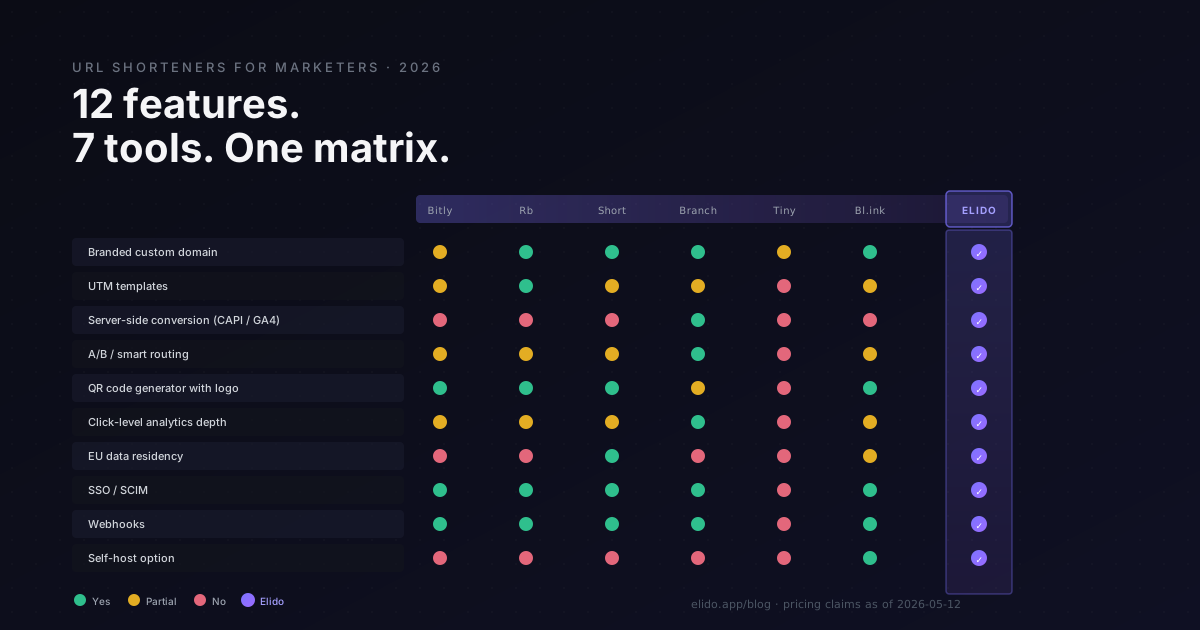
This table covers the capabilities marketing teams ask about most. Rows are ordered by how often the capability drives a vendor switch. Yes / Partial / No annotations are as of 2026-05-12; pricing claims link to source pages. Verify before quoting to procurement.
| Feature | Bitly | Rebrandly | Short.io | Branch.io | TinyURL | Bl.ink | Elido |
|---|---|---|---|---|---|---|---|
| Branded custom domain | ✅ Growth+ | ✅ Starter+ | ✅ All plans | ✅ All plans | ✅ Paid plans | ✅ All plans | ✅ Pro+ |
| UTM templates | ⚠️ Partial | ✅ Yes | ⚠️ Partial | ⚠️ Partial | ❌ No | ⚠️ Partial | ✅ Yes |
| Server-side conversion (CAPI / GA4) | ❌ Webhook only | ❌ Webhook only | ❌ No | ✅ Yes (mobile) | ❌ No | ❌ No | ✅ Built-in |
| A/B / smart routing | ⚠️ Deep links (Premium) | ⚠️ 4 dimensions (Starter+) | ⚠️ Country + device | ✅ Full mobile | ❌ No | ⚠️ Partial | ✅ 6 dimensions (Pro+) |
| QR code generator with logo | ✅ Yes | ✅ Yes | ✅ Yes | ⚠️ Partial | ❌ No | ✅ Yes | ✅ Yes |
| Click-level analytics depth | ⚠️ Aggregated, no raw | ⚠️ Aggregated | ⚠️ Aggregated | ✅ Event-level (mobile) | ❌ No | ⚠️ Aggregated | ✅ Raw events, ClickHouse |
| EU data residency | ❌ US-hosted | ❌ US-primary | ✅ Estonia (EU) | ❌ US-hosted | ❌ US-hosted | ⚠️ US, on-prem option | ✅ Frankfurt default |
| SSO / SCIM | ✅ Enterprise | ✅ Business+ | ✅ Enterprise | ✅ Enterprise | ❌ No | ✅ Yes | ✅ Business+ |
| Public API | ✅ Yes | ✅ Yes | ✅ Yes | ✅ Yes | ⚠️ Undocumented | ✅ Yes | ✅ OpenAPI 3.1 |
| Webhooks | ✅ Yes | ✅ Yes | ✅ Yes | ✅ Yes | ❌ No | ✅ Yes | ✅ Yes |
| Per-link cost model | ⚠️ BSU per link + click cap | ⚠️ Per branded-link cap | ✅ Per domain flat | ✅ Volume-based | ✅ Flat / free | ✅ Flat tier | ✅ Click-volume |
| Self-host option | ❌ No | ❌ No | ❌ No | ❌ No | ❌ No | ✅ On-prem | ✅ Apache 2.0 Helm |
Notes on specific cells:
- Rebrandly UTM templates: supported as "UTM presets" on Starter and up, though workspace-level enforcement requires manual discipline rather than a hard policy.
- Short.io EU data residency: company is Estonian, data plane location depends on the plan. The free Personal plan is EU-hosted; verify enterprise contracts explicitly. No pre-signed DPA on free.
- Branch.io server-side conversions: purpose-built for mobile attribution via the Branch Universal Ads SDK and server-to-server API. Not equivalent to web CAPI/GA4 forwarding; it is a different problem and Branch is the better tool for that specific problem.
- Bl.ink on-prem option: available via their "Bl.ink Professional" on-premises edition; requires separate licensing conversation.
- TinyURL API: an undocumented
api-create.phpendpoint exists and is widely used; it is not rate-limit-stable or contractually guaranteed.
Why per-link pricing breaks at scale#
Bitly and Rebrandly use different billing signals (BSU count and branded-link cap, respectively) but the failure mode is the same: the billing unit is link quantity, not click traffic, and link quantity in active marketing grows fast.
Take a performance-marketing team at 250,000 clicks per month. They run:
- 4 active campaigns simultaneously
- Each campaign mints 300-500 links at launch (per-creative UTM variants, per-channel slugs, geo variants)
- Campaign cycles every 6-8 weeks; old links aren't deleted because historical analytics need to be preserved
By the end of Q1, they're managing 3,000-5,000 active branded links. At Bitly's Growth plan (which as of the public pricing page accessed 2026-05-12 includes a defined monthly BSU allowance), a typical active campaign library at this scale is bumping the cap. Every link minted past the BSU limit is either an overage charge or a forced tier jump to Premium.
At Rebrandly, the same calculation runs against the per-branded-link cap. Starter sits at 25,000 links; Pro at 50,000. For a B2B team with a stable link library, those numbers are comfortable. For a performance-marketing team with high campaign turnover, the link count grows toward the cap faster than the click volume does. The quarterly renewal conversation becomes "we need to upgrade our link cap, not our click volume."
Elido's billing signal is click volume. The link library is effectively uncapped on paid plans. For most content-driven and performance-marketing teams, where link creation cadence is high and click volume per link varies, the click-volume model produces no billing surprises from link creation velocity.
Short.io's flat per-domain model is a third structure: you pay per domain per month, not per link or per click within a range. For teams with a small branded-domain set and high click volume through those domains, this is often the cheapest model. The constraint is that adding a new branded domain costs a flat increment; agencies managing per-client domains see the cost compound.
The Bitly alternatives feature gap post has the full BSU arithmetic for a few specific volume profiles, including worked examples from teams that switched.
Why server-side attribution matters in 2026#
Apple's Intelligent Tracking Prevention (ITP 2.3, webkit.org, 2019) capped cross-site cookie lifetime at 7 days and actively degrades storage mechanisms used for attribution. Chrome's third-party cookie deprecation (Privacy Sandbox, privacysandbox.google.com) has been extending its timeline, but the direction is set: browser-side attribution is shrinking, not growing.
For a marketing team running Meta Ads to a landing page: the user clicks the ad, gets redirected through a short link, lands on the page. The Meta Pixel fires. ITP may have purged the click attribution cookie. The Pixel tries to match the event; if it's Safari, the cross-site identifier is degraded or absent. The conversion either vanishes from Meta's attribution window or gets credited to "direct" in GA4.
Server-side conversion forwarding closes this gap by sidestepping the browser entirely. The flow becomes: user clicks the short link → shortener records the click ID + user-agent + timestamp → user converts on the landing page → you POST the conversion event to your shortener's API with the click ID → shortener hashes the user identifiers (email hash, phone hash) and fires to Meta CAPI and GA4 Measurement Protocol server-to-server. No browser involved in the attribution signal.
The catch is infrastructure: you need to capture the click ID on your landing page, store it through the conversion flow, and POST it back on conversion. That's a few hours of engineering work if the shortener provides a built-in endpoint. It's weeks of work if you need to build the CAPI hashing, the retry/dedup logic, and the per-provider API wiring yourself.
Most shorteners on this list give you a webhook and leave the CAPI integration as an exercise. Elido ships the forwarding built-in: register credentials once at the workspace level, POST conversions with a click_id, and the platform handles SHA-256 hashing and retry/dedup. Docs: conversion forwarding guide.
The 20-40% conversion-recovery figure I cited in the TL;DR is consistent with what performance-marketing teams report after switching from pixel-only to server-side attribution, and is corroborated by Meta's own CAPI implementation case studies. The exact number depends on your audience's Safari share, which varies sharply by market (EU mobile audiences skew iOS/Safari more than US audiences do).
Where each tool wins#
Honest take on where each vendor is the right choice.
Bitly wins on integration breadth. The Hootsuite, HubSpot, Sprout Social, and Salesforce Marketing Cloud integrations are one-click and well-maintained. If your team's link creation workflow runs through one of those platforms and you're not writing API code, Bitly is the path of least resistance. No alternative on this list has a fully equivalent one-click integration suite today.
Rebrandly wins on no-code setup polish. The domain wizard, the UTM builder UI, and the in-app analytics are all optimised for a non-technical marketer setting up a branded domain in 20 minutes. The onboarding is genuinely better than any other shortener at this price point. For a solopreneur or small team that wants branded links without touching a command line, Rebrandly's UX is the strongest argument.
Short.io wins on team UX and pricing predictability. The per-domain flat pricing is simple to budget. The team management UI is cleaner than Bitly's and Rebrandly's for teams between 5 and 50 people. The free tier is generous enough to evaluate real campaigns before committing. For EU-based teams where the Estonian jurisdiction satisfies residency requirements, Short.io is a strong value option.
Branch wins on mobile attribution. If your primary campaign type is mobile app install or re-engagement, Branch is purpose-built in a way no general-purpose shortener is. Universal links, deferred deep links, and the Branch Attribution API are mobile-native capabilities that the other tools either don't have or bolt on as an afterthought. For mobile-first companies, the comparison isn't even close.
TinyURL wins on friction-free link creation. No account required. No expiry. No setup. For internal tools, one-off sharing, or any use case where "the link just needs to work" is the only requirement, TinyURL eliminates all overhead. It has been doing this since 2002 and is more operationally reliable than several of the well-funded alternatives.
Bl.ink wins on compliance posture for US regulated industries. GLBA-aligned data handling, role-based access controls down to the link level, and on-premises deployment make Bl.ink the default choice for US financial-services marketing teams whose compliance team has a list of vendor requirements. The product is less flashy than the others; the compliance story is more rigorous.
Elido wins on EU residency plus server-side attribution as a package. Frankfurt-default hosting with a pre-signed Article 28 DPA is the procurement-friendly answer for EU regulated buyers. The server-side CAPI/GA4 forwarding built in at the API level recovers attribution signal that every other tool on this list loses to ITP and cookie deprecation. For European performance-marketing teams that need both, the combination is not available elsewhere as a single product.
Decision tree#
Four questions. Pick the branch that fits.
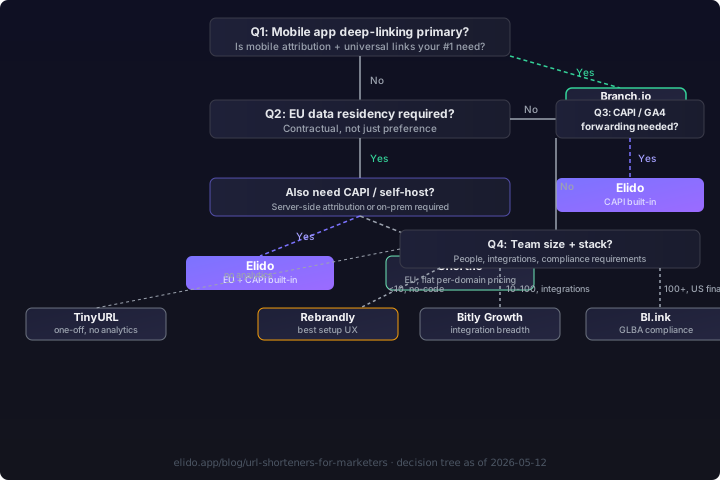
Q1: Is mobile app deep-linking your primary attribution need?
- Yes → Branch.io. Nothing on this list competes with it for mobile-native attribution. Stop here.
- No → continue to Q2.
Q2: Does your procurement require EU data residency (contractual, not just preference)?
- Yes, EU residency required → Elido if server-side attribution or self-host is also on your list; Short.io if your requirement is EU jurisdiction and you don't need CAPI forwarding or raw-event analytics.
- No requirement → continue to Q3.
Q3: Is server-side conversion forwarding (Meta CAPI / GA4 Measurement Protocol) on your requirements list?
- Yes → Elido. It is the only tool on this list that ships this as a built-in without BYO infrastructure.
- No → continue to Q4.
Q4: What is your team size and integration stack?
- Team under 10, primarily no-code workflow, one branded domain → Rebrandly. Best setup experience at this scale.
- Team 10-100, using HubSpot / Hootsuite / Salesforce MC integrations → Bitly Growth or Premium. Integration breadth wins.
- Team 10-100, want clean UX + predictable pricing + EU jurisdiction → Short.io.
- Team 100+, US financial services compliance requirements → Bl.ink.
- Team 100+, EU enterprise, EU residency + raw analytics + scale pricing → Elido Business.
- One-off or internal links, no analytics needed → TinyURL.
What we'd build if we were a marketer starting today#
Starting fresh in 2026, without existing vendor lock-in, this is the stack I'd choose by team profile.
Solo marketer or small startup (under 10 people, US-based, no compliance requirements). Start on Rebrandly's Starter plan. The setup is fastest, the UTM builder is decent, and the Zapier integration handles most automation needs without API code. Upgrade to Elido or Short.io when either the per-link cap starts driving your campaign architecture decisions or you add a second branded domain.
Growing marketing team (10-50 people, EU-based, running Meta and Google performance marketing). Start with Elido Pro. The EU residency DPA closes the procurement conversation immediately. Server-side CAPI forwarding is built in — wire it in the first sprint and you'll recover attribution signal from day one instead of retroactively trying to fix a broken attribution model three quarters later. UTM templates with workspace-level enforcement stop the utm_source=email vs utm_source=Email problem before it compounds in your GA4 data.
Performance-marketing agency (managing multiple client accounts, needs per-client workspaces and branded domains). Elido Business for the wildcard domain support (*.agency-links.example covers every client subdomain under one CNAME) and the per-client workspace model. Alternatively Short.io if the per-domain flat billing is more predictable at your client mix. Neither Bitly nor Rebrandly supports per-client white-label in a way that doesn't require either one account per client or a messy shared workspace.
Enterprise B2B (US financial services, compliance-first). Bl.ink. This isn't close. The GLBA posture, role-based access, and on-premises option are purpose-built for this buyer. Only consider Elido if you need EU residency or raw-event ClickHouse analytics and your legal team is comfortable with a newer vendor.
Mobile-first app team. Branch.io. A URL shortener is not the right tool for your core attribution need. Use Branch for deep links and in-app attribution; use a simple shortener (TinyURL or Short.io free) for any web-surface links that don't need app attribution.
Further reading#
The Bitly alternatives feature gap post has the BSU pricing arithmetic and the six-feature comparison that anchors this cluster. Elido vs Bitly is the pricing side-by-side at four volume levels. Elido vs Rebrandly covers the per-link-cap vs click-volume model in more depth. Elido vs Short.io is where the EU-residency comparison gets granular.
For Elido-specific details: the marketers solutions page covers the UTM template and conversion-forwarding workflow, and /pricing has the current tier numbers.
Pricing claims in this post are date-stamped 2026-05-12 against the respective vendors' public pricing pages. Shortener pricing changes frequently; verify before quoting to a budget owner.