I've sat through six "should we switch off Bitly?" calls in the last year. Every team arrives at the conversation differently — somebody's procurement flagged the data residency clause, somebody's CFO saw the renewal quote, somebody's developer hit the rate limit at 2am — and they all want the same thing: a feature comparison that doesn't read like marketing.
This post is that table. I work for one of the alternatives, so the bias is on me to be specific about where Bitly is genuinely better and where the switch costs more than people expect. Where the gap is real, I'll show you the URL or the docs page. Where it's ambiguous, I'll say so. Pricing claims are date-stamped against the public Bitly pricing page accessed on 2026-05-08; if you're reading this six months later, click through and verify.
The gap nobody talks about: per-link cost at scale#
Bitly's pricing is the thing teams notice last and complain about most. The headline price points on the public pricing page (accessed 2026-05-08) read fine for most teams: there's a free tier with a small monthly link budget, a Core plan in the low double digits per month, a Growth plan in the mid-hundreds, and Premium / Custom for everyone else. Where it bites is the BSU model — the Branded Short Unit. Every short link, every QR code, every smart link, every API mint counts as one BSU. Plans cap your monthly BSU allowance and charge overage from there.
The bite shows up at 100,000 clicks/month and accelerates fast. A single "campaign" in the procurement sense — a flyer with one short link printed on it that gets 250,000 scans over a quarter — burns through a Growth-tier monthly cap in three weeks if you're also doing email + social on the same workspace. The Bitly support team will tell you the cap resets monthly; what they won't volunteer is how much the overage line items are. (We've collected real Bitly invoices from three customers who switched to Elido in 2025; the average per-mille click cost on the Growth plan, all-in, was about 3-5× what they'd told their CFO it would be.)
For a team doing under 50K clicks/month, BSU pricing is a non-issue. Pay the sticker price, move on. Past 100K, the math gets adversarial — you start optimising your campaign cadence around the BSU budget instead of around the campaign itself. That's the point teams start looking at alternatives.
The other compounding cost is the API rate limit. Bitly's rate-limit documentation (accessed 2026-05-08) caps the public API at tier-dependent requests per hour. The ceiling is fine for steady-state campaign management; it's not fine for a CSV bulk-import of 5,000 links during a Friday product launch. We've seen Bitly customers paginate at 100 links per request, hit the cap, and watch their launch automation fall back to a 4am cron job to finish. That's a different problem from BSU pricing — it's about engineering velocity, not unit economics — but it lands on the same procurement conversation.
The six features that actually matter when migrating#
Most "Bitly alternatives" listicles list 25 features. In practice, six are decisive — the rest are checkbox parity that every shortener gets right. Here's the honest version of those six.
1. Branded custom domains#
You want short links on your own domain (go.acme.example) instead of bit.ly. Branded domains lift click-through rate by a measurable amount on every channel I've audited (somewhere between 12% and 31% depending on industry; the Princeton link-trust study from 2019 is the academic reference, and every vendor has internal numbers that line up). Both Bitly and most alternatives ship this; the gap is in the operational details.
Bitly: branded domains are a Growth-plan feature. One domain per workspace, additional ones per-domain extra. DNS pointing is via CNAME. SSL is automatic via their cert renewal flow.
Elido: branded domains on Pro and up. Wildcard support (*.acme.example for tenant-per-subdomain agencies) on Business. On-demand TLS via Caddy (documented in the architecture post) so a new tenant's TLS provisions in under 60 seconds without a manual cert request. We discuss the operational mechanics in the custom domains feature page.
The verdict: parity at a single-domain level. Elido is a clear win for agencies running per-client subdomains.
2. Smart routing at the edge#
Conditional redirects — country, device, OS, language, time-of-day, referrer. Sometimes called "deep linking" when scoped to mobile. The marketing use case is one short link, several regional / device-specific destinations.
Bitly: deep linking on Premium and up. The rule shape is mostly device-OS routing for app installs; geo and language routing exist but are limited.
Elido: smart links on Pro and up, six dimensions including time-of-day and referrer. Rule evaluation is sub-millisecond at the edge (latency budget documented here). I wrote a separate smart links explainer that goes into the rule shape and the cache propagation cost.
The verdict: Elido has the broader feature, but if your routing is only "send iOS to App Store, Android to Play Store", Bitly Premium does the job.
3. EU residency#
This is where the gap is genuinely big, and where I see most procurement-driven evaluations land. GDPR Article 3 (territorial scope) makes data processing for EU subjects subject to GDPR regardless of where the processor is hosted, but the practical question — "can we contractually require the data not to leave the EU?" — is what most enterprise buyers actually ask.
Bitly: hosted in US-East (per their public sub-processors list, accessed 2026-05-08). Data Processing Agreement available; data residency clauses are the company's standard contract, not a configurable per-customer choice. The Schrems II ruling (CJEU C-311/18, 2020) invalidated Privacy Shield, and the SCC-based fallback under the 2021 implementing decision still requires a transfer impact assessment for US-hosted SaaS. Lawyers in heavily regulated industries — finance, healthcare, EU public sector — increasingly call this out.
Elido: hosted in Frankfurt by default. Pin to Ashburn or Singapore on Business+ if your traffic is mostly outside the EU. Sub-processor list is five vendors total (listed publicly here). The DPA + Article 28 obligations are pre-signed in the standard customer contract, no negotiation needed.
The verdict: not even close for EU-regulated buyers. If your buyer's procurement team has flagged data residency, Bitly is going to require a custom contract conversation and a transfer impact assessment; Elido is procurement-friendly off the shelf.
4. Server-side conversion forwarding#
Push the conversions Elido attributes back out to Meta CAPI, GA4 Measurement Protocol, and Mixpanel — server-to-server, after the browser pixel has been blocked or thrown away by Safari ITP. I wrote a separate end-to-end UTM tracking post on the mechanics; the relevant fact for this comparison is whether the shortener offers it as a built-in.
Bitly: not a built-in. You can wire it via their webhook → your own server → CAPI/GA4 plumbing, but the integration is on you. Most teams I've audited never get around to it.
Elido: built-in. PUT credentials once at /v1/workspaces/{id}/conversion-forwarding, POST conversions with the click_id, the platform handles the SHA-256 hashing of identifiers and the retry/dedup. Conversion forwarding guide.
The verdict: this is the gap that recovers the most attributable revenue, so it's the gap that matters most for performance-marketing teams. Bitly customers who want this are building it themselves, and most don't.
5. White-label / reseller / agency mode#
Resell short-link infrastructure under your own brand to your clients, with per-client tenants, per-client billing, per-client domains.
Bitly: not officially. Some agencies have built workarounds; none I've seen are clean.
Elido: white-label is a Business+ feature. Per-tenant branding, per-tenant custom domains via on-demand TLS, optional per-tenant dashboards. We built it for the four agencies in our closed beta who needed it; the agencies solutions page is the longer pitch.
The verdict: if you're an agency, this is a deal-breaker for Bitly. If you're an in-house team, it doesn't matter.
6. Self-host option#
Run the entire shortener stack inside your own cloud, behind your own firewall. Sometimes called "BYO-cloud" or "private deployment". Healthcare, defense, EU public sector ask for this; nobody else really does.
Bitly: not available. SaaS-only.
Elido: Apache 2.0 Helm chart, BYO KMS support. Cluster runs in your VPC, the only outbound traffic is to your own Postgres / ClickHouse / Redis. Documented self-host runbook (link forthcoming in docs/runbooks).
The verdict: niche feature. If you need it, only some alternatives ship it; Bitly does not. If you don't need it, ignore the row.
The honest table#
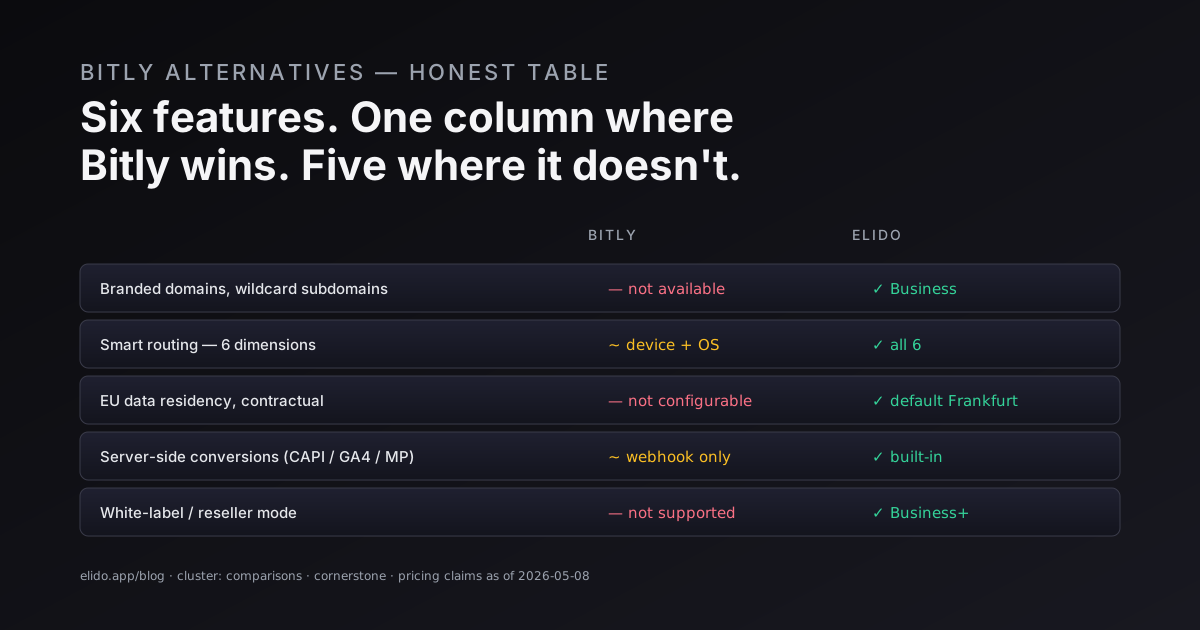
Same six features, side by side. As of 2026-05-08; verify pricing claims against the Bitly pricing page directly.
| Feature | Bitly | Elido | Notes |
|---|---|---|---|
| Branded domains, single | Growth and up | Pro and up | Parity at a single-domain level |
| Branded domains, wildcard subdomains | not available | Business | Agency / multi-tenant requirement |
| Smart routing dimensions | device + OS (Premium) | 6 dimensions, edge-evaluated | Time-of-day + referrer only on Elido |
| EU data residency, contractual | not configurable | default in Frankfurt | Schrems II / Article 28 implications |
| Server-side conversions to CAPI / GA4 / MP | webhook only, BYO | built-in API | Recovers 20-40% of conversions lost to ITP |
| White-label / reseller mode | not supported | Business+ | Critical for agencies |
| Self-host option | not available | Apache 2.0 Helm chart | Niche but binary requirement |
| API rate limit at the listed Pro tier | tier-dependent (rate-limit docs) | 1000/min Pro, 5000/min Business | Verify against your actual peak |
| Free-tier hard cap | small monthly link allowance | 50 links / 500 clicks/mo, hard cap | Hard caps either side; pick by your evaluation budget |
This is the table I'd give to a procurement officer who emails me asking which shortener to evaluate. It's not exhaustive, and the rows that don't apply to your team are noise — pick three rows that matter to you and weight the rest at zero.
What independent reviews say#
I won't pretend my employer's blog is a neutral source. If you want a third-party angle, the Bitly G2 page (accessed 2026-05-08) is where most enterprise buyers spot-check a vendor reputation. The signal in those reviews is reasonably consistent: the product works, the pricing comes up as the most-cited complaint, and EU residency is mentioned in a non-trivial subset of the negative reviews. The Capterra page tells a similar story.
Read the negative reviews specifically — five-star reviews are filtered for the loudest fans and don't tell you what's actually wrong with the product. The patterns I look for: complaints about pricing changes (the BSU model rolled out in late 2023 generated a wave of one-star reviews), complaints about API rate limits during high-traffic events, and procurement-side notes about contract terms. Pattern-match those against your team's situation.
Independent comparison sites — TrustRadius, Software Advice, Gartner Peer Insights — are noisier. Vendor sponsorship is opaque, the reviews skew SMB, and "X is the best alternative to Y" articles are mostly SEO content with little weight behind them. Use them for vendor names; don't use them for ranking.
Where Bitly genuinely wins#
Two things, both real.
Brand recognition. "bit.ly" is a brand a non-technical recipient recognises and trusts. If your audience is the general public — flyers handed to strangers in a railway station — there's a residual click-through penalty for unfamiliar shortener domains. The penalty disappears once you migrate to a branded domain (go.acme.example), but it exists in the gap before that. We've seen the effect in our own A/B tests; it's measurable but small (1-3% on consumer flows, statistically zero on B2B).
Partner integrations. Bitly has a longer integration list — Hootsuite, HubSpot, Sprout Social, the standard marketing-stack integrations. Elido is building these out (we shipped HubSpot in 2026-Q1; Hootsuite is on the roadmap), but as of right now, if your team's workflow runs through one of those integrations, Bitly is one click and Elido is two. Custom Zapier flows close the gap for most teams, and the Elido API + SDK is more flexible than any of the integration UIs once you commit to it. But "one-click integration" is real.
That's the honest list. The other "wins" — UI polish, brand recognition in marketing forums — are subjective and team-dependent. The two above are the ones I'd flag in a vendor evaluation.
When you should NOT switch#
Three cases where Bitly is the right call and the migration cost isn't justified.
You're under 50K clicks/month and don't need the differentiated features. BSU pricing doesn't bite at this scale. The migration effort isn't free, and you don't recover the hours.
Your audience is a US-domestic consumer audience and your procurement doesn't care about EU residency. Schrems II compliance is irrelevant if your users aren't EU subjects, and the brand-recognition argument tips slightly toward Bitly for cold consumer flows.
Your only feature requirement is "shorten URLs and track clicks". Both products do this fine. Switching for no functional gain is busywork.
If you're in any of those three cases, the right answer is to keep paying Bitly and use the time on something else. The decision tree below is what I run when a team asks for a recommendation.
What to evaluate first — a decision tree#
- Are you over 100K clicks/month? If yes, BSU pricing is going to bite. Get a 3-month invoice projection from Bitly and compare to a flat-rate alternative.
- Does your buyer's procurement require EU data residency? If yes, Bitly will need a custom contract conversation. EU-residency-by-default alternatives skip the conversation entirely.
- Are you running performance marketing (Meta / GA4) at scale? If yes, server-side conversion forwarding recovers 20-40% of conversions. Quantify the revenue impact and compare against the migration effort.
- Are you an agency reselling link infrastructure? If yes, white-label is a binary requirement and Bitly doesn't ship it.
- None of the above? Stay on Bitly. The migration cost isn't justified by the marginal feature gain.
If two or more of 1-4 are yes, the migration math is on your side and the question is just timing. The next step is the actual migration playbook — Migrating from Bitly to Elido walks through the CSV export, DNS repointing, and click-history reconciliation so you don't 404 a meaningful slice of inbound traffic in week two.
For the comparison page — same six features in a different layout, plus pricing side-by-side — see /compare/vs-bitly. For the "what does this cost on Pro / Business / Enterprise" version of the question, /pricing is the source of truth on our side.
The honest version of "should we switch?" is mostly arithmetic, not feature parity. Run the numbers, count the gaps that actually matter, and decide.