
T.LY is a url shortener that has found a clear position in a crowded field: low entry price, a polished browser extension, and a free tier that is more functional than most. If you need to shorten links quickly from wherever you are on the web and keep the monthly bill low, T.LY is a coherent choice.
That positioning also describes its ceiling. This post covers where T.LY does the job well, where the floor drops out, and what the decision actually costs when your requirements grow past the basics. All T.LY pricing and feature references are drawn from the April 2026 competitor research. The t.ly/pricing page blocked automated fact-checking in May 2026, so verify current numbers at t.ly/pricing before any procurement conversation.
TL;DR
- T.LY's free tier caps at 5 links per month, which is tight. Its Pro tier at $5/month is one of the lowest entry points in the market for a platform with real analytics and custom domains.
- The browser extension is T.LY's standout UX feature - it handles the shorten-from-anywhere workflow better than most competitors.
- T.LY's gaps are consistent: no geo or device routing, no A/B variants, no white-label, no EU data residency, audit log absent, SSO limited. These are not edge cases for a growing SMB - they appear one by one as the team scales.
- Elido covers those gaps directly: EU-default infrastructure, white-label with full custom domain TLS automation, six-dimension smart routing, A/B link variants, and a REST API for developer tooling workflows.
- If you're comparing across the full shortener landscape, the free URL shorteners ranked post compares the free tiers of five other platforms (TinyURL, Bitly, Rebrandly, Short.io and Elido) on a consistent methodology; T.LY is not in that set, so use the table below for it. Elido's current tier pricing is at /pricing.
Where T.LY wins
Entry price. T.LY Pro at $5/month is genuinely low for a plan that includes custom domains, real-time analytics, and a browser extension. The competitor research table shows most comparable plans starting at $8–$24. For a solo creator or a two-person team with moderate link volume and no compliance requirements, the $5 price point is the right decision. The free URL shorteners ranked post linked in the TL;DR covers the free tiers around it, though not T.LY itself.
Browser extension UX. T.LY ships a browser extension that handles the core shortening workflow without leaving your current tab. You highlight a URL, click the extension, optionally edit the slug, and copy the result. For a creator or marketer who shortens links while working in the browser - writing a newsletter, composing a social post, curating a reading list - this workflow is faster than switching to a tab and using a dashboard. The competitor matrix marks T.LY's browser extension as present (and marks it for Bitly, Rebrandly, Short.io, Dub.co, and others as well), but T.LY's positioning has leaned into the extension more heavily than most, and the UX reflects that emphasis.
Simple onboarding. T.LY's signup-to-first-link path is short. The dashboard is sparse by design. For a user who wants to be up and running in five minutes without reading documentation, the product's scope is narrow enough that orientation is fast. This is not a faint compliment - complexity fatigue is real, and a tool that does fewer things but does them without friction serves that user better than a more capable platform that takes longer to understand.
Analytics on paid plans. T.LY's paid tiers include real-time analytics with geo, device, and OS breakdowns - the competitor matrix marks all three as present. For the price, this is solid coverage. You get the click dashboard you need to understand which links are performing and where the traffic comes from.
Where T.LY stops
The competitor matrix is direct about the gaps. These are the cells that return empty for T.LY:
- Geo targeting (routing)
- Device targeting (routing)
- A/B testing / link rotation
- Conversion tracking
- Retargeting pixels
- White-label
- Roles and permissions
- Audit log
- SSO / SAML (marked as limited,
⚠️) - Dynamic QR (marked as limited,
⚠️) - Workspaces / teams (marked as limited,
⚠️) - Password protection (marked as limited,
⚠️) - Webhooks (marked as limited,
⚠️)
The analytics gap is worth separating from the routing gap, because they look similar on a feature checklist but mean different things operationally. T.LY can tell you that a link got 400 clicks from Germany on mobile. It cannot route those German mobile visitors to a different destination than US desktop visitors. Real-time analytics and conditional routing are distinct capabilities - T.LY ships the former, not the latter.
The white-label gap matters for a specific category of T.LY user: freelancers and small agencies who manage links on behalf of clients. If the client's deliverable includes a branded short domain under their own name, T.LY's architecture doesn't support the white-label layer. You're always T.LY's customer, not your client's invisible infrastructure.
Feature matrix
The matrix below uses the April 2026 competitor research. Items flagged ⚠️ are documented as limited in the research - present in some form but not at full capability or restricted to higher tiers. Verify current product state before using this in a procurement comparison.
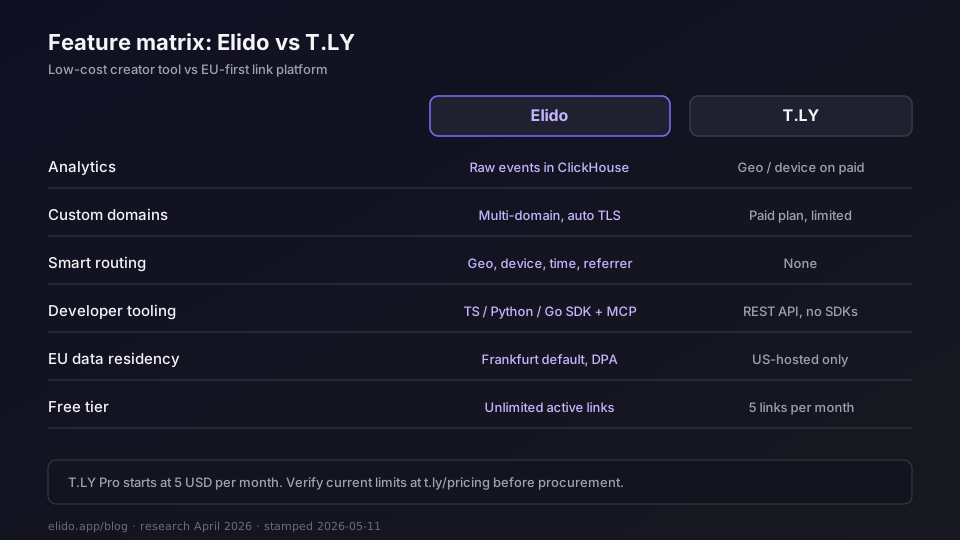
| Feature | T.LY Free | T.LY Pro ($5/mo) | Elido Free | Elido Pro |
|---|---|---|---|---|
| Links per month | 5 | Generous (unverified cap) | 50 | 250 to 5,000 by size |
| Custom slug | Yes | Yes | Yes | Yes |
| Custom domain | No | Yes (limited ⚠️) | No | Yes |
| Multiple domains | No | Limited ⚠️ | No | 1 to 3 by size (5+ on Business) |
| On-demand TLS for custom domain | - | Auto SSL (mechanics unverified) | - | Yes (automatic, <60s) |
| Real-time analytics | Yes | Yes | 500 clicks/mo | Full (raw click events) |
| Geo / device / OS analytics | Yes | Yes | No | Yes |
| Geo targeting (routing) | No | No | No | Yes |
| Device targeting (routing) | No | No | No | Yes |
| A/B link variants | No | No | No | Yes |
| Link rotation | No | No | No | Yes |
| Link expiration | Yes | Yes | No | Yes |
| Password protection | Limited ⚠️ | Limited ⚠️ | No | Yes |
| Dynamic QR codes | Limited ⚠️ | Limited ⚠️ | No | Yes |
| QR brand + logo + vector export | Limited ⚠️ | Limited ⚠️ | No | Yes |
| UTM builder | Limited ⚠️ | Limited ⚠️ | No | Yes |
| Conversion tracking | No | No | No | Yes |
| Retargeting pixels | No | No | No | Yes |
| Webhooks | Limited ⚠️ | Limited ⚠️ | No | Yes |
| Browser extension | Yes | Yes | No | No |
| Workspaces / teams | Limited ⚠️ | Limited ⚠️ | No | Yes |
| Roles / permissions | No | No | No | Yes |
| SSO / SAML | Limited ⚠️ | Limited ⚠️ | No | Yes (Business) |
| Audit log | No | No | No | Yes |
| 2FA | Limited ⚠️ | Limited ⚠️ | No | Yes |
| White-label | No | No | No | Yes |
| TypeScript / Python / Ruby / Go SDK | No | No | No | Go published; TS, Python, Ruby coming soon |
| MCP server | No | No | No | Local (stdio), not on npm yet |
| EU data residency | No | No | No | Yes (default) |
| Self-host option | No | No | No | Yes (Enterprise) |
A verification note: T.LY's custom domain mechanics, the exact limits on "limited" features, and the specifics of what the Premium ($19/month) and Custom tiers add are not fully documented in the April 2026 research. The ⚠️ entries reflect the research classification - present in some form, not fully verified at capability level. Do not use the T.LY columns as a procurement reference without checking the current product.
Where Elido wins
EU data residency comes as a default, not an option. T.LY's infrastructure is US-based. Click events - which include IP addresses and user agent strings, both personal data under GDPR Recital 30 - are processed in the US. For EU marketing teams, this requires Standard Contractual Clauses and, in regulated industries, a Transfer Impact Assessment. For EU public sector, fintech, or healthcare buyers, this is not a paperwork nuance; it's a procurement blocker.
Elido keeps its primary database, analytics store and backups in the EU, though redirect nodes in the US and Singapore still process visitor requests. A DPA with Article 28 obligations and EU SCCs is available on request on every plan; it is not pre-signed. Per-workspace region pinning is not available yet.
White-label depth with automated domain TLS. White-label in Elido means your end-users see your domain, your branding, and no Elido footprint. The custom domain stack is built on automatic on-demand TLS: you point a CNAME, Elido polls for propagation, and the certificate provisions on first request - under 60 seconds from DNS propagation, no manual trigger. For agencies managing per-client subdomains, the Business plan's wildcard domain support covers all subdomain variations under a single CNAME entry. The features page has the DNS and TLS mechanics in detail.
There is no white-label on T.LY. Custom domain support on its paid plans is present but described as limited in the research; the TLS provisioning mechanics are not publicly detailed.
Smart routing: geo, device, time, referrer. Elido's link routing covers six dimensions: country, device type, operating system, language, time of day, and referrer. You can build a link that sends German mobile users to the German-language App Store page, sends desktop users to the web landing page, and sends everything else to a default destination. T.LY has no conditional routing capability. The analytics show you the breakdown; the routing is not there.
For an SMB running a product launch across markets, this difference is the gap between a tool that reports on what happened and a tool that participates in what happens.
A/B link variants. Elido supports A/B testing at the link level: split traffic between two destination URLs, measure which variant drives more downstream conversions. T.LY has no A/B testing capability. The competitor matrix confirms this for T.LY and marks it absent for most shorteners - Short.io, Dub.co, and Elido are the shorteners in the comparison set that ship it.
MCP server and SDK story. Elido's Go SDK is published (github.com/elidoapp/elido-go v0.1.0); the TypeScript, Python and Ruby SDKs are not on their package registries yet. Its MCP server for Claude, Cursor, or any MCP-aware client runs locally over stdio and is not on npm yet. There is no Elido CLI. Today the integration path is the REST API, which has idempotency keys and a bulk endpoint of up to 100 links per request. T.LY also has a REST API and no published SDKs or MCP integration, so for a developer or platform engineering team managing link infrastructure programmatically this is not yet a deciding gap. See /features for the developer tooling overview.
Honest scenarios
When T.LY is the right tool
T.LY fits when all of the following are true:
- You need to shorten links quickly from the browser, and the extension workflow is worth more than a richer feature set you won't use.
- Your volume is low (T.LY Pro at $5 is hard to beat at this price point for basic analytics + custom domain).
- You have no compliance reason to control where click metadata is processed - your audience is US-based, or your category is outside regulated industries.
- You don't need to route traffic conditionally, run A/B tests, or manage links across a team with distinct roles.
- You're a creator, freelancer, or two-person team where the additional features Elido ships are overhead, not value.
In these scenarios T.LY is the correct tool. The price is fair, the extension is genuinely useful, and the analytics on paid plans cover the basics well.
When you've outgrown T.LY
The trigger is usually one of four things:
A routing requirement appears. You want to send mobile users somewhere different than desktop users, or you want to run a geo-targeted campaign that points French visitors to a French landing page. T.LY has no routing layer. This requirement alone is sufficient to move platforms - you cannot workaround its absence.
The team grows. T.LY's workspace and permission model is limited. Once a second or third person needs managed access to the same link library - with distinct roles, an audit trail of who created what, and a deprovisioning path when someone leaves - T.LY doesn't have the model to support it.
A client wants their own brand. Freelancers and agencies hit this first: the client expects a short domain that says links.theirclient.com, not t.ly. T.LY has no white-label layer. The only path forward from this requirement is a platform that supports custom domains under the client's branding, with the TLS automation to make it operationally manageable.
EU compliance surfaces. If a procurement checklist includes a data residency clause - EU public sector RFP, fintech vendor review, healthcare BAA - T.LY's US infrastructure is a non-starter. The conversation ends before the feature comparison starts.
Migration from T.LY
T.LY's export format is CSV. Each row contains the short URL, the destination, the domain, and the slug. The Elido bulk import endpoint at /v1/links/bulk accepts slug and tags from this export and preserves them verbatim. The practical sequence:
- Export your T.LY link library as CSV.
- Register your branded domain in your Elido workspace and let TLS provision (point the CNAME, Elido handles the rest within 60 seconds of DNS propagation).
- Run the bulk import with your domain and slugs. From the moment DNS propagates, the old slugs on your domain resolve via Elido.
Historic click data from T.LY does not transfer - analytics from migration day forward are fresh in Elido's analytics store. If you've accumulated months of T.LY click history that matters for reporting, export it from T.LY and archive it separately before closing the account. The migration mechanics are the same as the Rebrandly migration path documented in the Elido vs Rebrandly post.
The decision
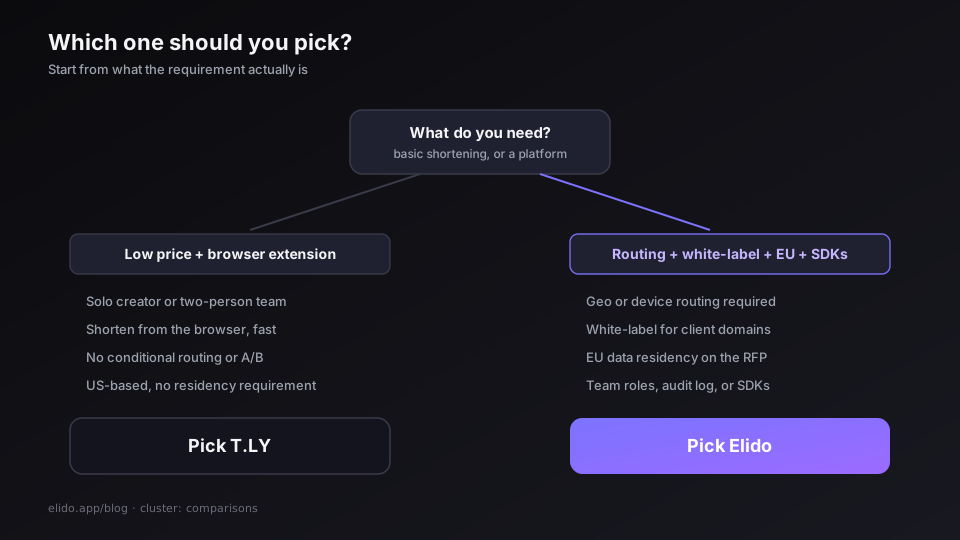
T.LY earns its position. The $5 Pro tier is honest value for a creator or solo marketer who wants custom domain analytics without a large monthly bill. The browser extension is the best single-feature differentiator among low-cost shorteners.
The platform's limits are also honest. There is no routing engine, no white-label, no EU residency, no A/B testing, no team model that scales past two or three people on a shared login. These are not missing features waiting to ship - they reflect a deliberate scope decision. T.LY is built for individual use, priced accordingly, and works well within that scope.
Elido is built for the layer above that: link management with attribution, team and permission structures, EU-first data handling, and developer integration depth. The overlap is real - both products will shorten a URL and show you click counts - but the scenarios where Elido's capabilities matter are the scenarios where T.LY provides no path forward.
Run T.LY as long as the extension workflow, the price, and the analytics depth are sufficient. Switch when routing logic, compliance requirements, white-label needs, or team scale pushes past T.LY's ceiling.
For the broader comparison across shorteners, the free URL shorteners ranked post covers the full field. Current Elido tier pricing is at /pricing.
Related on the blog
Try Elido
Paste a URL, get a working short link
No signup. Link lives for 30 days. Sign up to keep it forever.
No signup needed. Sign up free for 50 links a month.