
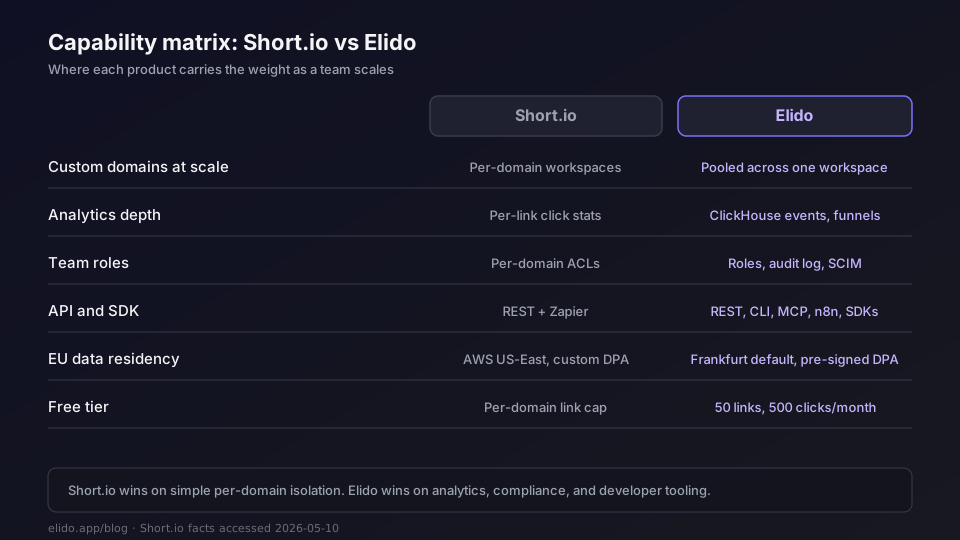
Short.io understood something that most early URL shorteners missed: teams don't run one domain, they run several. The product was built around that reality. Per-domain workspaces, per-domain member permissions, clean dashboard segmentation across brands - it is, genuinely, good product thinking. If you are a small team managing two or three domains with straightforward click analytics, Short.io works and it works without much configuration overhead.
The question is what happens after that. As teams grow, compliance requirements appear, click volumes climb, or engineering starts wanting an API that doesn't require hand-holding - the gap between what Short.io ships and what you need becomes real. This post is the arithmetic version of that gap.
All Short.io numbers below are pulled from short.io/pricing (accessed 2026-05-10) and their privacy policy (accessed 2026-05-10). Pricing changes quarterly; verify before you quote any of it to procurement.
TL;DR
- Short.io caps on links created per domain; Elido caps on clicks served. High link-count teams pay disproportionately on Short.io.
- Short.io stores personal data on AWS in Virginia, US; Elido stores its primary data in the EU. EU data residency is a custom contract conversation on Short.io. On Elido, EU storage is the default, though redirect nodes outside the EU still process visitor requests.
- Short.io has clean per-domain ACLs; Elido adds audit log, SCIM provisioning, and SSO at lower tiers than comparable Short.io plans.
- Short.io's API is clean and well-documented; Elido adds an MCP server, an n8n node, and SDKs for TypeScript, Python, Go and Ruby. Only the Go SDK is published so far; the other SDKs and the MCP server are not on their package registries yet, and there is no CLI.
Pricing model side-by-side
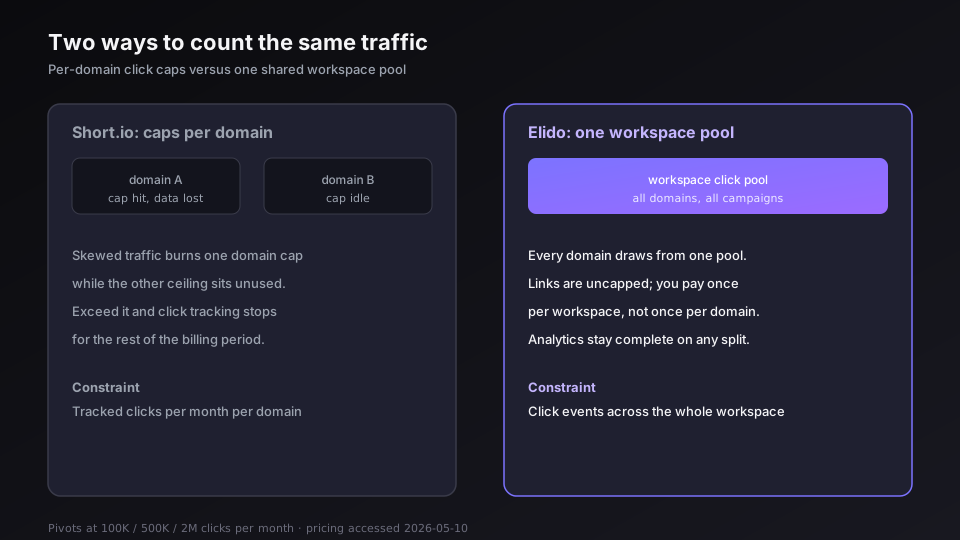
The Short.io model is domain-centric. On the public pricing page (accessed 2026-05-10), the Personal plan is free with a small link cap per domain; Team runs around $20/month with higher link limits and tracked clicks per domain; Business is around $80/month with higher caps and additional features; Enterprise is custom. The constraint that matters is the tracked-click ceiling per domain. Once you exceed it, you either upgrade or lose tracking for the rest of the billing period.
Elido bills differently. The constraint is click events across all domains in a workspace, with links uncapped. You pay once per workspace, not once per domain. The Free tier is 50 links and 500 clicks/month, hard-capped. Pro is a flat monthly fee with a cap that bursts gracefully. Business unlocks wildcard domains and SSO. Enterprise is custom contract.
The split matters at three concrete traffic shapes:
At 100K, think of a small B2B marketing team with two branded domains and a mix of email and social links. Under Short.io Team ($20/month) the ceiling applies per domain, so you need to watch which domain is burning through its tracked allowance faster. If your traffic skews to one domain, you hit the cap there while the other sits idle. Under Elido Pro, one pool is shared across all domains; the cap is a workspace cap, not a per-domain one. At this volume the headline prices are comparable. The operational difference is the pooling.
At 500K it is usually a performance marketing team running paid acquisition, affiliate, and email from three to five domains. At Short.io Business ($80/month), the per-domain ceiling leaves two options: spread links across domains deliberately to stay under each cap, or hit the ceiling and lose data fidelity partway through the billing period. Under Elido Business, the workspace pool at this tier covers 500K without per-domain accounting. Analytics stay complete regardless of which domain carries the load.
At 2M you are in agency or enterprise land. Under Short.io, this is Enterprise territory, with pricing off the public page and negotiated. The per-domain model at this scale means your contract needs to account for how traffic splits across domains, which adds complexity when client traffic isn't predictable. On Elido Business (or Enterprise), the pool covers the full workspace, and client-specific accounting is handled by folder-level reporting rather than per-domain plan caps.
The underlying question is whether your bottleneck is "links created" or "clicks served". The Short.io model is correct if you mint a small number of links that get very high individual traffic. Elido's model is correct if you mint many links across campaigns: high link count, moderate per-link traffic, aggregate click volume as the real constraint.
Team workflows - the feature both pitch
Both products are pitched at teams, not individuals. The feature sets overlap more than you'd expect; the gap is in depth and tier availability.
Short.io's core strength is per-domain workspace isolation. Each domain gets its own member list, its own link library, its own analytics view. Adding a team member to one domain doesn't give them access to another. For a multi-brand agency or a company with strict brand separation, this is exactly the right model. The UX is clean and the permission surface is small enough that non-technical users can manage their own domain without accidentally touching someone else's.
Elido's workspace model is hierarchical: workspaces contain folders, folders contain links, and roles apply at both levels. A workspace admin sees everything; a folder editor sees only their assigned campaigns; a viewer sees analytics without edit access. This maps better to a single marketing team running multiple campaigns under one brand - a structure where shared analytics and cross-folder reporting matter more than hard domain isolation.
Where Short.io wins: per-domain ACLs are more granular for true multi-brand isolation, and the configuration is simpler. Where Elido wins:
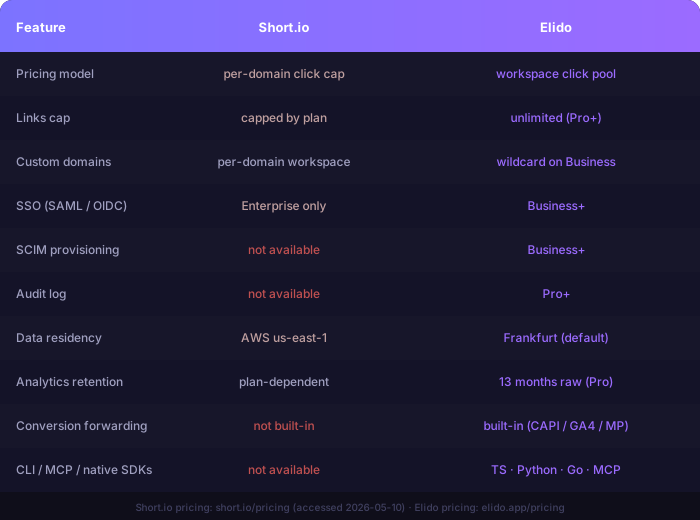
- Audit log - every link creation, edit, deletion, and member change is logged with timestamp, actor, and before/after state. Short.io's Team and Business plans don't include a comparable audit trail at the time of writing.
- SCIM provisioning - deprovision a member in your IdP (Okta, Azure AD, Google Workspace) and they're automatically removed from all Elido workspaces. Short.io does not advertise SCIM on any public plan page as of 2026-05-10.
- SSO tier - Elido ships SAML/OIDC SSO via WorkOS on the Business plan. Short.io's SSO is gated behind Enterprise.
For a 20-person in-house marketing team, per-domain ACLs are probably not the constraint - everyone is on the same domain family anyway. Audit log and SCIM are the features that matter when your IT/InfoSec team reviews the tool as part of an access review. Short.io passes a casual evaluation; Elido passes a formal one.
EU residency and compliance
Short.io's help centre (How safe is Short.io?, accessed 2026-11-12) says personal data is stored in AWS S3 in Virginia, in the US, and its About page lists its headquarters in Delaware. They offer a Data Processing Agreement; whether that DPA satisfies a data residency clause is a question for your legal team, not Short.io's marketing page.
The relevant EU authority on this is the European Data Protection Board, which has published guidelines on data transfers to third countries. The practical implication for any US-hosted SaaS under the current SCC framework: EU buyers who need to ensure personal data (including click-event IP addresses and user agent strings, which qualify as personal data under GDPR Recital 30) doesn't leave the EU need either a custom contractual arrangement or a vendor that defaults to EU hosting.
Elido keeps its primary database, analytics store and backups in the EU, though redirect nodes in the US and Singapore still process visitor requests and per-workspace region pinning is not available yet. The sub-processor list has 13 entries and is published on the trust page. A DPA with Article 28 obligations and EU SCCs is available on request on every plan; it is not pre-signed.
For teams in EU-regulated industries - healthcare, finance, EU public sector - the residency question is not about marketing claims, it's about what your DPA actually says and whether a Transfer Impact Assessment is required. Short.io's storage on AWS in the US needs that TIA. With Elido the stored data sits in the EU, which narrows the TIA to the redirect nodes outside the EU rather than removing it. The solutions/marketers page has the procurement-facing specifics if your legal team asks for them.
Analytics depth
Analytics on Short.io are per-link: country, device type, browser, referrer, and OS for each link, with a time range selector defaulting to the last 30 days. The product is honest about what it is - click-level event data visualised cleanly, without the complexity of a full analytics product.
Behind Elido's analytics sits a columnar analytics store holding raw click events with no sampling. The practical differences:
- Retention: Short.io's publicly documented retention varies by plan, and on Free and Team tiers historical data depth is limited. Elido keeps click rows for 90 days on Free, one year on Pro and two years on Business.
- Funnels. Elido's analytics exposes funnel reports over click events, plus conversion reports for Stripe and Shopify purchases tied to the link. Short.io does not ship funnel reports.
- Exports run on a schedule in Elido, as CSV on a daily or weekly cadence, delivered to S3 or email. Short.io's export is manual and on-demand.
- Event forwarding sends click events server-side to GA4, Mixpanel, Klaviyo, Brevo and Datadog. Forwarding purchases to Meta CAPI or GA4 is not available yet. Short.io does not ship server-side forwarding as a built-in.
For a team doing basic click reporting, Short.io's analytics are sufficient and the UI is genuinely cleaner. For a performance marketing team where attribution fidelity matters - where you want raw, unsampled click events you can forward to your own analytics stack - the columnar analytics store is the operational difference.
APIs and integrations
Short.io's REST API is well-documented (see developers.short.io) and supports the core operations: create, read, update, delete links, retrieve click statistics, manage domains and team members. The Zapier integration covers most automation scenarios a non-technical user would reach for. It's a clean, functional API with clear documentation; no complaints.
Elido ships the API plus the surrounding tooling:
- No CLI yet. A command-line tool for CI pipelines is planned; today a CI job calls the REST API directly.
- An MCP server that connects Elido to Claude, Cursor, or any MCP-aware client. It runs locally over stdio, is not on npm yet, and acts with the scope of the API key you give it.
- An n8n custom node, a native integration for teams that run their automation stack on n8n rather than Zapier.
- Official SDKs for TypeScript, Python, Go and Ruby, each maintained against the OpenAPI 3.1 spec. The Go SDK is published (v0.1.0); the TypeScript, Python and Ruby SDKs are not on npm, PyPI or RubyGems yet.
If your team's automation lives entirely in Zapier, Short.io's integration is the simpler choice. If you're running a developer-managed link infrastructure - CI pipelines creating campaign links, LLM tools querying click stats, a Go service bulk-importing partner redirects - Elido's tooling surface covers more without forcing a custom integration.
Migrating from Short.io
You can pull links out of Short.io through their API or as a CSV download from the dashboard. The CSV includes the original slug, destination URL, domain, tags, and creation date. Click history is not in the export.
Import Short.io's CSV into Elido using the bulk import endpoint, specifying the original slugs verbatim to preserve all existing short URLs:
curl -X POST https://api.elido.app/v1/workspaces/{workspace_id}/links/bulk \
  -H "Authorization: Bearer $ELIDO_API_KEY" \
  -H "Content-Type: application/json" \
  -d '{
    "links": [
      {
        "slug": "abc123",
        "destination": "https://your-destination.com/page",
        "domain": "go.yourdomain.com",
        "tags": ["migrated", "short-io"]
      }
    ]
  }'
The bulk import endpoint accepts up to 100 links per request and preserves slugs verbatim, so a workspace with thousands of links just means paginating the CSV and running the import in batches until the file is done. It's idempotent on slug + domain. Re-running the same import won't create duplicates, and that's the property I'd test first before trusting any migration script with live links.
DNS repointing is where the cutover window comes from. Lower your branded domain's CNAME TTL to 60 seconds at least 24 hours before the switch, then repoint the CNAME to Elido's edge. Once the DNS propagates, on-demand TLS provisions the certificate in under 60 seconds. The old Short.io slugs continue resolving on Elido's infrastructure as long as the CNAME points there. More on the DNS mechanics in the custom domains feature page.
Related: the sibling post Elido vs Bitly covers the migration path from Bitly specifically, and Elido vs Rebrandly covers the team workflow angle from a different starting point. The Bitly alternatives feature gap cornerstone has the broader feature table if you're evaluating multiple shorteners at once.
When Short.io is the right pick
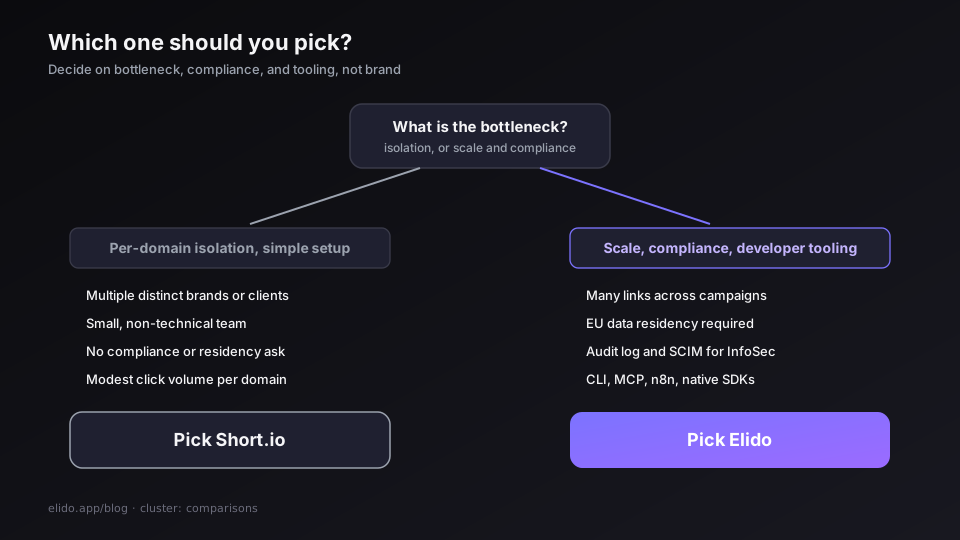
Short.io is the right call when:
- You run multiple distinct brands or clients and want hard domain isolation without building a permission hierarchy. The per-domain workspace model is elegant for this shape.
- Your team is small and non-technical. The Short.io UX is polished and approachable. There's less configuration surface to get wrong.
- You don't have a compliance ask: no EU data residency requirement, no SCIM provisioning, no audit log requirement from InfoSec. Short.io clears the bar for a straightforward SaaS purchase review.
- Your click volumes are modest and stay within the per-domain click caps on Team or Business. At that scale, Short.io's pricing is competitive and the per-domain pooling doesn't create accounting friction.
Don't switch for the sake of switching. If Short.io is working for your team and none of the constraints above apply, the migration effort isn't justified by the marginal feature gain.
Where the decision actually pivots
Two variables determine which product is the right fit.
The first is the pricing model. Short.io's per-domain click caps create operational overhead - you need to watch which domain burns through tracked clicks and how fast - and they put a ceiling on analytics completeness when traffic spikes unpredictably. Elido's workspace-level click pool removes the per-domain accounting problem. If you mint many links across campaigns, the workspace pool is the cleaner model. If you mint a few links per domain and traffic is predictable, Short.io's caps probably never bite.
The second is EU residency. Short.io stores personal data on AWS in the US. If your buyer's procurement team is going to require a Transfer Impact Assessment or a data residency clause, that conversation adds weeks and doesn't resolve cleanly. Elido stores its data in the EU. A DPA is available on request on every plan; it is not pre-signed. The 13-entry sub-processor list is public.
For teams that don't hit either of those constraints - modest link volume, no EU residency ask - Short.io is a reasonable product that doesn't need replacing. For teams that do, the comparison resolves quickly.
See /compare/vs-short-io for the side-by-side comparison table, and /pricing for current Elido tier pricing before you run your own numbers.
Related on the blog
Try Elido
Paste a URL, get a working short link
No signup. Link lives for 30 days. Sign up to keep it forever.
No signup needed. Sign up free for 50 links a month.