Short.io and Rebrandly both sell branded short links, and the plans look similar until you read the meters. Short.io is the cheaper, higher-volume option: its $18 Pro plan has unlimited branded links and unlimited tracked clicks. Rebrandly costs more per tier and caps links and clicks monthly, but it adds workspaces and teammates earlier and has an Enterprise tier listing SOC 2 Type 2 and HIPAA.
I compared the two on pricing, custom domains, analytics, API, QR and bio pages, team features, compliance, and migration. Every number below comes from each vendor's own pages (accessed 2026-10-01), and where a page didn't say something, I left it out. If you're still choosing between this pair and the wider market, the Short.io alternatives and Rebrandly alternatives roundups cover the field, and best EU URL shorteners covers residency.
Pricing Tiers Side by Side
The two vendors meter differently, which makes a plain price comparison misleading. Short.io counts a lifetime pool of branded links and a monthly tracked-click allowance. Rebrandly counts new links and tracked clicks per month, so the quota resets each billing cycle.
| Level | Short.io (monthly price) | Rebrandly (monthly / annual price) |
|---|---|---|
| Free | $0: 1,000 branded links total, 50,000 tracked clicks/mo, 5 domains, 1 user | $0: 10 links/mo, 100 tracked clicks/mo, 1 domain |
| Entry | Hobby $5: 2,500 links total, 100,000 clicks/mo, 7 domains | Essentials $11 / $8: 250 links/mo, 10,000 clicks/mo, 2 domains |
| Mid | Pro $18: unlimited links and clicks, 10 domains, 1 user | Professional $32 / $22: 1,500 links/mo, 25,000 clicks/mo, 3 domains |
| Team | Team $48: 50 domains, unlimited users | Growth $99 / $69: 3,500 links/mo, 150,000 clicks/mo, 10 domains |
| Top | Enterprise $148: unlimited domains, SSO | Enterprise: custom quote, SSO |
Sources: Short.io pricing and Rebrandly pricing, accessed 2026-10-01. Short.io shows a 17% saving on annual billing; I've listed its monthly prices.
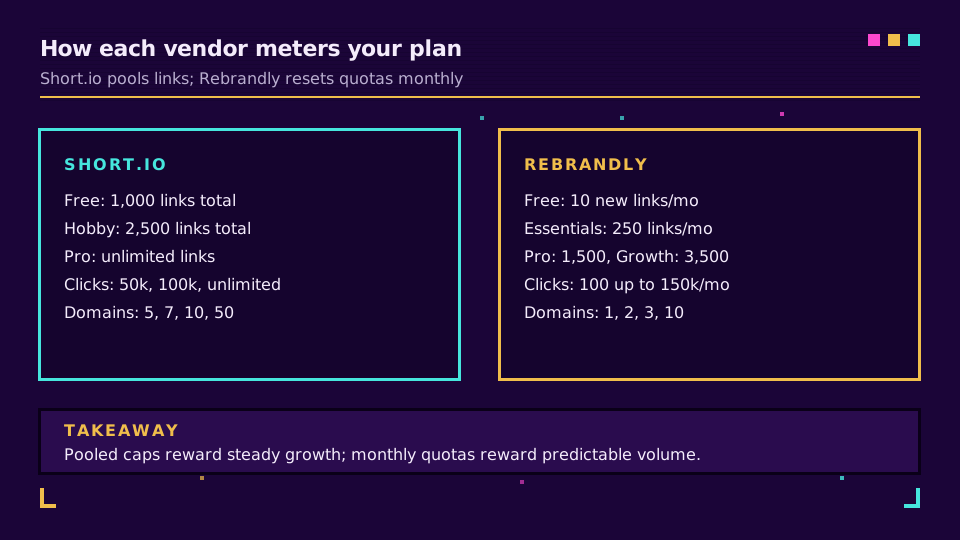
Two details matter more than the sticker price. Short.io's free plan hides statistics after the first 50,000 clicks, though it keeps collecting data and your links keep working. And Short.io's $18 Pro plan still has a single user, so a small team pays $48 for Team before a second person can log in. Rebrandly's Professional plan lists two workspaces and teammates at $32.
Custom Domains
Custom domains are where both products earn their keep, and the difference is access. Short.io requires you to use your own domain: there is no generic shared domain for shortening. Its free plan allows 5 custom domains, Pro 10, Team 50, and Enterprise unlimited, and the Short.io pricing FAQ says domain connection is included in every plan.
Rebrandly gives you a free generic shortener domain, which is handy for a quick test, and a branded domain from the free plan up. The count climbs slowly: 1 on free, 2 on Essentials, 3 on Professional, 10 on Growth. Rebrandly's comparison page makes the same point about Short.io.
For an agency running a domain per client, Short.io's domain counts are the clearest difference in this whole comparison. For one brand with one domain, either is fine. Our custom domains guide covers DNS setup either way.
Analytics and Click Data
On Short.io, "tracked clicks" means redirects visible in statistics by country, device, language, and time. Rebrandly's pricing page describes engagement data on clicks and QR scans per month, with basic audience data on Essentials and city-level data from Professional up. Conversion tracking appears at Professional on Rebrandly; Short.io's table lists a conversions allowance of 50 per month on free and 200 on Hobby, unlimited from Pro.
So both meter analytics, just differently. Short.io's cap resets monthly and lifts at Pro. Rebrandly's cap tops out at 150,000 tracked clicks per month on Growth, and Enterprise is custom. If you run high-traffic campaigns, check the cap against your real click volume before you pay anyone. Rebrandly's pricing page also lists clickstream on Enterprise, which pipes raw click events out. Short.io offers a daily raw export to S3 on Enterprise.
API and SDKs
Both treat the API as a standard feature rather than an add-on. Short.io lists the API on every plan with a 50 requests per second limit on all of them, and its site mentions JavaScript, Node.js, iOS and Android SDKs. Rebrandly's API documentation covers API key and OAuth authentication, official Python and Node.js libraries, an OpenAPI spec, and clickstream webhooks to a REST endpoint or an S3 bucket.
Rebrandly's rate limits scale by plan: its pricing page lists 100 calls per minute on free, rising to 1,000 on Growth. Short.io's flat 50 requests per second is a very different shape if you bulk-create links. Short.io also separates "link automation" (links created via API or bulk) from "branded links total" (links created in the web app), with its own caps per plan. The point to take away: read the limit that matches how you'll create links. For retries and idempotency on either API, rate limits and idempotency explains what to look for, and API and SDK quickstart shows the pattern.
QR Codes and Bio Pages
Short.io includes QR codes on every plan, with colors, logos, and finder shapes, plus link-in-bio "posts" and link bundles that group several links behind one branded landing page. None of these are gated by plan on its comparison table, though storage grows with the tier, from 10 MB on free to 1 GB on Pro.
Rebrandly includes QR codes and link galleries (its bio-style pages) on every plan but meters both: QR codes per month run 10, 250, 1,500, and 3,500 up the ladder, and galleries run 1, 3, 4, and 11. If you generate QR codes at scale for print, that cap matters. If you only need a handful, it doesn't. For what makes a QR code worth printing, see the Elido QR codes feature and bio pages pages.
Team Features and Compliance
This is where Rebrandly pulls ahead on paper. Its pricing lists 2 or more teammates on Professional and 5 or more on Growth, and Enterprise adds SSO (SAML), SCIM provisioning, and "GDPR, SOC II Type 2, HIPAA Compliant." Rebrandly's features page also lists audit logs and a 99.99% uptime SLA. Rebrandly's comparison article says Short.io has a smaller selection of user roles, and Short.io's site describes role-based access with Admin and Member.
Short.io gives you unlimited users from the $48 Team plan and a 99.9% uptime SLA there too. Multiple teams and SSO wait until Enterprise at $148. Its feature table lists GDPR privacy as included on every plan, with Short.io acting as data processor. I couldn't find a SOC 2 claim on its pricing or features pages, so I won't say it has or lacks one: ask for the report if your security review requires it.
On residency, neither the pricing page nor the features page for either vendor lists a choice of storage region. If "click data stays in the EU" is a written requirement, you need a written answer from either vendor, not an assumption. That gap is why teams with a hard EU rule often end up looking at an EU-first option instead.
If you want a branded link tool where EU residency is the default rather than a contract question, try Elido on a few real links and compare analytics and API behavior against what you've seen above. It's a newer product than either of these, so check it against your integration needs.
Migration Between the Two
Moving between them is mostly a domain question. Short.io says you can import existing short URLs from other shorteners and export all your links free by asking support. Rebrandly publishes a guide on how to switch from Short.io to Rebrandly, and Short.io publishes its own page on switching from Rebrandly, so each vendor is happy to take you from the other.
The risk is the same either way. Links on your own domain keep working after you repoint DNS, while links on a vendor-owned shared domain stay behind. Exports typically carry slugs, destinations, and tags, but historical click data rarely comes along. The Rebrandly migration playbook walks through the handover without losing slugs, and the same logic applies in reverse.
Which One to Pick
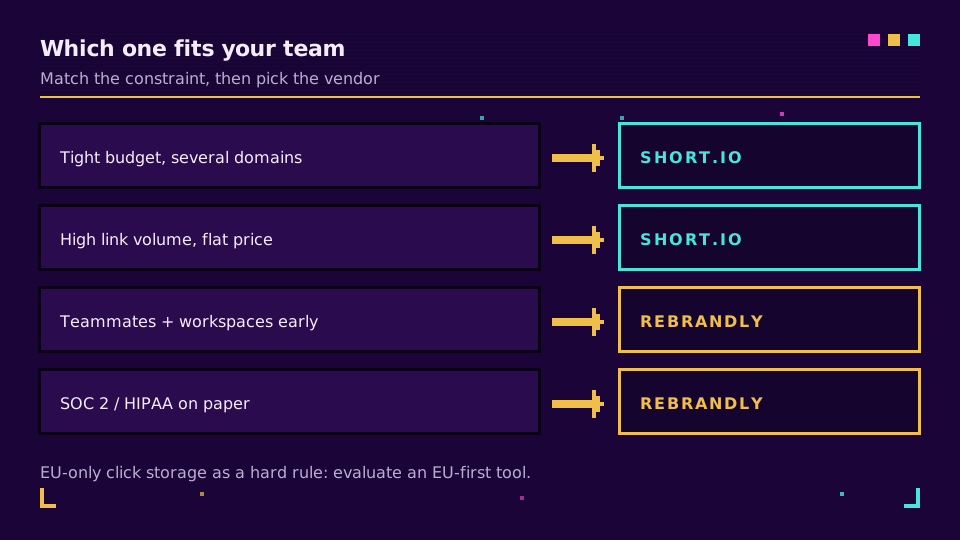
Pick Short.io if your constraint is budget or domain count, and one user on Pro is enough. Pick Rebrandly if teammates, workspaces, an integration catalog, or SOC 2 and HIPAA on Enterprise are what a buyer will ask about first. Neither is a mistake. I'd test both free plans with your real links for a week, since Short.io's is genuinely usable and Rebrandly's is a trial.
For the same pair against a third vendor, see Short.io vs Bitly and Bitly vs Rebrandly. For how Elido compares to each, read Elido vs Short.io and Elido vs Rebrandly. More head-to-heads live in the comparisons cluster.
Related on the Blog
Frequently asked questions
Which is better, Short.io or Rebrandly?
Neither wins everywhere. Short.io is the better pick when you want a low flat price, many custom domains, and unlimited tracked clicks from the $18 Pro plan. Rebrandly is the better pick when you need teammates and workspaces on lower tiers, a SOC 2 Type 2 and HIPAA story at the Enterprise level, or a broad integration catalog.
Is Short.io cheaper than Rebrandly?
At comparable tiers, yes. As of 2026-10-01, Short.io lists Pro at $18/month with unlimited branded links and clicks, while Rebrandly lists Professional at $32/month ($22 billed annually) with 1,500 new links and 25,000 tracked clicks per month. Short.io also offers a much larger free plan.
Do Short.io and Rebrandly have a free plan?
Yes, both do. Short.io's free plan allows 1,000 branded links in total, 50,000 tracked clicks per month, and 5 custom domains. Rebrandly's free plan allows 10 new links and 100 tracked clicks per month with 1 custom domain, so it is more of a trial than a working tier.
Does Short.io or Rebrandly have an API?
Both have a REST API on every plan. Rebrandly documents API key and OAuth authentication, official Python and Node.js libraries, an OpenAPI spec, and clickstream webhooks. Short.io lists its API on every plan with a 50 requests per second limit and JavaScript, Node.js, iOS and Android SDKs on its site.
Can I use QR codes and link-in-bio pages on both?
Yes. Short.io includes QR codes and link-in-bio posts on every plan, including free. Rebrandly includes QR codes and link galleries too, but caps them per month and per plan, for example 10 QR codes and 1 gallery on free.
How do I migrate from Rebrandly to Short.io, or the other way?
Export your links and import them into the new tool, then repoint your custom domain's DNS. Short.io documents free link export on request and a link import feature. Links on your own branded domain survive the move; links on a vendor-owned shared domain do not.
Try Elido
Paste a URL, get a working short link
No signup. Link lives for 30 days. Sign up to keep it forever.
Free, no signup required · 2 per day