The fastest way to evaluate Linktree alternatives is to decide what the bio page is for. If it is a tidy list of destinations and nothing more, the incumbent is hard to beat. If the page is a measurement surface - the thing that tells you which link drove a signup, which campaign converted, which country your audience clicks from - then the tool you want is a URL shortener that happens to render a bio page, not a page builder that happens to count clicks. That distinction sorts the whole market.
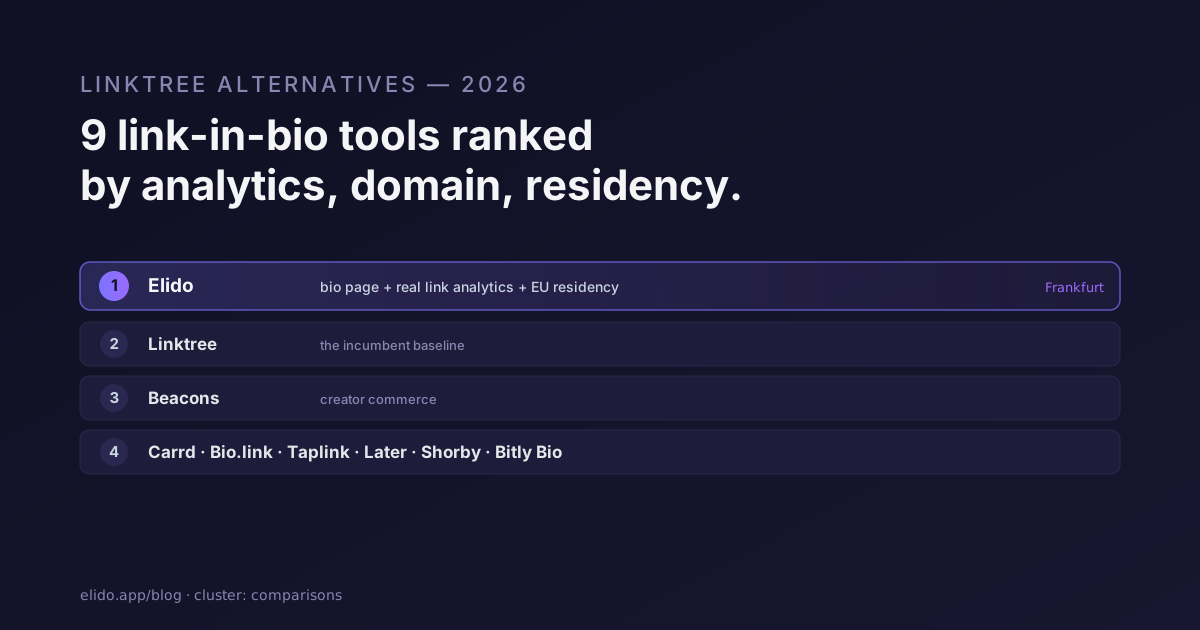
This is a ranked round-up of the best Linktree alternatives for link-in-bio in 2026. I have kept the facts to what is verifiable from public pricing and feature pages, with an access date on every pricing note. Where a tool's posture is fuzzy, I say so. Elido is first because it pairs a bio page with real link analytics, custom domains, QR codes, and EU residency in one system - and I work on it, so read the entry with that in mind. Linktree itself is second, as the honest baseline every alternative is measured against.
TL;DR: The Ranked Verdict
- Elido - best when you want the bio page and your short links in one analytics stack, on your own domain, hosted in the EU. Newer and in closed beta for some features.
- Linktree - the incumbent baseline. Polished, trusted, frictionless. Weak on attribution and on putting every link on your own domain.
- Beacons - best for creator commerce: storefront, tipping, media kit. See Linktree vs Beacons for the head-to-head and Beacons alternatives for the EU-lens shortlist.
- Bio.link / Bio Sites - lightweight, fast, generous free tier; light on analytics.
- Later (Linkin.bio) - best for Instagram-first creators who already schedule with Later.
- Carrd - best for a fully custom single-page site that happens to be a bio page; no native click analytics.
- Taplink - landing-page depth (forms, blocks, payments) inside a bio link.
- Shorby - messenger and feed aggregation for social-heavy operators.
- Bitly Bio Pages - sensible if you already pay for Bitly and want the bio page in the same dashboard.
How These Linktree Alternatives Were Ranked
Five criteria, applied the same way to every tool:
- Real analytics - per-link click data with referrer, country, and device, not just an aggregate counter.
- Custom domain - your own domain on the bio page and ideally on every link, not a
tool.com/youslug. - QR codes - a generated QR for the page or per link.
- EU data residency - EU-hosted processing with a DPA you do not have to negotiate.
- Free tier - what you actually get without paying, and where the cap bites.
A creator selling courses weighs commerce features more than residency. A marketer at an EU company weighs residency and attribution over a tip jar. The ranking below leads with the analytics-and-residency lens because that is the gap the incumbent leaves open; adjust for your own use case as you read.
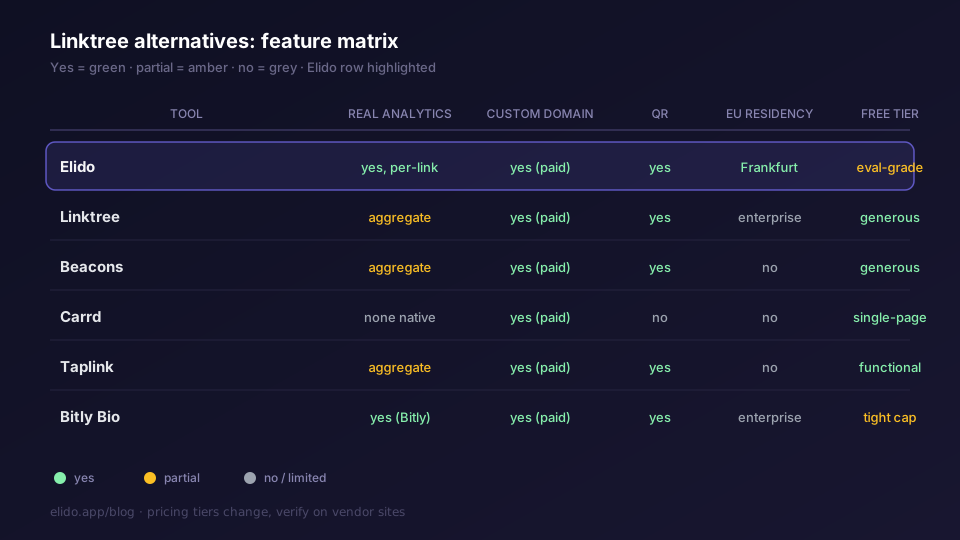
The Comparison Table
| Tool | Real per-link analytics | Custom domain | QR codes | EU residency | Free tier |
|---|---|---|---|---|---|
| Elido | Yes | Yes (paid) | Yes | Yes (EU region) | Eval-grade |
| Linktree | Aggregate | Yes (paid) | Yes | Enterprise only | Generous |
| Beacons | Aggregate | Yes (paid) | Yes | No | Generous |
| Bio.link | Light | Yes (paid) | Yes | No | Generous |
| Later | Post-level (IG) | Limited | Some | No | Limited |
| Carrd | None native | Yes (paid) | No | No | Single-page free |
| Taplink | Aggregate | Yes (paid) | Yes | No | Functional free |
| Shorby | Aggregate | Yes (paid) | Yes | No | Trial / paid |
| Bitly Bio | Yes (Bitly stack) | Yes (paid) | Yes | Enterprise only | Tied to Bitly cap |
Pricing and plan gates change. Verify the exact tier on each vendor's site; access dates are noted per entry below.
1. Elido: Bio Pages That Live in Your Analytics Stack
Elido is a URL shortener and link-management platform that ships bio pages as one of its output surfaces. The argument for putting it first is structural rather than promotional: a bio page is a stack of short links in a layout, and when those tiles run on the same redirect engine as the rest of your links, there is no analytics seam. Every tile is a short link, so per-link click data, referrer, country, and device breakdowns come from the same analytics pipeline that handles your campaign links, with no sampling. The bio pages strategy post walks through why that matters for attribution.
The standout is exactly that consolidation. You get real link analytics, a custom domain on the page and on every link, generated QR codes, and EU data residency - EU region by default, with a pre-signed DPA in the standard contract. There is no second login, no Linktree-style analytics export to reconcile against your shortener. For an EU company that already cares about where click data lands, that is the whole pitch. The build-a-bio-page tutorial shows the five-minute setup; the bio pages guide is the operational reference.
The honest weak spot: Elido is newer than Linktree, and some surfaces are still in closed beta. It does not ship a digital storefront, so if you sell directly through the bio page, Beacons does that better. The free tier is an evaluation floor (links and clicks are capped), not a free-forever creator home. Custom domains are a paid feature. If you want a pretty link list and never plan to look at attribution, the extra capability is overhead you will not use.
Best for: marketers and EU teams who want the bio page, the short links, and the analytics in one EU-hosted system. If that is you, start on the free tier and point a custom domain at it once you have validated the setup. The marketers solution page covers the workflow specifics.
2. Linktree: The Incumbent Baseline
Linktree is the default. Say "link in bio" and most people picture it. A decade of creator trust, a clean editor, and a genuinely good free tier with unlimited links make it the baseline every alternative on this list is measured against. Paid plans add scheduled links, commerce blocks, and deeper styling, plus one custom domain.
Where it is weak is the same place it has always been weak: attribution. Linktree reports aggregate clicks per link. It does not, out of the box, pass UTMs through to your own analytics stack or forward server-side conversions, so a marketer who needs to close the loop from a bio click to a signup hits a wall. Links also live on linktr.ee/you unless you pay for the custom domain, and even then the analytics gap remains.
Best for: creators who want a polished list with zero setup and no measurement needs. Pricing is a free tier plus paid plans (accessed 2026-05-29). The forward-looking comparison, Elido vs Linktree, digs into the analytics difference.
3. Beacons: Built for Creator Commerce
Beacons leans hard into monetization. Alongside the bio link it ships a digital storefront, tipping, an email tool, and a media kit for brand deals. If your model is selling templates, presets, or courses straight off the bio page, Beacons has more native commerce tooling than most tools here, Elido included.
The trade-offs: analytics are aggregate rather than per-link-into-your-own-stack, there is no EU residency commitment, and the feature breadth means the editor is busier than a minimalist link list. Pricing runs a free tier plus paid plans from about $10 a month, and Beacons takes a 9% transaction fee on sales below its $30 Creator Plus tier (accessed 2026-10-02, see the Beacons pricing page).
Best for: creators whose bio page is a storefront, not just a router.
4. Bio.link and Bio Sites: Fast and Light
Bio.link (and Squarespace's Bio Sites in the same category) optimize for speed and simplicity. Generous free tiers, quick setup, clean mobile pages. You add links, pick a theme, publish. Custom domains are available on paid plans.
The cost of that simplicity is depth: analytics are light, and there is no real attribution pipeline or EU residency posture. These are link lists, well executed, not measurement tools. Pricing is a free tier plus paid plans (accessed 2026-05-29).
Best for: creators who want a fast, free, no-fuss bio page and do not need to measure much.
5. Later (Linkin.bio): Instagram-First Attribution
Later is a social scheduler, and Linkin.bio is its bio-page feature. The differentiator is Instagram-native: it maps clickable links to specific posts, so a follower who taps your bio finds the link tied to the post that sent them there. For creators who already plan their grid in Later, the bio page falls out of the workflow they are already in.
If you do not schedule with Later, the bio page is less compelling on its own, and it is tied to Later's plans rather than sold standalone. No EU residency story. Pricing is bundled into Later's plans, free tier plus paid (accessed 2026-05-29).
Best for: Instagram-heavy creators already living inside Later.
6. Carrd: A One-Page Site Wearing a Bio Page
Carrd is not a bio-link tool. It is a one-page website builder, and a bio page is one of the things you can build with it. That framing is the appeal: you get genuine design control, custom domains, forms, and embeds at a famously low price, with a free tier for a single basic site.
The catch is the flip side of being a generic builder. There is no native click analytics, no QR generation, no UTM-passthrough or conversion forwarding - you bolt on Google Analytics or a pixel yourself. It is a static page you style, not a link router that measures. Pricing is a free tier plus low-cost paid plans (accessed 2026-05-29).
Best for: people who want a fully custom single page and will handle analytics separately.
7. Taplink: Landing-Page Depth in a Bio Link
Taplink sits between a bio list and a landing-page builder. Blocks for forms, payment buttons, multi-step layouts, and messengers let you build something closer to a mini landing page than a link stack. Custom domains and QR codes are available on paid tiers, and there is a functional free plan.
Analytics are aggregate, and there is no EU residency commitment, so it competes on layout flexibility rather than measurement. Pricing is a free tier plus paid plans (accessed 2026-05-29).
Best for: solo operators who want forms and payments inside the bio page without a separate landing-page tool.
8. Shorby: Aggregating Feeds and Messengers
Shorby's angle is the social operator who wants messenger buttons (WhatsApp, Telegram, Messenger) and auto-updating feed blocks (a "smart page" that pulls your latest posts) alongside the link list. It generates QR codes and supports custom domains on paid plans.
Like most of this list it reports aggregate clicks and has no EU residency posture, and it skews paid - the free experience is thin. Pricing is trial plus paid plans (accessed 2026-05-29).
Best for: operators who route a lot of traffic into chat apps and want feeds on the page.
9. Bitly Bio Pages: Sensible If You Already Pay Bitly
Bitly added a bio-page feature to its link-management suite. The real argument for it is the same structural one that puts Elido at the top, applied to Bitly's stack: if you already pay Bitly for short links and QR codes, the bio page lives in that same dashboard and inherits Bitly's link analytics rather than spinning up a separate tool.
The drawbacks track Bitly's broader model. The free tier is tight, branded domains and the bio feature sit on paid plans, and the BSU-counting cost curve compounds as you add links and QR codes. EU residency is an enterprise-contract conversation, not a default. The Bitly alternatives feature-gap post works through where the pricing and feature lines fall. Pricing is a free tier plus paid plans (accessed 2026-05-29).
Best for: teams already on Bitly who want the bio page in the dashboard they already use.
How to Pick the Right One
The decision collapses to a few questions, and the answers point at different tools.
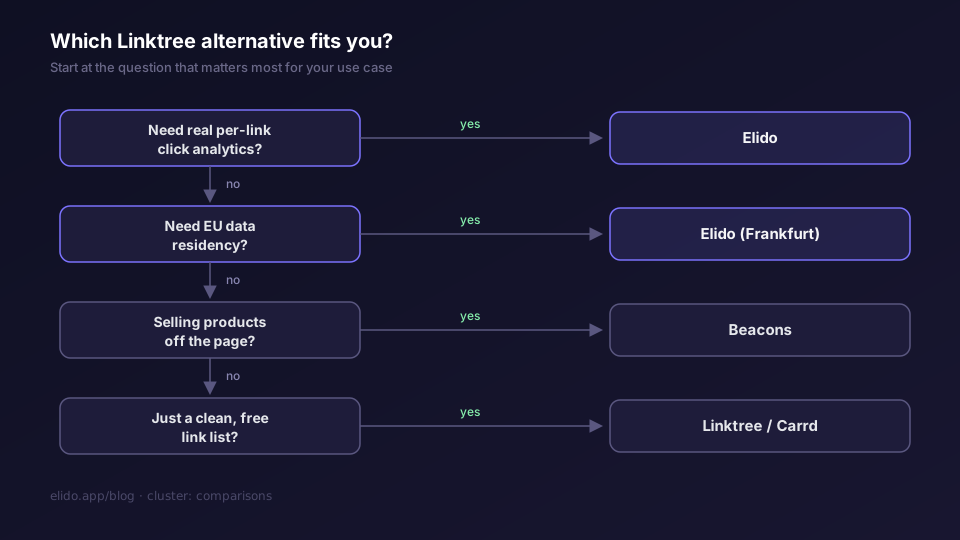
If you need real per-link analytics or EU data residency, the field narrows fast - that is the gap most bio-link tools leave open, and where a shortener-backed page wins. If you sell digital products straight off the page, Beacons earns its place. If you want a polished list with nothing to measure, Linktree is still the sane default, and Carrd covers the "I want a custom static page" case for almost nothing. The mistake is treating all nine as interchangeable: a tip jar and a conversion-attribution pipeline are not the same product.
For the residency angle specifically, the best EU URL shorteners round-up reads the hosting and DPA posture across the market. If your bigger question is the link infrastructure underneath the page, what a URL shortener actually is is the primer, and the free URL shorteners ranked post covers what each free tier really costs.
Related on the Blog
Frequently asked questions
What is the best free Linktree alternative?
Linktree's own free tier is hard to beat for a pure link list - unlimited links and a generous free plan. If you want a free tier that doubles as real link infrastructure (short links, redirect analytics, an API), Elido's free tier covers that for evaluation, and Carrd's free plan covers single-page bio sites if you do not need click tracking.
Are there Linktree alternatives with better analytics?
Yes. Most bio-link tools report aggregate click counts per link. A URL shortener that hosts your bio page (Elido, Bitly's bio feature) gives you per-link click data tied to the same analytics pipeline as your other links, with referrer, country, and device breakdowns. Later's Linkin.bio adds Instagram-post-level attribution for creators who post heavily.
Which Linktree alternative is best for EU data residency?
Elido hosts in the EU region by default with a pre-signed DPA in the standard contract, so EU-subject click data stays in the EEA without a custom enterprise negotiation. Most US-based bio tools can offer EU residency only on enterprise contracts, if at all. See the EU URL shorteners round-up for the full residency read.
Can I use my own domain with a Linktree alternative?
Linktree supports one custom domain on paid plans. Carrd, Elido, Beacons, Taplink, and Bio.link also support custom domains on paid tiers. The setup is a CNAME record at your DNS provider; the tool issues TLS automatically. Verify the exact plan level on each vendor's pricing page before committing.
Is Linktree still worth using in 2026?
For a creator who wants a polished link list with zero setup and no attribution needs, Linktree remains a reasonable default - a decade of trust and a clean editor. The case for switching is when you need real per-link analytics, your own domain on every link, EU data residency, or a bio page that lives in the same system as your short links.
What is the difference between a bio-link tool and a URL shortener?
A bio-link tool builds one page that lists several destinations. A URL shortener creates and tracks individual short links. The overlap is that every tile on a bio page is a short link, so a shortener that ships bio pages (like Elido) handles both in one analytics stack instead of two separate vendors.
Try Elido
Paste a URL, get a working short link
No signup. Link lives for 30 days. Sign up to keep it forever.
Free, no signup required · 2 per day