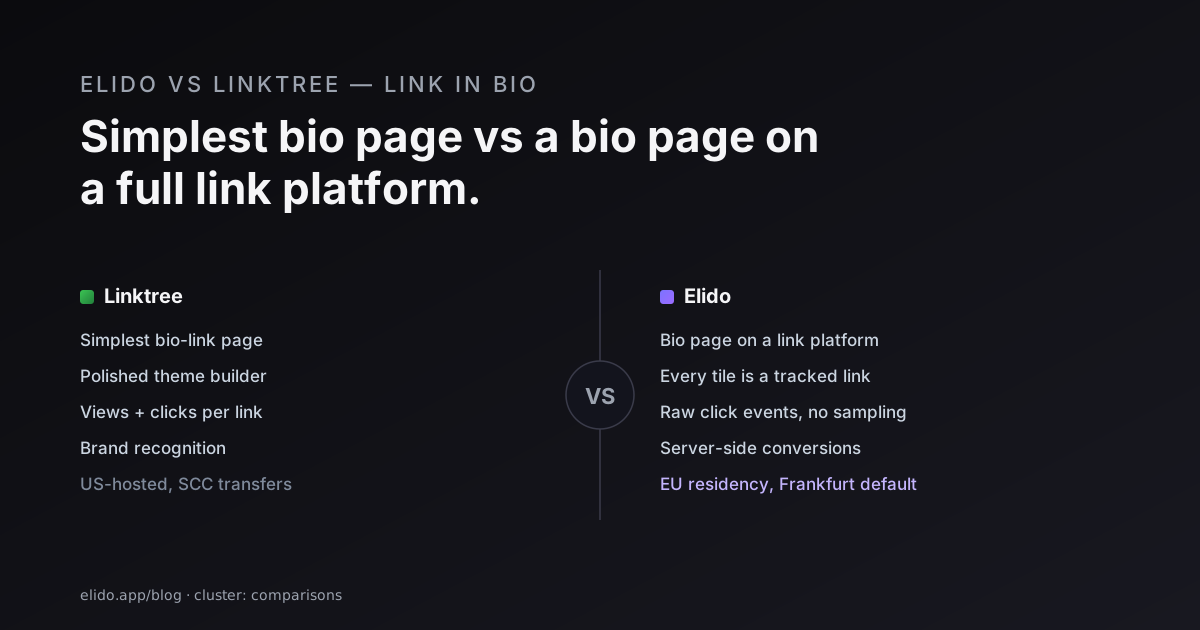
If you searched "Elido vs Linktree", here is the verdict before the detail. Linktree is the simplest, most recognized link-in-bio page on the market, and for a creator who wants a clean menu of links behind one Instagram URL, it is hard to beat on ease and brand familiarity. Elido is a link-in-bio that sits on top of a real link-management, analytics, and EU-residency platform. The bio page is one surface among many, sharing the same redirect layer, the same click pipeline, and the same custom domains as your short links.
That difference decides the whole comparison. Linktree treats the bio page as the product. Elido treats it as one output of a link platform. Neither framing is wrong. They serve different people. A solo creator who has never touched a URL shortener and wants a page live in ten minutes should probably reach for Linktree. A marketer or agency already running tracked links, who wants the bio page in the same analytics stack and the data kept in the EU, is the person Elido is built for.
This post is the head-to-head. I will be fair: Linktree wins on simplicity, ecosystem, and brand recognition, and I will say so plainly. Elido wins on analytics depth, EU data residency, and being a full platform rather than a single page. All Linktree facts below are date-stamped against the Linktree site and their pricing page (accessed 2026-05-29). If you are reading this after a pricing change, click through and verify before you quote any figure.
Linktree vs Elido at a glance
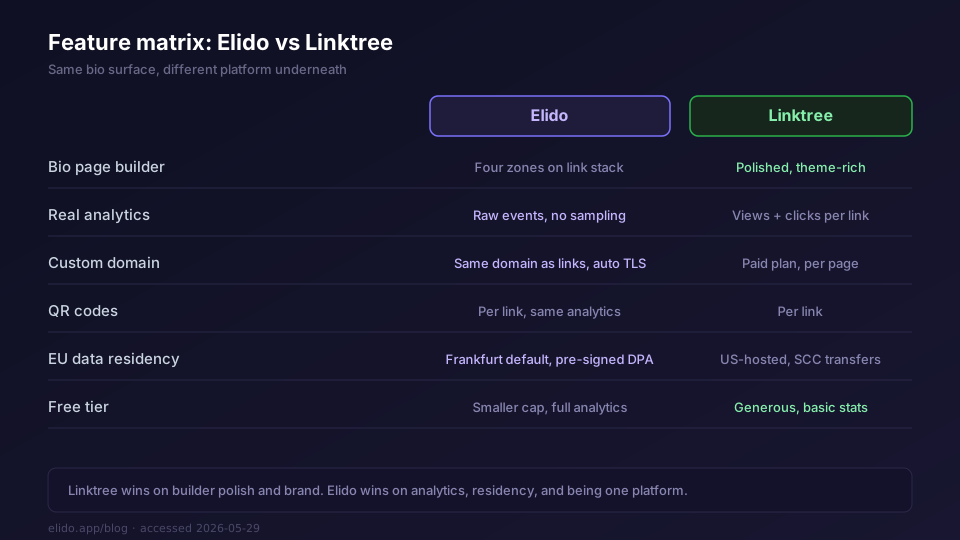
Here is the comparison in one table. The rest of the post unpacks the rows that actually move a decision.
| Dimension | Linktree | Elido |
|---|---|---|
| Core product | Bio-link page | Link-management platform with a bio page |
| Bio page builder | Polished, theme-rich, drag-and-drop | Four-zone builder on the same stack as short links |
| Link analytics | Views and clicks per link | Raw click events in our analytics store, no sampling |
| Conversion tracking | Not a built-in for server-side forwarding | Built-in server-side forwarding to ad and analytics platforms |
| Custom domain | Paid-plan feature, per page | Same branded domain as your short links, auto TLS |
| QR codes | Generated per link | Generated per link, same analytics |
| EU data residency | US-headquartered, SCC-based transfers | EU-default, EU click storage, pre-signed DPA |
| Free tier | Generous on links and basic stats | Smaller link cap, full analytics graph |
| Best for | Creators who want the simplest page | Marketers and agencies who run links at scale |
Read the table as a map, not a scoreboard. The "best for" row is the one that should settle it for most people.
The bio page builder
Both products build the same shape of page. A creator economy converged on it years ago: a hero block with an avatar and a short bio, a stack of link tiles, a featured slot for whatever is current, and a footer row of social icons. I broke that anatomy down in bio pages for creators, and the four-zone layout is the same whether you build it in Linktree or Elido.
Where Linktree is genuinely ahead is the builder experience itself. It has a decade of design iteration behind it, a deep theme library, drag-and-drop reordering, and onboarding that gets a first-time user to a live page in minutes without a single decision about DNS or analytics. If "make a nice page fast" is the whole job, Linktree does it with less friction than anything else, Elido included.
Elido's builder covers the same four zones but assumes a different starting point. You are likely already in a workspace that holds short links, custom domains, and analytics. The bio page is created the same way you create a link, every tile is a short link, and it inherits the UTM template and routing rules you already use. The trade is real: you get less theme variety than Linktree, and you get a page wired into a link graph instead of standing alone. For a step-by-step walkthrough, build a link-in-bio in 5 minutes covers the Elido flow end to end.
So the builder round goes to Linktree on polish and speed-to-first-page. The point of building inside Elido is everything that happens to the page after it goes live.
Linktree analytics vs Elido's click pipeline
This is the row where the two products stop looking alike. Linktree's analytics, per their feature pages (accessed 2026-05-29), report views and clicks per link, with richer breakdowns on paid tiers. That answers "how many people tapped this tile". For a lot of creators, that is the entire question, and Linktree answers it cleanly.
Elido answers a different question. Every tile on an Elido bio page is a short link, and every click on a short link is stored as a raw event in our analytics store with no sampling. That means you are not looking at a counter, you are querying raw events. Per-tile click rate, sure, but also per-tile conversion rate when a downstream event posts back, device and OS splits, referrer breakdowns, and the same UTM passthrough that carries into your own analytics stack. What you measure and why it matters is the subject of short link analytics: what to measure.
The practical gap shows up in two places. First, conversion forwarding. Linktree does not ship server-side conversion forwarding to ad and analytics platforms as a built-in. If you want a tile click attributed to a signup or a sale in Meta CAPI or GA4, that wiring is on you. Elido forwards conversions server-side from the workspace, handling the identifier hashing and the retry logic, so a bio-page tile is attributable the same way a campaign link is. Second, the silo. A Linktree page generates clicks that live in Linktree, separate from whatever shortener or analytics you run elsewhere. An Elido bio page is one more surface in the same attribution graph, not a second dataset to reconcile.
If your reporting stops at a click count, the depth is wasted on you and Linktree is the lighter tool. If you need the conversion loop closed, this is the single biggest reason to pick Elido.
Custom domains and QR codes
Both let you put the page on your own domain. On Linktree, a custom domain is a paid-plan feature configured per page, and the setup is the usual point-a-record-and-verify flow. It works, and for a single page it is straightforward.
On Elido, the bio page lives on the same branded domain as your short links. If you already pointed links.brand.example at Elido for short links, your bio page is on that domain too, with automatic DNS verification and automatic on-demand TLS. No second domain, no second vendor, no separate cert cycle. The custom domains feature page and the bio pages guide cover the DNS and TLS mechanics. For a multi-client agency, this consolidation is the difference between one domain configuration and one per tool.
QR codes are near parity. Both generate a QR for any link, including the bio page itself. The Elido difference is again the analytics: a scan is a click event in the same pipeline, so a QR on a conference banner and a tap from Instagram land in the same report. The QR codes feature page has the detail.
EU data residency and GDPR
For European buyers this row often outweighs every other. Linktree is a US-headquartered service. Like most US-hosted SaaS, its transfers of EU personal data rely on Standard Contractual Clauses. SCCs are a legitimate mechanism, but the Schrems II ruling (CJEU C-311/18) established that SCC-based transfers to the US still require a case-by-case Transfer Impact Assessment. For a solo creator that is a non-issue. For a regulated EU buyer, a TIA on a US sub-processor is a standard procurement step that adds weeks.
Elido is hosted in the EU region by default. Click events from the bio page and from every short link are stored in the EU; the data plane does not leave the EEA unless a workspace is explicitly pinned to another region on Business plans. The sub-processor list is short and published, and the DPA ships with Article 28 obligations pre-signed in the standard contract, so most EU buyers need no custom negotiation. The procurement-facing detail lives on the trust page. For the wider EU landscape, the best EU URL shorteners overview puts Elido in context against other residency-first tools.
The honest framing: if your buyer or your own compliance posture requires EU data residency contractually, Elido is procurement-ready off the shelf and Linktree means a TIA conversation. If you have no residency requirement, this section does not change your decision.
Pricing, with the usual caveat
Pricing is the part most likely to be stale by the time you read this, so treat the next two paragraphs as a shape, not a quote, and check the live pages.
Linktree (per the Linktree pricing page, accessed 2026-05-29) runs a free tier that is genuinely generous for a single creator: a hosted page, unlimited links in the stack, and basic click stats. Paid tiers unlock a custom domain, deeper analytics, scheduling, and commerce blocks, billed per page. The model is built around the bio page as the unit, which is exactly right if the bio page is all you need.
Elido bills per workspace and seat, not per bio page. The free tier is smaller on raw link volume than Linktree's, because Elido's free tier is sized for evaluating a link platform rather than hosting one creator page. Paid plans fold the bio page in with your short links, analytics, and custom domains at no separate bio-tool charge. The current numbers are on the pricing page. The buying question is not which sticker is lower in isolation, it is whether you are about to pay for a shortener and a bio tool separately when one platform covers both.
Who should pick which
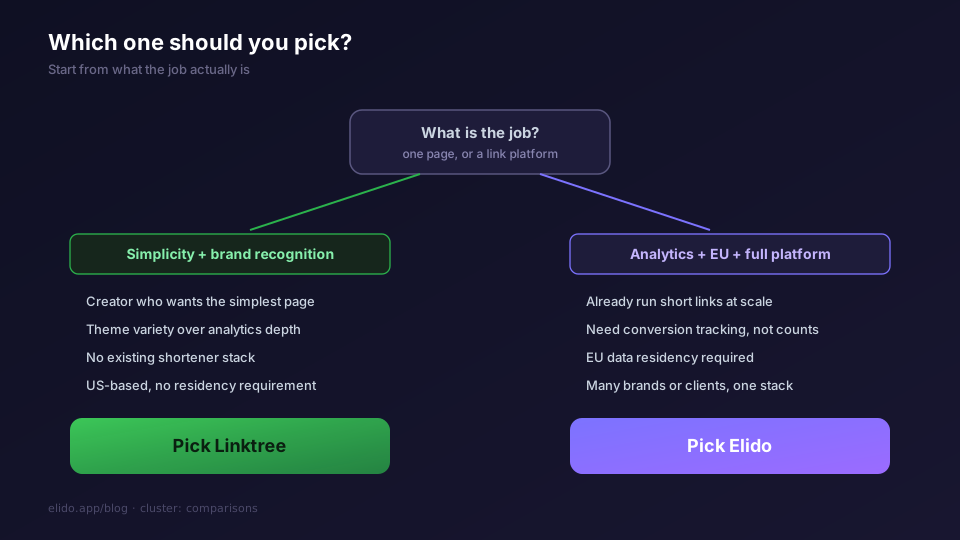
Let me make the recommendation concrete, because a fair comparison should still end with a clear call.
Pick Linktree if any of these describe you:
- You are a creator or solo operator who wants the simplest, most recognized bio page and your needs end at a tidy list of links with view counts.
- You value theme variety and a polished drag-and-drop builder over analytics depth.
- You have no existing shortener or link-management stack and no reason to build one.
- You are US-based with no EU data residency requirement.
Pick Elido if any of these describe you:
- You already run short links at scale and want the bio page in the same analytics graph rather than a separate silo.
- You need real click analytics, per-tile conversion rate, and server-side conversion forwarding, not just a click count.
- Your buyer or your compliance posture requires EU data residency with a pre-signed DPA.
- You manage links or bio pages across multiple brands or clients and want one domain configuration and one analytics destination. The marketers solution page covers that workflow.
The middle case, a creator who is starting to think like a marketer, can go either way. If you are still early and the page is the whole job, start with Linktree. The day you find yourself exporting Linktree clicks into a spreadsheet to reconcile them against your other links is the day Elido starts to pay for itself.
Where this lands
Linktree earned its position. It is the simplest, most recognized way to put a menu of links behind one social URL, and nothing here is an argument that it is bad. It is an argument that "bio page" and "link platform with a bio page" are different products solving overlapping problems.
If your job is one clean page, Linktree wins on simplicity and ecosystem. If your job is attribution, residency, and running links at scale with the bio page as one piece of that, Elido wins because the page is not a separate tool, it is the same system. For more on the landscape of alternatives, the Linktree alternatives roundup widens the field and Linktree vs Beacons covers the other big head-to-head, and if you are still nailing down the basics, what is a URL shortener starts from first principles. The bio pages feature page and the analytics feature page are the product-side references.
Related on the blog
Frequently asked questions
Is Elido a Linktree alternative?
Yes, for the bio-page part. Elido ships a bio page with a hero block, tracked link tiles, a featured slot, and a social footer, the same surface Linktree builds. The difference is what sits underneath: Elido's bio page runs on the same redirect, analytics, and custom-domain stack as your short links, so every tile is a tracked short link rather than a button with a click counter.
Does Linktree have better analytics than Elido?
Linktree reports views and clicks per link, which answers 'how many taps did this get'. Elido stores every click as a raw event in our analytics store with no sampling, so you get per-tile conversion rate, device and referrer breakdowns, and UTM passthrough to your own stack. If your attribution ends at a click count, Linktree is enough. If you need to close the loop to a conversion, Elido goes further.
Can I use a custom domain with Linktree and Elido?
Both support a custom domain. On Linktree it is a paid-plan feature, configured per page. On Elido the bio page lives on the same branded domain as your short links, with automatic DNS verification and on-demand TLS, so there is no second domain or second vendor to manage.
Which is better for EU data residency, Linktree or Elido?
Elido. It is hosted in the EU region by default, stores click events in the EU, and ships a DPA with Article 28 obligations pre-signed. Linktree is a US-headquartered service whose standard transfers rely on Standard Contractual Clauses, which can trigger a Transfer Impact Assessment for regulated EU buyers. Verify both vendors' current terms before quoting them to procurement.
Is Linktree's free plan enough?
For a creator who wants a clean page of links and basic click counts, Linktree's free tier is generous and fine. The limits bite when you want a custom domain, deeper analytics, or to fold the page into a wider link-management setup. Elido's free tier is smaller on raw link volume but puts every tile in the same analytics graph as your other links.
Should I pick Linktree or Elido?
Pick Linktree if you want the simplest, most recognized bio page and your needs end at a tidy list of links with view counts. Pick Elido if you already run short links at scale, need real click analytics, want EU data residency, or want the bio page to live inside one link-management platform instead of next to it.
Try Elido
Paste a URL, get a working short link
No signup. Link lives for 30 days. Sign up to keep it forever.
Free, no signup required · 2 per day