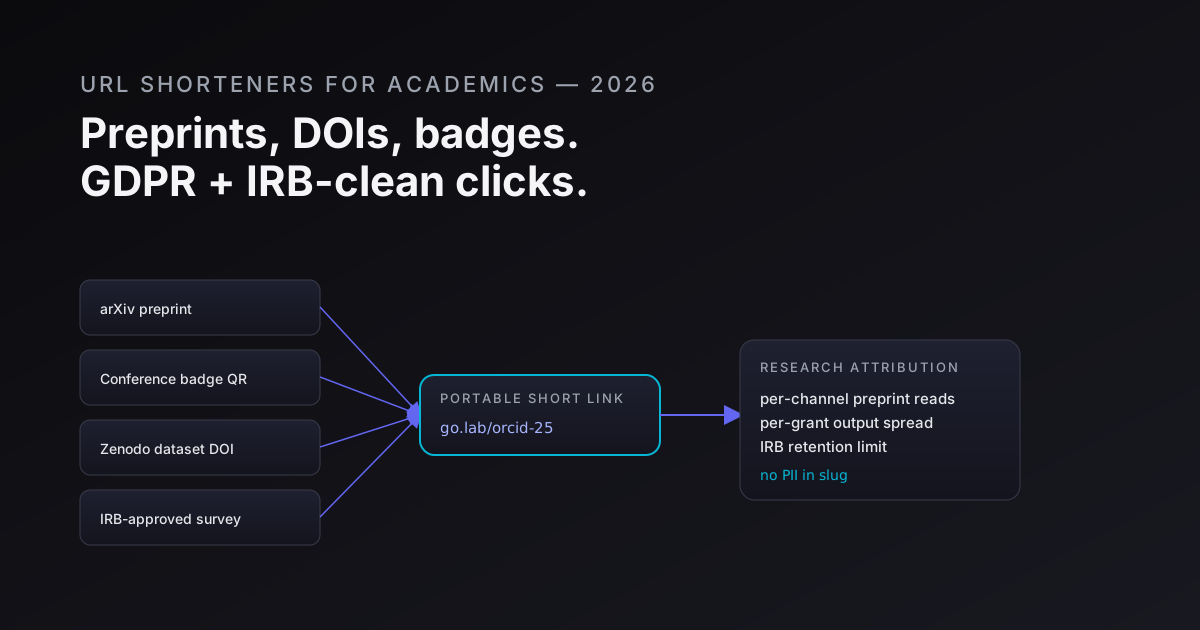
Academic publishing runs on links. arXiv links, Zenodo DOIs, ORCID profiles, conference programme pages, survey recruitment URLs. When those links are a mess - a raw arXiv share in a tweet, a doi.org redirect with no attribution, a university vanity URL owned by a web team you'll leave when you change institutions - the data on how your work spreads disappears. This post covers the six use cases where short links unlock real measurement for researchers, and the four anti-patterns that quietly corrupt the picture.
For the GDPR mechanics of tracking clicks on research audiences, GDPR for URL shorteners is the cornerstone. This post focuses on the academic-specific architecture.
Six use cases that matter in academic contexts
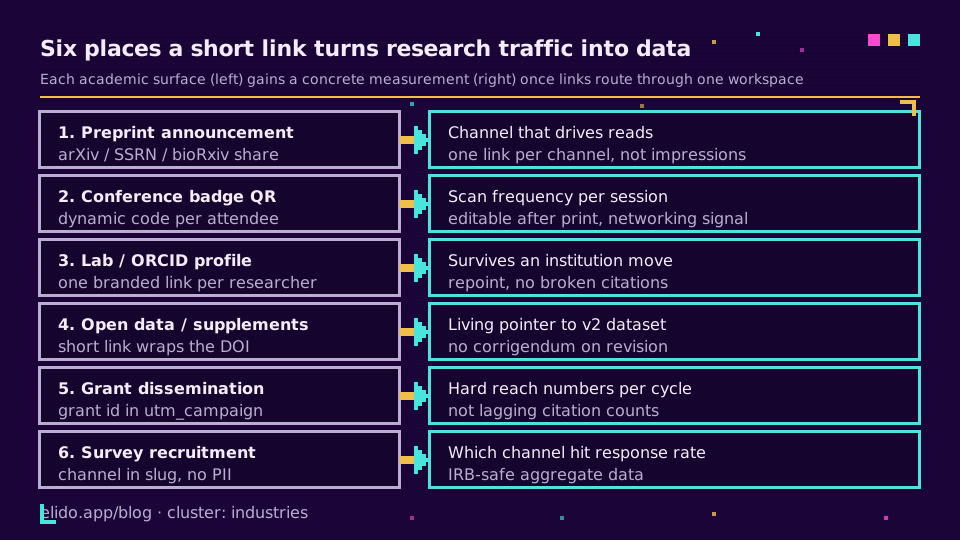
1. Preprint download tracking
You post a preprint on arXiv, SSRN, or bioRxiv. You announce it on Twitter/X, in a mailing list digest, on your lab homepage, and in a departmental Slack. A week later, you look at arXiv's stats: 423 abstract views, 198 "downloads." You have no idea where those 198 came from.
What a short link gives you: one link per announcement channel - elido.me/paper-nlp-twitter, elido.me/paper-nlp-ml-list, elido.me/paper-nlp-lab - each pointing at the same arXiv abstract (or directly at the PDF if you want full-PDF click counts). The click data tells you which channel actually drives reads, not just impressions. When the Twitter/X post outperforms the mailing list 4:1, you adjust where you spend the 20 minutes writing the next announcement.
UTM discipline: bake ?utm_source=twitter&utm_medium=social&utm_campaign=nlp-preprint-2026 into the arXiv URL before shortening. If your institution's analytics or your personal Google Analytics property receives that click, the UTM survives the redirect and shows up in channel breakdowns. Tracking UTM campaigns end-to-end covers the full pipeline if you want the analytics to land somewhere queryable.
The arXiv share trap: arXiv's own "share" buttons append nothing. The arXiv stats counter lumps all traffic under "external." A short link is the only way to break that lump into something meaningful.
2. Conference badge QR codes
Academic conferences increasingly print QR codes on badges. The QR resolves to the attendee's homepage, Google Scholar profile, or a curated list of their recent papers. Most programmes treat the QR as a static decoration - they embed the destination URL into the badge at print time, lose the ability to update it, and get no signal on whether anyone scanned it.
What measurable badge QR looks like: one dynamic short link per attendee, all under a conference short domain (go.nips2026.org or the programme committee's Elido custom domain). Each link resolves to the attendee's self-reported destination - a Google Scholar URL, an academic homepage, a lab page. Because the QR is dynamic (the printed code resolves through a short-link service, not directly to the destination), the programme committee can:
- See scan frequency across the conference floor - which attendee-types generate the most networking interest
- Update a destination after the badge has been printed (the attendee updates their profile on day-2; the badge QR follows)
- Detect scan patterns per session slot - who got scanned most during the Tuesday evening poster session
Per-attendee generation: POST /v1/links/bulk with the attendee CSV. Each row gets a unique slug. The QR code for each slug is returned in the same batch response, ready for the badge printer.
For the static-vs-dynamic decision in detail, dynamic vs static QR codes covers the durability and changeability trade-off. For conference use, dynamic is always the right answer.
3. Lab website and ORCID linking
A working researcher typically maintains: a university faculty page (controlled by IT, slow to update), a personal academic homepage (GitHub Pages or Hugo, updated when there is time), an ORCID profile (manually synced), a Google Scholar page (auto-updated but not editable), and a ResearchGate profile (updated by ResearchGate's bot whether you like it or not).
The problem: the link you put in your email signature, on your conference slides, in your paper's author block, and on your business card ideally resolves to whichever of these is most current. That destination changes when you move institutions (the faculty page URL breaks), when you rename a GitHub repo (the homepage URL breaks), or when you finally clean up the lab page that was last updated in 2023.
One branded short link per researcher: go.youruniversity.edu/~jsmith or elido.me/jsmith-lab resolves to whatever the researcher has decided is their canonical landing point this month. Changing institutions? Update the destination in the short-link dashboard. The printed links in your past papers, your conference proceedings citations, your email signatures - all continue to resolve correctly without a corrigendum or a redirected university page.
This is also the cleanest EU data-residency story: the click data (geo, UA, referrer) from people who follow your academic profile link lives in EU-region storage, not in a US commercial analytics service, which matters when you publish under EU-affiliated institutions.
4. Open-data and supplementary materials
A paper cites supplementary data on Zenodo, Dryad, or FigShare. The DOI for the dataset version is baked into the published PDF. Eighteen months later, the dataset is updated (version 2 with corrections), deposited under a new DOI. The old DOI still resolves, but to the deprecated version. A reader following the citation gets the wrong data.
The short-link fix: the paper PDF cites elido.me/dataset-membrane-2025, not the DOI directly. The DOI is the destination behind the short link. When the dataset is revised and re-deposited under a new DOI, the author updates the short link's destination in the dashboard - no corrigendum, no errata notice, no email chain with the journal. The PDF citation remains permanently valid and points at the current version.
On DOI coexistence: DOIs are permanent by design - this is a feature. The short link is not replacing the DOI; it wraps it. The DOI still exists, still points at the original version for citation integrity. The short link provides the "living pointer" for readers who want the current recommended version. Both can coexist in the paper's supplementary materials section.
For the broader challenge of links that stop working in published materials, link rotting prevention strategy covers the full architecture.
5. Grant proposal attribution
Funding agencies increasingly ask PIs to demonstrate dissemination impact: how many reads did the funded paper get, which channels drove those reads, what was the geographic reach of the work? The standard answer is "Google Scholar citations + journal download counts," which is a lagging indicator that takes years to accumulate and tells the funder nothing about whether their money drove any reach this cycle.
Per-grant short links let you instrument dissemination as it happens. The pattern:
- One short link per grant-funded paper, tagged with the grant identifier in the UTM campaign field:
?utm_campaign=ERC-2024-ADG-12345 - One short link for the dataset release: same UTM campaign tag
- One short link for the press release or lay summary
All three resolve to their respective destinations; all three share the same campaign tag. The analytics view filtered to that campaign gives you: total clicks, geographic breakdown, channel breakdown (where did the traffic originate - academic social, direct, institutional list?), and a time-series of reach.
When the next funding cycle's application asks "what was the reach of the previous grant's output," you have hard numbers from your Elido dashboard, not a citation count that's 18 months behind reality.
6. Survey and questionnaire recruitment
IRB-approved studies frequently distribute recruitment links via postcards in pediatric clinics, QR codes on community boards, end-of-paper links in published PDFs, and targeted mailing lists. Knowing which recruitment channel hit the target response rate matters for the study's methodology section and for the IRB renewal report.
Per-channel attribution without PII: the short link carries the channel attribution (postcard vs. mailing list vs. PDF link) in the slug or UTM, but the slug itself contains no personally identifiable information. The respondent who clicks elido.me/study-grief-clinic gets redirected to the Qualtrics or REDCap form with a clean URL; no PII is encoded in the path that a bystander could read.
GDPR and IRB retention limits: short-link click data is aggregate (geo, UA, referrer, timestamp - no email, no name, no IP stored beyond the session). Most EU IRBs and US IRBs are comfortable with this because the data collected at the short-link layer does not constitute "personal data" under GDPR Article 4 when IP is not logged. If your IRB requires explicit data-retention limits, Elido's EU-region storage with configurable retention windows (90-day default, configurable down to 14 days) satisfies the requirement without a custom DPA. EU data residency for marketing teams covers what "EU residency" actually means in the contract.
The four anti-patterns that ruin academic data
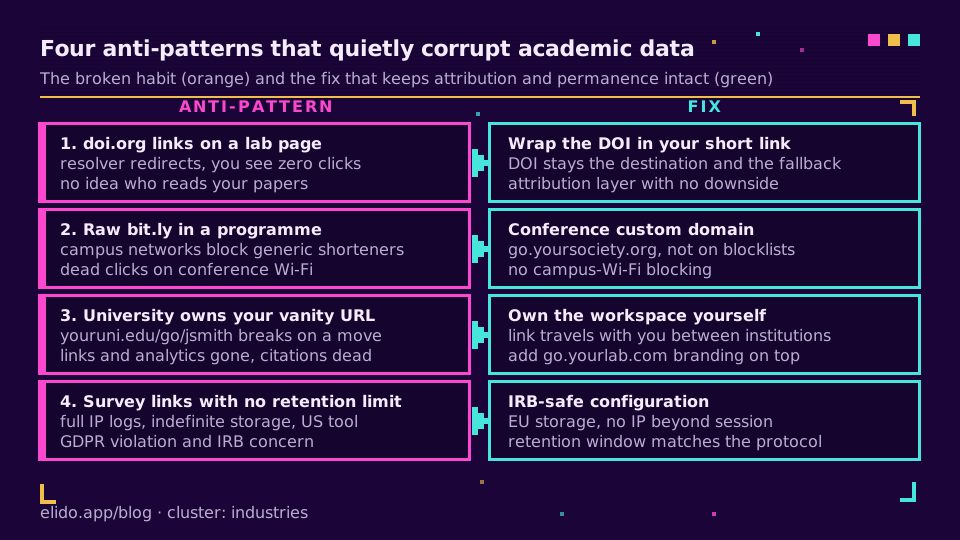
1. DOI-shorteners on personal link lists.
A lab website that links to papers via doi.org/10.1000/xyz tells you nothing about who clicks those links. The DOI resolver handles the redirect; you see zero click data. The fix is to run each paper link through your own short link with the DOI as the destination. You keep the DOI's permanence guarantee (it still works even if you stop using the shortener) while gaining the attribution layer. When you abandon the short link, the DOI fallback still works - there is no downside.
2. Raw bit.ly in a conference programme.
Many universities and research institutions block bit.ly, tinyurl.com, and other generic shorteners at the campus network level as a phishing mitigation. A conference programme that uses a generic short domain will generate dead clicks for every attendee who opens it over the campus Wi-Fi. The fix is a conference-specific custom domain (go.yoursociety.org) or a short domain that is explicitly whitelisted by major EU/US universities. Elido's elido.me domain is not on standard university blocklists; conference committees using it report no campus-Wi-Fi blocking issues.
3. Letting your university's web team own the vanity URL.
youruni.edu/go/jsmith looks professional until you change institutions. At that point, the link is gone, the analytics are gone, and every citation that used it is permanently broken. A personally owned short link (your own Elido workspace, not the university's) travels with you. The institutional affiliation branding can be added as a custom domain on top (go.yourlab.com), but the workspace is yours regardless of where you work.
4. Survey recruitment links without IRB-approved retention limits. A survey recruitment link that logs full IPs, stores click data indefinitely, and uses a commercial US-based shortener is a GDPR violation and, depending on the study population, a US IRB concern. The IRB-safe configuration: EU-resident storage, no IP logging beyond the session, data-retention window matching the study's approved data-handling plan. Write this into your IRB protocol as a data-processing activity; it is a 2-sentence addition that prevents a compliance finding.
A reference architecture for a mid-size academic conference
This is what a workable link architecture looks like for a 300-800 person research conference. It scales to 3000 with the same structure.
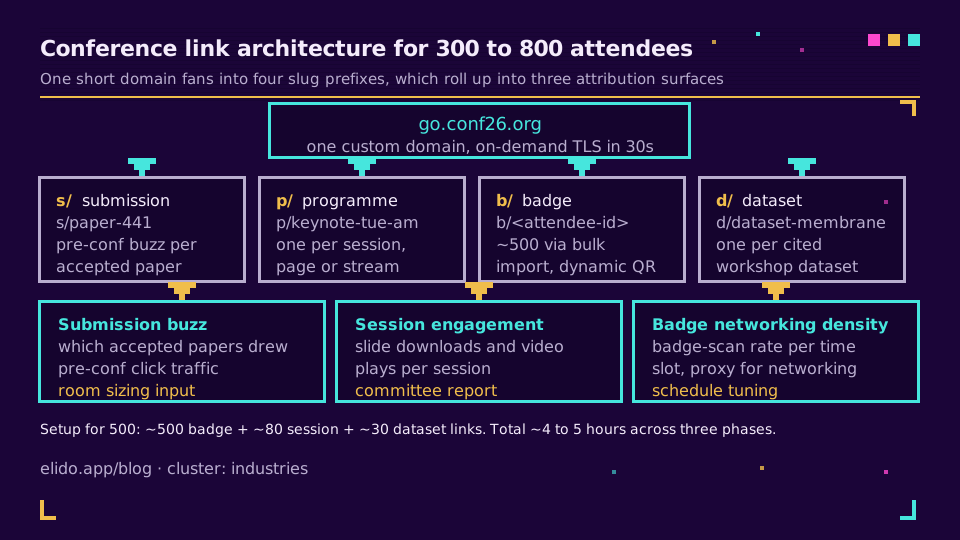
One conference short domain. Register go.yourconference2026.org (or use a persistent society domain go.yoursociety.org/conf26/). Point it at your Elido custom domain. TLS is issued automatically on-demand; the domain is live in 30 seconds.
Four slug prefixes:
s/- submission links.go.conf26.org/s/paper-441. Resolves to the submission in the conference system. Authors can share this; clicks tell the programme committee which papers generated pre-conference buzz.p/- programme links.go.conf26.org/p/keynote-tue-am. One per session. Resolves to the session detail page or the video stream on the day.b/- badge links.go.conf26.org/b/<attendee-id>. One per attendee. Resolves to the attendee's self-selected academic profile.d/- dataset / supplementary links.go.conf26.org/d/dataset-membrane. One per dataset cited in any workshop paper.
Three attribution surfaces:
- Submission buzz (
s/prefix analytics): which accepted papers generated pre-conference click traffic from author social posts? Useful for scheduling high-interest sessions in larger rooms. - Session engagement (
p/prefix analytics): which session drove the most slide downloads / video plays? Feeds into the post-conference programme committee report. - Badge networking density (
b/prefix analytics): which session time slots produced the highest badge-scan rates? Proxy for networking intensity per slot.
Setup for 500 attendees: ~500 badge links via bulk import, ~80 session links manually created in the programme-building phase, ~30 dataset links submitted by authors at camera-ready time. Total setup time: 4-5 hours spread across the three phases.
Where Elido sits in academic workflows
We did not build Elido specifically for academic use - but the constraints that academic use cases impose (EU data residency, no PII in slugs, configurable retention, custom domains that travel with the researcher) align closely with the platform's core architecture.
A few capabilities that matter specifically to academic workflows:
- Configurable data retention - set 90-day, 30-day, or 14-day retention on click data per link group. IRB protocols can cite the exact retention window.
- EU-region storage by default - click events are written to an EU-region analytics store. No additional DPA paperwork for EU-based institutions; the standard Elido DPA covers it.
- Bulk badge generation -
POST /v1/links/bulkaccepts a CSV of attendee IDs and returns dynamic-QR-ready short links in a single call. 500 badges in under 3 seconds. - Custom domain per researcher or per lab -
go.yourlab.comis a CNAME away. On-demand TLS. The domain stays with the researcher's Elido workspace regardless of institutional affiliation. - No PII in slugs - the slug generation is random by default (or researcher-chosen, never auto-generated from a name or email). Survey recruitment URLs are attribution-clean without encoding respondent identity.
For the sibling post on link tracking for published content and editorial workflows, URL shorteners for publishers covers the overlap between academic publishing and commercial publishing use cases. For the EdTech angle - LMS link management, course attribution, SCORM-adjacent tracking - URL shorteners for EdTech is the adjacent read.
Related on the blog
- GDPR for URL shorteners - the legal layer that every EU-affiliated researcher needs to understand before adding click tracking to study materials
- EU data residency for marketing teams - what "EU residency" means in practice and what to put in an IRB protocol
- Track UTM campaigns end-to-end - the cornerstone for building a queryable attribution pipeline behind your short links
- Dynamic vs static QR codes - the durability/changeability trade-off for conference badge printing
- Link rotting prevention strategy - how to keep supplementary material links alive across dataset migrations and institution changes
- URL shorteners for publishers - sibling post for editorial and publishing workflows
- URL shorteners for EdTech - sibling post for LMS and course attribution use cases
Try Elido
Paste a URL, get a working short link
No signup. Link lives for 30 days. Sign up to keep it forever.
Free, no signup required · 2 per day