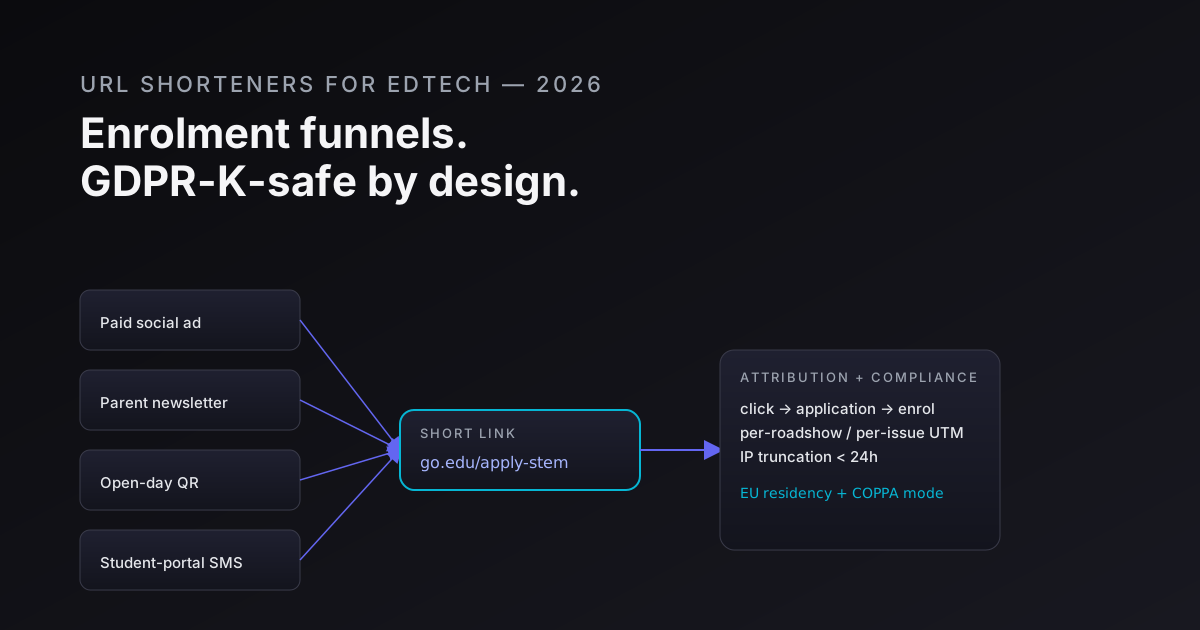
Education runs on links. Enrolment CTAs in email sequences, QR codes on open-day prospectuses, deep links in SMS reminders that push students to tomorrow's homework, permission-slip URLs in weekly parent bulletins. When the link layer is broken - every campaign with a raw LMS URL, attribution split across a Bitly free tier and a Google Analytics install that fires on 60% of page loads - the question "where do paying students come from?" stays permanently unanswered.
This post covers the four main EdTech link use-cases (enrolment attribution, parent communications, student portal deep linking, and university open-day QR) plus the affiliate/referral layer that course creators bolt on top, the COPPA/GDPR-K compliance considerations that make EdTech distinct, and the four anti-patterns that show up in almost every institution we talk to.
For the UTM fundamentals that underpin all of this, tracking UTMs end-to-end is the cornerstone. Come back to this post for the EdTech-specific context.
Use-case 1: course enrolment funnel attribution
A course creator running paid traffic on Meta, Google, and TikTok - plus an email nurture sequence and an organic YouTube channel - needs to know which channel produced each paying student. Without per-channel attribution, budget optimisation is guesswork.
The failure mode is monotonous: one campaign URL (teachable.com/courses/my-course/enroll) gets shared everywhere with the same UTM tag, or no UTM at all. The Teachable dashboard reports total enrolments; the Meta Ads dashboard reports clicks. Nobody can connect the two.
The working pattern: one short link per channel, per campaign, per send. Each link carries a distinct UTM (source, medium, campaign, and content for A/B variants). The short link's click-through data joins to the enrolment confirmation event either via URL parameter passthrough or a conversion webhook from the LMS.
A practical link set for a course launch week:
| Slug | Source | Medium | Notes |
|---|---|---|---|
go.yourcourse.com/e/meta-ig-v1 | meta | paid-social | Instagram feed ad, creative variant 1 |
go.yourcourse.com/e/meta-ig-v2 | meta | paid-social | Instagram feed ad, creative variant 2 |
go.yourcourse.com/e/email-seq3 | nurture | Sequence email 3 of 7 | |
go.yourcourse.com/e/yt-desc | youtube | organic | Channel description link |
go.yourcourse.com/e/affiliate-{id} | affiliate | referral | Sub-ID per affiliate (see use-case 5) |
The e/ prefix scopes all enrolment links in the analytics filter in one click. The short domain (go.yourcourse.com) takes 20 minutes to stand up via CNAME and is a branding signal that the raw teachable.com/courses/...?token=... URL never was.
On UTM discipline: the short-link analytics guide has the full breakdown of which dimensions are load-bearing for funnel attribution.
Use-case 2: K-12 parent communications
A typical primary school newsletter goes out weekly. It contains 8–15 links: the field-trip permission slip, the upcoming school photo order form, the parent-teacher meeting booking, the canteen menu, the term calendar PDF, the three upcoming events, the safeguarding update. The email is sent to 600 parent addresses.
The school communication coordinator has no idea whether parents read any of it. Did 400 of 600 parents click the permission slip, or did 40? The class trip coordinator chases paper slips for two weeks because the email felt ignored - or 95% of parents completed it digitally and the coordinator didn't know to stop chasing.
Short links with click tracking answer this directly. Each link in the bulletin is a distinct tracked short link. The weekly report shows per-link CTR. The coordinator sees: "permission slip: 87% CTR, canteen menu: 12%, safeguarding update: 6%". The conclusion: safeguarding content needs a different channel (perhaps a banner at collection time); the permission slip format is working.
The operational pattern: the communications platform (Seesaw, ClassDojo, ParentMail, or a plain email tool) replaces raw links with short links before send. This can be manual (a comms coordinator runs links through a shortener before copying into the email), automated (the platform has a URL-shortening integration), or hybrid (a spreadsheet with a macro that calls the API for batch-import on send day).
The GDPR-K angle matters here. These click records tie to parent email addresses, and the parents are the guardians of children in the school. The data-residency rules for a UK school post-Brexit differ from those for a French state school; an Irish Gaelscoil has different requirements than a Dutch basisschool. The rule of thumb: if the school is in the EU, the URL shortener must process and store click data in the EU. EU data residency for marketing tools has the detail on what "EU storage" actually requires vs what some vendors claim.
Use-case 3: student-portal deep linking
An LMS sends an SMS to a student: "You have an assignment due tomorrow in Introduction to Data Science. View it now." The SMS contains a link. That link either:
A. Goes to platform.com/dashboard and the student has to navigate to the right course, the right module, the right assignment from there. Three taps, 45 seconds, high abandonment.
B. Goes to lms.yourschool.edu/a/ds101-wk4-assn which resolves to the deep link platform.com/courses/intro-data-science/modules/week-4/assignment - directly to the assignment - with the session cookie already set from a prior login so the student doesn't authenticate again.
Option B requires that the short link can carry context through the redirect (query parameters passed through to the destination) and optionally trigger an app deep link if the student has the mobile app installed. Deep links without an SDK covers how to handle the mobile routing without requiring the LMS to integrate a native SDK.
The practical benefit is measurable: completion rates on time-sensitive assignments rise when the path from notification to task is two taps rather than five. The link analytics also tell you whether the SMS channel is working at all - if 70% of students open the SMS and only 15% click the link, the problem is the link behaviour (or the CTA copy), not the channel.
Use-case 4: university open-day QR campaigns
University admissions teams produce printed prospectuses. The prospectus goes to 40 schools across four open-day roadshow dates in October. Each page has a QR code pointing to the relevant undergraduate programme application page.
The static-QR trap: if the QR codes encode the application URL directly, two things go wrong:
- The application URL changes (it always does - the intake year rolls, the form migrates to a new platform, the university rebrands). All printed prospectuses now point at a dead URL. There is no fix without a reprint.
- There is no per-school attribution. All 40 schools deliver the same QR. The admissions team can't tell whether the roadshow stop at St Joseph's College drove applications or whether those came from the prospectus posted at Sixth Form Centre in another county.
The dynamic-QR pattern: each prospectus variant gets a distinct short link embedded as the QR destination. apply.youruni.ac.uk/q/st-josephs-oct12, apply.youruni.ac.uk/q/6th-form-centre-oct14. The QR encodes the short link. The short link resolves to the current application form URL, which can be updated at any time without reprinting. Per-school click data flows into the admissions dashboard.
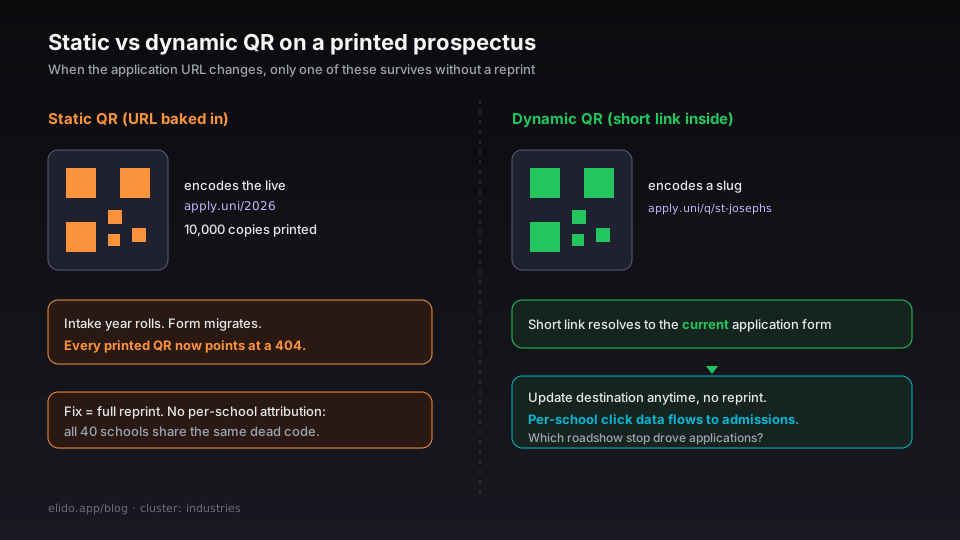
The attribution payoff: after the roadshow, the admissions team can answer "which stop drove the most applications?" per programme. If engineering applications skewed heavily from two schools but law applications came from a different cluster, the roadshow budget for next year allocates accordingly.
For the full QR production-to-print workflow, the same dynamic-QR architecture is covered in the events post's on-site QR section - the mechanics are identical, the domain is different.
Use-case 5: affiliate and referral programmes for course creators
Course creators on Teachable, Kajabi, and Thinkific routinely run affiliate programmes. Each affiliate gets a tracked link; enrolments through that link are attributed to the affiliate and trigger a commission payout.
The problem is that most LMS affiliate modules issue a link like platform.com/courses/my-course?ref=affiliateid123. This link:
- Exposes the affiliate ID in the URL (visible to anyone who inspects the redirect destination)
- Is tied to the LMS vendor's tracking cookie, which is first-party only and expires after 30 days
- Cannot be customised per campaign or per content placement (the affiliate can't run separate links for their email list vs their YouTube description)
A better architecture uses the course creator's short domain as the affiliate-link layer. Each affiliate gets a slug (go.yourcourse.com/e/affiliate-xyz) that the creator controls. The short link passes a sub_id parameter to the LMS webhook; the LMS's affiliate module reads the sub-ID and attributes the commission. The affiliate can create sub-links for specific placements by appending an &placement= parameter that the short link preserves on passthrough.
The sub-ID passthrough pattern is covered in forwarding conversions to Meta CAPI - the conversion-forwarding logic is the same whether the downstream system is Meta, a CRM, or a Teachable webhook.
COPPA and GDPR-K: what makes EdTech different
Every other industry section in this cluster has a GDPR paragraph. EdTech has two compliance regimes to navigate, not one.
GDPR-K (under-16 in most EU member states, under-13 in some): the EU's General Data Protection Regulation doesn't have a special "K" edition - the K stands for "children" in practitioner shorthand. The principle: personal data relating to children requires heightened protection and, for minors below the age of digital consent, parental consent before processing. Click data that can identify a child (device fingerprint, IP address linked to a student account) triggers this.
For K-12 link tracking, the relevant implication is: the URL shortener should not retain identifiable click data for longer than necessary, and should not process it in a way that builds a profile linked to a student identity. Session-level anonymisation (aggregate clicks, no per-student linkage) is the safe default unless there is an explicit lawful basis for per-student tracking (such as the school's legitimate interest in monitoring assignment-completion notifications).
COPPA (US, under-13): US-based EdTech platforms serving children under 13 cannot collect personal information without verifiable parental consent. An IP address is personal information under COPPA in most interpretations. A URL shortener that logs full IP addresses for redirect analytics is collecting personal information. The practical requirement: either the shortener has a COPPA-compliant mode (anonymised or truncated IP, no persistent cookies, no cross-site tracking), or the platform must not use link tracking for content directed at under-13s.
The short version for procurement: when evaluating a URL shortener for K-12 use, ask three questions:
- Where is click data stored? (EU storage for EU schools; US-only storage is a data-residency issue for EU state schools)
- How long are raw IP addresses retained? (72 hours is a common GDPR-compliant window; COPPA pushes toward immediate anonymisation)
- Does the shortener set third-party tracking cookies on redirect? (It should not, for any EdTech use)
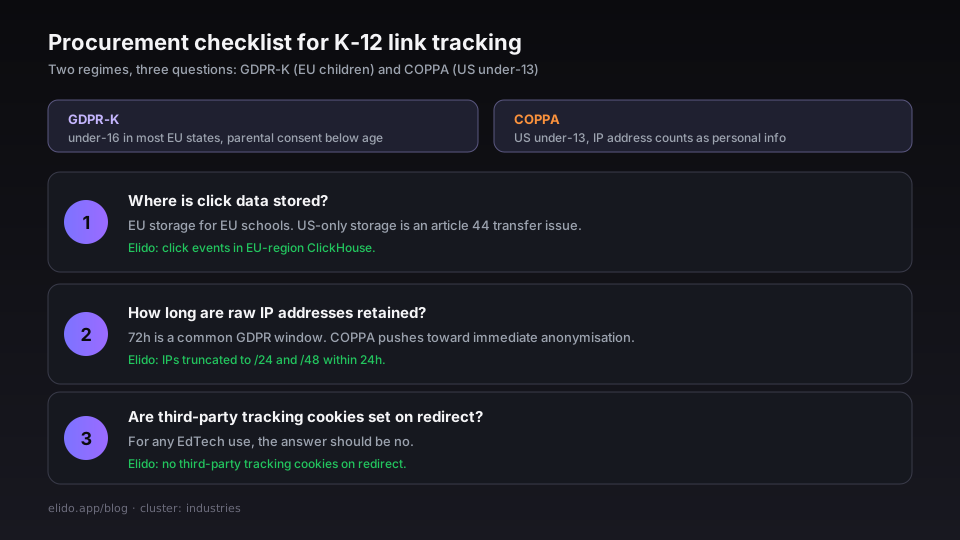
Elido's GDPR compliance overview covers the specifics of how redirect-time data handling works and what "EU residency" means at the infrastructure level.
The four anti-patterns that quietly drain EdTech link data
1. Sharing the LMS auto-generated URL. The URL your LMS generates for a course enrolment page looks like platform.com/courses/12345?token=abc123xyz or go.teachable.com/p/course-name?coupon=LAUNCH50. It's long, it exposes internal IDs, and the token is sometimes session-scoped (meaning the link breaks for anyone who didn't generate it). Shortening it is a one-minute fix; not shortening it is a data problem that persists for the life of the campaign.
2. Using utm_source=email everywhere with no per-issue distinction. Every send to the same nurture list gets utm_source=email&utm_medium=nurture. Three months later, "email" is the top source for paid enrolments - but you don't know if that came from the day-1 welcome email or the day-21 final-push email. Per-send UTM tagging (utm_campaign=launch2026&utm_content=seq-email-7) is the minimum viable attribution. The short link slug can encode this (e/email-launch26-seq7) without requiring a parameter editor in the email platform.
3. Using a US-only shortener for EU school communications. Several popular free-tier URL shorteners store all click data on US infrastructure. For a state school in Germany or a public university in Poland, routing parent or student click data through US servers is a potential GDPR article 44 transfer issue unless standard contractual clauses are in place. Most free-tier shorteners don't offer SCCs or a DPA. The risk is diffuse and rarely enforced proactively - until it is. EU data residency for marketing tools has the specific transfer mechanism requirements.
4. Static QR codes on printed prospectuses. This is the university admissions version of the same trap that catches event organisers. The print run is 10,000 prospectuses. The application URL changes when the new admissions cycle opens. Every QR code in every printed copy now points at a redirect or a 404. The fix costs a reprint or a desperate last-minute redirect at the old URL. Dynamic QR codes (where the QR resolves through a short link that you can update) cost approximately the same effort as static QR and eliminate the problem entirely.
A reference link architecture for a mid-size EdTech operation
This scales from a solo Kajabi creator with an affiliate programme up to a 10,000-student online university.
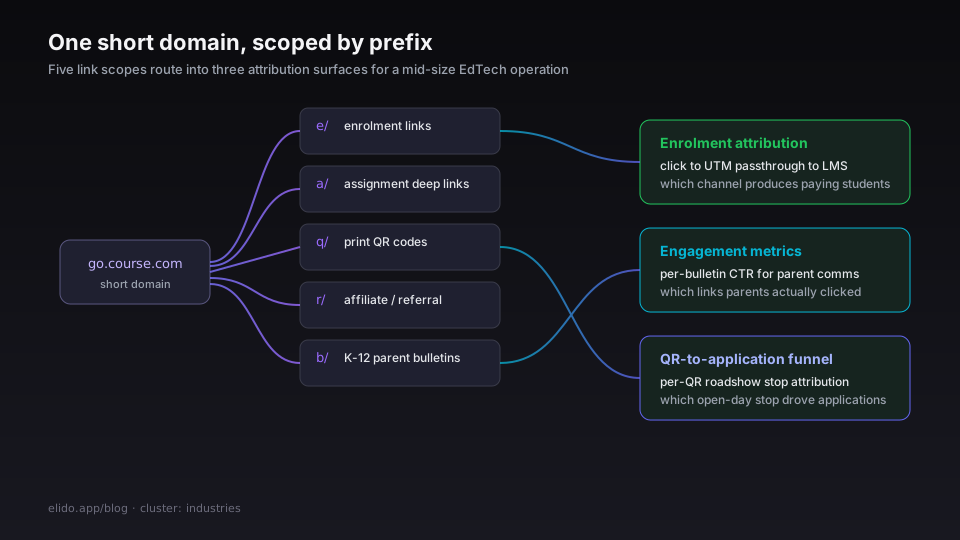
One short domain, scoped by prefix:
e/- enrolment links (paid ads, email, organic)a/- assignment and LMS deep links (SMS, in-app notifications)q/- print QR codes (prospectuses, flyers, campus signage)r/- affiliate/referral links (sub-ID per affiliate)b/- bulletin links for K-12 parent comms
Three attribution surfaces:
- Enrolment attribution: short-link click-through → UTM passthrough to LMS → enrolment confirmed event → join in analytics. Answers "which channel produces paying students at what CPA?"
- Engagement metrics: per-bulletin CTR for K-12 comms. Weekly report: which links parents actually clicked. Informs comms format and frequency decisions.
- QR-to-application funnel: per-QR click data from the
q/prefix. Roadshow stop attribution for admissions teams.
One EU-resident data store. For any institution that processes EU resident data (school in the EU, students in the EU, parents in the EU), the click data store needs to be EU-resident. This is infrastructure, not a setting - it requires that the URL shortener vendor's click event storage runs in EU datacentres, not just that the control plane is EU-hosted.
Where Elido sits
Elido wasn't purpose-built for EdTech, but EU-first data residency and GDPR-compliant click handling are baked into the architecture rather than bolted on as enterprise add-ons. The specific capabilities that matter for the use-cases above:
- Custom short domains with on-demand TLS -
go.yourcourse.com,links.yourschool.edu,apply.youruni.ac.uk/q. CNAME → cert in 30 seconds via automatic on-demand TLS. No per-domain pricing. - UTM passthrough and sub-ID forwarding - query parameters attached to the short link are forwarded to the destination URL by default. Affiliate sub-ID passthrough to the LMS webhook works without additional configuration.
- App-deep-link routing - the
redirect_iosandredirect_androidfields on a link let the same short URL route to the mobile app deep link on mobile and the web URL on desktop. No SDK required in the LMS. - EU click-data storage - click events go to our EU-region analytics store. Raw IPs are truncated to /24 (IPv4) and /48 (IPv6) within 24 hours. No third-party tracking cookies on redirect.
- Bulk link creation -
POST /v1/links/bulkfor semester-start assignment link batches or prospectus QR generation runs. Up to 2,000 links per call.
For COPPA-mode (under-13 content), contact us - the configuration is a per-workspace flag that disables IP retention and cookie setting entirely for links in that workspace.
For the broader analytics picture, short-link analytics: what to measure covers the metrics hierarchy from raw click volume to revenue attribution - relevant for any EdTech team trying to justify the link infrastructure budget to a finance team.
Related on the blog
- Track UTM campaigns end-to-end without a CDP - the attribution cornerstone this post builds on
- Deep links without an SDK - routing students from SMS notifications to the right LMS page
- GDPR for URL shorteners - the compliance reference for EU schools and EdTech platforms
- Short-link analytics: what to measure - the metrics hierarchy from click volume to enrolment attribution
- Forwarding conversions to Meta CAPI - sub-ID passthrough for affiliate attribution
- EU data residency for marketing tools - what "EU storage" actually requires vs what vendors claim
- URL shorteners for marketers - the broader marketing use-case sibling
Try Elido
Paste a URL, get a working short link
No signup. Link lives for 30 days. Sign up to keep it forever.
Free, no signup required · 2 per day