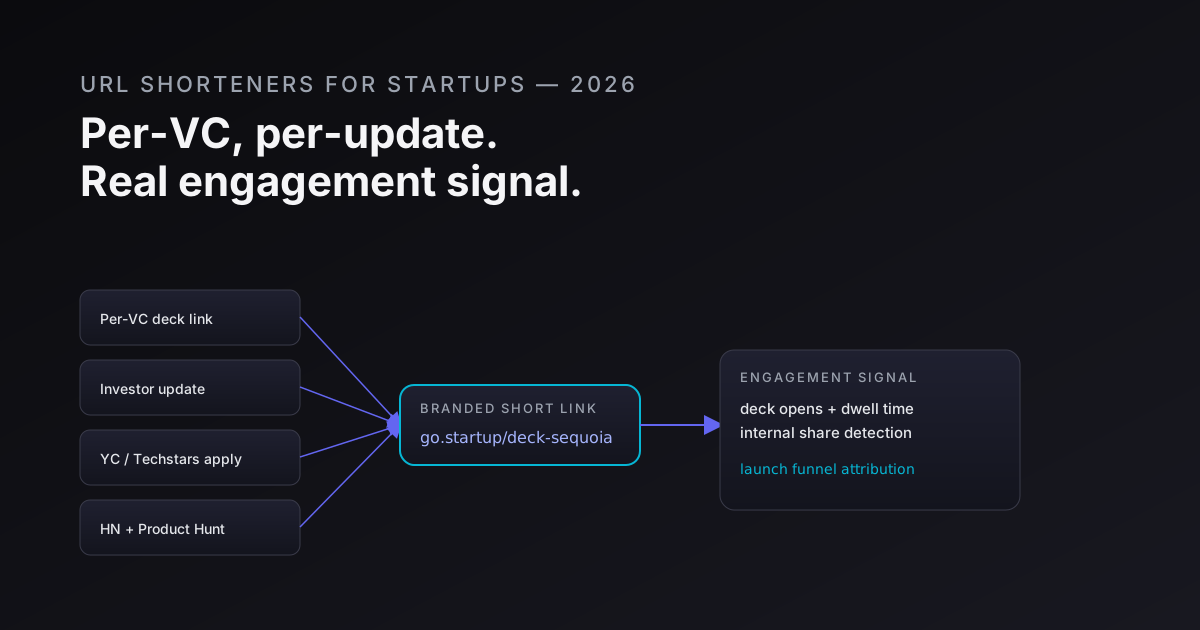
Startups run on links. The PDF deck you email to a partner at Sequoia. The quarterly update you send to 12 angel investors. The Notion job description you DM to a senior engineer you met at a meetup. The Product Hunt post you spent three weeks preparing. Every one of those links is a signal you are almost certainly not capturing.
This post is a practical blueprint for the link layer at a pre-Series-A startup: what to track, why the tracking matters in a fundraising context, and where the four anti-patterns will silently destroy your deal signal.
For the UTM mechanics that underpin everything here, Track UTM campaigns end-to-end is the right starting point. This post is the startup-specific application layer on top of that foundation.
Why the link layer matters more at a startup than anywhere else
At a Series-C company, the investor relationship is managed by the CFO and an IR team. At a pre-seed startup, it is managed by you, with a spreadsheet, at 11 pm. You have no budget for DocSend at $150/month per seat. You have no Salesforce licence to track email opens. You have no analyst to pull a report of which board observers read the financial appendix.
What you do have is a URL shortener with custom domains - and if you use it correctly, it replicates 80% of DocSend's value at a fraction of the cost and with none of the SaaS lock-in.
The same principle applies to recruiting, accelerator applications, and launch-day traffic. The signal is there; the question is whether you wired up the capture.
1. Pitch-deck distribution tracking
DocSend's entire business is built on one insight: founders want to know whether VCs actually opened the deck. The product wraps a PDF viewer with per-viewer analytics: did they read all 12 slides? Did they spend 45 seconds on the traction slide? Did they share the link with a partner?
You can replicate the core of this without the DocSend subscription.
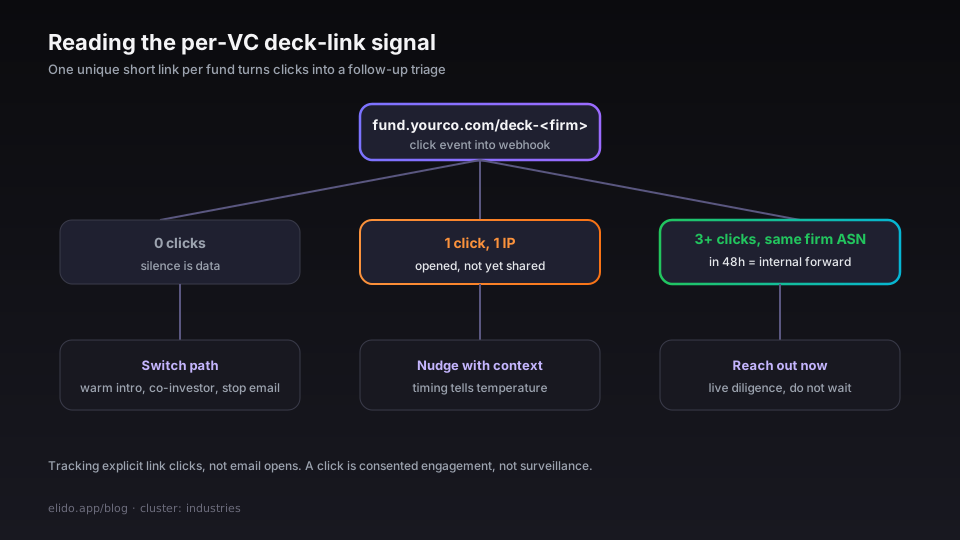
The setup: upload your deck to S3 (or Google Drive, or Notion). Create a short link to that URL via Elido. Give every VC a unique short link - fund.yourco.com/deck-a16z, fund.yourco.com/deck-sequoia, fund.yourco.com/deck-firstround. Set up a click webhook that fires into a Slack channel or a Notion database whenever a link is clicked.
What you learn:
- Which VCs opened the deck at all (versus the ones who said "I'll take a look" and never did)
- Whether a single VC's link received multiple clicks - indicating the deck was forwarded to a partner or associate internally. Three clicks from the same firm in 48 hours is a strong signal of live diligence
- Time-of-day data: a click at 9am Monday morning is different from a click at 11pm - the latter often means a partner is doing personal-time research, which is a very different temperature
What you won't get without a proper document viewer is page-level analytics. Per-page time-on-page requires a viewer layer, not just link tracking. But first-open + re-open signal alone is enough to prioritise your follow-up queue, which is usually the harder problem.
For the analytics mechanics - click events, webhook forwarding, custom events - the short link analytics guide covers the event model in detail.
2. Investor-update engagement tracking
Most founders send quarterly investor updates as plain text or a formatted email with zero tracking. Then they wonder why board observers go quiet between quarters.
Tracked links inside your investor update reveal real engagement. Structure your update with distinct anchor sections (financial metrics, product milestones, team updates, asks, financial appendix), and embed a tracked short link in each section header that resolves to the same anchor on a web version of the update. Now you know:
- Which sections investors actually click into
- Whether the financial appendix link (the one that leads to the ARR bridge spreadsheet) is being clicked by lead investors versus observers
- Who is reading the full update versus skimming the headline block
This sounds invasive; it isn't. You are not tracking email opens (which are unreliable since Apple Mail Privacy Protection) - you are tracking explicit clicks on links you put in the document. If a board observer clicks the ARR bridge link, they wanted to read it. That click is a signal of engagement, not surveillance.
Practical structure: one update, one base slug per quarter, sub-slugs for each section. updates.yourco.com/q1-2026/financials, updates.yourco.com/q1-2026/product, updates.yourco.com/q1-2026/appendix. If your update goes to 15 investors, you don't need per-recipient links at this stage - the section-level signal is usually sufficient.
For the server-side event forwarding that makes this reliable (not dependent on client-side JS), server-side conversion tracking covers the mechanics.
3. Per-VC inbound-interest tracking
The canonical mistake in seed fundraising: one generic deck link shared with 50 VCs over three months. All clicks aggregate into a single number. You have no idea whether Andreessen Horowitz opened it once or whether a general partner at Benchmark forwarded it to two colleagues.
The fix: per-VC short links. Not 50 DocSend links at $3 each - 50 short links on your custom domain, created in a bulk import from a CSV of firm names and UTM slugs. Setup time: 10 minutes.
The signal that matters most: a VC's link gets clicked three times from three different IP addresses in the same firm's ASN within a 48-hour window. That is an internal forwarding event - they liked the deck enough to pass it to a partner. This is your cue to reach out with more context, not to wait for them to come to you.
The supporting signal: a VC's link was never clicked. You can stop following up via email and try a different path (warm intro, co-investor intro, LinkedIn). The silence is data.
This is operationally manageable for a single founder managing 30-60 fund relationships. You are not building Salesforce. You are running a webhook into a Notion database where each row is a fund name, the short link slug, click count, and a "warm / cold / no-signal" status you update manually after each engagement.
4. Recruiting funnel by source
Founders at a 10-person startup recruit personally and aggressively. The canonical channels: Twitter DMs, LinkedIn messages, conference hallway conversations, referrals from investors, job boards, and the occasional Hacker News "Who's hiring" thread.
Most founders have no idea which channel actually produces hires. They have a vague sense that "Twitter worked better last round" but can't back it up with data.
Per-source short links to your jobs page (or to the specific Notion job description) give you the attribution layer:
jobs.yourco.com/src-twitterfor the link in your Twitter pinned postjobs.yourco.com/src-hnfor the Hacker News commentjobs.yourco.com/src-ref-a16zfor the referral email you sent to your lead investor's portfolio networkjobs.yourco.com/src-conference-sfofor the QR code on the card you hand out at meetups
After your next three hires, pull the click-to-application rate per source. You will likely find that two channels produce 80% of qualified applications and three channels produce none. Stop spending time on the zero-signal channels.
This also helps in a practical recruiting conversation: a candidate who came via a partner referral link is in a different context than one who found you via a job board. The source tells you something about how they framed the opportunity before they applied.
5. Accelerator application and mentor outreach tracking
Y Combinator, Techstars, and Entrepreneur First all send applications into a review pipeline where you have no visibility into engagement. But the pre-application sequence - the intro emails to alumni, the mentor coffee request, the demo-day invite you sent to a batch partner - is fully within your control.
Founders who go through multiple accelerator application cycles usually develop an intuition for which warm intros actually moved the needle. Tracked links make that intuition data.
The pattern:
- Every personalised intro email you send to a YC alum has a unique short link to your deck or product demo. If they click it before replying, that is a pre-qualified engagement signal - they were curious enough to look before deciding whether to respond.
- Demo-day signup links sent to mentors: per-mentor short link tells you who RSVPed and who clicked without converting. The "clicked but didn't sign up" group is the warm outreach list for the next event.
- The application link itself: if the accelerator lets you include external links in the application, use tracked links to your deck, your product demo, and your traction dashboard. Some partners review applications on mobile, some on desktop - the UA breakdown from your link analytics tells you something about how the review is happening.
This is a low-stakes use of tracking - it does not change the application outcome - but it builds a pattern of instrumentation that compounds over time. Founders who run their first accelerator application with tracked links have a data-backed retrospective after the outcome instead of a guess.
6. Launch-day channel attribution
A startup launch - Hacker News Show HN, Product Hunt, a Twitter thread, a founder newsletter, a TechCrunch piece - generates a burst of traffic that looks great in Google Analytics for 48 hours and then the question becomes: which channel actually drove retained users, not just pageviews?
The answer requires per-channel short links with UTMs, not just raw traffic.
The setup for a typical launch:
go.yourco.com/hn-launch- the short link in your Show HN comment (UTM: source=hackernews, medium=community, campaign=launch-may-2026)go.yourco.com/ph-cta- the Product Hunt maker CTA button (UTM: source=producthunt, medium=listing, campaign=launch-may-2026)go.yourco.com/tw-announce- the founder Twitter thread link (UTM: source=twitter, medium=organic, campaign=launch-may-2026)go.yourco.com/nl-collab- the link in a collaborating newsletter (UTM: source=newsletter-name, medium=email, campaign=launch-may-2026)
After 7 days, join your link analytics click data against your signup funnel activation data. You want the conversion rate per source, not the raw click count. HN might send 2000 clicks and 40 activated users. Product Hunt might send 400 clicks and 80 activated users. The channels are not equal.
Without the per-channel short links with UTMs, all of that traffic looks like a single undifferentiated spike in your dashboard, and you are flying blind on where to double down for the next launch.
For the full UTM-to-activation join mechanics, track UTM campaigns end-to-end and server-side conversion tracking cover the plumbing.
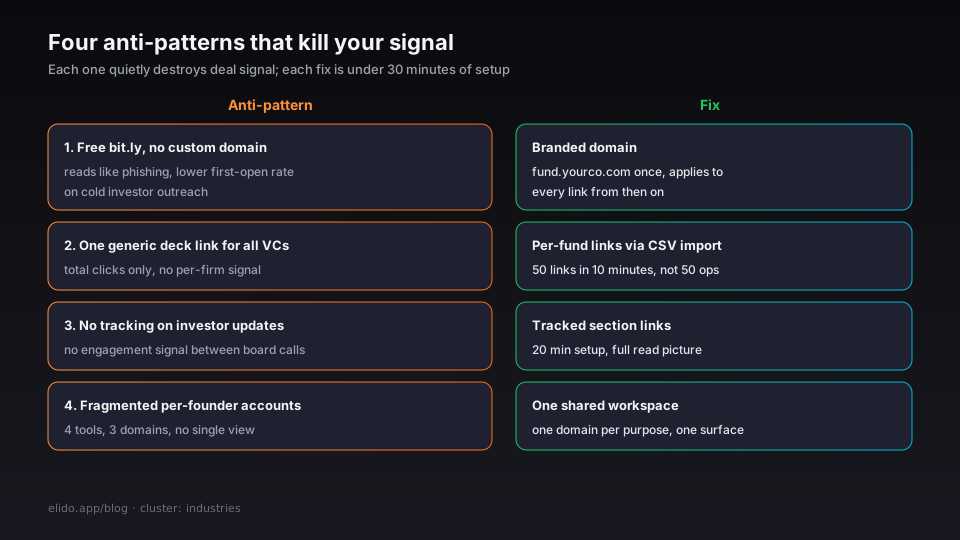
The four anti-patterns that kill your signal
1. Free-tier bit.ly with no custom domain.
Investors are increasingly suspicious of bit.ly links in cold outreach - the domain is synonymous with phishing campaigns and spam. If your deck link reads bit.ly/3xKb92q, a cautious partner will not click it from email. This is measurable: decks sent with generic shortened URLs have lower first-open rates than decks sent with branded short links on a custom domain.
Set up fund.yourco.com or go.yourco.com as your short domain. It takes 30 minutes once and applies to every link you send from that point forward. The branded short links setup guide is the step-by-step.
2. One generic deck link shared with all VCs.
If you send 50 VCs the same go.yourco.com/deck link, you know the total click count but nothing about who clicked. The per-fund signal - the one that tells you which firm is in active diligence - is gone. Create per-fund links. It is a CSV import, not 50 manual operations.
3. No tracking on investor updates.
If you send quarterly updates with no tracked links, you have no engagement signal between board calls. You may be spending 8 hours writing a beautifully crafted update that 10 of your 12 angels never open past the header. The tracked-section-link approach described in section 2 costs you 20 minutes of setup and returns a complete engagement picture.
4. Per-founder fragmented shortener accounts as the team scales.
You start with a personal Bitly account in year one. Your co-founder sets up a Rebrandly account for their investor deck. Your first marketing hire brings a third tool. By the time your VP of Marketing arrives 18 months in, there are four shortener accounts, three custom domains, and no single view of link analytics.
The clean approach: one shared workspace on one platform, one custom domain per purpose (fundraising, marketing, recruiting), one analytics surface. This is not an enterprise concern - it is the 10-person company concern, because that is where the fragmentation starts. Short links as infrastructure - treating them like Terraform covers the IaC mindset that prevents this.
A reference link architecture for a pre-Series-A startup
Here is the configuration I recommend most often. It is opinionated but simple enough to maintain solo.
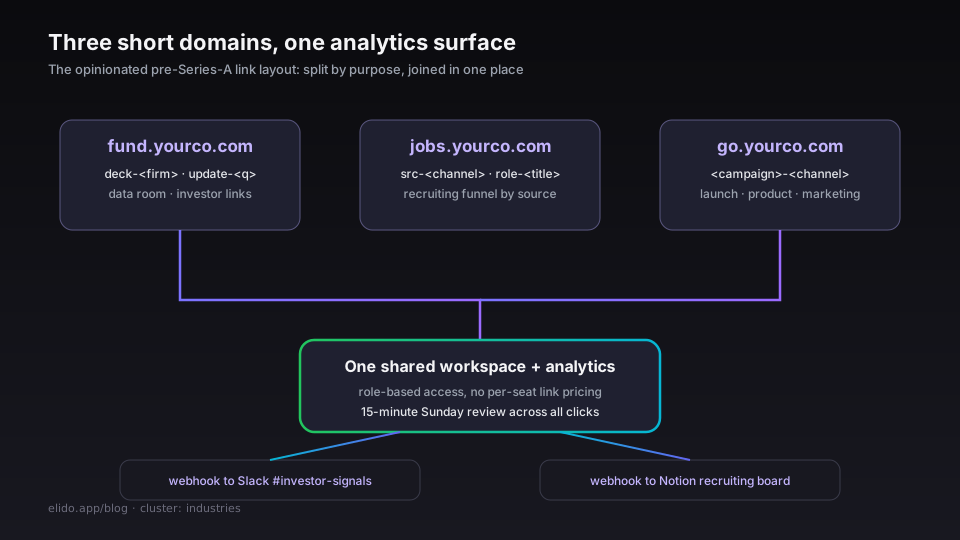
Three custom short domains:
fund.yourco.com- all fundraising-related links (deck distribution, investor updates, data room access)jobs.yourco.com- all recruiting links (job descriptions, application forms, referral landing pages)go.yourco.com- everything else (launch links, product links, marketing CTAs)
Three slug naming conventions:
- Fundraising:
fund.yourco.com/deck-<firm>,fund.yourco.com/update-<quarter>-<section>,fund.yourco.com/dr-<module>(data room) - Recruiting:
jobs.yourco.com/src-<channel>,jobs.yourco.com/role-<title> - General:
go.yourco.com/<campaign>-<channel>matching UTM campaign and source
Two webhook integrations:
- Click events on
fund.yourco.com/*→ Slack channel#investor-signals+ Notion database row update - Click events on
jobs.yourco.com/src-*→ Notion recruiting dashboard row update
One analytics review cadence: 15 minutes every Sunday, reviewing the week's click data across fundraising and recruiting links before Monday outreach planning.
The whole setup is under 4 hours to stand up and under 1 hour per week to maintain. At the stage where you are managing a seed round and early hires simultaneously, having a real-time signal layer is the difference between reactive and proactive.
Where Elido sits
Elido is not a startup-specific tool - the architecture above is platform-agnostic. But several of our design decisions are particularly well-suited to the pre-Series-A context:
- No per-seat pricing at the link level. Shared workspaces with role-based access mean your co-founder, your first hire, and an advisor can all see the same link analytics without multiplying the monthly cost.
- Custom domains on every tier.
fund.yourco.comis not an enterprise feature. It is available from the free tier with CNAME setup and same-day cert issuance. - EU data residency by default. Click events from your investors - many of whom are EU-based - stay in EU-region infrastructure. If you are fundraising from EU VCs, this is a GDPR compliance detail worth having documented.
- Webhook-on-click with HMAC signing. The investor-signal Slack notification described in this post is a
POST /v1/links/{slug}/webhookconfiguration, not a custom integration. The webhook fires within 200ms of the click event. - Bulk link creation. The per-VC deck links, the per-source recruiting links, the per-channel launch links - all created from a CSV import in a single API call.
For the analytics model that connects link clicks to activation events in your product, short link analytics - what to measure is the next read.
Related on the blog
- Track UTM campaigns end-to-end without a CDP - the UTM mechanics behind every tracked link in this post
- Server-side conversion tracking - how to join link clicks to product activation without client-side JS
- Set up branded short links - step-by-step custom domain setup for
fund.yourco.comandgo.yourco.com - Short link analytics - what to measure - the event model and the metrics worth tracking
- URL shorteners for SaaS - the link layer once you've raised and are scaling GTM
- URL shorteners for B2B sales - link tracking in the sales cycle: proposals, demos, follow-up sequences
- Short links as Terraform - treating your link infrastructure as code so it doesn't fragment as the team grows
Try Elido
Paste a URL, get a working short link
No signup. Link lives for 30 days. Sign up to keep it forever.
Free, no signup required · 2 per day