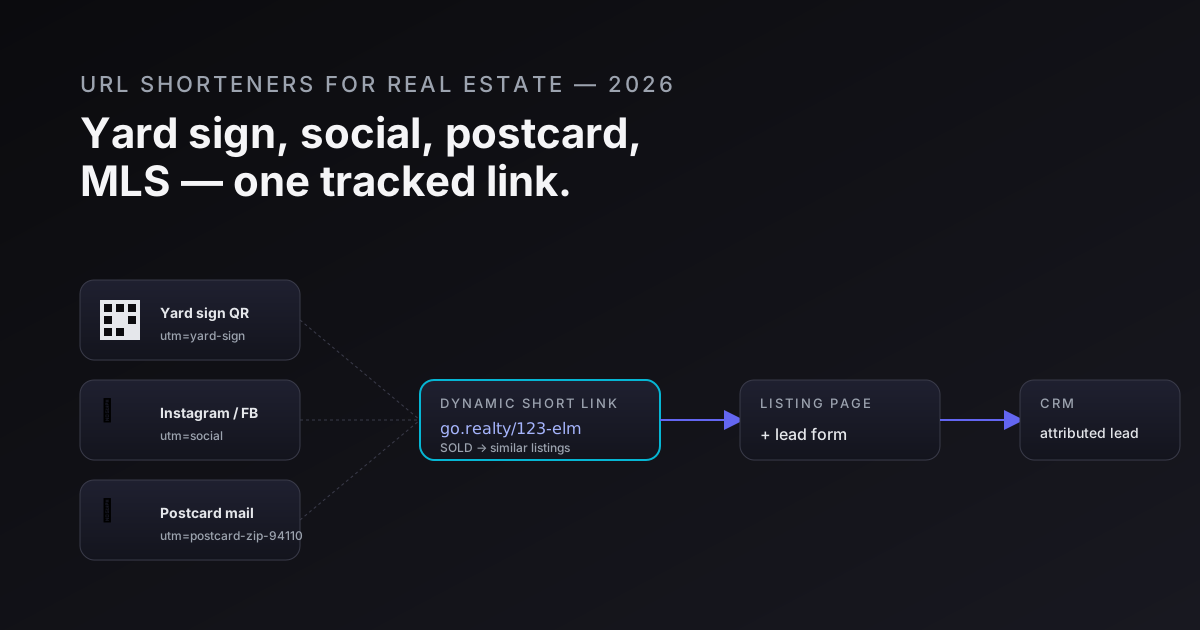
Real-estate marketing is a print-first world. Yard signs, postcards, brochures, open-house flyers. Every one of those prints carries a URL or a QR code - and most of them have no analytics attached. The agent gets a lead, marks it "internet" in the CRM, and has no idea whether the caller came from the yard sign QR, the Instagram reel, the email blast, or the Zillow syndication. This post is the link architecture that fixes that, from yard sign to closed deal.
For the QR print-specification deep dive, QR code campaign from scratch is the long read. This post covers the full real-estate link strategy.
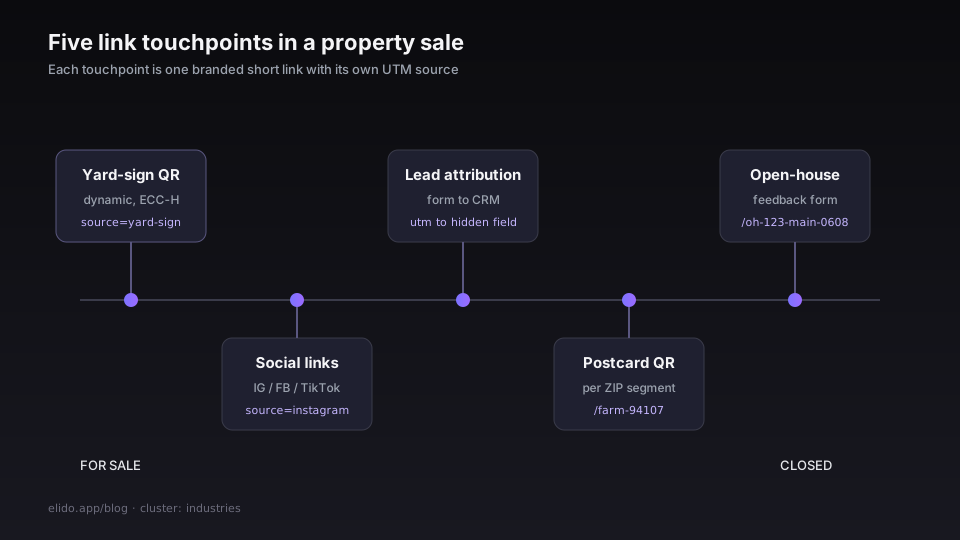
The five link touchpoints in a property sale
Every listing goes through the same five touchpoints. Each one has different link requirements.
1. The yard-sign QR code
The yard sign is the highest-stakes print job in real estate. It sits outside the property for weeks, gets photographed by curious neighbours, and is still sitting on someone's kitchen table six months after they toured the property.
What matters: The QR has to scan reliably from 2m in bright sun and in the shadow of a covered porch. That means ECC-H (error-correction level High), module size of at least 3 cm × 3 cm on the physical sign, and ≥ 60% contrast between modules and background. White or pale-yellow backgrounds are the default safe choice; dark-stained cedar sign boards are where agents lose scan rates.
Why dynamic QR is non-negotiable here: A static QR code bakes the destination URL into the modules - it can never change. The moment the property goes under contract, the yard sign is still at the kerb. The moment it closes, the sign is in someone's garage. Twelve months later, someone finds it on a shelf and scans the QR expecting the listing - and gets a 404. A dynamic QR resolves through a short-link service; when you update the destination, every future scan goes to the new page. The right update sequence: FOR SALE → listing page, UNDER CONTRACT → "this home is under contract - see similar listings", SOLD → "this property sold, here are three properties like it in the same neighbourhood". The yard sign is now a perpetual lead capture point, not a dead end.
For the full durability argument, dynamic vs static QR codes covers what happens when a static code outlives its destination.
2. Listing-page short links for social
Instagram, Facebook, and TikTok do not like long URLs. A raw MLS listing URL (www.mlslistings.com/property/CA-SFBA/listing/123456789-1234-main-street-anytown) breaks link previews, looks unprofessional in captions, and provides zero analytics back to the agent.
What matters: A branded short link (yourname.go/123-main) that fits in a caption, creates a clean link preview, and carries a UTM tag per platform. source=instagram, source=facebook, source=tiktok - each platform gets its own destination URL so the analytics surface answers "which platform drove the most clicks on this listing?" The slug itself can be human-readable (123-main-street) so followers remember it and can type it if they don't tap the link.
The Zillow trap: Many agents share Zillow's URL for their listing on social. Zillow's URL changes when the listing status changes. The moment the property goes pending, the Zillow URL redirects to a search page, not the listing - and the social post becomes a dead link. Share your own short link, pointed at your own listing page (or at the MLS sheet you control). You retain the destination, and you see the click data.
See setup branded short links for the DNS-to-first-link walkthrough.
3. Per-listing lead attribution
A competitive listing runs in four or more channels at once: yard sign, social, email blast to the farm, MLS syndication. When a lead submits a contact form, which channel drove it?
What matters: Each channel's short link carries a distinct UTM source and campaign. The contact form captures UTM parameters from the URL and passes them as hidden fields. The CRM creates the contact record with lead_source = utm_source and campaign = utm_campaign. Now the attribution chain is: click on source=yard-sign-qr → landing page → form submission → CRM record tagged yard-sign-qr.
What breaks this: Forwarding all four channels to the same destination URL without distinct UTMs. The clicks land, the form submits, and the CRM sees "direct" on every single record because there was nothing in the URL to distinguish them. Track UTM campaigns end-to-end is the cornerstone for the mechanics of capturing UTM at form submission - the real-estate pattern is identical to the e-commerce pattern covered there.
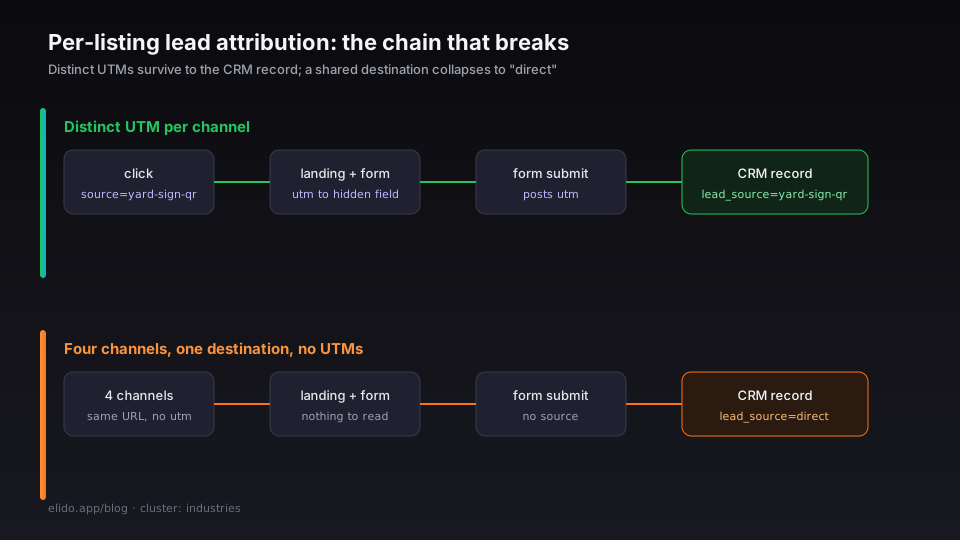
After a few listings you have enough data to answer: does the yard sign or Instagram drive more form submissions? Does email produce better lead-to-showing conversion than social? That data is worth more than the time it takes to set up UTMs.
4. Direct-mail postcard QR codes
Farming territory is one of the highest-cost items in an agent's marketing budget. Postcards, every 4–6 weeks, to a geographic patch. Most agents have no idea which ZIPs are yielding responses.
What matters: Each print run gets a distinct short link, keyed to the ZIP code or neighbourhood segment. go.youragency.com/farm-94105, go.youragency.com/farm-94107. After three or four mailings, the analytics surface tells you: ZIP 94107 produced 12 scans and 3 form submissions per 200 cards mailed; ZIP 94105 produced 2 scans and 0 submissions. You know where to continue farming and where to stop.
The link in the postcard goes to a landing page specific to that market area - comparable sales, recent listings, a home-valuation CTA. That landing page's form captures the same UTM as the short link, so the CRM record knows it came from the 94107 postcard and which mailing date.
Short link analytics - what to measure covers the metrics that matter for a print-driven campaign like this.
5. Open-house feedback collection
Every open house has a brochure. The brochure has a QR code or short URL. That link usually goes to the listing page - and the visit data is lost.
A better pattern: The open-house link goes to a two-question form: "Rate this property 1–5" and "What brought you to the open house today?" The agent gets one feedback record per open house, attributed by event date. After 10 open houses, the pattern is visible: certain neighbourhoods attract buyers from a specific source (farm postcard vs. social reel vs. agent referral). That informs where to spend the next quarter's marketing budget.
Create a separate short link per open house event, not per listing. go.youragency.com/oh-123-main-0608 for the June 8th open house at 123 Main. If the property has two open houses, each gets its own link so attendance and feedback is attributed by event date, not just by listing.
Compliance considerations
US agents operate under NAR Code of Ethics and state real-estate board advertising rules. Many states require that any advertisement for a property - including links in social posts - display the agent's licence number and brokerage affiliation. A short link is not an advertisement by itself, but the destination it resolves to must carry the required disclosures.
Do not short-link in a way that obscures required information. If your state requires the licence number in the ad copy, the short-link destination must display it. Redirecting to a landing page that strips brokerage identity from the listing is non-compliant regardless of how the short link is branded.
EU agents face additional GDPR constraints on click tracking: if you're tracking individual click events (IP, user agent, timestamps), you need either a legitimate interest basis or consent. Elido's EU-region data residency keeps click events in EU infrastructure, which is the prerequisite for any GDPR compliance argument - but it does not substitute for your own legal basis review.
The four anti-patterns that break real-estate attribution
1. Static QR codes on yard signs. The most common mistake. The QR is generated once by the sign shop, baked into the vinyl, and points to a page that will 404 or redirect incorrectly the moment the listing status changes. Every yard sign should carry a dynamic QR code routed through a short-link service, so the destination can be updated without reprinting. See dynamic vs static QR codes for the full argument.
2. Using the brokerage's centralised shortener account. The brokerage admin created the Bitly account. Agents can create links but can't see other agents' analytics. The individual agent has no way to pull "which channel drove the most leads for 123 Elm?" without going back to admin. The fix is either per-agent sub-accounts with scoped analytics, or per-agent custom domains (each agent has firstname.go/slug) so every agent controls their own data. Custom domain TLS in 5 minutes covers issuing an agent-level short domain.
3. Sharing Zillow's URL on social. Zillow's listing URL is keyed to Zillow's internal listing status. When the listing goes pending, Zillow redirects the URL. When it closes, the URL may disappear entirely. Any social post with Zillow's URL is a time bomb. Always share your own short link pointed at your own listing page. You keep the destination, you see the analytics, and the link stays valid regardless of Zillow's internal status changes.
4. Not capturing UTM at form submission. The short link carries UTMs. The prospect clicks it, arrives on the listing page, and fills out the "schedule a showing" form. If the form doesn't capture utm_source and utm_campaign from the URL, the CRM record is created with no source attribution - it looks like "direct" no matter where the prospect came from. Every contact form in a real-estate marketing stack should read UTM parameters from the URL and pass them as hidden fields on submit. Track UTM campaigns end-to-end covers the implementation details.
A reference architecture for a single active listing
This is the link structure I recommend for a single listing. It scales to a full brokerage's catalogue with a consistent naming convention.
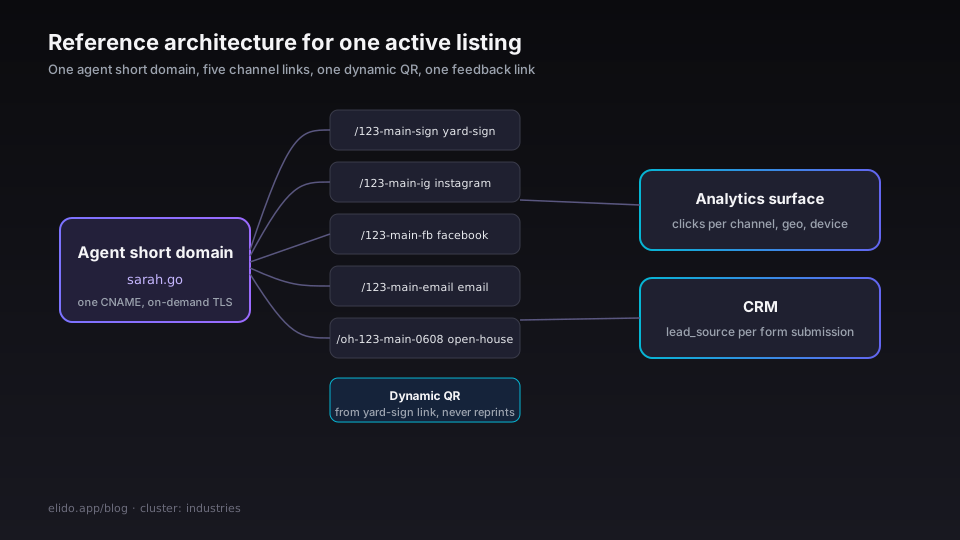
One branded short domain per agent. firstname.go (e.g. sarah.go). Single DNS CNAME to your shortener. All links for all listings live under one analytics surface. The custom-domain TLS setup takes 10 minutes; custom domain TLS in 5 minutes walks through every step.
Five links per listing:
| Channel | Slug pattern | UTM source |
|---|---|---|
| Yard sign QR | sarah.go/123-main-sign | yard-sign |
sarah.go/123-main-ig | instagram | |
sarah.go/123-main-fb | facebook | |
| Email blast | sarah.go/123-main-email | email |
| Open-house brochure | sarah.go/oh-123-main-0608 | open-house |
All five resolve to the same listing page (or separate landing pages if you A/B test messaging by channel). The UTM source differs on each. The analytics dashboard answers "which channel drove the most clicks?" at listing level; the CRM answers "which channel drove the most form submissions?" at lead level.
One dynamic QR per yard sign. Generated at listing time from the yard-sign short link. Printed at ECC-H, ≥ 3 cm × 3 cm, on a sign insert or rider. When the property status changes, the short link destination updates - QR never reprints.
One feedback link per open house. Created fresh for each open-house date. Destination is a form, not the listing page. Attribution by event date.
The full setup for a new listing takes under 15 minutes once the naming convention is in place. Most agents script it as a checklist in their transaction management system.
What the analytics surface should tell you
Within 48 hours of going live with a new listing, you should be able to answer:
- Total clicks per channel (social vs. yard sign vs. email vs. open house)
- Click-to-form-submission rate per channel (which channel has the best intent signal?)
- Geographic distribution of clicks (are the clicks local or distant?)
- Device split (mobile-heavy on yard sign; desktop-heavier on email - useful for landing page optimisation)
- Day-over-day click trend (did social traffic spike after the Instagram reel dropped?)
After the listing closes, the retrospective question is: which channel drove the lead that converted? If your CRM captures UTM at form submission, you have a clean answer. If not, you're guessing. Short link analytics - what to measure covers building this reporting surface without a dedicated analytics warehouse.
Where Elido sits
The architecture above works on any URL shortener that supports custom domains, dynamic QR, and per-link UTM analytics. Elido adds a few things that matter specifically for real-estate volume:
- Dynamic QR with status-transition updates - the destination update is a single API call or dashboard click. Brokerage platforms can hook into the MLS status change event and auto-update the yard-sign destination via
PATCH /v1/links/:id. - Per-agent scoped access - agents get access scoped to their own slug prefix. The brokerage admin sees everything; the individual agent sees only their listings. No shared credentials, no data leakage between agents.
- EU data residency for click events - for brokerages operating across EU and US markets, click events are stored in our EU-region analytics store by default. Country-level geo is available without relying on third-party enrichment.
- On-demand TLS for agent custom domains - point
sarah.goat our edge; the cert is issued in under 60 seconds. Each agent can have their own branded short domain with no involvement from the brokerage IT team.
For the full setup walkthrough, setup branded short links is the starting point.
Related on the blog
- Dynamic vs static QR codes - the durability and changeability trade-off for printed QR
- QR code campaign from scratch - print specifications, ECC levels, contrast testing
- Track UTM campaigns end-to-end - the cornerstone for UTM capture at form submission
- Short link analytics - what to measure - building an attribution dashboard from click data
- Custom domain TLS in 5 minutes - per-agent short domains with automatic cert provisioning
- Setup branded short links - end-to-end DNS and first-link walkthrough
- URL shorteners for marketers - the broader marketing attribution playbook
Try Elido
Paste a URL, get a working short link
No signup. Link lives for 30 days. Sign up to keep it forever.
Free, no signup required · 2 per day