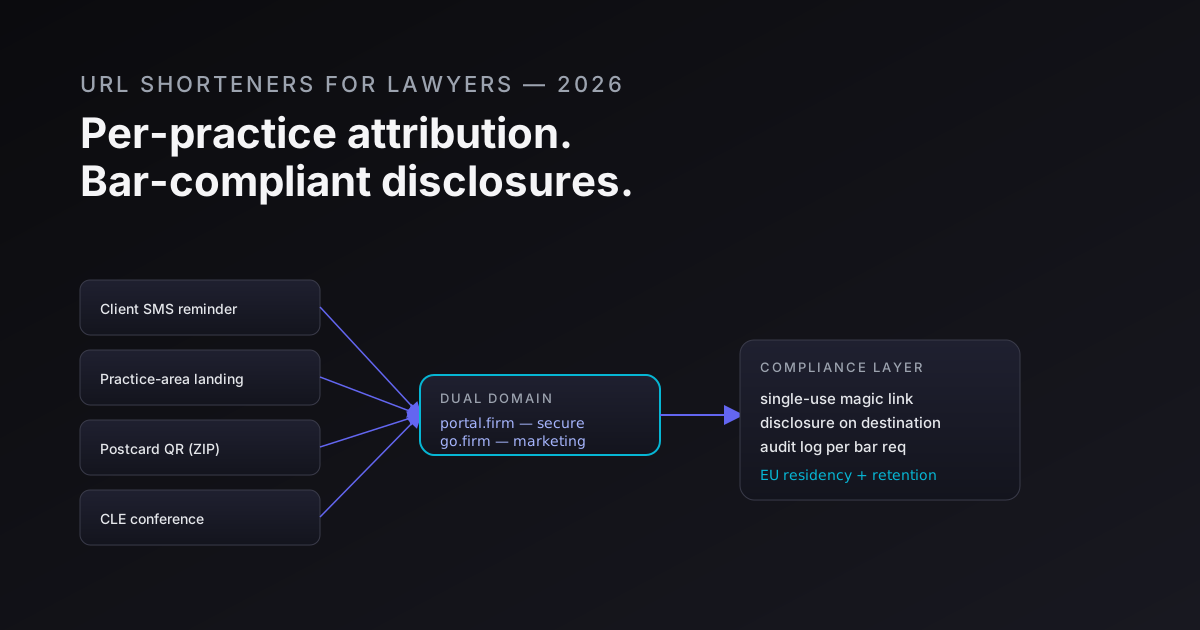
Legal practice runs on links. Client-portal invitations, court-deadline reminders, case-update SMS messages, CLE speaker slides, direct-mail postcards, billboard QR codes. When the link layer is informal - a personal Bitly for the litigation team, a Google redirect for the estate-planning intake form, a spreadsheet of shortened URLs maintained by the marketing coordinator - you get broken attribution at best and bar-compliance exposure at worst.
This post is the link architecture for law firms that takes the compliance angle seriously: bar-association advertising rules, GDPR data residency for EU-client data, and the single-use magic-link pattern for client portal access that your IT team has probably been meaning to build for two years.
For the UTM fundamentals, Track UTM campaigns end-to-end is the cornerstone. For the GDPR angle, GDPR for URL shorteners covers the lawful basis and data-residency requirements in detail. This post is the legal-industry-specific application layer on top of both.
The four use cases that matter most
Legal practice is not one audience - it is solo practitioners doing their own marketing, BigLaw IP departments with dedicated business-development teams, in-house counsel who never market at all, and legal-aid organisations that need to reach low-income clients over SMS. The link layer looks different across each. These four patterns cover most of the cases.
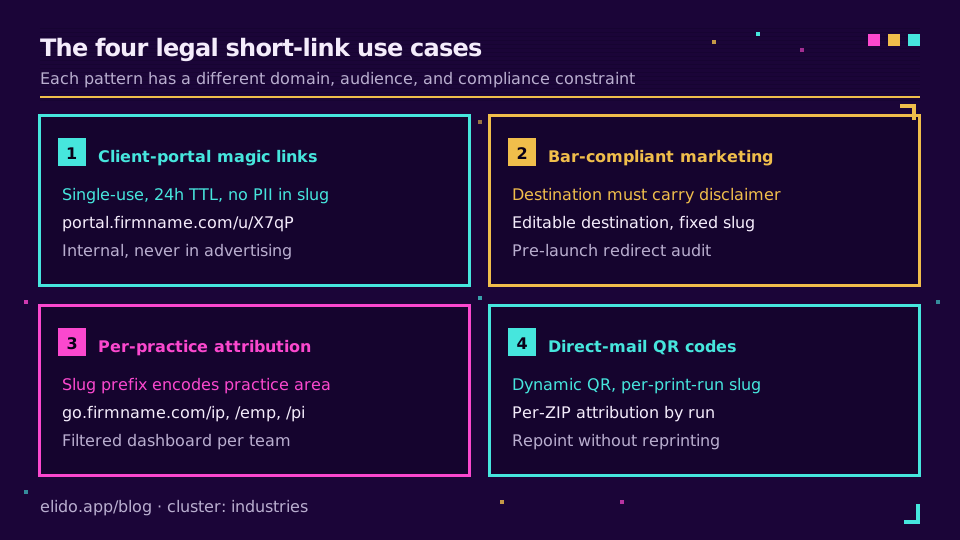
1. Client-portal magic links
The single most impactful use of a short link in legal practice is the client-portal magic link. A case update is ready. The firm sends an SMS or email: "Your case update is ready - review here: go.firmname.com/u/X7qP". The client taps the link and lands directly inside the portal, authenticated, on the relevant document.
What makes this different from a standard short link:
- Single-use. Once the link is followed, it must expire. The redirect service issues the link with a 24-hour TTL; after that, the link resolves to a "this link has expired - log in directly" page. A link that stays live indefinitely in an SMS thread is a social-engineering vector.
- No PII in the slug. The slug is a random token (
X7qP), not the client's name or case number. The resolution to the specific client's portal session happens server-side against a lookup table. An SMS thread screenshot does not reveal client identity. - Delivery is a redirect, not a raw URL. The short link domain is
go.firmname.com- the firm's own domain, not a third-party shortener domain. The client never seesbit.ly/3xF…in a message that is supposed to feel like it came from a trusted advisor.
The implementation pattern: the case-management system triggers a webhook when a case update is published. The webhook handler calls your URL shortener's API to create a single-use link with a 24-hour TTL, then sends the short link via the SMS/email gateway. The short link points at an auth-callback endpoint that validates the token, creates a session, and redirects into the portal.
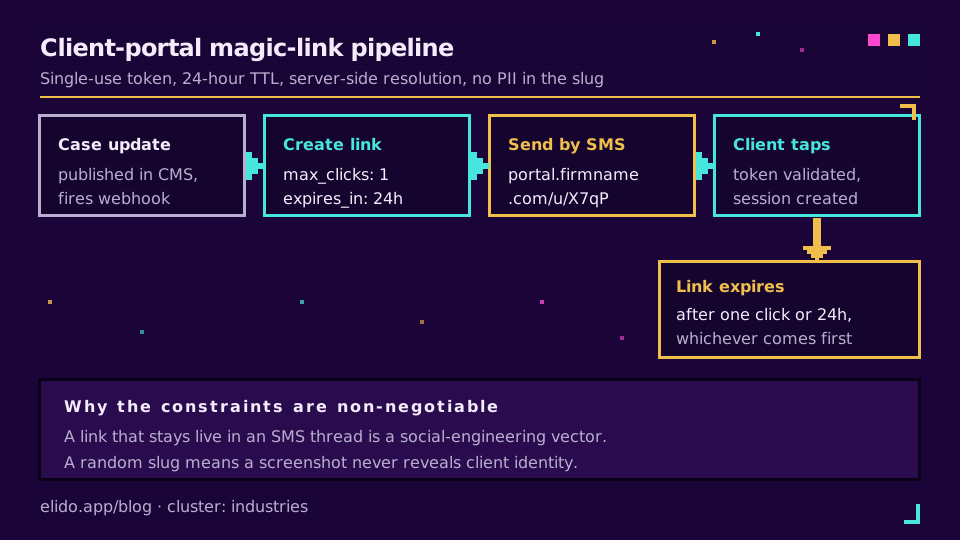
This is the pattern behind every "magic link" login you have ever received - law firms are late adopters of it relative to SaaS products, but the legal use case is more high-stakes, so the TTL and single-use constraints are non-negotiable.
2. Bar-compliant marketing short links
Most US state bars regulate lawyer advertising. The exact rules vary by jurisdiction, but the common thread is: a lawyer advertisement must be identifiable as advertising, must include the attorney's name and contact information, and in many states must carry a specific disclaimer ("Attorney Advertising" or similar). Some states require every linked destination to comply with the same disclosure requirements as the advertisement itself.
This creates a compliance trap that short links can inadvertently spring:
- The firm runs a television spot with a short URL on screen. The TV ad carries the required disclaimer. The short URL redirects to a landing page that does not.
- The firm prints a postcard with a QR code. The QR resolves to a practice-area sub-page that has no disclaimer because it was built as an internal page, not an advertising destination.
- A re-org changes the practice-area URL structure. The short link now redirects to a 404, or worse, to an unrelated page - and the billboard is already up.
The discipline that prevents this:
Every marketing short link should be audited at creation time against a checklist: does the destination display the required disclaimer text? Does it carry the attorney's name and bar number where required? Is the disclaimer visible above the fold on mobile?
The short link service should allow you to update the destination URL without changing the slug. When the firm re-platforms, you update the 40 marketing short links from the dashboard - the physical media (billboards, postcards, business cards) still resolve correctly.
Never let a short link strip a required disclosure. A redirect is not an opportunity to route around ethics rules. If the destination page does not carry the required language, the short link is not the problem - but the short link owner is the one who approved the campaign.
For the compliance angle on click-data collection, URL shortener security checklist covers the data minimisation requirements that intersect with bar confidentiality rules.
3. Per-practice-area attribution
Large and mid-size firms run distinct marketing programs for different practice areas. IP, M&A, employment, real estate, family law, and personal injury all have different client acquisition economics, different referral sources, and different conversion funnels. Without per-practice attribution, the marketing budget is allocated to "the firm", not to the practice area that actually generates the ROI.
Short links make per-practice attribution simple:
go.firmname.com/ip/conference-2026- IP team's CLE conference linkgo.firmname.com/emp/linkedin-q2- employment team's LinkedIn campaigngo.firmname.com/pi/postcard-chicago-north- personal-injury team's direct-mail ZIP
The slug prefix encodes the practice area. The analytics dashboard, filtered by prefix, gives the IP team their own attribution surface without cross-contaminating the employment team's numbers.
The alternative - one firm-wide short domain with unnamespaced slugs - means the marketing coordinator owns all attribution and must manually tag every report by practice area. That works when there are five campaigns. It breaks at twenty.
For the UTM mechanics that sit behind this, Track UTM campaigns end-to-end is the reference.
4. Direct-mail QR codes
Direct mail is disproportionately effective in personal-injury and estate-planning marketing, where the client demographic skews older and less likely to respond to digital-first advertising. A postcard with a QR code is the standard vehicle. The QR code is typically the only tracking mechanism on the mailer - there is no pixel, no cookie, no UTM in the recipient's browser.
Per-print-run, per-ZIP attribution turns a blunt instrument into a measurable channel:
- Run A has ZIP codes 60601–60620 and the slug
go.firmname.com/pi/chi-north-2026-a - Run B has ZIP codes 60621–60640 and the slug
go.firmname.com/pi/chi-south-2026-b
The QR code on each run resolves to its own slug. The scan data tells you which geographic cluster converts - and because the QR is dynamic (the image is fixed, the destination is configurable), you can run a follow-up campaign pointing the same QR at a new landing page without reprinting.
For the static-vs-dynamic QR decision, dynamic vs static QR codes covers when each is appropriate. The short answer for direct mail: always dynamic.
The cost of a static QR in direct mail is a reprint when the destination URL changes. For a 10,000-piece postcard run, that is a non-trivial budget line.
CLE conference and speaking-engagement attribution
Speaking at CLE conferences is a primary business-development channel for many practices. A speaker who presents at five CLE events per year wants to know which speaking engagements generate referrals, not just which events they attended.
The mechanism is straightforward:
- Issue a unique short link for each speaking engagement:
go.firmname.com/cle/aba-ip-2026,go.firmname.com/cle/nysba-estate-q3 - Put the short link in the slide deck, in the handout, and on the speaker bio page for the event
- Track scans/clicks over the 90 days following each event
- Join the click data to the new-matter intake form (which asks "how did you hear about us?") to close the attribution loop
A speaker with five engagements a year and a tracked link at each can rank their speaking calendar by revenue-per-engagement within two years. That data is the argument for a speaking budget and the argument for cutting low-return events.
The URL shorteners for marketers post covers the broader marketing-attribution pattern; the legal version is the same mechanics applied to a referral-driven funnel rather than a paid-media funnel.
EU GDPR + US state-bar constraints in combination
Firms with EU clients - and most large US firms have some - face a dual compliance environment: US state-bar rules on advertising data retention, and EU GDPR on personal-data residency and retention.
The friction points:
Data residency. Click data from a short link includes the clicker's IP address, which is personal data under GDPR. If a Brussels-based client clicks a case-update link and the click event is stored on a US data centre, that is a cross-border transfer requiring a lawful transfer mechanism (adequacy decision, standard contractual clauses, or similar). For many firms, the simplest answer is: store EU-client click data in an EU-resident data store and US-client click data domestically.
Elido's default EU data residency means EU-origin click events never leave the EU region. For the legal analysis, EU data residency for marketing and Schrems II and tracking pixels cover the transfer-mechanism requirements.
Retention limits. US state bars typically require law firms to retain advertising materials for a defined period - many jurisdictions specify several years. If the short link is part of an advertisement (and the URL in a TV spot is), the redirect record and the click data are arguably advertising materials. GDPR, on the other hand, requires data minimisation and storage limitation - you should not retain click-level detail longer than necessary for the purpose. These two requirements are not in conflict, but they do require a deliberate retention policy: keep the link and its destination URL for the bar-required period; delete click-level IP data at the GDPR retention limit (typically 13 months for analytics purposes).
A URL shortener that lets you configure per-link or per-workspace retention limits makes compliance policy enforceable rather than aspirational.
The four anti-patterns that create ethics and attribution risk
1. The marketing URL on letterhead that breaks during a re-org.
A firm rebrands its real-estate practice. The domain changes. The short link on every piece of existing letterhead, every business card in circulation, and the courthouse directory listing now resolves to a 404 or, worse, a competitor's domain if the old domain lapses.
Static URLs on physical materials are permanent mistakes. Short links are not: update the destination in the dashboard and every physical artefact resolves correctly. This is the core value proposition of a dynamic redirect in physical marketing.
2. One generic firm-wide URL for all practice areas.
go.firmname.com/intake is the short link on every piece of marketing across IP, employment, family law, and personal injury. Now you have no per-practice attribution, no way to know which marketing spend converts by area, and the intake team manually tags every new matter by the area the referral mentioned on the intake call.
Issue per-practice-area links from the start. The overhead is one extra link per campaign; the payoff is an attribution model that survives partner-level budget reviews.
3. Using a US-only shortener for an EU client base.
A firm with EU clients uses a US-based shortener that stores click data exclusively in US data centres. Every time an EU client clicks a case-update link or a marketing link, the firm is executing a cross-border personal-data transfer without a lawful mechanism in place.
The fix is either a shortener with configurable data residency (EU-default is the strongest option) or a self-hosted instance inside the EU. The GDPR for URL shorteners post covers the options.
4. Letting a short link redirect to a destination that strips the required ethical disclosure.
A bar-compliant TV ad carries the required disclaimer. The short URL in the ad redirects to a landing page that was built for organic search, has no disclaimer, and does not identify the content as attorney advertising.
The short link is not the problem - but it is the mechanism. The firm is responsible for where its links point. A redirect audit before any advertising campaign goes live is not optional.
What a compliant link architecture looks like
Pulling the four use cases and four anti-patterns together, a law firm's link architecture should have:
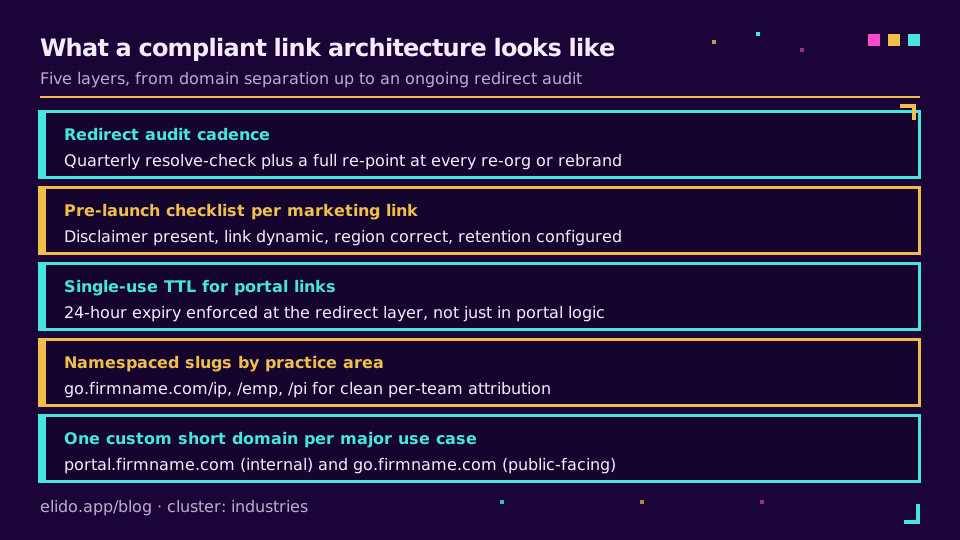
One custom short domain per major use case:
portal.firmname.comfor client-portal magic links (internal, not in advertising)go.firmname.comfor marketing and business development (public-facing)
Namespaced slugs by practice area:
go.firmname.com/ip/…,go.firmname.com/emp/…,go.firmname.com/pi/…
Single-use TTL for portal links:
- 24-hour expiry enforced at the redirect layer, not just in the portal session logic
A pre-launch checklist for every marketing short link:
- Does the destination display the required disclaimer?
- Is the link dynamic (can the destination be updated without reprinting)?
- Is the click data stored in the right region for the target client base?
- Is the retention policy configured to satisfy bar retention requirements?
A redirect audit cadence:
- Quarterly: verify every active marketing short link resolves to the correct destination
- At every re-org or rebrand: redirect all affected slugs before the old destinations are decommissioned
Where Elido sits
The link architecture above is not Elido-specific - you can build most of it on any shortener that supports custom domains, single-use links, and configurable TTLs. The Elido-specific additions that matter for legal practice:
- EU data residency by default. Click events from EU-origin IPs are stored in our EU-region analytics store and never transferred to US infrastructure. No per-link configuration required; it is the platform default.
- Single-use links via the API.
POST /v1/linkswith{ "max_clicks": 1, "expires_in": "24h" }creates a link that expires after one click or 24 hours, whichever comes first. The client-portal magic-link pattern is two API calls away. - Custom short domains on your own DNS.
portal.firmname.comandgo.firmname.comare separate workspaces in Elido, with separate analytics surfaces and separate access controls. The client-portal workspace never appears in the marketing dashboard. - Per-link retention configuration. Set a retention policy at the workspace level; link-level overrides are available for cases where bar-required retention and GDPR storage limitation point in different directions.
- Webhook on redirect. Every client-portal magic-link click fires a webhook into your case-management system within 200ms - the portal gets the token, validates it, invalidates it, and creates the session. No polling required.
For a setup conversation, the solutions page for legal and professional services has the relevant detail.
Related on the blog
- GDPR for URL shorteners - lawful basis, data-residency requirements, and what "EU-resident click data" actually means
- EU data residency for marketing - the infrastructure layer behind EU-default storage
- Track UTM campaigns end-to-end - the cornerstone for the attribution cluster
- URL shortener security checklist - data minimisation and access-control requirements that intersect with bar confidentiality rules
- Dynamic vs static QR codes - when to use each for direct mail and physical advertising
- URL shorteners for marketers - the broader marketing-attribution context this legal post sits inside
- Schrems II and tracking pixels - the transfer-mechanism requirements for EU-client click data
Try Elido
Paste a URL, get a working short link
No signup. Link lives for 30 days. Sign up to keep it forever.
Free, no signup required · 2 per day