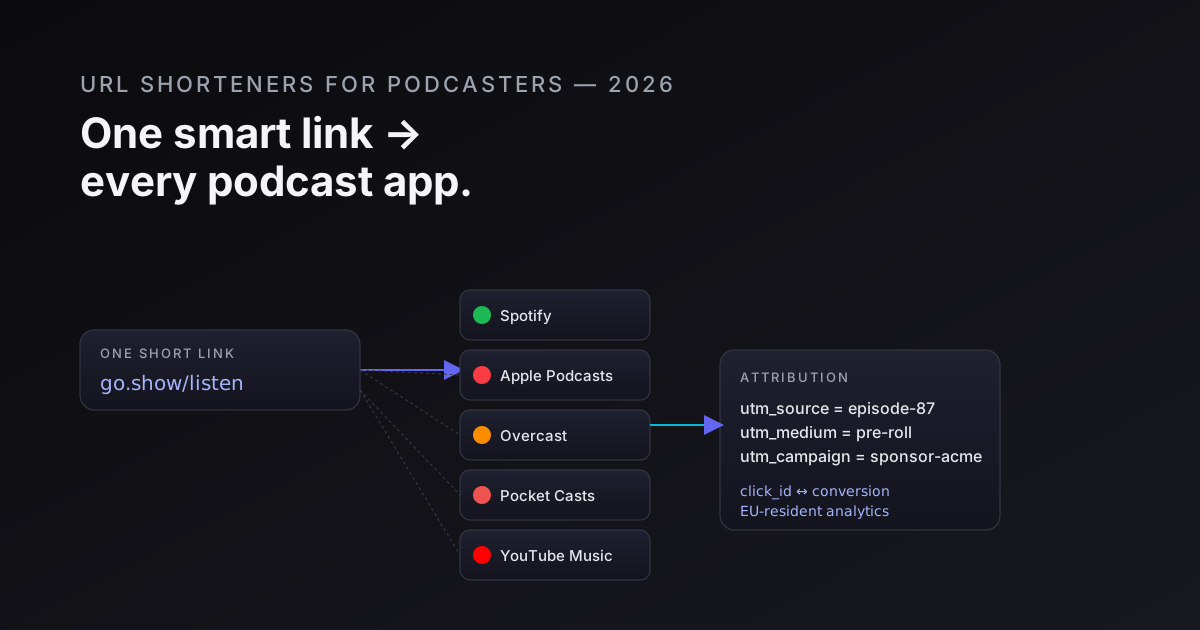
Podcast monetisation lives or dies on attribution. Sponsors pay for exposure but demand conversion data. Listeners follow shows across five different apps. Show notes carry 12 outbound links nobody tracks. The link layer of a podcast operation is usually a mess — and it's a mess that costs money every time a sponsor asks "how did episode 87 perform?" and you have no answer better than "our promo code redemptions were up."
This post is the link architecture for podcasters who want real attribution. It covers sponsor campaigns, multi-platform smart links, show-notes tracking, live event QR codes, and newsletter cross-promotion. The smart links explained cornerstone is the prerequisite for the platform-routing section if you haven't read it.
Sponsor links vs. promo codes — why you need both#
The standard podcast sponsorship model sends listeners to acme.com/yourshow and gives you a promo code YOURSHOW. You read the code at mid-roll, the listener goes directly to the brand's site, and the sponsor counts promo code redemptions.
That's last-touch attribution. It tells you how many listeners typed YOURSHOW into a checkout field. It tells you nothing about:
- How many clicked through but didn't convert
- Which episode drove the highest intent traffic
- Whether the mid-roll placement outperforms the pre-roll placement
- Whether episode 87's audience had a higher conversion rate than episode 91's
A tracked short link — go.yourshow.com/acme-ep87 pointing at acme.com/yourshow?utm_source=yourshow&utm_medium=podcast&utm_campaign=ep87 — gives you the click-through picture that the promo code misses. The promo code is still there. The sponsor still tracks redemptions. You add a second data layer on top: clicks before the checkout, segmented by episode.
Both belong in the same campaign. The promo code is the sponsor's last-touch signal. The short link is your first-touch signal. The gap between the two (high click-through, low redemption) tells you something is breaking at the landing page — that's a negotiating point with the sponsor and a signal to send them a conversion rate optimisation note, not just your download numbers.
For the full UTM mechanics, track UTM campaigns end-to-end covers the utm_source/utm_medium/utm_campaign/utm_content taxonomy and how to avoid double-counting across channels.
Smart links for multi-platform episode distribution#
The standard pre-roll "subscribe at buzzsprout.com/123456/episodes/abc" is a branding failure. Nobody types that URL. Nobody remembers it. And it doesn't route the listener to their preferred app.
A smart episode link — go.yourshow.com/listen-ep87 — resolves based on the listener's device and browser:
- iOS → Apple Podcasts deep link (
podcast://...) - Android → Spotify deep link or Google Podcasts redirect
- Desktop → your landing page with all platform badges
- Unknown UA → fallback to your default platform
One URL. One thing to say on air. One thing to put in the episode description. The routing happens at the redirect layer, not in the listener's hands.
The smart links explained post covers how the UA detection and conditional redirect works at the redirect-service level. The short version: the redirect service reads User-Agent and issues a 302 to the appropriate deep link, with the fallback URL as the catch-all. No JavaScript, no app store redirect API dependency.
The practical payoff: "subscribe at go.yourshow.com/listen" in every pre-roll resolves to the right app for every listener. You track which platform gets the most subscribes per episode. If Spotify drives 70% of your new subscribers and Apple Podcasts drives 20%, that's an ad-placement signal — Spotify-native advertising formats are worth testing.
For context on how deep links work without requiring an SDK in the third-party app, deep links without an SDK explains the universal link / App Link / fallback chain.
Show-notes link tracking#
A typical podcast episode has 8-15 outbound links in the show notes: the guest's website, the book they mentioned, the tool they demoed, the research paper they cited, the other podcast they recommended. Every one of those is a raw URL.
Raw URLs in show notes are dead data. You don't know if the reference to the guest's newsletter drove 400 clicks or 4. You don't know if your audience is more interested in the tool demo or the book recommendation. You don't know which show-notes link drove the most value for your guest — and that's exactly the kind of data that makes a guest want to come back.
The pattern is simple: every show-notes link goes through a short link. go.yourshow.com/ep87-book, go.yourshow.com/ep87-tool, go.yourshow.com/ep87-guest. Three seconds per link to create; 30 days of click data after the episode publishes.
The slug structure I recommend is ep<number>-<topic>. It's sortable by episode, readable in an RSS feed, and short enough to survive email client link-truncation. Keep the prefix consistent — if you ever want to ask "which types of show-notes references drive the most traffic across all episodes," the consistent prefix makes that query trivial.
For what the click-level data looks like once you're collecting it, short link analytics — what to measure covers the dashboard metrics that matter vs. the ones that look impressive but don't drive decisions.
Per-episode sponsor attribution#
When ACME sponsors episode 87, they want to know what episode 87 drove for them. Without per-episode links, you can tell them your total download count and hope the promo code data is enough. With per-episode links, you have the click-through rate for every placement in episode 87 and a direct line between that episode's audience and the sponsor's conversion funnel.
The setup for a properly attributed sponsor campaign looks like this:
Sponsor: ACME — runs episodes 85, 87, 91
Links:
  go.yourshow.com/acme-ep85 → acme.com/yourshow?utm_source=yourshow&utm_medium=podcast&utm_campaign=ep85
  go.yourshow.com/acme-ep87 → acme.com/yourshow?utm_source=yourshow&utm_medium=podcast&utm_campaign=ep87
  go.yourshow.com/acme-ep91 → acme.com/yourshow?utm_source=yourshow&utm_medium=podcast&utm_campaign=ep91
Three links. Three clean attribution buckets. At campaign close, you pull a report: ep87 drove 340 clicks, ep85 drove 290, ep91 drove 410. ACME's conversion team correlates their signup data against the utm_campaign values and reports back a per-episode conversion rate. You now know that episode 91's audience over-indexes for ACME's product — useful for pitching the next campaign at a higher CPM for that topic niche.
The conversion feedback loop closes if ACME sends you their utm_campaign-segmented conversion data, or if your redirect service supports a webhook that fires on click and you forward it into a shared attribution workspace. We cover the forwarding mechanics in forwarding conversions to Meta CAPI — the same pattern (webhook → conversion endpoint) applies to any CRM or analytics pipeline, not just Meta.
If you can negotiate a pixel placement on ACME's thank-you page with your episode's utm_campaign, you get conversion attribution in your own analytics, independent of whatever they're willing to report back. This is the gold standard for sponsor ROI measurement and the thing most podcast ad networks don't know to ask for.
Live events and show-floor QR codes#
Live podcast recordings, festival appearances, conference booths. You have a stage, a banner, and 400 people in the room.
The canonical play: a QR code on the stage backdrop and on your swag table, both resolving to go.yourshow.com/follow — a smart link that routes to Apple Podcasts or Spotify based on device, with a fallback to your linktree-style landing page.
A few things that matter specifically for the live context:
Print at ECC-H. Stage backdrops get scanned from 5-8 metres. ECC-H (high error correction) tolerated partial occlusion and scanning angle degradation that ECC-M can't. The QR is more visually dense but more reliably scanned. The dynamic vs. static QR codes post covers the error-correction / module density trade-off in detail.
Use a dynamic QR. Print the QR before the event. If the Spotify link changes, or you want to swap the landing page destination mid-event, the dynamic redirect lets you do that without reprinting. A static QR bakes the destination permanently at print time.
Swag is a different context. A sticker on a water bottle gets scanned 30 days after the conference. The destination should still be valid. Route to a durable landing page, not to a timely CTA like "register for today's Q&A."
Per-venue slugs. go.yourshow.com/follow-podcon vs go.yourshow.com/follow-sxsw. Tells you which live appearance drove the most new subscribers. Two-day setup cost; permanent attribution data.
Newsletter cross-promotion#
Most podcasters with a newsletter are leaving attribution data on the floor. The episode description on Spotify and Apple Podcasts has a link to the Substack. It's raw. It has no utm_source, no utm_medium. You can't tell how many newsletter subscribers came from the podcast description vs. the episode page vs. social.
The minimum viable setup:
- Episode descriptions on all platforms:
go.yourshow.com/newsletter-podcast→yourshow.substack.com?utm_source=podcast-description&utm_medium=podcast - Show-notes section of each episode:
go.yourshow.com/newsletter-ep87→yourshow.substack.com?utm_source=show-notes&utm_campaign=ep87 - Social post plugging the episode: separate
utm_source=twitter/utm_source=linkedintagged links
Three short links. Three clear attribution buckets. Now you know whether the podcast description CTA or the mid-episode show-notes mention drives more newsletter signups, and which episodes are the best newsletter conversion drivers.
This compounds. The episodes that convert the best for newsletter signups tell you which topics your audience is most invested in. That's the editorial planning input most podcasters are currently generating by feel.
The four anti-patterns that ruin podcast data#
1. Reading the host platform's auto-generated URL. "You can find this episode at buzzsprout.com/123456/episodes/14725823." No branding. No redirect analytics. No ability to update the destination if you move to a different host. If you're going to read a URL on air, it should be a short link on your own domain. The URL is free to create and the data payoff starts from episode one.
2. One short link for all sponsor placements. go.yourshow.com/acme used for episodes 85, 87, and 91. You get aggregate click data across three episodes and you can't decompose it. Create per-episode links — it's three minutes of work per campaign, and you can automate it with bulk create if you're running more than a handful of concurrent campaigns.
3. Letting sponsors send their own promo URL without a tracked wrapper. The sponsor says "send listeners to acme.com/yourshow." You read it, and now you have no click data at all — just whatever the sponsor's server logs show. Wrap it. One short link, sponsor's URL as the destination, your UTMs in the query string. Sponsors who understand attribution will appreciate the additional data. Sponsors who don't understand attribution will still get their promo code redemptions — nothing changes for them.
4. Measuring subscriber growth per week instead of per episode. "We added 280 subscribers this week" is signal mixed with noise from every episode that ever existed in that RSS feed, plus algorithm discovery, plus social, plus guests sharing. If you have per-episode subscribe links (go.yourshow.com/listen-ep87 → Spotify subscribe intent URL), you can measure which episodes drive net-new subscribers directly. That's the data that justifies a CPM increase with sponsors: "episodes in this topic niche drive 2.3x the new-subscriber rate of our average episode."
Where Elido sits#
We didn't build Elido specifically for podcasters, but the platform's core architecture maps well to the patterns above:
- Bulk per-episode link creation —
POST /v1/links/bulktakes a CSV of episode numbers, sponsor slugs, and destination URLs and returns a batch of tagged short links. Useful at the start of a campaign season when you're creating 30-60 links at once. - Smart-link resolver — conditional redirect based on
User-Agentwith a configurable fallback URL. No JavaScript dependency. The router lives at the edge, so the redirect resolves in the same latency budget as a standard short-link hit. - Webhook on click — every click on a sponsor link can fire a webhook within 200ms to your attribution pipeline. Deliveries are signed with HMAC-SHA256; your endpoint verifies origin without a shared auth header.
- EU data residency by default — click events, UA data, and geo data live in EU-region ClickHouse. GDPR coverage is built in; no per-campaign paperwork if your audience is EU-heavy.
- Custom domain via CNAME —
go.yourshow.compointed at our edge, cert issued in under 60 seconds. Your brand on every link, including sponsor campaign links you hand to your ad network.
For the setup walkthrough, the URL shorteners for marketers post covers the custom domain configuration and UTM taxonomy in more depth.
Related on the blog#
- Smart links explained — how conditional redirects by device/browser work at the redirect layer
- Track UTM campaigns end-to-end — the full
utm_source/utm_medium/utm_campaigntaxonomy and attribution model - Dynamic vs. static QR codes — the right choice for stage backdrops, swag, and printable assets
- Short link analytics — what to measure — the dashboard metrics that drive decisions, not just impressions
- URL shorteners for influencers — the adjacent use case: creator-economy link attribution across platforms