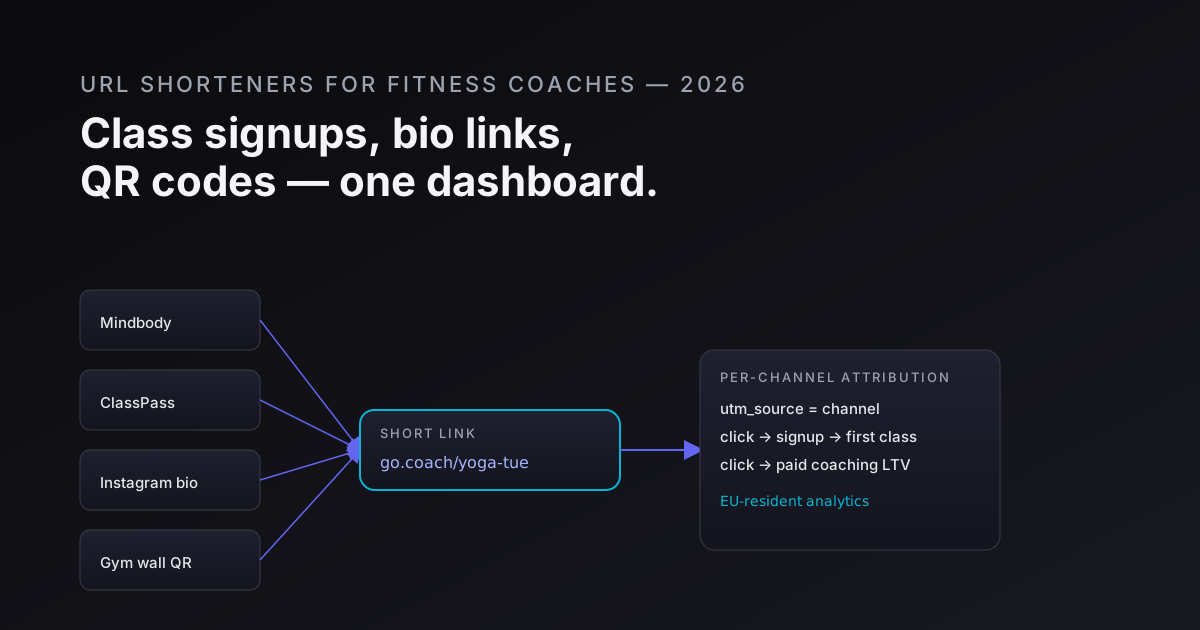
Fitness coaches live in a scattered link environment. The class is on Mindbody. The free programme is a PDF on Google Drive. The Instagram bio says "link in bio" and points to a Linktree. The WhatsApp group gets a raw Glofox URL. The physical studio has a printed QR code stuck to the wall from 2022 that still points to the old booking domain.
None of it ties together. The coach cannot answer "which platform drove the most paid sign-ups last month?" They can guess, but they cannot know. That is the problem this post solves.
For the bio-link mechanics specifically, building a link-in-bio page in 5 minutes covers the setup end to end. This post is the broader picture: every touch point from the first Instagram scroll to a confirmed paid coaching client, instrumented so you can see what actually works.
Why the fitness industry has a worse link problem than most
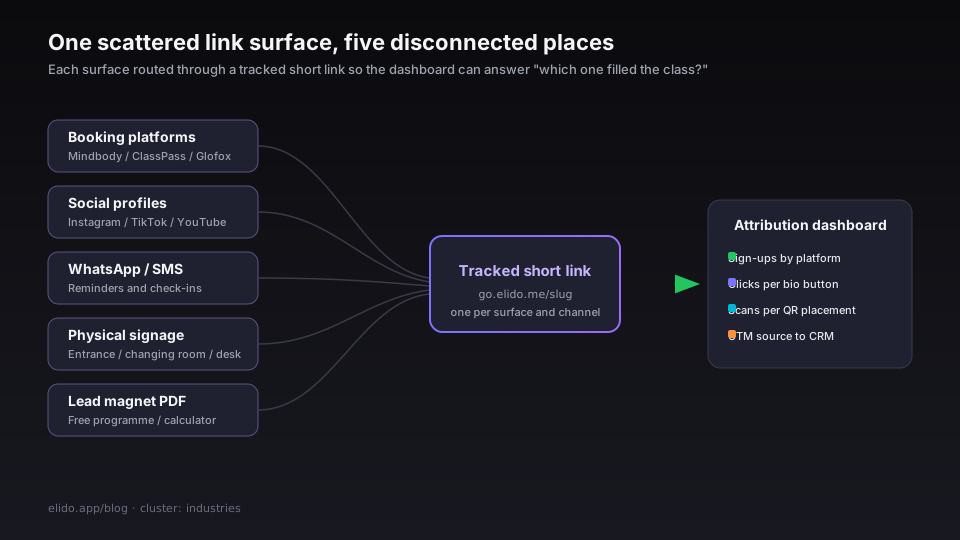
Most B2B SaaS companies have one website and one CRM. A fitness coach has:
- A booking platform (Mindbody, Glofox, Wodify, ClassPass, or some combination)
- An Instagram profile with 3,000 to 80,000 followers, a TikTok, maybe a YouTube channel
- A WhatsApp Business account for direct client communication
- A physical location with printed signage and locker-room collateral
- An email list, a lead magnet PDF, and a landing page for the flagship coaching programme
These five surfaces operate on different time horizons (social posts live for hours; printed QR codes live for years) and serve different conversion goals (Instagram drives brand awareness; WhatsApp drives same-day attendance). Measuring them requires instrumented links at every layer, not a single analytics script on one website.
Six link use cases that matter for fitness
1. Class signup links per booking platform
Most boutique studios list on multiple platforms simultaneously. A Saturday HIIT class might be bookable through Mindbody, ClassPass, and the studio's own Glofox page. The coach promotes the class once on Instagram - but which booking platform actually captures the conversion?
The standard approach is one short link per platform:
go.elido.me/hiit-sat-mindbodygo.elido.me/hiit-sat-classpassgo.elido.me/hiit-sat-direct
The Instagram post caption uses the direct link. The story swipe-up uses Mindbody (because ClassPass commissions are higher when the studio keeps the first-booking attribution). The email to the ClassPass subscriber list uses the ClassPass link. After 60 days you can see the split: if ClassPass drives 65% of first-time sign-ups but less than 20% of returning-member conversions, that is a meaningful distribution decision.
For studio chains, extend the slug to include location: go.elido.me/hiit-sat-brixton-direct. Per-location attribution answers a completely different question - which site has the healthiest organic acquisition and which one is living on ClassPass subsidies.
2. Bio link for Instagram and TikTok
Coaches are restricted to one link in the Instagram bio. That one link has to do a lot of work: current class schedule, book a 1-on-1 session, download the free programme, join the mailing list, watch the testimonial reel.
A bio-link page - sometimes called a link-in-bio - resolves this. It is a single short URL that opens a lightweight landing page with per-CTA buttons, each one a separately tracked short link. The coach posts content and changes the "featured class" CTA on the bio page without changing the bio URL itself.
What makes this useful for attribution is that clicks are tracked per button, not just per page visit. If the bio page gets 400 unique visitors this week and:
- "Book this Saturday's HIIT class" gets 180 clicks
- "Download the free 4-week plan" gets 120 clicks
- "Book a 1-on-1 coaching call" gets 40 clicks
- "Join the mailing list" gets 60 clicks
...you know where the audience intent sits today. In a week where you post three transformation posts, the 1-on-1 booking button clicks go up. In a week where you post a free-tip video, the PDF download clicks go up. That is the data that tells you what content to make.
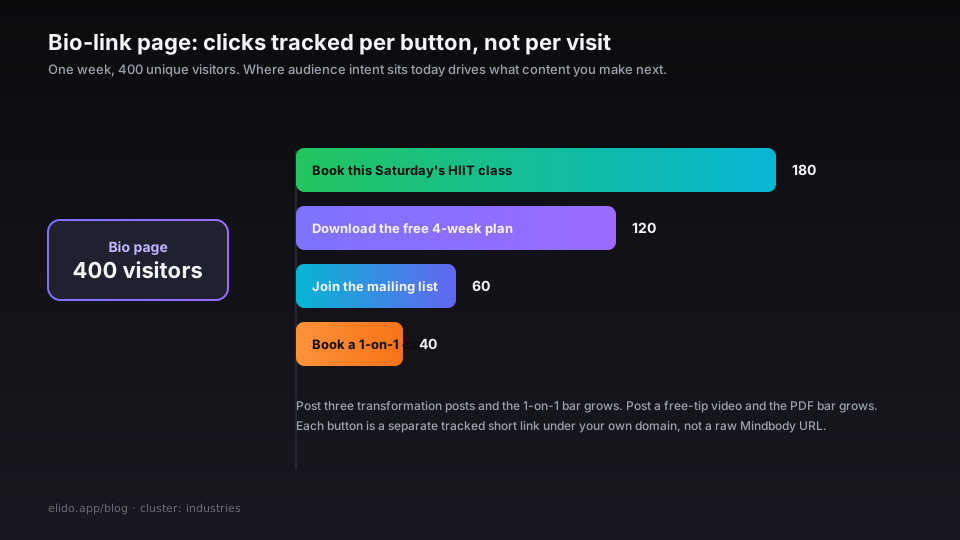
Build a link-in-bio page in 5 minutes covers the setup. The analytics piece requires that each button on the page be a tracked short link, not a raw Mindbody URL.
3. Transformation testimonial attribution
The before/after post is the highest-converting content format in fitness. A coach posts a client's 12-week transformation with a CTA: "Want results like this? Book a free call." The link in the caption (or the "link in bio" instruction) is the conversion point.
If the same coach is posting on Instagram, TikTok, and Facebook, and sending the same testimonial image to their email list, the question is: which platform produced the actual consultation booking?
One short link per channel:
go.elido.me/transform-instagramgo.elido.me/transform-tiktokgo.elido.me/transform-email
After the campaign closes, the click data answers the channel attribution question with real numbers instead of gut feel. For coaches running paid ads alongside organic posts, extending this to include transform-ig-paid vs transform-ig-organic gives you the organic vs. paid attribution split as well.
The more sophisticated pattern is closing the loop: the consultation booking form captures the UTM source from the incoming click and writes it to the CRM record. Now you can see not just which channel drove the click, but which channel drove the consultation that converted into a paying client. Track UTM campaigns end-to-end covers the full mechanics.
4. QR codes in physical gyms
A physical studio has multiple locations where a QR code converts idle attention into a booking action:
- The entrance wall ("Scan to see this week's class schedule")
- The changing room ("Scan to book your next class before you leave")
- The welcome pack for new members ("Scan to download your onboarding guide")
- The equipment station ("Scan for the form guide video for this machine")
- The front desk leaflet rack ("Scan to refer a friend and get a free class")
Each of these should be a separate short link so you know which placement is actually driving scans. The entrance wall scan rate tells you about reach. The changing room scan rate tells you about retention intent. They are different signals.
The critical rule for physical signage: use dynamic QR codes, not static ones. A static QR code has the destination URL baked into the modules at print time. When the booking platform changes its URL structure (Mindbody has done this twice in three years), the QR code is dead and you need a reprint. A dynamic QR code resolves through a short link - the short link's destination can be updated in 10 seconds without reprinting anything.
For a studio chain with five locations, issue one short link per location per placement and tag by location in the slug. The analytics dashboard gives you a heat map: location A's changing-room QR gets 40 scans per week; location B's gets 6. That is a training conversation, not a printing problem.
For the full QR production workflow, QR code campaign from scratch and dynamic vs static QR codes together cover everything from error-correction level selection to bulk generation.
5. Lead magnet PDF distribution
Free content is the standard entry point for online coaching. "Download my free 4-week kettlebell programme" or "Get the macro calculator spreadsheet." The PDF is hosted somewhere - Google Drive, a landing page, Gumroad - and the coach promotes the download link across platforms.
The attribution problem: the coach posts the lead magnet on YouTube (description link), Instagram (bio link), email list (direct link), and Pinterest (pin description). The lead capture form on the landing page has 400 submissions this month. Where did they come from?
Without per-channel tracked links, you have no idea. With them:
go.elido.me/kettlebell-youtubego.elido.me/kettlebell-instagramgo.elido.me/kettlebell-emailgo.elido.me/kettlebell-pinterest
The click data tells you reach; the conversion data (email sign-ups divided by clicks) tells you quality. If YouTube drives 800 clicks and 120 sign-ups (15% conversion) while Instagram drives 1,200 clicks and 60 sign-ups (5% conversion), the quality picture is the opposite of the volume picture. The YouTube audience is more intent-qualified for the free kettlebell programme. That changes where you invest content production hours.
This pattern extends to paid coaching programmes as well. A "free strategy call" funnel works the same way: per-channel tracked links to the booking form, close the loop by capturing the UTM in the booking record, measure cost-per-qualified-lead by channel.
6. WhatsApp and SMS class reminders
WhatsApp Business is the default communication channel for independent personal trainers and boutique studios in most of Europe, the Middle East, and Latin America. Coaches send class reminders, accountability check-ins, and promotional offers directly to a client list.
A class reminder message might look like: "Your HIIT class is in 30 minutes. Doors open at 6:50. See you there: [link to the session page]." The question the coach almost never asks is: does this message actually drive attendance among people who haven't confirmed? Or is it only people who were already coming who click the link?
Per-message tracked links answer this. A coach running a 40-person class with a 72-hour reminder and a 30-minute reminder can measure:
- Did the people who clicked the 72-hour link show up at a higher rate than those who did not click?
- Did the 30-minute nudge drive any last-minute sign-ups from the waitlist?
- Which message template gets a higher click rate?
Over three months, those numbers sharpen the reminder strategy. WhatsApp Business deep links covers the wa.me link format and how to combine click tracking with WhatsApp's own metrics.
The same pattern applies to SMS for markets where WhatsApp penetration is lower. Short links matter more in SMS because the character budget is 160 characters per segment - a raw Mindbody class URL consumes 80 of them before you write a word.
The four anti-patterns that ruin fitness-coach attribution
1. The untracked Mindbody URL shared everywhere. The coach copies the direct Mindbody class URL from the address bar and pastes it into Instagram, the email, the WhatsApp group, and the studio door poster. Mindbody's analytics shows bookings; it does not show which channel drove them. The data is permanently lost. Every channel-specific share should use a separately tagged short link, even when all of them point to the same Mindbody class page.
2. Per-coach individual shortener accounts in a chain. A studio chain with six locations and eight coaches ends up with eight Bitly free accounts, no shared dashboard, and no way for the studio owner to ask "what is our combined attribution across all coaches and all locations?" Consolidate on a shared account under the studio domain before the attribution problem gets inherited by a data analyst two years from now.
3. Static QR codes on permanent signage. Printed on the wall in 2023. Booking platform changed its URL structure in 2024. The QR now 404s or (worse) redirects to the platform's homepage, not the specific class. A dynamic short link behind every QR code on physical signage is not optional - it is the minimum viable production standard. The incremental cost of a dynamic link over a static one is zero when you are already paying for a URL shortener.
4. Linking to the homepage instead of the class page. "Book a class" → mindbody.io/yourstudio (the studio homepage). The potential client now has to find the class themselves. Every additional navigation step reduces conversion. The link should point at the specific class on the specific date, ideally pre-filtered by time slot if the booking platform supports it. A 10-click path from Instagram to a confirmed booking loses most people somewhere between steps 4 and 7. A 3-click path - Instagram post, class detail page, confirm booking - is the target. The short link is how you enforce that discipline across every coach and every channel in the studio.
A reference link architecture for a boutique fitness studio
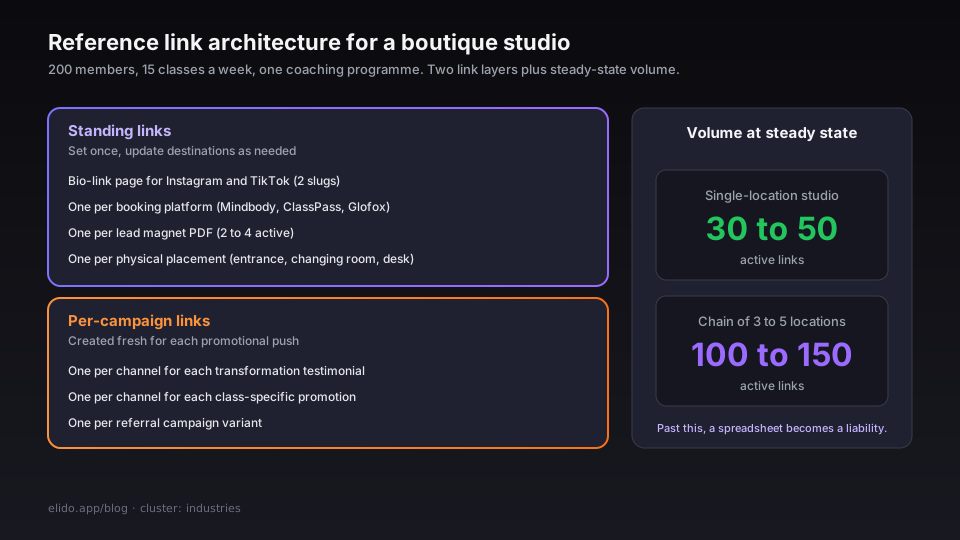
A 200-member boutique studio running 15 classes per week and one active coaching programme ends up with roughly this link inventory:
Standing links (set once, update destinations as needed):
- One bio-link page short URL for Instagram (
go.studiodomain.com/bio) - One bio-link page short URL for TikTok (same destination, different slug for attribution)
- One short link per booking platform (Mindbody, ClassPass, Glofox direct)
- One short link per lead magnet PDF (typically 2-4 active at any time)
- One short link per physical placement (entrance, changing room, front desk, welcome pack)
Per-campaign links (created for each promotional push):
- One short link per channel for each transformation testimonial post
- One short link per channel for each class-specific promotion
- One short link per referral campaign variant
Volume at steady state: approximately 30-50 active links for a well-instrumented single-location studio, rising to 100-150 for a chain of three to five locations. At that volume, a spreadsheet to manage slug assignments becomes an operational liability. A URL shortener with tag filtering and team permissions is not a nice-to-have; it is the thing that keeps the attribution legible to a new hire who joins six months from now.
Post-month analysis
The questions a coached-up studio owner should be able to answer in under two minutes from the link analytics dashboard:
- Which booking platform drove the most first-time sign-ups last month?
- Which content format (transformation post, free-tip video, class promotion) drove the most bio-link visits?
- Which lead magnet download channel produced the highest email-to-paid conversion rate?
- Which physical QR placement has the lowest scan rate relative to estimated footfall?
- Did the 30-minute WhatsApp reminder increase attendance among the people who had not confirmed?
If the URL shortener cannot surface these answers from its own dashboard, the next layer of the answer is whether the click data exports cleanly to a BI tool or CRM where the coach's team can build the view. At a minimum, the export should carry the slug, the click timestamp, the referrer, and the UA string.
Where Elido sits
We built Elido for EU-first data residency and single-digit-millisecond redirect latency, but the fitness-coach use case is where we end up spending a lot of setup time because the link surface is so fragmented:
- Bio-link pages with per-CTA click tracking - a hosted link-in-bio page where every button is a separately tracked short link under your own domain (
go.yourstudio.com). Change the featured class CTA without changing the bio URL. - Dynamic QR codes for physical signage - every QR generated through Elido resolves through a dynamic short link. Change the destination post-print from the dashboard. No reprint, no dead QRs.
- Bulk per-location link generation - studio chains can generate a full set of per-location, per-placement short links from a CSV in one API call. 50 QR codes across 5 locations in under 10 seconds.
- Per-tag analytics filtering - tag links by location, channel, or campaign. The dashboard filtered to
tag:brixtonshows only Brixton-location attribution data. Useful when a chain owner wants per-location reporting without separate accounts. - EU data residency by default - click events write to our EU-region analytics store. No per-member cookie consent paperwork beyond what the booking platform already requires, because Elido's redirect is cookieless by default.
For the URL shorteners for influencers angle (coaches with a large personal brand operate similarly), URL shorteners for influencers covers the creator-economy specifics. For physical-location QR strategies in adjacent industries, URL shorteners for restaurants is the closest sibling.
Related on the blog
- Build a link-in-bio page in 5 minutes -- the fastest path to a tracked bio-link page under your own domain
- Dynamic vs static QR codes -- the trade-off that matters for physical studio signage
- QR code campaign from scratch -- production-grade QR design and the bulk generation workflow
- WhatsApp Business deep links -- wa.me link format, click tracking, and combining with WhatsApp's own metrics
- Track UTM campaigns end-to-end -- the cornerstone for closing the loop between click attribution and CRM conversion
- URL shorteners for influencers -- sibling post for coaches building a personal brand
Try Elido
Paste a URL, get a working short link
No signup. Link lives for 30 days. Sign up to keep it forever.
Free, no signup required · 2 per day