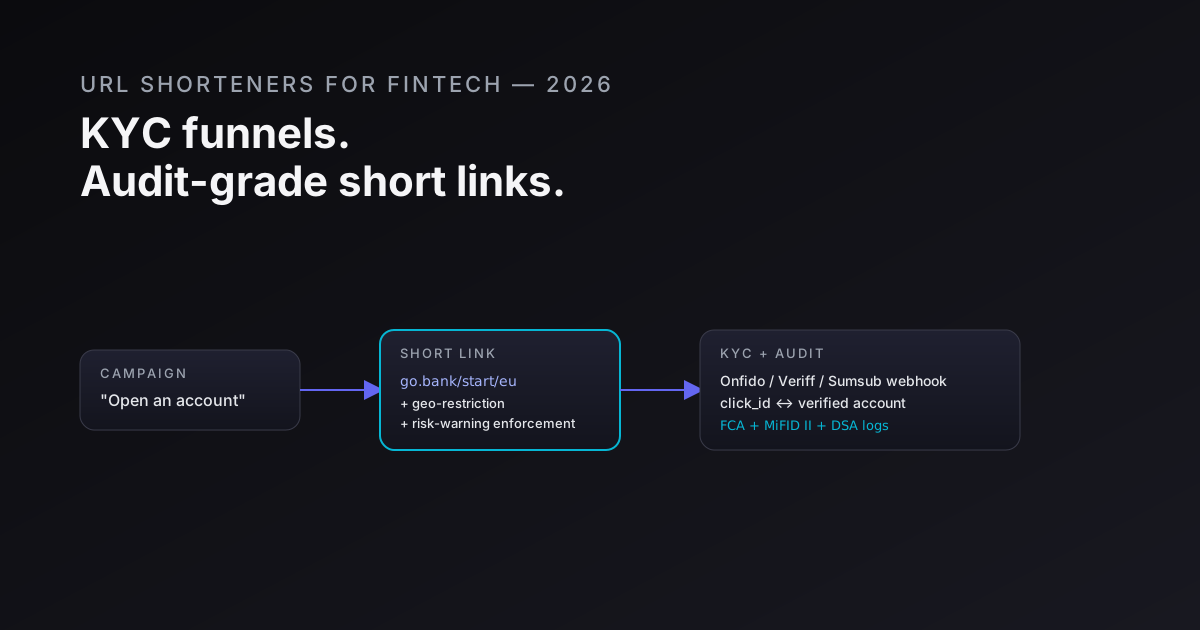
Fintech is the industry where a misconfigured redirect can trigger a regulatory enforcement notice. A crypto promo link served to a UK user without a risk warning is an FCA breach. A geo-restricted product link that ignores the IP check is a licensing violation. A "open an account" CTA that routes through a free-tier bit.ly shortener gets filtered by UK carrier spam gates before the user ever sees it.
This post covers the link architecture for regulated financial products: neobanks, payment processors, crypto exchanges, and insurtech. The four anti-patterns at the end are from real compliance reviews.
For general GDPR posture on the redirect layer, GDPR for URL shorteners is the right starting point. This post assumes you have that baseline and focuses on the fintech-specific requirements on top.
Why short links in fintech need a compliance layer
Every other industry uses short links for convenience - shorter text in an email, trackable UTMs in a campaign. Fintech uses them for all of that, but with an additional constraint: the redirect itself is part of the regulated promotion chain.
UK FCA and EU MiFID II define "financial promotion" broadly. The short link that leads to a promotional page is part of that chain. If the destination page omits the required risk warning, or if the geo-restriction is not enforced at the redirect layer, the breach exists regardless of what the legal team wrote in the campaign brief.
The short link service is not just a performance tool. It is a compliance control point.
1. KYC funnel attribution
The headline metric for neobank marketing is cost per acquired account - not cost per click and not cost per install. The funnel looks like:
- Ad impression → click → short link → app store / landing page
- App install → registration start
- KYC initiation (identity document upload)
- KYC pass / fail
- Account activated
Most attribution tools instrument steps 1-2 well and step 5 poorly. Steps 3 and 4 - the actual bottleneck - are invisible unless you plumb the KYC vendor's webhook back into your link analytics.
What this means for the short link layer:
Each channel gets its own short link with baked-in UTM parameters. go.yourbank.com/open/paid-ig-summer25 for Instagram paid, go.yourbank.com/open/email-reactivation for the winback sequence, go.yourbank.com/open/partner-wise for a referral partner. The UTM flows through to the registration form via a hidden field, persists in the user record, and is available when the KYC vendor fires its identity_check.completed webhook.
Your analytics pipeline then joins: click event (from the short link service) → registration event (from your backend) → KYC outcome event (from Onfido / Veriff / Sumsub webhook) → account-activated event. The join key is the UTM campaign + source pair that was captured at click time.
Without channel-level short links, this join is impossible. You know the aggregate KYC pass rate; you do not know that Instagram paid traffic has a 34% KYC pass rate versus email reactivation's 61%, which is the number the finance team needs to set channel CAC targets.
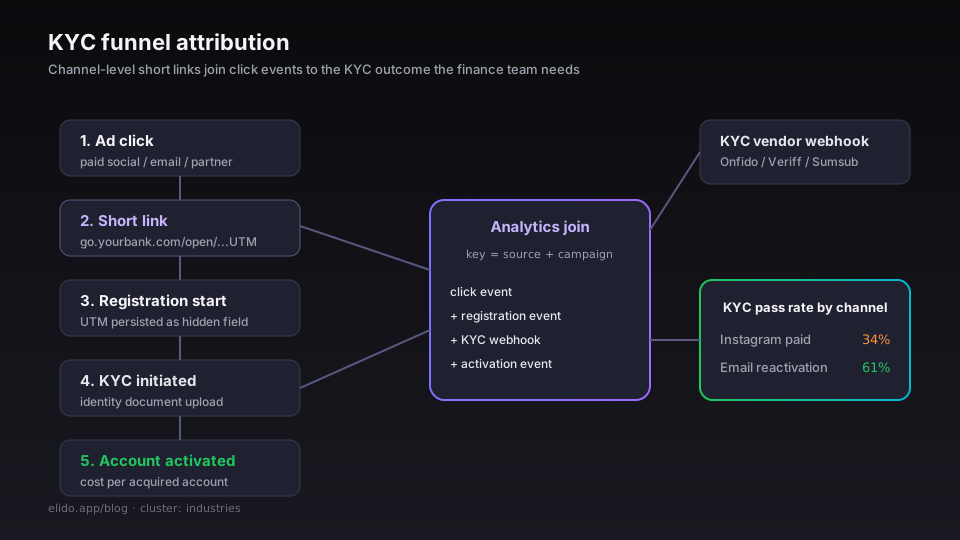
For the event-forwarding mechanics that make the join work, the pattern in tracking UTM campaigns end-to-end applies directly - replace "checkout" with "KYC pass" as the downstream conversion event.
2. Regulator-mandated disclosures
FCA, MiFID II, and the EU Digital Services Act all require that certain promotional content be accompanied by specific disclosures. The exact wording varies by product type (investment risk, crypto volatility, credit risk), but the principle is consistent: the user must see the disclosure in proximity to the promotional claim.
The short link itself cannot carry the disclosure. It redirects; it doesn't render content. But the destination URL must carry it - and this creates a trap.
The trap: a campaign goes live with a short link pointing at a dedicated landing page that carries the correct risk warning. Three weeks in, the performance marketing team updates the landing page to A/B test a "cleaner" hero that removes the warning block to improve conversion. The short link still points at the same URL; the URL no longer carries the warning. The campaign is now in breach, and there is no record of when the destination changed.
The controls that prevent this:
- Link creation must tag the destination URL against a campaign record.
- Any edit to the destination URL must be logged with timestamp and user ID - not just the current state, but the full edit history.
- An automated check should scan the destination page at creation time and flag missing disclosure elements (this is harder - but at minimum, the link service should require a human sign-off on destination changes for links tagged as regulated promotions).
The audit log requirement later in this post covers the logging side. The compliance check is a manual process at most teams today; a few large fintechs have built destination-URL linters into their CI pipeline that validate disclosure presence before a campaign can go live.
3. Geo-restricted links
Some products cannot be legally promoted in some jurisdictions. The most commonly litigated case is crypto:
- UK: FCA crypto-promo rules (effective October 2023) require any crypto promotion targeting UK persons to be approved by an FCA-authorised firm or issued by a registered crypto-asset firm. Promotion to UK users without that approval is an offence.
- US: New York BitLicense and various state money-transmitter regulations restrict which crypto products can be offered.
- EU MiCA: Crypto-asset service providers must be registered; marketing to EU users requires MiCA-compliant disclosures by product type.
The standard response is geo-blocking: detect the user's country by IP, and redirect to a jurisdiction-specific page (or a "not available in your region" page) instead of the promotional URL.
This geo-check must happen at the redirect layer, not at the destination page.
If the short link redirects to a marketing page that then performs the geo-check in JavaScript, there is a window - between the redirect and the JS executing - where the promotional content renders. On slow connections, slow devices, or if the JS fails, the full promotional page may render anyway. That render constitutes a promotion served to a user in a restricted jurisdiction.
The correct architecture: the short link service evaluates the request's IP against a geo-ruleset and returns either a 302 to the promotional destination or a 302 to the blocked-region page, before any promotional content is transmitted to the client.
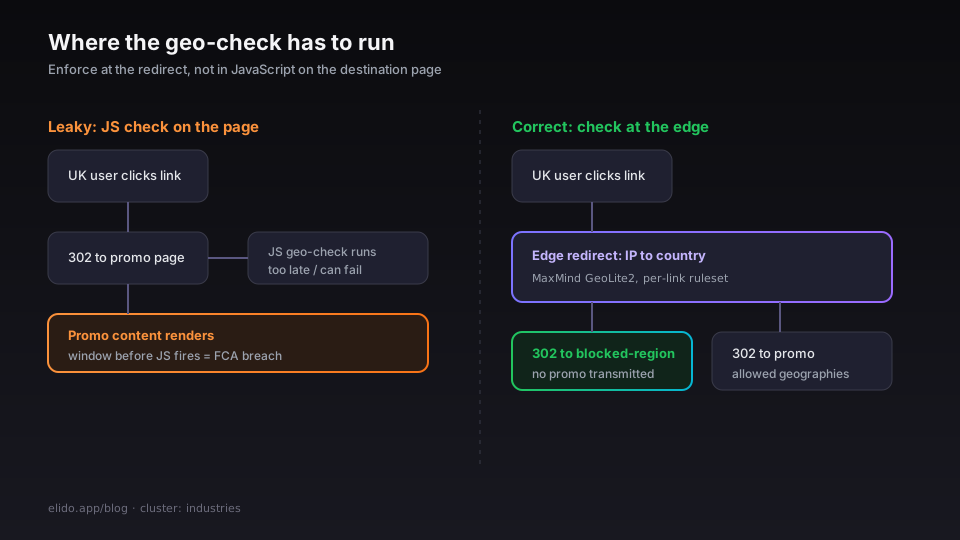
Elido's geo-restriction works at the edge layer (the same layer that handles the redirect) with no round-trip to an origin for the policy check. IP-to-country lookup is performed in-process against a locally-cached MaxMind GeoLite2 database updated weekly. The restricted-geography ruleset is per-link, stored alongside the link record, and evaluated in the same request path as the redirect resolution.
For data-residency implications of storing IP-to-geo lookups for EU users, EU data residency for marketing covers the relevant GDPR requirements.
4. Phishing resistance and domain reputation
Fintech is the primary target of SMS phishing (smishing). The attack pattern is well-established: send an SMS that looks like it comes from a bank, include a short link to a credential-harvesting page, collect credentials before the user notices.
Short link services are part of this attack surface in two ways:
- The attacker uses a generic short link service (
bit.ly/bank-verify) to obscure the phishing destination. The user sees a short link that looks like it might be from their bank. - The attacker shortens to a domain that looks like the bank - domain squatting is common.
elido-lloyds.com/verifyis notlloyds.com, but at a glance in an SMS it can be confused for it.
Fintech teams using a URL shortener need to address both directions: ensuring their own links are not confused with phishing, and ensuring the shortener won't shorten phishing destinations.
Signals of a phishing-resistant short link service:
- Custom domain on your own brand.
go.yourbank.comcannot be spoofed by someone registering a different shortener domain.bit.ly/yourbankcan be (and has been) spoofed bybit.ly/yourb4nk. - Pre-flight destination scan. The shortener should refuse to shorten a URL that resolves to a domain on a blocklist (Google Safe Browsing, SURBL, PhishTank). This prevents an attacker from using your shortener as an indirection layer.
- DMARC/SPF on the redirect domain. If you send
go.yourbank.comlinks via email, the email itself needs DMARC/SPF alignment onyourbank.com. The redirect domain needs at minimum an SPF record so receiving MTAs can verify the link's domain origin. - HTTPS-only redirects. The shortener should refuse to resolve to
http://destinations. An HTTP destination in a financial SMS is immediately suspicious; HTTPS is table stakes.
The URL shortener security checklist covers the full set of controls in depth, including HSTS configuration on the redirect domain and the certificate transparency logs worth monitoring.
If your product also prints QR codes on statements, branch doors or ATMs, the same exposure applies in physical form; QR codes for banking covers overlay stickers and code governance.
5. Audit logging for compliance
A financial services auditor reviewing a marketing campaign will ask:
- Who created this short link and when?
- What was the destination URL at campaign launch?
- Was the destination URL ever changed? By whom? When?
- What is the click volume, and was there any anomalous traffic pattern?
- When was the link retired?
If the link service cannot answer all five questions for every link created in the last three years, the audit will note a control gap. In a regulated entity, a control gap noted by an auditor becomes an action item with a remediation deadline.
What this means in practice:
Every short link must be created against a named user account (not a shared API key). The link record must include the campaign tag, the product tag (for financial-product classification), and the team owner. Every edit to the destination URL must write an immutable log entry - the link analytics database is the right home for this, not a mutable field in a CMS.
Click logs must be retained for the required period. Under UK FCA record-keeping rules, communications relating to a regulated activity must be retained for five years (certain MiFID II instruments extend this to seven). Click data for a financial promotion link is arguably within scope - check with your compliance team.
The practical minimum: timestamps (creation, every destination-URL edit, retirement) + user attribution for every action + click volume with daily granularity retained for five years. Export to your SIEM or compliance data warehouse is the cleaner play - don't rely on the link service's own dashboard as your audit record.
For the SSO/SCIM provisioning that makes per-user attribution tractable at scale (so you're not managing 40 individual shortener accounts), SCIM and SSO for marketing tools covers the provisioning model.
6. EU eIDAS qualified links - a niche case worth knowing
Most fintech short links are ordinary marketing redirects. But for a small subset of regulated use cases - cross-border KYC document delivery, electronic signature workflows, qualified electronic registered delivery service (QERDS) - the link itself may need to carry eIDAS qualified status.
eIDAS is the EU framework for electronic identification and trust services. A "qualified electronic delivery" under eIDAS carries a presumption of integrity and delivery that a plain 302 redirect does not.
This is not a typical marketing-team concern. But if your fintech team is building a cross-border document-delivery flow (for example, delivering a KYC request pack to a customer in a different EU member state with a certified receipt), the delivery mechanism - including any short link in the notification - may need to be issued by an eIDAS Qualified Trust Service Provider, not a general-purpose URL shortener.
Flag this to your legal team if you are building cross-border regulated-document workflows. For ordinary marketing links, this section does not apply.
The four anti-patterns
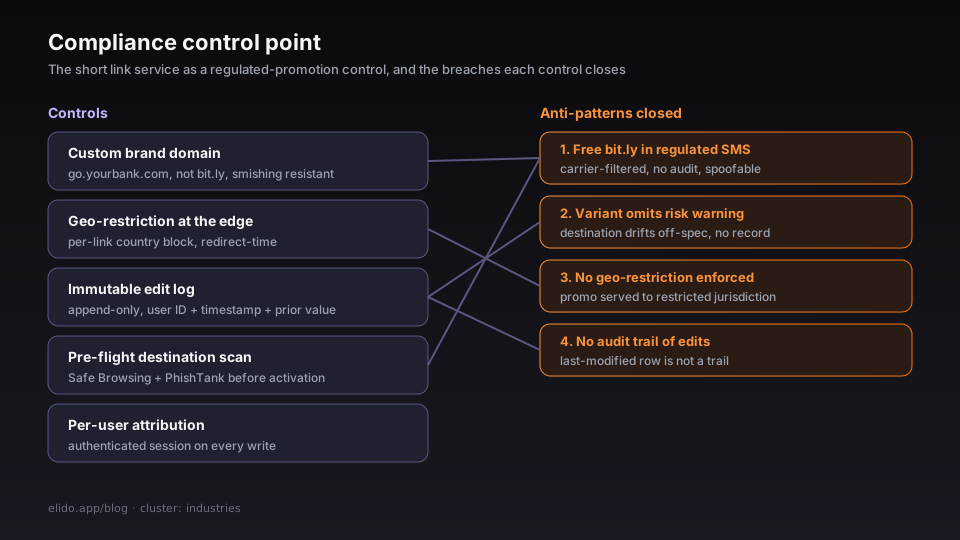
1. Using a free-tier bit.ly link in a regulated SMS campaign.
Several major UK mobile carriers have introduced bit.ly domain filtering on SMS routes that typically carry financial spam. A bit.ly link in an SMS from a bank may be suppressed entirely by the carrier or flagged with a spam warning before the user sees it. Beyond deliverability, bit.ly provides no geo-restriction, no audit log attributable to your organisation, and no pre-flight destination scan. Free-tier shorteners are not a compliance control.
2. Destination URL pointing at a marketing variant that omits the risk warning.
This is the single most common fintech short-link compliance failure in a regulatory review. The campaign brief specifies the warning; the page variant that was created for a specific A/B test or a specific geo-market omits it; the short link stays pointed at the wrong variant for weeks. By the time the compliance team reviews, the audit window has passed and there is no log of when the destination changed. Solved by: immutable destination-edit logs, and a sign-off step on destination changes for links tagged as regulated promotions.
3. No geo-restriction enforced on a product that cannot be promoted in certain jurisdictions.
A crypto exchange runs a UK-targeted Instagram campaign. The short link resolves without geo-checking. A small percentage of clicks come from UK IP addresses. Those clicks constitute a promotion to UK persons by an entity without FCA approval. The fact that the targeting parameters said "exclude UK" is not a defence - the redirect layer is where the enforcement happens, and if it did not enforce, the breach occurred.
4. No audit trail of who edited the destination URL after campaign launch.
The compliance team asks who changed the destination URL. The link service's answer is a last-modified timestamp on a database row. No user ID, no history, no intermediate states. This is not an audit trail. An audit trail is an append-only log of every state the record passed through, with the identity of the actor who caused each transition. If your link service provides a mutable redirect record with no history, you do not have an audit trail.
Where Elido sits
Elido was built EU-first, which means the compliance requirements above shaped the architecture from the start rather than being retrofitted:
- Geo-restriction at the edge - per-link country blocklists evaluated at redirect time in the same in-process step as the URL lookup. No round-trip, no JavaScript dependency, no window where the promotional content renders to a restricted-geography user.
- Immutable edit log - every destination-URL change writes an append-only record to our analytics store with the user ID, timestamp, and previous value. The log is exportable to CSV or queryable via the analytics API.
- Pre-flight destination scan - new short links are checked against Safe Browsing + PhishTank before activation. Destinations resolving to known-bad domains are rejected with an error.
- Per-user attribution on every action - link creation, edit, and retirement all require an authenticated user session. Shared API keys can be scoped to read-only for monitoring integrations; write operations always carry a user identity.
- EU data residency by default - click data lives in our EU-region analytics store. No cross-border transfer for the standard plan. SOC 2 and HIPAA for link tracking covers the third-party audit and certification status.
- Schrems II compliant data flows - the Schrems II and tracking pixels post covers how click data flows are structured to avoid the invalidated Privacy Shield transfer mechanism.
For a setup call with the compliance and solutions engineering team, the fintech solutions page has the relevant detail.
Related on the blog
- GDPR for URL shorteners - the baseline compliance layer before fintech-specific requirements
- URL shortener security checklist - HSTS, DMARC, pre-flight scanning, and certificate transparency monitoring
- EU data residency for marketing - GDPR transfer requirements and data-residency options
- SOC 2 and HIPAA for link tracking - third-party audit coverage for regulated industries
- Schrems II and tracking pixels - how to structure data flows after Privacy Shield invalidation
- SCIM and SSO for marketing tools - per-user attribution at scale via directory sync
- URL shorteners for marketers - the sibling post for general marketing-team use cases
- QR codes for banking - payment, onboarding, branch and statement codes with change control
Try Elido
Paste a URL, get a working short link
No signup. Link lives for 30 days. Sign up to keep it forever.
Free, no signup required · 2 per day