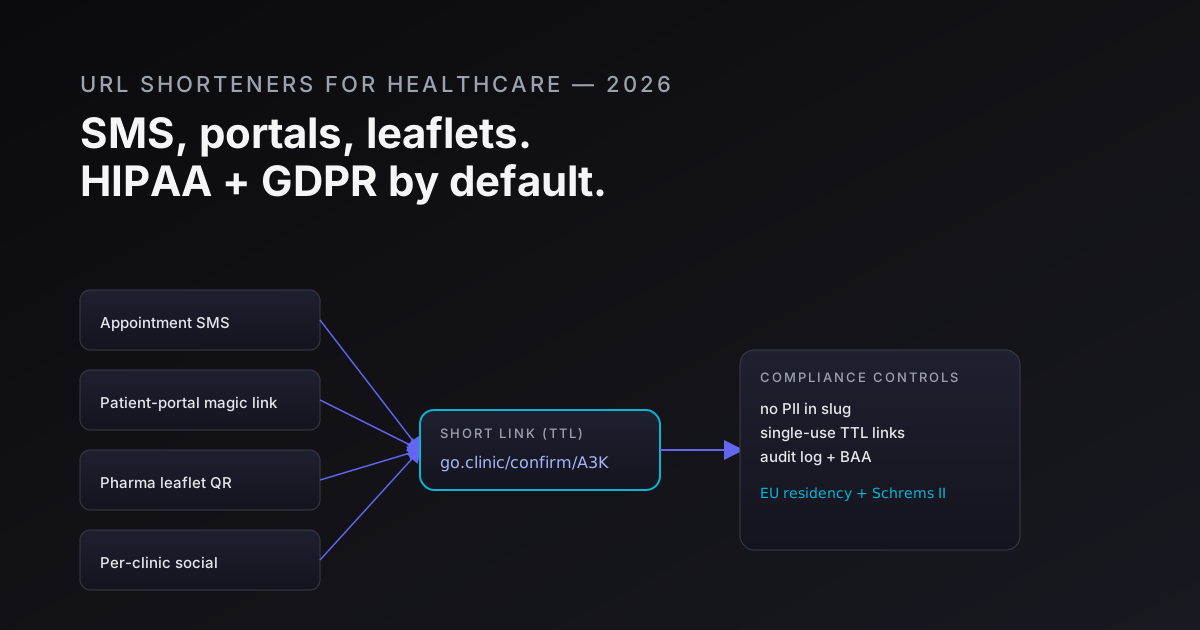
Healthcare is one of the highest-stakes environments for URL shorteners. The link layer touches patients directly - appointment reminders, portal logins, discharge summaries, medication instructions - and every one of those touchpoints carries regulatory weight. Use the wrong shortener and you have a HIPAA business-associate violation before the first patient clicks anything. Use the right one poorly - PII baked into a slug, click logs shipping to a US analytics cloud - and you're still exposed.
This post is the practical architecture for getting it right. If you're running a clinic chain, a telemedicine platform, or a pharma patient-support programme and you've been putting off the "what do we do about short links" question, this is the answer.
For the underlying GDPR mechanics, GDPR for URL shorteners is the cornerstone read before you get into the healthcare-specific layer here. The SOC2 and HIPAA for link tracking post goes deeper on the compliance certifications you should require from any vendor before signing a BAA.
Why healthcare links are different
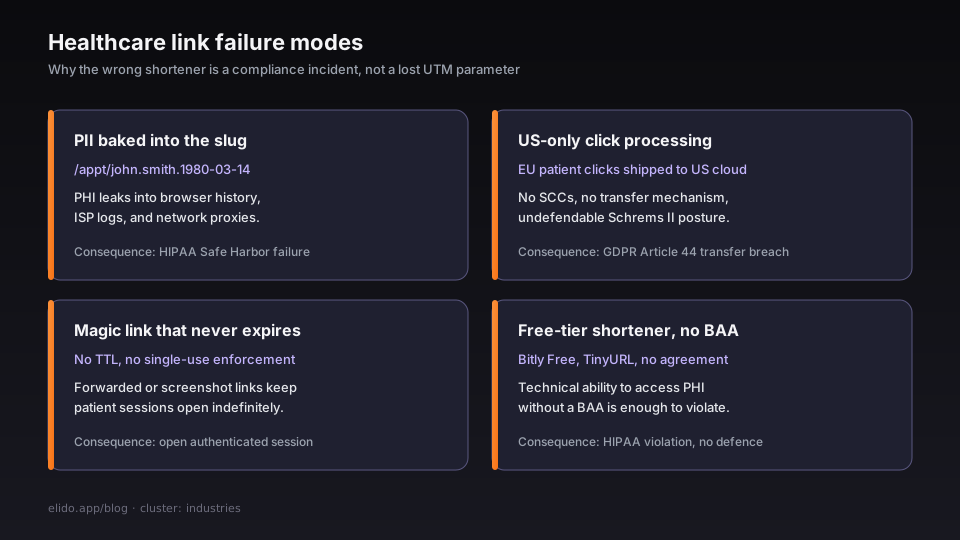
Most URL shortener guidance assumes the worst outcome of a misconfigured link is a lost UTM parameter or a 404. In healthcare, the failure modes are categorically different:
- A short link that leaks a patient identifier in the URL bar exposes PHI in browser history, ISP logs, and any proxy the patient's network routes through.
- A shortener that sends click data to a US analytics platform without a data-processing agreement is a GDPR Article 44 transfer violation for EU-based clinics - even if the destination URL is EU-hosted.
- A single-use magic link that doesn't expire can be forwarded, screenshot, or accessed from a public device hours after the patient intended.
- A free-tier shortener with no BAA is a HIPAA violation regardless of what data actually flows through it - the potential to access PHI is enough.
The good news: none of these are hard problems to solve with the right platform. They are hard problems to ignore until a regulator asks.
Use case 1: appointment-reminder SMS deep links
The most common healthcare short-link pattern. The patient receives an SMS:
Your appointment with Dr Nowak is tomorrow at 10:00. Confirm or reschedule:
go.yourclinic.com/c/X8J2
The slug X8J2 is opaque - it encodes no patient name, no date of birth, no appointment detail. On the server side it resolves to the clinic's scheduling system with the correct patient session token. The patient clicks, lands on a pre-authenticated confirmation screen, taps Confirm.
What this architecture requires from the shortener:
- Per-link metadata - the link record must store which clinic issued it, which appointment it references, and (for audit purposes) the time it was issued. The click log records that the link was clicked; it does not need to record the patient's identity.
- No referrer forwarding - the redirect must strip the
Refererheader before forwarding. The scheduling system should never see that the patient came from an SMS campaign. - No full-IP logging by default - storing the full client IP in the click log is unnecessary for attribution and is PII under GDPR. Hashed or truncated IP is fine for geo resolution; raw IP should be off unless there is an explicit lawful basis.
- Webhook on click - the scheduling system can receive a webhook from the shortener the instant the patient clicks confirm. Latency matters here: a 2-second redirect on a confirmation flow is a bad patient experience.
Per-clinic attribution is a side effect of doing this correctly. Each clinic in the chain issues links under its own prefix or campaign tag. The roll-up dashboard shows confirmation rates by clinic - useful for identifying clinics with low SMS confirmation rates that might benefit from a phone-call fallback.
For the deep-link mechanics when the CTA lands inside a mobile app rather than a browser, WhatsApp Business deep links covers the app-link plumbing in detail.
Use case 2: patient-portal magic links
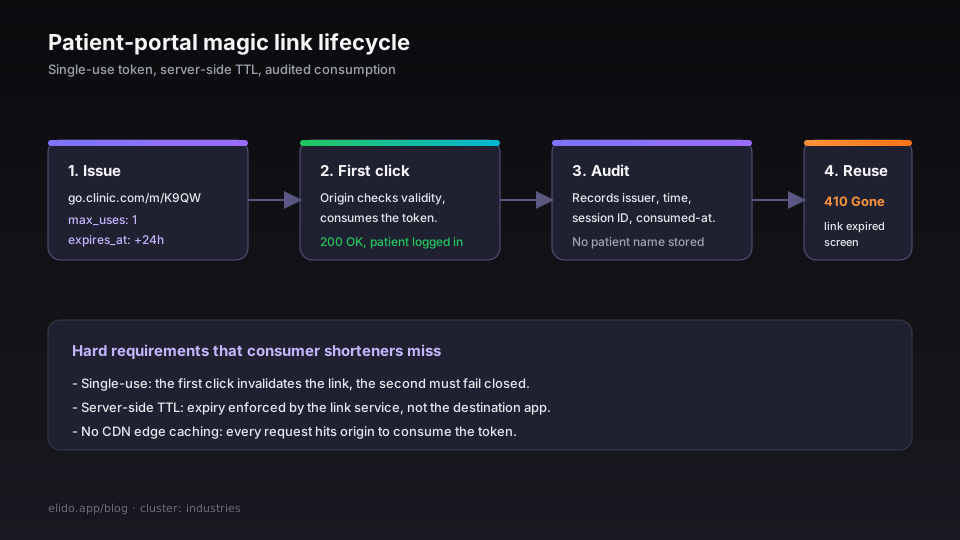
Magic links - single-use authenticated URLs that log the patient in without a password - are common in patient portals, especially for older patients or populations with low digital literacy. Short links are the natural format: go.yourclinic.com/m/K9QW is typeable, scannable, and shareable by phone without misreading characters.
Magic links have stricter requirements than appointment-reminder links:
- Single-use enforcement - the first click invalidates the link. If the same link is clicked twice (tab refresh, forwarded SMS), the second click must fail with a "this link has expired" screen, not silently re-authenticate.
- TTL - the link must expire. 24 hours is a common default; some regulatory frameworks require shorter windows for links that surface clinical data. The shortener must enforce TTL server-side, not rely on the destination application.
- No caching at CDN edge - magic links must not be cached. Every request for
go.yourclinic.com/m/K9QWmust hit the short-link service's origin to check validity and consume the single-use token. - Audit record - the short-link service must record: who issued the link, when, for which patient session (by session ID, not name), and when it was first consumed. This is the audit trail regulators expect.
The critical distinction from marketing shorteners: most consumer-grade shorteners have no concept of single-use links or server-side TTL. They are permanent redirects until manually deleted. Using a marketing shortener for magic-link flows is not a minor misconfiguration - it is a design flaw that leaves patient sessions open indefinitely.
Use case 3: pharma patient-support QR codes
A chronic-disease patient leaves their rheumatologist's office with a printed leaflet. The leaflet has a QR code:
Scan to download the SymptomTracker app and connect with a nurse specialist
The brand team at the pharma company wants to know which physician offices are actually distributing the leaflets and which have them sitting in a cupboard. The answer is per-batch QR codes.
The architecture:
- Each print batch is issued a unique short link:
go.symptomtracker.com/q/LON-0412(London office, batch 412). - The QR on each batch's leaflets encodes that batch's short link.
- When a patient scans, the click registers against batch
LON-0412. No patient data - the click log records the batch, the timestamp, and a coarse geo. Not the patient. - The brand team's dashboard shows scans per batch per month. Batches with zero scans after 8 weeks are restocked; batches with high scan rates get replenishment offers.
The compliance note: this is one of the cleanest healthcare link patterns from a privacy perspective. The QR encodes no patient identity - it's a batch identifier. The click log is aggregated batch-level analytics, which is epidemiological/operational data rather than personal data. GDPR legitimate-interest basis is generally straightforward here; HIPAA doesn't apply unless the pharma company is a covered entity or business associate for those specific patients.
The link analytics: what to measure post covers the metrics the brand team should be pulling from this data, including the cohort-survival curve for QR campaigns with long distribution tails.
Use case 4: multi-site clinic chain attribution
A chain with 30 clinics uses short links across social media, SMS, and printed materials. Each clinic has its own Instagram account, its own local SMS sender, and occasionally prints local leaflets. The marketing director wants one question answered monthly: which clinic's marketing converts highest into new patient registrations?
This requires per-clinic link scoping from day one.
The structure:
- Each clinic gets a three-letter prefix:
go.healthchain.com/bwn/(Bonn clinic),go.healthchain.com/mxc/(Munich clinic). - Every link issued for that clinic - social post, SMS, leaflet QR - uses that prefix.
- The roll-up dashboard aggregates all
bwn/clicks against Bonn's registered patient count for the same period. The normalised conversion rate is the marketing efficiency signal.
What this is NOT: per-patient tracking. The click log records which clinic's link was clicked, not which patient clicked it. Attribution is at the campaign/clinic level, not the individual level. The lawful basis for this analytics is legitimate interest - the clinic chain is measuring its own marketing effectiveness, not profiling patients.
The operational discipline: the structure only works if every link is issued through the central platform, not through each clinic's own Bitly account. The first month a clinic manager decides to use a free shortener for a quick post, the attribution gap starts. This is more of a process enforcement problem than a technical one - the technical solution is restricting link creation to the central platform through API-only provisioning with clinic-scoped API tokens.
For the broader EU data-residency question when a German, French, and Polish clinic share one short-link platform, EU data residency for marketing covers the cross-border processor chain in detail.
Use case 5: audit trail for regulated communications
Healthcare regulators in both the EU and US expect auditable records of patient communications. For pharma promotional communications, the EMA and national competent authorities require that companies can demonstrate which materials were sent, when, and to which audience cohort - not individual patients, but cohort-level evidence that promotional rules were observed.
For a covered entity under HIPAA, the requirement goes further: a business-associate agreement must be in place with every vendor that handles PHI, and access logs must be available for 6 years.
What the short-link service must retain:
- Who issued the link (user ID + role in the clinic's system, or API token identifier)
- When it was issued
- The destination URL at time of issue (the URL can be updated for dynamic links - both the original and updated destination should be logged)
- For single-use links: whether and when it was consumed
- For campaign links: the campaign identifier and associated patient cohort ID (not individual patient IDs)
What the short-link service must NOT retain in the click log:
- Full patient name or date of birth
- Full IP address when IP is not necessary for the stated purpose
- Device fingerprint sufficient to re-identify an individual
- Referrer URL when that URL contains PHI (e.g. a URL from the patient portal that includes a patient ID query parameter)
The distinction is: audit trail of issuance (who issued what, when) is required; audit trail of individual patient behaviour (who clicked, when, from where) is generally not required and is often prohibited without explicit consent.
The URL shortener security checklist covers the vendor assessment questions in checklist form - useful when your security or compliance team is reviewing a shortener vendor's documentation.
The four anti-patterns
1. Free-tier shortener with no BAA
This is the most common mistake and the one with the clearest legal exposure. A free-tier shortener - Bitly Free, TinyURL, any shortener without a commercial agreement - has no business-associate agreement. Under HIPAA, if the shortener has any technical ability to access PHI (even PHI that you don't intend to put in the URL), the absence of a BAA is a violation. The fact that you only use it for appointment reminders that don't contain explicit PHI is not a defence the OCR has historically accepted.
The fix: use a shortener that offers a BAA, or operate your own. Elido's Business and Enterprise plans include a signed BAA as part of the DPA.
2. PII baked into the slug
go.yourclinic.com/appt/john.smith.1980-03-14 is an extreme example, but the pattern is common in less obvious forms. URL-based appointment IDs that encode the appointment date + clinic code + patient initials are PHI under a strict reading of the HIPAA Safe Harbor method. Even if the patient's name is not present, a combination of appointment date, clinic, and partial identifier can be sufficient to re-identify.
The fix: opaque slugs that mean nothing outside the system. The server-side lookup maps X8J2 → the correct appointment record. Nothing in the slug itself is interpretable.
3. US-only shortener for EU clinics
A shortener that processes click data exclusively in US-region infrastructure fails GDPR Article 44 for EU clinics. Patient click data - even aggregated - is personal data when it can be linked back to an individual (as appointment-reminder clicks often can). The data must be processed under Standard Contractual Clauses or an equivalent transfer mechanism, and the Schrems II risk assessment must be defensible. In practice, the easiest answer is a shortener with EU-region data residency so the transfer question doesn't arise.
The Schrems II and tracking pixels post covers the transfer-mechanism analysis in detail; the same framework applies to click logs from a short-link service.
4. Single short link reused across campaigns
go.yourclinic.com/book links to the booking page. It went into the spring newsletter, the SMS recall campaign, and a poster in the waiting room. Now it's driven 4,000 clicks and the marketing team has no idea which channel drove which clicks.
For consumer brands this is a missed attribution opportunity. For healthcare communications, it's also a compliance problem: the EMA expects that promotional and non-promotional communications are distinguishable in the record. If the same link appears in both a promotional email campaign and a clinical recall notice, the audit trail collapses.
The fix is structural: issue net-new links for each campaign, each channel, and each communication type. The overhead is low when link creation is API-driven; the alternative is an unauditable mess.
Choosing a shortener vendor: the compliance checklist
When evaluating a URL shortener for healthcare use, the five non-negotiable questions are:
1. Will you sign a BAA / DPA? For HIPAA covered entities and business associates: yes or no, no nuance. "We comply with HIPAA" without a signed BAA is not compliance.
2. Where is click data processed and stored? EU clinics need EU-region processing. Some vendors offer region selection; many do not. Confirm the specific data centre region, not just "compliant with GDPR".
3. Does your platform support single-use links with server-side TTL? If you need magic links for patient portal access, this is a hard requirement. Most consumer-grade shorteners do not support it.
4. Can click logs be configured to exclude full IP addresses? Data minimisation under GDPR Article 5(1)(c) requires that you not collect more data than necessary. Full IP is rarely necessary for appointment-reminder attribution; truncated IP for geo resolution usually suffices.
5. What is your data retention and deletion policy? Under GDPR Article 17 (right to erasure), patients can request deletion of their data. Can the vendor delete click records associated with a specific patient session within a reasonable timeframe? If click records are anonymised by design (no patient ID in the log), this is a non-issue; if they aren't, you need a deletion pathway.
The SOC2 and HIPAA for link tracking post has the full vendor assessment framework including the questions to ask about subprocessors - important when the shortener vendor uses a US-based analytics subprocessor that processes EU patient data.
Where Elido sits
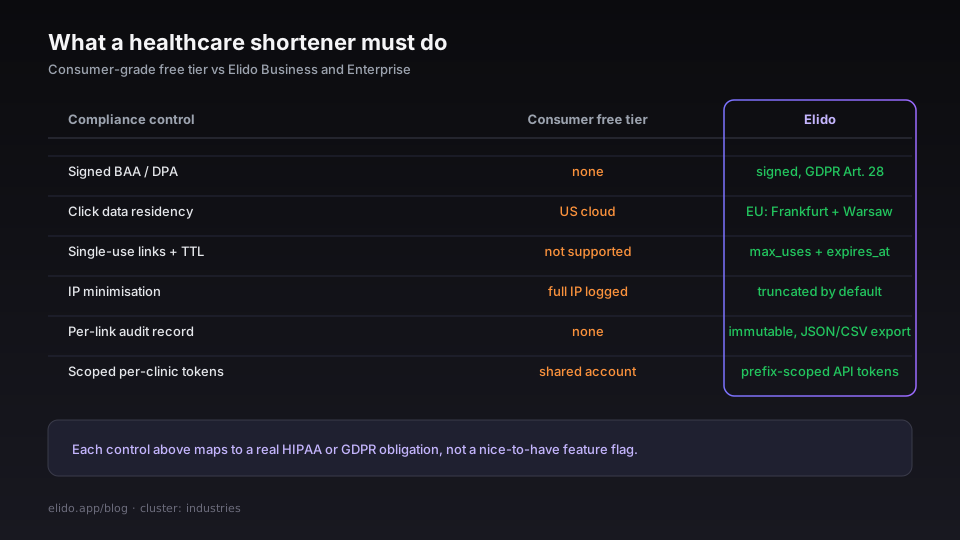
Elido's platform was designed from the start for EU-first data residency and privacy-by-default link analytics. The features most relevant to healthcare:
- EU-region analytics store for click events - click data lives in our EU-region nodes. No US transfer by default.
- Signed BAA/DPA available on Business and Enterprise plans - legal team review is straightforward because the DPA is purpose-written for GDPR Article 28.
- Single-use links with configurable TTL -
POST /v1/linkswithmax_uses: 1andexpires_at: +24h. First click consumes the token; subsequent requests return 410 Gone. - IP truncation by default - the last octet of IPv4 (and last 80 bits of IPv6) is zeroed before storage. Full IP available only under an explicit account setting with a documented lawful basis.
- Per-link audit log - every link carries an immutable issuance record: creating user/API token, timestamp, original destination, and (for single-use links) consumption timestamp. Exported as JSON or CSV for regulator requests.
- Custom domains with on-demand TLS -
go.yourclinic.comup in 30 seconds. Each clinic in a chain gets a scoped API token restricted to its own prefix namespace.
For a detailed compliance walkthrough before signing a BAA, the healthcare solution brief covers the technical and legal specifics.
Related on the blog
- GDPR for URL shorteners - the foundational compliance read
- SOC2 and HIPAA for link tracking - vendor certification requirements
- EU data residency for marketing - cross-border processor chain analysis
- URL shortener security checklist - vendor assessment questions
- Schrems II and tracking pixels - transfer mechanism analysis
- Link analytics: what to measure - the metrics layer once the links are compliant
Try Elido
Paste a URL, get a working short link
No signup. Link lives for 30 days. Sign up to keep it forever.
Free, no signup required · 2 per day