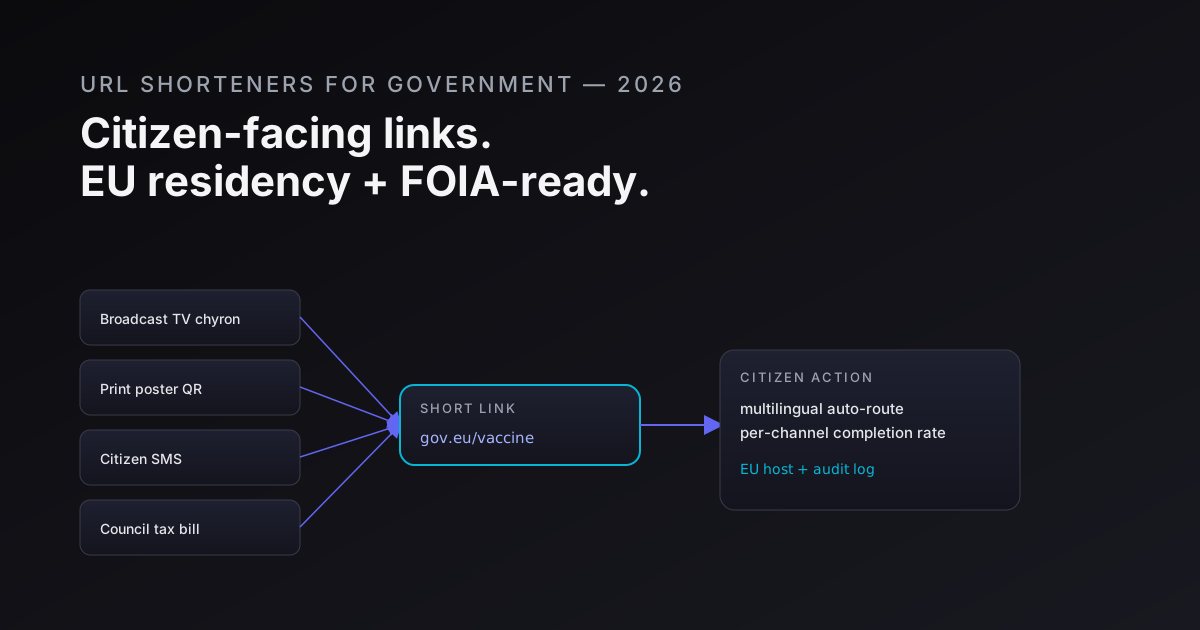
Government communications teams face a constraint commercial marketers rarely encounter: every digital tool in the stack must be compliant before anyone clicks a link. Data-residency rules, audit-trail requirements, accessibility standards, and multilingual obligations all apply simultaneously. Most commercial URL shorteners were never designed for this environment. This post covers the link architecture that fits the public sector - and the four failure modes we see when agencies reach for the wrong tool.
For the EU data-residency specifics that underpin the whole picture, GDPR for URL shorteners is the right starting point. This post is the government-specific layer on top of that foundation.
Why government communications need a short-link layer
Short links are not a vanity feature for public-sector teams. They are the primary mechanism that answers the question every communications director is eventually asked: "Which channel actually worked?"
A public health vaccination campaign runs simultaneously on broadcast TV (a chyron visible for 4 seconds), print posters, SMS, and social media. A raw destination URL - https://vaccination.health.gov.example/campaign/spring-2026/register?lang=en - fails on every one of those channels. It is too long for a chyron, too unwieldy for a poster, and too fragile in SMS (line-wrap breaks it). More importantly, one shared URL gives you no attribution: you cannot tell whether the spike in registrations came from the TV buy or the SMS batch, so you cannot justify either spend next year.
Per-channel short links solve both problems at once. They are typeable, they are scannable as QR codes, and they carry the attribution signal that lets the team defend the budget line by line.
The six pillars of a government-grade link service
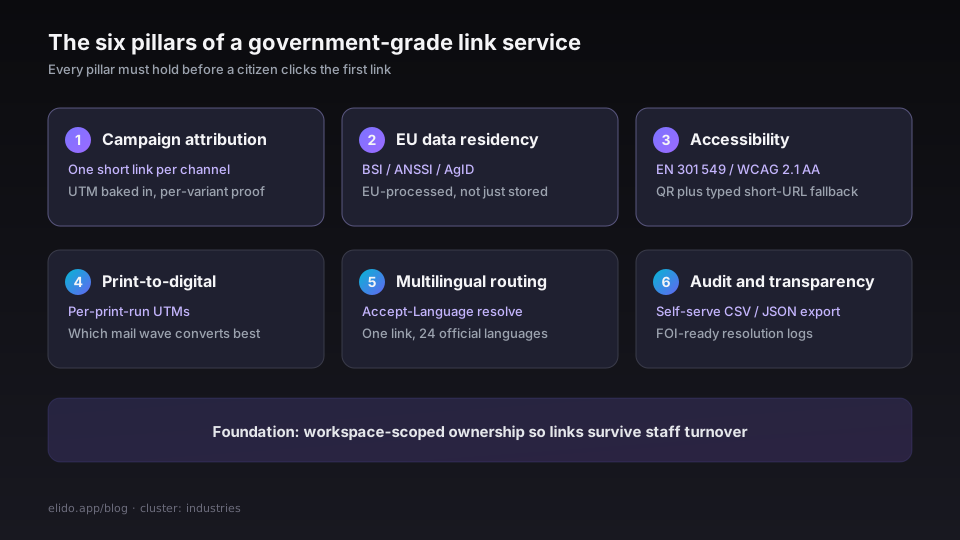
1. Citizen-facing campaign attribution
Public-health campaigns, tax-filing reminders, voter-registration drives, and emergency-alert calls-to-action all share the same measurement challenge: multiple simultaneous channels, a single destination, and stakeholders who need channel-level proof of impact.
The setup that works: issue one short link per channel-variant pair. vote.gov.example/tv-morning, vote.gov.example/poster-city-north, vote.gov.example/sms-batch-1. All resolve to the same registration page. Each carries a UTM source and medium baked into the destination. The analytics dashboard shows which batch of print posters drove the highest completion rate before noon, and which SMS send converted better among the 25-34 cohort.
This is not a technical novelty - it is the same UTM attribution that commercial teams have used for a decade. The difference in a government context is that the data from those clicks must stay in EU jurisdiction and must be exportable on demand for public-records requests. Short link analytics: what to measure covers the dashboard mechanics; the residency requirement is what makes the choice of vendor non-trivial.
2. EU and national data-residency compliance
Most EU member-state governments operate under residency requirements that go further than baseline GDPR. Germany's BSI Technical Guidelines, France's ANSSI cloud doctrine (SecNumCloud), and Italy's AgID cloud classification all place government data in a category that requires EU-hosted infrastructure - and in some frameworks, infrastructure operated by EU-domiciled entities only. US-headquartered SaaS vendors with EU data centres often do not satisfy these requirements because US law (Cloud Act) can compel disclosure regardless of where the data physically sits.
For a URL shortener, the data surface is: the click log (IP address, timestamp, user-agent, referrer), any UTM parameters appended to the destination, and the link metadata itself. Every one of those fields is personal data under GDPR. A short-link vendor that routes clicks through US infrastructure, even briefly, creates a Schrems II exposure. Schrems II and tracking pixels walks through the legal structure; the practical answer for government procurement is: require EU-only hosting as a scored criterion, not an optional preference.
The EU data residency for marketing post covers the procurement checklist in detail. For public bodies, the same checklist applies at a higher compliance threshold - "EU-hosted" must mean EU-processed, not just EU-stored.
3. Accessibility - WCAG and EN 301 549
Public-sector digital services in the EU are subject to EN 301 549, the European accessibility standard that incorporates WCAG 2.1 AA as its web content baseline. Short URLs contribute to accessibility in two specific ways that government communications teams often overlook.
Print accessibility. A short URL on a council-tax bill or a parking notice is a typed fallback for users who cannot scan QR codes. For low-vision users who rely on screen magnification rather than a screen reader, a short URL (pay.council.example/ct) is far easier to transcribe than a 90-character form URL. This is not a marketing benefit - it is a direct accessibility improvement on the printed page.
QR + short-URL pairing. A QR code on its own fails screen-reader users entirely; a short URL on its own fails users without a keyboard. Pairing both on the same printed item satisfies both groups. The EN 301 549 requirement for non-text content applies to QR codes in digital documents as well: the QR must carry an alt text equivalent when embedded in a PDF or HTML, and the printed short URL is the physical-world analogue of that alt attribute.
Size and contrast requirements on QR codes are not optional for public-sector print runs. The dynamic vs static QR codes post covers the contrast and error-correction-level specifications that meet print accessibility standards.
4. Print-to-digital bridging
Paper-based government services are not going away. Council-tax bills, parking notices, voter cards, benefits letters, and planning notices all carry a call-to-action that must bridge the user from a physical document to an online service. The short URL + QR pairing is the standard mechanism.
The analytics insight that most government digital teams are missing: per-print-run UTMs tell you which mail batches achieve the highest online-completion rate versus which cohort falls back to in-person or phone service. A local authority that sends 80,000 council-tax bills in three waves can tag each wave with a distinct short link. If wave-3 completions are 40% lower than wave-1, the question becomes: is that a demographic effect, a timing effect, or a print-quality issue on the third batch? Without the per-wave attribution, the question is unanswerable.
The setup is identical to the campaign attribution architecture in pillar 1: one short link per print run, UTMs baked in, analytics scoped to the pay. or gov. short domain. The destination URL stays the same across all runs; only the attribution tag changes.
5. Multilingual link resolution
EU institutions and multilingual member-state bodies serve documents in multiple official languages. The European Commission serves 24. The Swiss federal administration serves 4. Many municipal governments in Belgium, Luxembourg, and Finland serve 2 or 3.
A naïve approach: one short link per language variant. info.example/en, info.example/fr, info.example/de. This works but multiplies the link inventory - a 20-link campaign becomes 60 links - and forces the communications team to manage language-specific analytics separately.
A smarter approach: one short link that resolves by Accept-Language header to the correct localised page. The user scans the QR on a multilingual poster; the short-link service reads their browser's language preference; they land on the French-language form without seeing a language-selection interstitial. The communications team sees a single analytics surface with a language breakdown dimension.
Not every URL shortener supports header-based routing at the redirect layer. It is worth testing explicitly: scan the QR from a device configured in German and verify you land on the German-language destination, not the English default. The feature matters most for pan-EU communications where the poster audience is linguistically heterogeneous.
6. Audit trails and transparency requirements
Public-sector procurement of digital services routinely requires auditability: who created which link, when, what destination, and what the resolution log shows. This is not a theoretical requirement. Freedom-of-information requests in the UK, access-to-document requests under EU Regulation 1049/2001, and national transparency-law equivalents can reach URL shortener records.
The minimum audit surface a government link service must provide:
- Per-link creation log: user identity, timestamp, original destination URL, last-modified timestamp.
- Per-link resolution log: click timestamp (bucketed, not individual IP logs in most frameworks), referrer, user-agent category, country.
- Full export in machine-readable format (CSV/JSON) without requiring vendor support - self-serve export is a procurement requirement for most EU institutions.
- Link ownership by team, not individual - so that when a staff member leaves, the links and their history remain on the institutional account.
The last point is operationally significant. When a communications officer who owns 200 campaign links departs, those links should transfer to the team account automatically. Short-link services that issue links to individual user accounts, not workspaces, create a link-ownership cliff every time someone leaves the organisation.
The URL shortener security checklist covers the technical security requirements that sit alongside the audit requirements - both are typically evaluated together in a public-sector procurement.
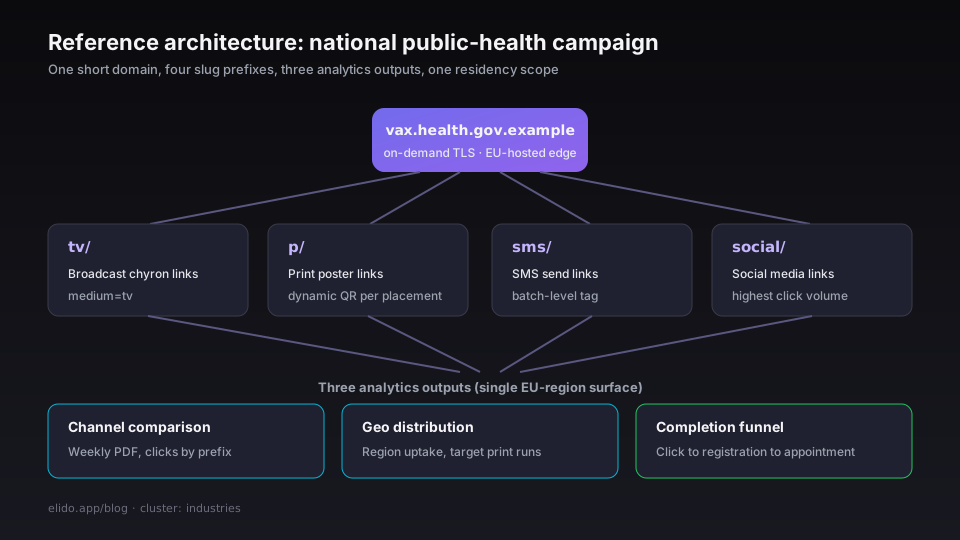
A reference architecture for a national public health campaign
This is the link architecture for a sustained public-health campaign - vaccination, screening, or mental-health awareness - running over 6-8 weeks across broadcast, print, SMS, and social.
One short domain for the campaign. vax.health.gov.example. Issued via the health ministry's DNS. The short-link vendor manages the cert via on-demand TLS. Every campaign link lives under this domain. One analytics surface; one data-residency scope; one vendor contract.
Four slug prefixes:
tv/- broadcast TV chyron links.vax.health.gov.example/tv/morning,tv/prime. Short enough to be readable on screen for 3 seconds. UTMmedium=tv,source=morning-slot.p/- print poster links.vax.health.gov.example/p/citycentre,p/gp-surgery,p/pharmacy. Each print placement gets its own slug. The QR on the poster encodes the same URL - dynamic QR so the destination can be updated after print.sms/- SMS send links.vax.health.gov.example/sms/batch1,sms/reminder. SMS links are already short but the attribution slug carries the batch-level tag into the analytics.social/- social media links.vax.health.gov.example/social/twitter,social/instagram. These typically carry the highest click volume; scoping them to a prefix keeps the attribution clean.
Three analytics outputs:
- Channel comparison report - weekly PDF to the campaign director showing click volume by prefix. Which channel is driving registrations this week?
- Geo distribution - country and region breakdown from the click log. Is uptake low in a specific region? Commission an additional print run there.
- Completion funnel - if the registration form passes the click's UTM through a hidden field into the CRM, the analytics join click-to-registration-to-appointment. This closes the attribution loop from the TV chyron to the vaccination appointment.
The architecture compiles to ~30-50 links for a 6-week campaign. Setup time is 2-3 hours; the compliance review of the vendor is the longer path.
The four anti-patterns
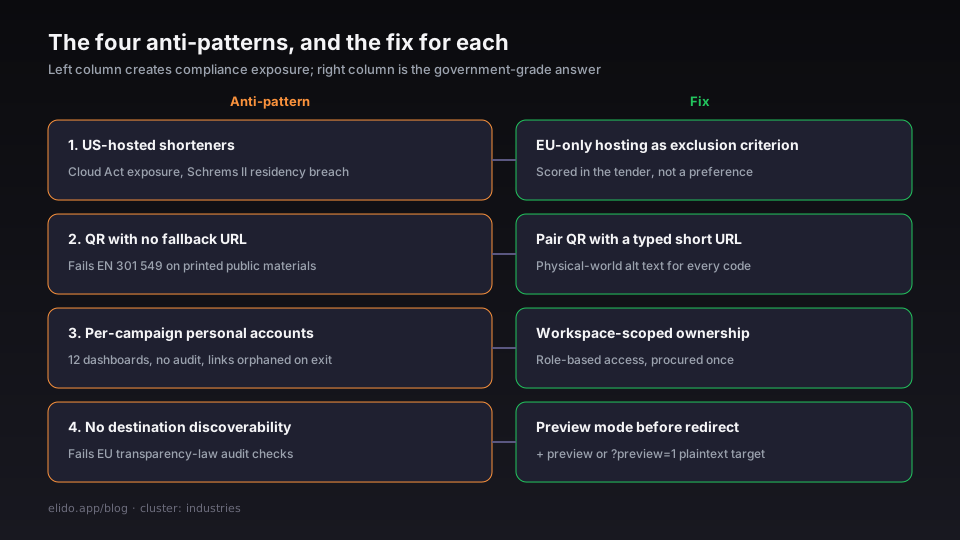
1. US-hosted shorteners for EU public communications. Bit.ly, Rebrandly free tier, and most US-headquartered shorteners process click data on US infrastructure. For EU public bodies, this is a clear residency violation - not a grey area. The procurement error is treating the short-link vendor as a utility with no data-processing footprint. It has one. Require EU-only hosting in the tender specification, not as a preference but as an exclusion criterion.
2. QR codes without accessible fallback text URLs. A QR code on a government poster with no short URL printed underneath it is an accessibility failure. Users without a smartphone, users with vision impairment who cannot scan reliably, and users in low-connectivity environments (poor camera hardware) all need the typed alternative. The EN 301 549 standard does not exempt physical print materials - if the document is distributed as part of a public service, the accessibility obligation applies.
3. Per-campaign individual accounts. Communications staff set up individual shortener accounts for each campaign because the corporate procurement process is too slow. The result: 12 Bitly accounts, none of which the IT department can audit, links owned by personal email addresses, and an attribution picture spread across 12 dashboards that no one can reconcile. The fix is not faster procurement - it is a workspace-scoped account with role-based access and team-level link ownership, procured once and available to all campaign teams.
4. Short URLs without destination discoverability.
Some EU transparency frameworks require that shortened links be auditable: a member of the public should be able to determine where a government short link resolves. Short links with no preview mechanism, no plaintext destination in the metadata, and no public redirect log fail this requirement. The minimum viable transparency feature is a + preview URL (as Bitly popularised) or a ?preview=1 mode that shows the destination before redirecting. A government short-link domain without this feature creates transparency-law exposure in several member states.
Where Elido sits
Elido was designed with EU residency as a first-class constraint, not a feature added later. The architecture is EU-hosted end to end: click events land in our EU-region analytics store, link metadata lives on high-availability database replicas in the EU region, and no data plane routes through US infrastructure. The redirect edge runs on EU infrastructure operated by EU entities - with a p95 redirect latency under 15ms.
For public-sector procurement specifically:
- Workspace-scoped link ownership - links belong to the workspace, not the user who created them. Staff turnover does not orphan campaign links.
- Full audit-log export - every link creation, modification, and deletion is logged with user identity and timestamp, exportable as CSV or JSON via API without requiring support involvement.
- Dynamic QR with on-demand regeneration - every short link generates a print-ready QR at any resolution via
GET /v1/links/{slug}/qr?size=1200. Destination can be updated post-print without reissuing the QR. - Header-based language routing - the routing layer can resolve a single short link to language-specific destinations based on
Accept-Language, with a configurable fallback. - Data Processing Agreement - a DPA covering the GDPR Article 28 processor requirements is available for signature without a custom contract. EU-standard contractual clauses included.
For government procurement enquiries, the security checklist and the EU data residency post are the two documents most often requested at the technical evaluation stage.
Related on the blog
- GDPR for URL shorteners - the legal foundation for EU-compliant link tracking
- EU data residency for marketing - procurement checklist for EU-hosted tooling
- Schrems II and tracking pixels - why US-hosted analytics creates legal exposure
- URL shortener security checklist - the technical evaluation checklist for procurement
- Dynamic vs static QR codes - durability and post-print updateability for government print runs
- Short link analytics: what to measure - the metrics that answer campaign attribution questions
Try Elido
Paste a URL, get a working short link
No signup. Link lives for 30 days. Sign up to keep it forever.
Free, no signup required · 2 per day