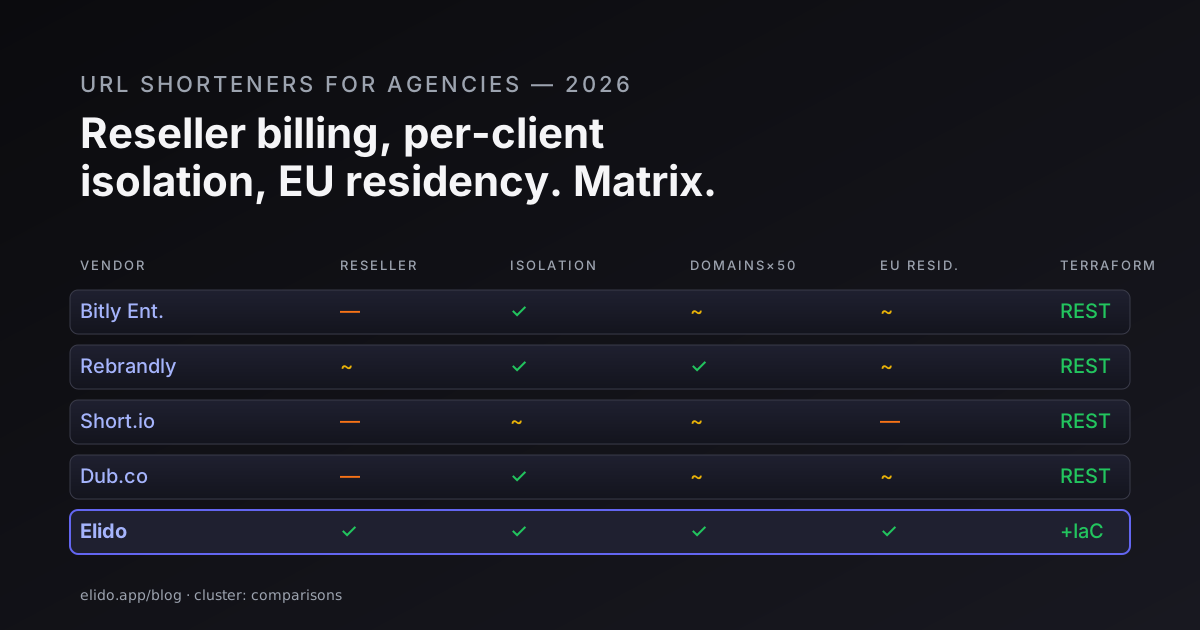
Most "URL shorteners for agencies" listicles compare the same things consumers compare - custom domains, click counts, QR codes. That misses the point. An agency runs 20 clients on one platform. The platform either supports that or fights you. This post is the matrix that actually matters at procurement time.
For the buyer's-guide framing on what white-label means specifically, the white-label URL shorteners for agencies post is the longer read. This post is the comparison.
The eight capabilities that separate "consumer plus" from "agency-grade"
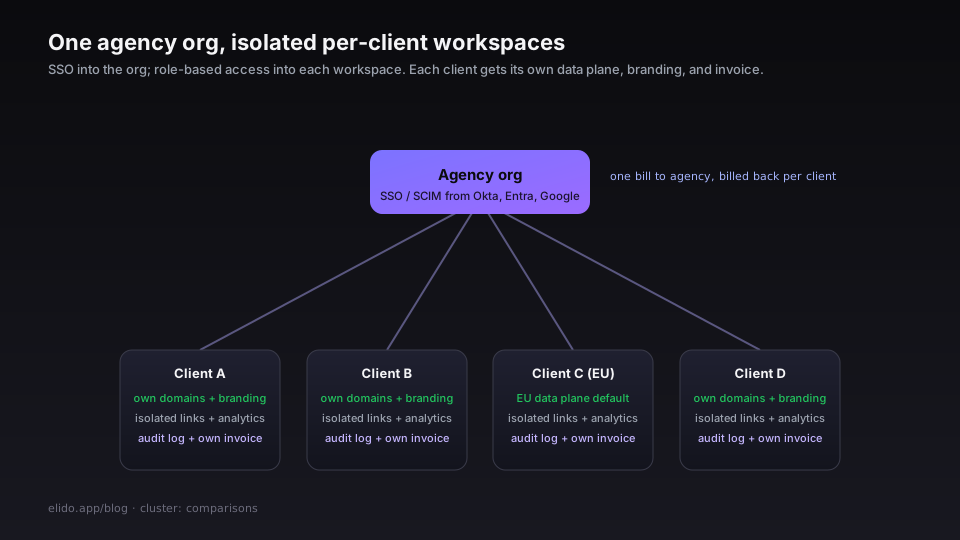
- Per-client workspace isolation. Each client lives in its own data plane. Their team can't see another client's links. Your team sees all of them from a single login. Single-sign-on into the agency org, role-based access into individual client workspaces.
- Reseller billing. You pay one invoice; you bill clients separately. The platform either supports this (your name on their invoice) or doesn't.
- Custom domains in bulk. Every client gets at least one short domain. Sometimes two. Sometimes a different domain per campaign. The platform should support 50+ domains with automated TLS and DNS-verification, not "contact us for enterprise pricing" at the 11th domain.
- Per-client branding. Login pages, password-reset emails, exported reports, dashboards - each can carry the client's logo + colour, not yours. Important for hand-off when the agency relationship ends and the client takes the platform in-house.
- Audit log per workspace. Compliance teams ask this. Who changed which link, when, from what IP. Not just "the agency did it" - the specific user inside the agency.
- SCIM/SSO across the org. When an agency hires or fires, the platform's user list should sync from the agency's IdP (Okta, Entra, Google) without a per-tool admin chore.
- API + Terraform. Repetitive work - creating 50 short links per campaign, provisioning a new client workspace, rotating an API token - should be scriptable. The platform's REST + IaC story tells you whether you can do that in 30 minutes or 3 days.
- EU residency option. Half of agency portfolios have one EU client with a hard residency line. Without an EU data plane option, that one client knocks you out of the platform entirely.
These eight are the floor. Beyond the floor, agencies care about reporting templates, white-label PDFs, scheduled exports - but those are nice-to-haves that don't usually decide a procurement.
The matrix
Five vendors agencies typically evaluate: Bitly Enterprise, Rebrandly, Short.io, Dub.co, and Elido. Scored on the eight capabilities above.
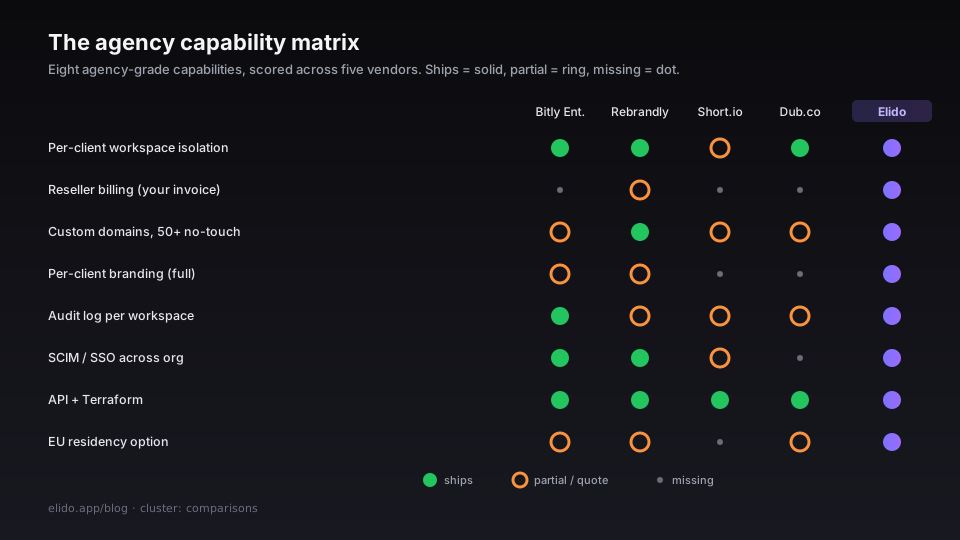
| Capability | Bitly Ent. | Rebrandly | Short.io | Dub.co | Elido |
|---|---|---|---|---|---|
| Per-client workspace isolation | ✅ | ✅ | ⚠️ shared¹ | ✅ | ✅ |
| Reseller billing (your invoice) | ❌ | ⚠️ partial² | ❌ | ❌ | ✅ |
| Custom domains (50+ no-touch) | ⚠️ Enterprise quote | ✅ | ⚠️ per-plan ceiling | ⚠️ early access | ✅ |
| Per-client branding (full) | ⚠️ Enterprise quote | ⚠️ logo only | ❌ | ❌ | ✅ |
| Audit log per workspace | ✅ | ⚠️ org-only | ⚠️ csv export | ⚠️ csv export | ✅ |
| SCIM/SSO across org | ✅ | ✅ | ⚠️ SSO only | ❌ | ✅ |
| API + Terraform | ✅ REST | ✅ REST | ✅ REST | ✅ REST | ✅ REST + Terraform provider |
| EU residency option | ⚠️ US-anchored³ | ⚠️ EU available, opaque | ❌ | ⚠️ US-anchored | ✅ EU-anchored default |
¹ Short.io's "team" model is shared by default; per-client isolation needs careful seat/permission setup. ² Rebrandly's reseller program exists but pricing is per-quote and not advertised; for transparent reseller billing, plan to negotiate. ³ Bitly's data residency story is improving (EU CDN, GDPR DPA available) but contract-level US residency is the default.
A ✅ means the capability ships in the standard product; ⚠️ means it exists but requires negotiation, an enterprise quote, or a workaround that costs you setup time; ❌ means it doesn't exist on the platform.
How to read the matrix at procurement time
The matrix is honest, not exhaustive. Some honest caveats:
The reseller billing column is where most agencies bounce off most vendors. If your business model requires invoicing your client with your branding (rather than the vendor's), most consumer-shaped URL shorteners can't do this without you writing a wrapper service. Elido's reseller program is the most agency-native; Rebrandly's is the next-closest if you can navigate their quoting process.
Custom domains in bulk is where price/usage shapes diverge. Vendors that charge per-domain at $X/month become uneconomic at 30+ clients; vendors that bundle domains into the plan don't. The matrix doesn't show the dollar amount because that's specific to your domain count + plan tier - but get the per-domain cost in writing before signing.
The EU residency column matters more than agencies usually realise. One EU client (or one US client whose enterprise security team flags Schrems II) can knock the whole agency off a platform. If your portfolio is US-only, the column is moot. If you have any EU exposure, treat it as a hard requirement, not a nice-to-have. The EU URL shorteners landscape post lays out which vendors actually have EU data planes vs. which have a Dublin office.
What the matrix doesn't capture
Some capabilities are real but binary - they're either on the roadmap or they're not. They don't fit a check column:
- PDF report generation. Agencies want to ship monthly client reports. Vendors with built-in PDF/HTML export save you the integration work. Elido ships a PDF report builder; most vendors don't, and the workaround is to wire the API into your own reporting tool.
- Sub-workspace tagging. Inside one client's workspace, can you partition by campaign? Almost every vendor supports tags; only a few support tag hierarchies that match how agencies organise work (
client→campaign→audience). - White-label mobile apps. If your client base includes ones who want a branded mobile experience, a few vendors offer this; most don't. Usually irrelevant for B2B agencies, occasionally critical for ad agencies serving consumer brands.
- Migration tooling. When a new client comes off Bitly, can you import their full link history in one click? Elido ships migration workers for five vendors; most platforms expect you to write the importer.
These are checklists you build out at the proposal stage. They're not in the matrix because most agencies' procurement processes don't ask them - they should.
Pricing model considerations
Vendors price agencies in four shapes. They're not interchangeable:
- Per-link. Bills on the count of active short links. Agencies churn campaigns; old campaigns leave behind links. The cost compounds.
- Per-click. Bills on monthly redirects. Predictable for steady-state campaigns; surprises you on a viral hit.
- Per-seat × per-workspace. Bills on the number of users × the number of client workspaces. Predictable for an agency, but the workspace-multiplier is the steepest line item.
- Flat tier with feature gates. One agency-tier price covers N workspaces / M domains / unlimited links. Predictable; the gates are where the negotiation happens.
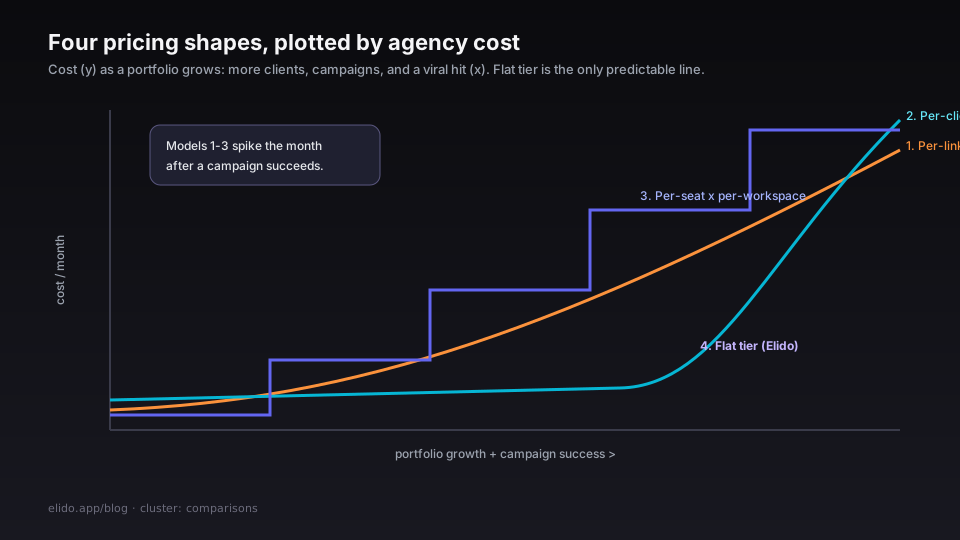
Elido prices on tier (model 4) for agencies because that's what most agencies tell us they need to underwrite their own retainer pricing. The pricing page has the current per-tier limits. Bitly prices on a hybrid of (1) + (3) at the Enterprise tier; the other three vendors mostly use (1) or (2) - both of which create cost surprises at the worst time for an agency (the month after a successful campaign).
The procurement checklist
Before signing with anyone, get answers in writing on:
- Who shows on the client's invoice (vendor name or your agency name)?
- What's the per-additional-workspace price? Per-additional-domain?
- Is there an EU data plane option, and is it the default or an upgrade?
- Does the audit log surface user-level changes or just org-level?
- How does the platform handle a client off-boarding? Can the client take their workspace + links with them, or do they have to re-shorten everything?
- What's the SLA on custom-domain TLS issuance? (5 minutes is typical; some platforms quote 24 hours.)
- API rate limits per workspace. (Agency-shaped usage will routinely hit per-org limits on platforms that don't scope rate-limits per workspace.)
Answers to those seven questions tell you more about whether a vendor is genuinely agency-ready than the marketing site.
Where Elido sits
The matrix above is, of course, partially self-serving - Elido is the platform this blog is on. We built it for agencies as one of the three explicit personas. The other two are in-house marketing teams and developer-focused product companies. For agencies specifically:
- Reseller billing on by default. Each workspace bills back to your agency org; you bill clients separately.
- Per-client custom domains with on-demand TLS. Add a CNAME → cert issued in 30 seconds. Up to 50 domains on the agency plan with no per-domain charge.
- Full branding per workspace. Each client workspace can carry that client's logo + colour scheme on the dashboard, login pages, exported PDFs, and even password-reset emails (configurable per workspace).
- EU data plane is the default. EU-region edge for redirects, an EU-region analytics store for analytics, an EU-region database for source data. US deployment is a paid upgrade for agencies with US-only clients.
- Terraform provider - every workspace, domain, link, and webhook is
terraform apply-able. Hand a Terraform module to a new agency hire and their first campaign is provisioned in minutes.
If your agency portfolio fits the profile in the matrix above - EU exposure, custom domains per client, reseller billing - book a setup call or read the agency solution page. If the matrix tells you another vendor fits better, that's still a useful afternoon spent.
Related on the blog
- White-label URL shorteners for agencies: a complete buyer's guide - the long-form companion to this matrix
- The best EU URL shorteners in 2026 - the EU residency landscape in detail
- Bitly alternatives - the actual feature gap - cornerstone for the comparisons cluster
- SCIM/SSO for marketing tools: what to actually check - the access-control story
- Short links as Terraform: the engineering cornerstone - IaC for link management
Try Elido
Paste a URL, get a working short link
No signup. Link lives for 30 days. Sign up to keep it forever.
Free, no signup required · 2 per day