
Dub.co is the modern darling of the URL shortener space. Open-source, MIT-licensed, beautifully designed, and with a GitHub star count that makes people in the Vercel ecosystem trust it on sight. If you're a solo developer or a small startup that wants a polished short-link tool with a genuine OSS backstory, Dub is a coherent, well-executed choice.
This post is not a hit piece. Dub is genuinely good.
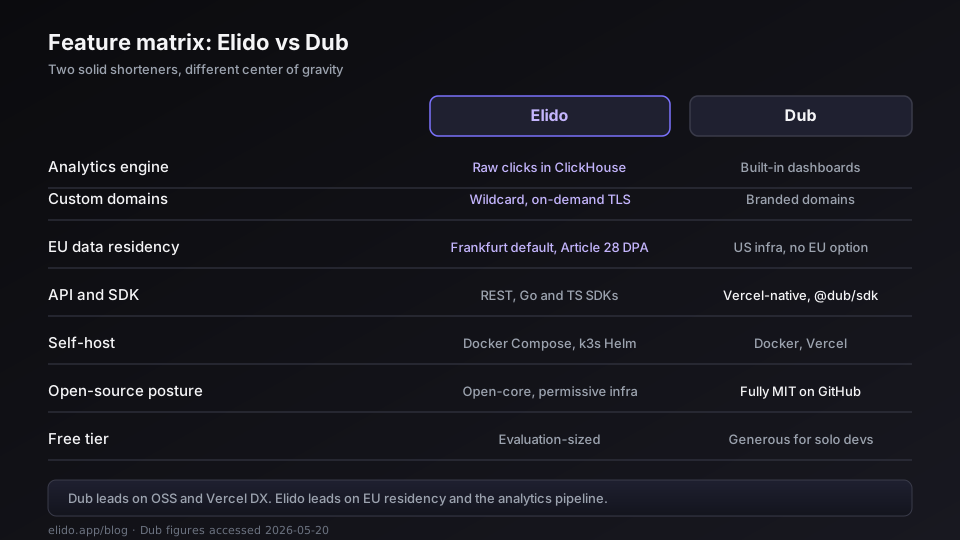
The question is whether it's the right fit for your team's specific profile. For three types of team - mid-market orgs that need SSO without paying enterprise prices, teams doing server-side conversion attribution, and EU-hosted SaaS companies with data residency requirements - Dub gates the features they need behind tiers where the price stops making sense.
All Dub figures below are from the public Dub pricing page accessed 2026-05-20. Pricing changes; verify against the live page before you quote any of these figures to your CFO.
TL;DR
- Dub is excellent for individual developers, early-stage startups, and Vercel-ecosystem teams. Its OSS credentials and polished UX are the real deal.
- SSO (SAML/OIDC) on Dub is Enterprise-only - it is not available on the Business plan at $75/month. On Elido, SSO is available on the Business plan.
- Conversion tracking on Dub requires the Business plan ($75/month) or above. On Elido, conversion tracking ships on the Pro plan.
- Dub has no EU data residency offering. All data is processed on US infrastructure. Elido stores its database and analytics in the EU and publishes its sub-processors; there is no per-workspace region choice yet.
- Both platforms can be self-hosted, but on different terms. Dub is fully open-source under the MIT license. Elido is not open source; self-hosting in your own infrastructure exists only under an Enterprise contract.
What Dub does best
The honest answer is: a lot. Before we get into where Elido is a better fit, here is where Dub is genuinely stronger or at parity.
Open-source with real OSS culture. Dub's codebase is on GitHub, MIT-licensed, and actively maintained. The repo has meaningful community contributions, a public changelog, and governance that makes the OSS credibility stick. If "can I audit the redirect logic" or "I want to contribute upstream" is a real requirement, Dub has a stronger answer than most SaaS URL shorteners.
Polished UI and DX. Dub's web app is one of the most thoughtfully designed tools in this category. The link creation experience, the QR code builder, the analytics dashboards - the product has visual quality that matches the Vercel/Raycast design standard that a certain slice of the developer audience cares about deeply. If your team judges tools by their UX aesthetics, Dub will win that evaluation.
Vercel ecosystem integration. Dub's Next.js SDK and the @dub/sdk package have first-class support for edge functions and Vercel's deployment model. If your stack is Next.js deployed to Vercel, Dub's integration surface is native in a way that requires no adapter work.
AI features on Pro. Dub ships AI-generated link slugs and AI-assisted UTM parameter generation on the Pro plan. These are genuinely useful for teams creating high volumes of links where slug collisions and UTM consistency are operational friction. Elido ships UTM templates and bulk import; it does not ship AI slug generation as of this writing.
GitHub social proof and community. For teams where "will this tool still exist in two years?" is a real evaluation criterion, Dub's GitHub stars and OSS community offer a continuity guarantee that a closed-source SaaS vendor can't match. That's a legitimate signal - the code is on GitHub and the community ships PRs against it.
The three feature gaps for mid-market teams
Acknowledging where Dub is strong makes it easier to be specific about where it doesn't fit. These aren't obscure edge cases - they're features that mid-market B2B teams routinely put on the evaluation checklist.
SSO: Enterprise-gated, not Business
On Dub's public pricing page, SSO (SAML/OIDC) is listed as an Enterprise feature. The Business plan at $75/month does not include SSO. Enterprise pricing is custom and negotiated.
This matters for a specific buyer profile: mid-market SaaS companies in the 50–500 employee range where the IT department has a policy that every SaaS vendor used by more than five people must be integrated into the corporate identity provider. These teams are not "enterprise" by revenue or headcount. They are enterprise by IT governance posture. They need SSO because their IT department requires it, not because they want to pay for an enterprise contract.
On Elido, SSO is available on the Business plan. It uses our authentication layer for identity management with WorkOS plugged in for SSO/SCIM. The SSO feature page covers the supported providers and the SCIM provisioning integration. If your IT policy requires SSO and you're not on an enterprise budget, this gap is the whole decision.
Conversion tracking: Business required
Dub's conversion tracking (click-to-conversion attribution) is listed as a Business-plan feature on the pricing page. If you're on the Pro plan at $19/month and want to track whether a click on your short link resulted in a signup, purchase, or event downstream, you need to upgrade to Business before you can wire this up.
Elido ships conversion tracking on the Pro plan. Purchases arrive from Stripe and Shopify webhooks and are tied to a link through an elido_link_id in the order metadata, so revenue shows per link, campaign and day. Click events can go server-side to GA4, Mixpanel, Klaviyo, Brevo and Datadog, but purchases are not forwarded to ad platforms yet, and there is no public endpoint for arbitrary conversions; both are on the backlog. The conversion tracking feature page describes what ships today. No extra plan tier required.
The pricing arithmetic matters here. If you're a team that wants both a polished link shortening product and server-side conversion tracking, Dub's entry point for that combination is $75/month. Elido's entry point is the Pro plan. The feature set you're paying for at Dub's Business tier is not equivalent to Elido Pro - Dub's Business plan includes more analytics depth, team management, and AI features - but if conversion tracking is the specific gap, the per-feature price of unlocking it differs.
EU data residency: absent at every tier
Dub processes all data on US infrastructure. There is no EU residency option listed on the pricing page, no EU-region selection during workspace setup, and no DPA that commits to keeping click data within the EEA. For a developer tool used by solo builders, this is a non-issue. For a B2B SaaS vendor whose customers are EU-based businesses, it can be a procurement blocker.
The legal background is the same as in every URL shortener comparison: GDPR Article 3 makes processing EU subject data subject to GDPR regardless of processor location, and the Schrems II ruling (CJEU C-311/18) means SCC-based transfers to US processors require a Transfer Impact Assessment in regulated industries. If your buyer is a German fintech, a French healthcare SaaS, or an EU public sector entity, a TIA on a US-hosted sub-processor is standard procurement. That adds weeks.
Elido stores its database, analytics store and backups in the EU. The trust page lists the 13 sub-processors and the regions they operate in, including redirect nodes in the US and Singapore that process visitor requests. A DPA with Article 28 obligations and EU SCCs is available on request on every plan, including Free. If your buyer's procurement team asks "where does the click data go?", the Elido answer is "stored in the EU, redirect nodes elsewhere, here's the trust page." A shorter conversation than a TIA exercise, though not a zero-length one. The solutions/compliance page is the procurement-facing version of this.
Open-source comparison
Dub can be self-hosted by anyone; Elido only under an Enterprise contract, so the licensing models differ.
Dub is fully open-source under the MIT license - the entire codebase, including the redirect infrastructure, the analytics pipeline, and the web app, is in the public GitHub repo. Fork it, modify it, run it commercially, no restrictions. The self-host docs cover Docker and Vercel deployment paths.
Elido is not open source: there is no public repository and no open licence. Deployments in your own infrastructure are offered only under an Enterprise contract ([email protected]). The self-host documentation describes that deployment; the k3s playbook post is the operational walkthrough.
If "full codebase auditability under MIT" is a hard vendor-onboarding requirement, Dub satisfies it and Elido does not. If a vendor-operated service with a contract-based self-hosting option is sufficient, Elido covers that.
Pricing comparison at three volumes
Dub's tier structure as of 2026-05-20 is: Free, Pro ($19/month), Business ($75/month), Enterprise (custom). The pricing page shows the feature set for each tier. The main billing signals are tracked links and included clicks; overage behavior varies by tier.
Elido's tiers are Free, Pro, Business, and Enterprise. See /pricing for current numbers - I am deliberately not quoting Elido's specific pricing here because that page updates with promotions and regional pricing. The relevant structural difference is: SSO and conversion tracking gate differently across the tier ladder.
Small B2B SaaS (30K clicks and 200 links a month). Both vendors' free or entry paid tiers cover this volume. Neither pricing model bites. If your team doesn't need SSO or server-side conversion tracking, Dub's Pro plan ($19/month) is a very competitive offer - the AI slug generation and polished UI are real value at that price. Elido's Pro tier covers the same volume. At this scale, the decision is about features and future-proofing, not cost.
Performance marketing team (150K clicks and 3K links a month). This is where conversion tracking becomes operationally relevant. Running paid acquisition without server-side conversion attribution means Safari ITP and browser-side cookie restrictions are silently eroding your attribution. On Dub, conversion tracking means the $75 Business plan. On Elido, it's on the Pro plan. If conversion attribution is part of your measurement stack at this volume, the tier-gating comparison is the deciding pricing input.
Mid-market SaaS under an SSO policy (400K clicks and 10K links a month). Here the SSO question is the gating factor. The IT department requires IdP integration; the team is not on an enterprise budget. On Dub, SSO means an Enterprise custom quote. On Elido, SSO is on the Business plan. The total cost comparison at this tier depends heavily on Dub's Enterprise quote, which varies. What's clear is the structural difference: Elido's Business plan includes SSO; Dub's does not.
Migration considerations
If you're moving from Dub to Elido, the operational steps are lighter than most migrations. Dub's data model is clean and the export format is well-documented.
Start with the link export. Dub's workspace export produces a CSV or JSON file with the short link, destination URL, domain, slug, tags, and creation timestamp. The format is straightforward. Elido's bulk import endpoint at /v1/workspaces/{workspace_id}/links/bulk accepts slug, destination, domain, and tags - the fields map one-to-one from a Dub export. A migration for 10,000 links is an hour of work plus DNS propagation time.
Next comes the custom domain DNS handover. If your branded domain is currently pointing at Dub's redirect infrastructure, you'll need to repoint the CNAME to Elido and allow TLS to provision before the old slugs resolve correctly through Elido. The approach is the same as any CNAME cutover: lower the TTL the day before, repoint, validate. Elido provisions TLS on first request via automatic on-demand TLS - typically under 60 seconds. The custom domains guide covers the DNS and TLS mechanics in detail.
Then there is analytics continuity. Click analytics from before the migration stay in Dub's system. Analytics from migration day forward accrue in Elido. Budget for a break in the historical trend line and communicate that to whoever owns reporting.
For self-hosted Dub users, the migration path is the same as above. If you want Elido in your own infrastructure instead of the hosted product, that is an Enterprise-contract option ([email protected]); the k3s playbook linked above describes what is involved.
Decision matrix
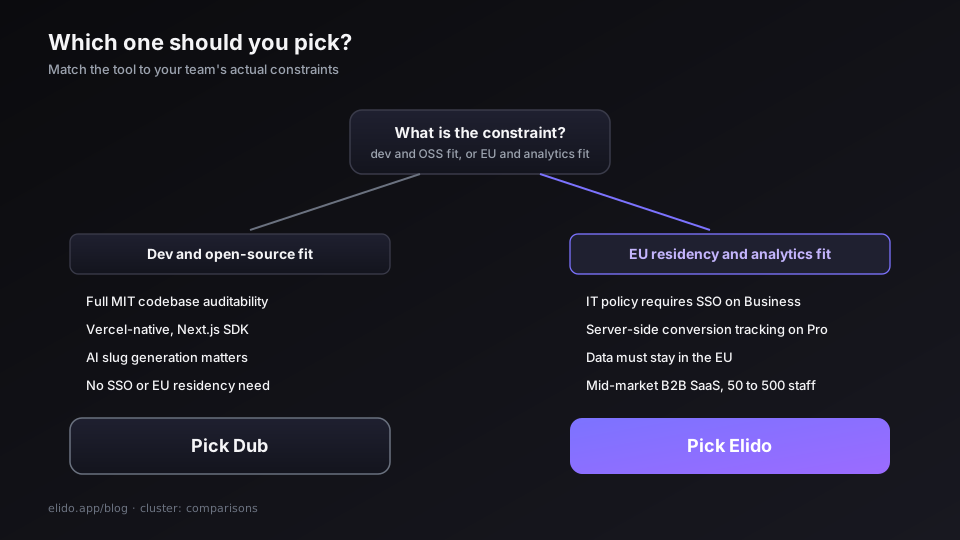
When Dub is the better pick:
- You are a solo developer or early-stage startup that values OSS auditability, a beautiful UI, and the Vercel-native integration pattern. Dub's Pro plan is excellent value.
- Full MIT open-source is a hard requirement. If you need to audit and fork the complete codebase, Dub's MIT license covers this unambiguously.
- You are deep in the Vercel/Next.js ecosystem and want first-class SDK support for edge functions. Dub's
@dub/sdkis optimized for this. - AI slug generation matters for your volume. Dub's AI-powered link features are ahead of Elido on this specific dimension.
- You have no SSO requirement and no EU residency requirement. If those two constraints don't apply, Dub's Pro plan delivers a polished product at a competitive price.
When Elido is the better pick:
- Your IT policy requires SSO and you're not on an enterprise budget. Elido Business includes SSO; Dub requires an Enterprise contract.
- You need server-side conversion tracking on Pro. Elido includes this; Dub gates it behind the Business plan.
- Your data must stay in the EU. Dub has no EU residency option. Elido stores its data in the EU and offers an Article 28 DPA on request.
- You are evaluating for a mid-market B2B SaaS with 50–500 employees, an IT governance posture, and EU customers. This is the profile Elido is built for.
- You need wildcard custom domains for agency or multi-tenant use cases. Elido Business supports
*.agency.examplewith one CNAME and one TLS certificate rotation.
Large enterprises with complex procurement requirements should think carefully before choosing either. At that scale both vendors offer custom Enterprise pricing and a self-serve tier comparison stops being the right lens.
FAQ
The questions that come up most when teams compare the two.
Is Dub actually open-source?
Yes, fully. The Dub codebase is MIT-licensed and on GitHub. You can fork it, self-host it, and modify it commercially. This is a genuine differentiator and the OSS community around it is active.
Does Elido have an open-source version?
No. Elido is not open source and has no public repository or open licence. Self-hosting in your own infrastructure is available only under an Enterprise contract ([email protected]). The self-host page describes what that deployment includes.
Why does SSO cost so much on Dub?
Enterprise SSO historically carried support overhead (IdP configuration, SCIM edge cases, security reviews) that justified premium pricing, and Dub's positioning reflects that heritage. Elido's view: mid-market teams need SSO for IT policy reasons, not because they're "enterprise", and gating it behind a custom contract is a mismatch for that buyer.
If I self-host Dub, do I get SSO for free?
MIT license means you can implement SSO yourself in the codebase - but that means engineering work: configuring an IdP, wiring the SAML/OIDC flow, and maintaining the integration. "Technically available in OSS" and "ships as a maintained feature" are different things. Check the self-hosted Dub docs against your engineering capacity before assuming this is a free path.
Can I use Elido's EU hosting from outside the EU?
Not as a choice. The primary database, analytics store and backups are in the EU, and redirect nodes in the US and Singapore process visitor requests. Per-workspace region pinning is not available on any plan yet; it is planned.
Does Elido have AI features like Dub?
Not at parity. Elido ships UTM templates, bulk import, and smart routing with six dimensions. It does not ship AI-generated slugs or AI-assisted UTM parameter generation as of this writing. If AI-powered link creation is a primary evaluation criterion, Dub is ahead on that dimension.
What's the migration effort from Dub to Elido?
For a team with one branded domain and under 10,000 links, plan for half a day: export CSV, bulk import to Elido, repoint CNAME, validate. Larger workspaces with multiple domains or automation-heavy workflows should budget a day or two for testing. See the migration section above for the step-by-step.
Related on the blog
- SCIM and SSO for marketing tools: what enterprise IT actually asks
- Server-side conversion tracking: the full setup guide
- EU data residency for marketing tools: what your DPO actually asks
- Self-hosting Elido on k3s: a production-ready playbook
- URL shorteners for SaaS: the 2026 evaluation guide
- Dub alternatives: 6 link management platforms compared
Frequently asked questions
Is Dub actually open-source?
Yes, fully. The Dub codebase is MIT-licensed and on GitHub. You can fork it, self-host it, and modify it commercially. This is a genuine differentiator and the OSS community around it is active.
Does Elido have an open-source version?
No. Elido is not open source: there is no public repository and no open licence. Self-hosting in your own infrastructure is available only under an Enterprise contract ([email protected]).
Why does SSO cost so much on Dub?
Enterprise SSO historically carried support overhead - IdP configuration, SCIM edge cases, security reviews - that justified premium pricing, and Dub's positioning reflects that heritage. Elido's view is that mid-market teams need SSO for IT policy reasons, not because they are enterprise, and gating it behind a custom contract is a mismatch for that buyer profile.
If I self-host Dub, do I get SSO for free?
The MIT license means you can implement SSO yourself in the codebase, but that means engineering work: configuring an IdP, wiring the SAML or OIDC flow, and maintaining the integration. Technically available in OSS and ships as a maintained feature are different things. Check the self-hosted Dub docs against your engineering capacity before assuming this is a free path.
Can I use Elido's EU hosting from outside the EU?
Not as a choice. The primary database, analytics store and backups are in the EU, and redirect nodes in the US and Singapore process visitor requests. Per-workspace region pinning is not available on any plan yet; it is planned.
What is the migration effort from Dub to Elido?
For a team with one branded domain and under 10,000 links, plan for half a day: export CSV from Dub, bulk import to Elido, repoint the CNAME, and validate. Larger workspaces with multiple domains or automation-heavy workflows should budget a day or two for testing. Elido's bulk import endpoint accepts slug, destination, domain, and tags, which map one-to-one from a Dub export.
Try Elido
Paste a URL, get a working short link
No signup. Link lives for 30 days. Sign up to keep it forever.
Free account required. The free plan includes 25 links in total. Already have an account? Log in