Sniply is a CTA overlay tool: you shorten a link to someone else's article, and when people open it they see the article with your own button, form or banner on top. Elido now does a basic version of that: a single bar, at the top or bottom, with text and a button. Anything beyond it, such as forms, banner images or A/B tests, isn't built. So the honest answer to Elido vs Sniply is simple. If you want a full call-to-action toolkit on content you curate, choose Sniply (or Replug). If you want branded links with retargeting, bio pages and QR codes for less, that's where Elido fits.
I'm on the Elido team, and this is a comparison where our product loses the main event, so I'll say it up front. Sniply facts come from Sniply's pricing page and homepage, accessed 2026-11-11. For the wider field, start with the cornerstone on URL shorteners for marketers.
What Sniply Does Beyond Elido's Bar
Content curators share a lot of links to pages they don't own: a news story about their industry, a review, a study. Each share sends attention away. Sniply's pitch is to win some of it back by laying a small message over the shared page, like "Get the full report" with a button to your landing page.
Its pricing page lists five CTA types: a button, a text link, an email capture form, a banner image, and a hidden type that shows nothing but keeps the analytics and retargeting. There's a theme library, custom colours and placement (the FAQ ties colours and placement to Pro and above), A/B tests for CTAs, and an option to remove the Sniply logo. Custom CSS is marked as coming soon.
Elido has one of these things: a plain bar with a button.
On Pro, Business and Enterprise you create it in the workspace, pick top or bottom, set the text and four colours, and attach it to a link. The dashboard counts impressions and clicks per overlay. Email forms, banner images, hidden CTAs, A/B tests of overlay copy and UTM passthrough are not built, and we've logged them as gaps rather than pretend otherwise.
Sniply and Elido Compared
Beyond the overlay, the two tools overlap more than you'd expect: both shorten links on your own domain, both carry retargeting pixels, and both track clicks.
| Question | Elido | Sniply |
|---|---|---|
| CTA on the page you share | Basic: top or bottom bar with text and a button | Yes: button, text, email form, banner or hidden |
| What's metered | Links (each Pro link brings 10 clicks a month) | CTAs and CTA impressions; link clicks unlimited |
| Free plan | Yes: 50 links, 500 clicks | No; 14-day trial on every plan |
| Retargeting pixels | Meta, Google, LinkedIn, TikTok, behind a consent card | Tracking and targeting scripts; homepage names Facebook, Twitter, Google Ads |
| Team members, entry paid tier | 3 on Pro 250 (3.50 EUR) | 1 on Basic ($9) |
| API | Every plan | Enterprise only |
| Bio pages, QR, smart routing | Yes | Not on its pricing page |
Sniply's model fits people who share a lot of other people's content and count success by CTA clicks. Elido fits people who share their own pages and count clicks, audiences and conversions.
Sniply Pricing: CTAs and Impressions
Sniply meters two things: how many CTAs you can design and how many times they're shown each month. Link clicks are unlimited on every plan.
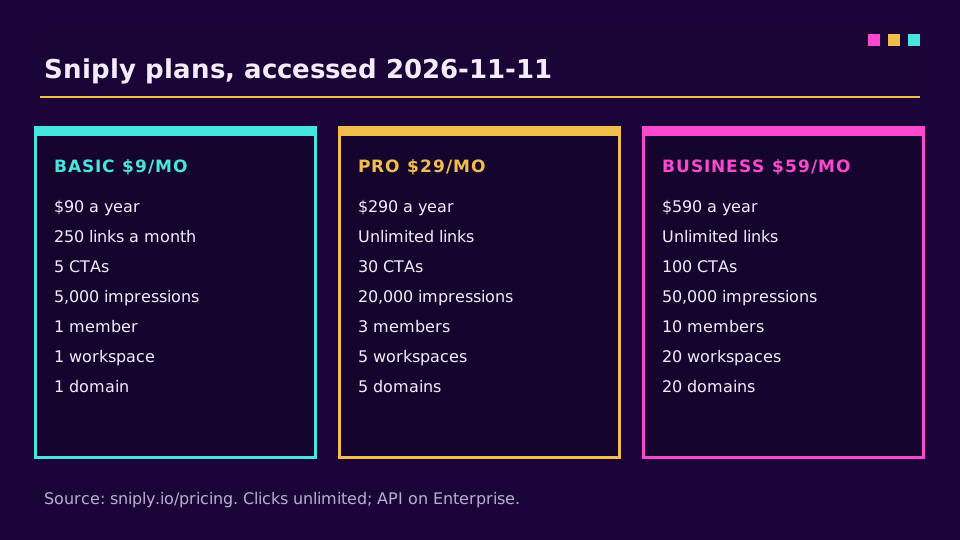
Basic is $9 a month or $90 a year, with 250 Sniply links a month, 5 CTAs, 5,000 CTA impressions, one team member and one custom domain. Pro is $29 ($290 yearly) with unlimited links, 30 CTAs, 20,000 impressions, three members, five workspaces and five domains. Business is $59 ($590) with 100 CTAs, 50,000 impressions, ten members and twenty of each workspace and domain. Enterprise is custom and the only tier listing API access (all accessed 2026-11-11).
The impression cap is the number to plan around.
Once it's spent, Sniply's FAQ says links still open, but the CTA disappears until the month resets. A curated post that goes viral on the 3rd of the month can use up Basic's 5,000 impressions in an afternoon.
For comparison, Elido's paid plans start at 3.50 EUR a month for 250 links and three seats, and Pro 1K is 10 EUR for 10,000 clicks with five seats. Different meters, so the pricing page is the place to model your own traffic.
Where Overlay Links Get Tricky
Overlay links have three practical limits, whichever vendor you pick.
The first is framing. A common way to keep your CTA on top of another site is to load that site in a frame, and sites can forbid that with the X-Frame-Options header or a CSP frame-ancestors rule. Sniply announced in February 2023 that it "now works on all websites", without saying how. Test your real target URLs in the trial anyway, on desktop and on a phone. Elido has the same limit: it checks each destination's headers in the background, and a destination that forbids framing gets a normal redirect with no bar.
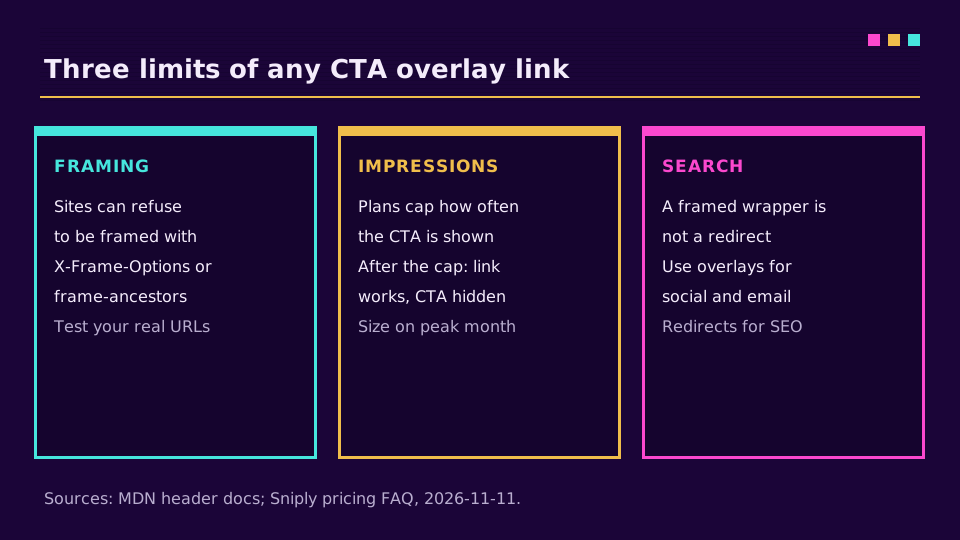
The second is the impression cap described above. The third is search. An overlay link is a sharing tool, not a way to publish content: a framed wrapper is not a normal redirect, and our post on link cloaking and URL masking explains why frame-based masking does nothing for SEO. Use overlay links on social posts and newsletters, and a plain redirect anywhere ranking matters.
Consent is worth a line too. If your Sniply CTA carries a retargeting script, the same EU rules apply as on your own site. Our guide to cookie consent for short links covers what that means.
When Elido Is the Better Fit
If most of your links point at your own pages, an overlay adds little: you already control what's on the page. A bar over your own site is rarely worth the frame. What you need then is the short link itself, done well.
- Retargeting pixels on Pro and Business, behind a consent card that treats Global Privacy Control and Do Not Track as a no. Setup lives on our retargeting page.
- Smart links that route by country, device, operating system, browser or language, with A/B variants.
- Bio pages and QR codes on every plan, webhooks and an audit log from Pro, and SSO with SCIM on Business.
- An API on the Free plan, so you can script link creation before paying anything.
Primary data stays in the EU. And if your team shares lots of third-party content as well, nothing stops you running Sniply for curated links and Elido for your own; they don't collide.
Verdict: Who Should Pick Which
Pick Sniply if you curate other people's content and want a real call-to-action toolkit on it. It's the original tool for that job, the CTA types are broad, and the 14-day trial lets you check it on your own sources. Replug is the closest alternative with overlays plus bio links, and our Elido vs Replug post covers it.
Pick Elido if your links mostly point at your own site and what you want is branded links, retargeting with consent, smart routing and seats at a low price, with a simple bar overlay as an extra. For the full list of overlay tools we checked, see Sniply alternatives.
Related on the Blog
よくある質問
What does Sniply do?
Sniply shortens a link to someone else's page and shows your own call-to-action on top of that page when people open it. The CTA can be a button, a text link, an email capture form or a banner image, or hidden if you only want the tracking. Curators use it to send readers of third-party articles back to their own site.
How much does Sniply cost?
Basic is $9 a month ($90 a year) with 5 CTAs and 5,000 CTA impressions a month. Pro is $29 ($290) with 30 CTAs and 20,000 impressions. Business is $59 ($590) with 100 CTAs and 50,000 impressions. Every plan has a 14-day trial and unlimited link clicks. Prices accessed 2026-11-11 on sniply.io/pricing.
Does Elido have Sniply-style CTA overlays?
Only a basic version. On Pro, Business and Enterprise you can attach a top or bottom bar with text and a button to a link, and visitors see it over the destination in a frame. It works only when the destination allows framing; otherwise they get a normal redirect. There are no forms, banner images, hidden CTAs or A/B tests. If you need those, use Sniply, Replug or JotURL.
What happens when Sniply CTA impressions run out?
Per Sniply's pricing FAQ, links keep working after you pass the monthly CTA impression limit, but the CTA stops showing and visitors go straight to the target page. Hidden CTAs don't count as impressions. Size your plan on your busiest month.
Who owns Sniply?
UpContent. In a post dated 2023-10-24, UpContent announced that Sniply is now under the UpContent umbrella, and Sniply's own site carries an acquisition banner pointing to it. The product, pricing and domain stayed as Sniply.
Does Sniply have an API?
Only on Enterprise, according to its pricing page (accessed 2026-11-11), which lists API access and setup assistance under that custom-priced plan. Sniply's lower plans rely on integrations such as Hootsuite, Buffer, Sendible, Mailchimp and Zapier. Elido's REST API is on every plan, including Free.
Elidoを試す
URLを貼り付けて短縮リンクを取得
登録不要。リンクは30日間有効。永久に保存するには登録してください。
登録不要。無料登録すると月 50 件のリンクを作成できます。