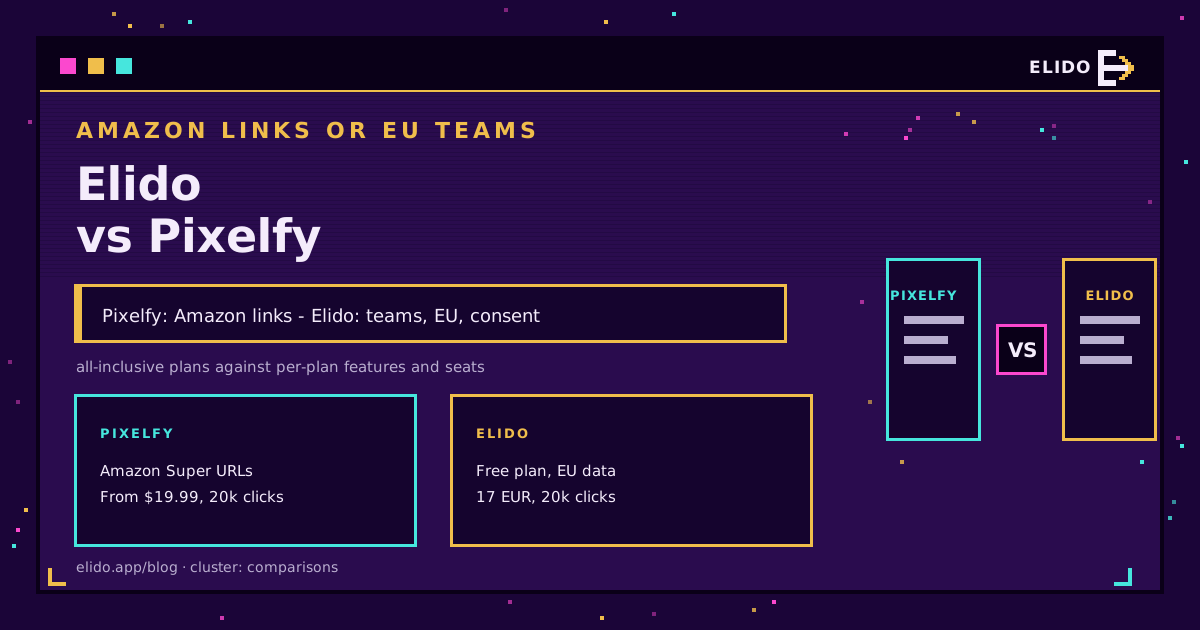
Pixelfy is a link shortener aimed at Amazon and Walmart sellers, affiliates and bloggers: every plan includes every feature, and its best-known products are Amazon "Super URLs" that send shoppers to a listing through a keyword search. Elido is a general-purpose shortener with its primary data in the EU, built for marketing teams, with retargeting pixels behind a consent card, smart links, bio pages and QR codes. In Elido vs Pixelfy, the deciding question is whether you sell on Amazon. If you need ranking links, choose Pixelfy, because Elido doesn't make them. For everything else, compare the click tiers and the team features below.
I'm on the Elido team, so weigh my verdict with that in mind. Pixelfy's facts come from Pixelfy's pricing page, its homepage and help centre, accessed 2026-11-11. Elido's come from our plan catalogue and product code the same day. The cornerstone on URL shorteners for marketers maps the wider field.
Pixelfy and Elido Side by Side
Around since 2017 and serving 25,000-plus active users by its own count, Pixelfy keeps pricing simple: three plans that differ only in clicks. We gate some features by plan and meter links, not clicks. Neither model is wrong; they suit different buyers.
| Question | Elido | Pixelfy |
|---|---|---|
| Free plan | Yes: 50 links, 500 clicks a month | No; 7-day trial on each plan |
| Entry paid plan | 3.50 EUR (250 links, 2,500 clicks, 3 seats) | $19.99 (20,000 clicks) |
| Features by plan | Some on Pro or Business only | All features on every plan |
| Amazon, Walmart, Target links | No | Yes: Super URLs, 2-step and Search-Find-Buy links, retailer URLs |
| Social preview (Open Graph) | No per-link override | Open Graph settings listed |
| Retargeting pixels | Meta, Google, LinkedIn, TikTok, with a consent card | Tracking codes; its help article uses the Facebook Pixel |
| Bio pages, QR, deep links | Yes | Yes |
| SSO, SCIM, audit log | SSO and SCIM on Business; audit log from Pro | Not on its pricing page |
Pixelfy takes the Amazon row and the "everything included" row outright. The team and identity rows are ours.
Amazon Seller Tools: Pixelfy's Home Turf
Most of Pixelfy's pricing page is about features any shortener has. The bottom of it is not. There's a section of Amazon links (Supreme URL, Supreme URL 2.0 and 3.0, a 2-step brand URL, Search-Find-Buy, a review request link, an Amazon's Choice Super URL) plus retailer URLs for Walmart and Target.
What they share is the goal. Pixelfy's Amazon page describes tools that mimic organic keyword searches from outside traffic to help a product rank. A shopper clicks your link, lands on an Amazon search for your keyword, and finds your product there, so the sale looks like it came from search.
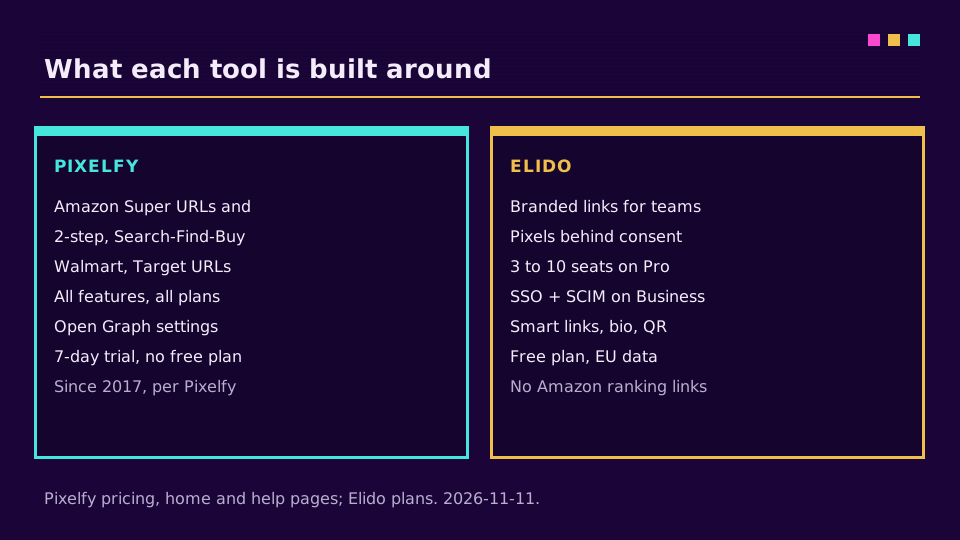
We have nothing like this.
Pixelfy's page doesn't mention Amazon's seller policies at all, so whatever tool you use, read Amazon's rules on traffic and ranking before you rely on these links. If you're an Amazon Associate rather than a seller, the rules are different again. Our Amazon affiliate link shortener guide covers what Associates can and can't do with short links.
Pixelfy Pricing Against Elido's Tiers
Its plans are sold by clicks. Professional is $19.99 a month for 20,000 clicks, Business $49.99 for 150,000 and Enterprise $99.99 for 500,000, each with every feature and a 7-day trial (accessed 2026-11-11). The page doesn't show annual pricing or a link limit.
Ours are sold by links, and each Pro link brings ten clicks a month.
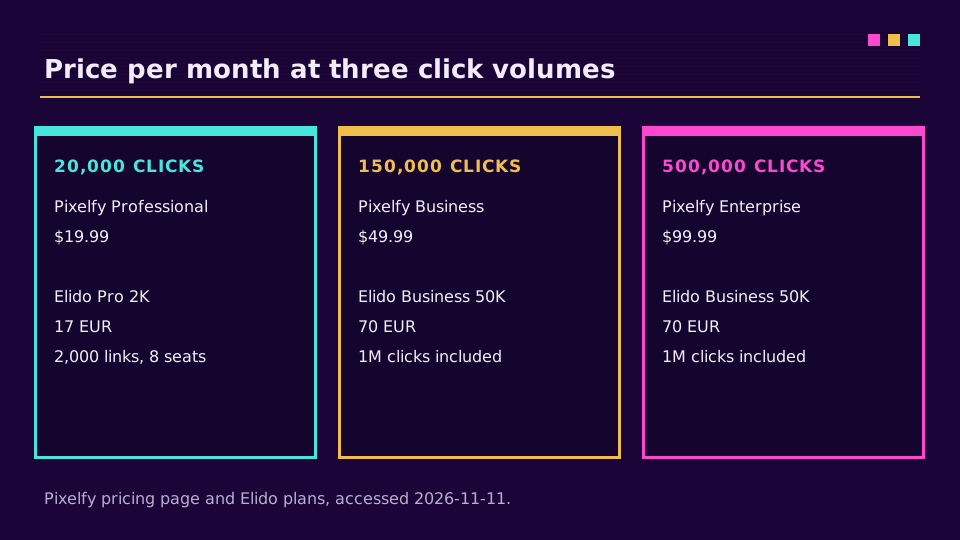
At 20,000 clicks, the two are close: Elido Pro 2K is 17 EUR with 2,000 links, three branded domains and eight seats, against Pixelfy Professional at $19.99. At 150,000 clicks Pixelfy Business is cheaper than our next step, since Elido Pro tops out at 50,000 clicks (Pro 5K, 35 EUR) and Business starts at 70 EUR. But that 70 EUR includes a million clicks, double Pixelfy's top plan.
So Pixelfy wins the middle of the range, Elido wins both ends, and Pixelfy never makes you upgrade for a feature. The tiers are all on our pricing page, and Pro 1K, 2K and 5K start with a 14-day trial.
Retargeting, Previews and Privacy
Both tools fire retargeting pixels on short links. On Pixelfy they're called tracking codes: you store snippets and attach them to links, and anyone who clicks gets tagged. Its help article on tracking codes uses the Facebook Pixel as the example and doesn't describe a consent step.
Our side supports the Meta Pixel, a Google tag (Ads or GA4), the LinkedIn Insight Tag and the TikTok Pixel, on Pro and Business. A link with pixels on shows a short consent card before anything third-party loads. Decline, Global Privacy Control or Do Not Track all mean no pixel code reaches the page. If most of your clicks come from the EU, that default saves a conversation with your DPO; our cookie consent for short links guide explains why.
Previews go to Pixelfy.
Its Open Graph settings let you shape the card a link shows when shared. Ours can't, and fixing a broken link preview explains what you're left with: the destination's own tags.
When Elido Fits Better
For a marketing team rather than a solo seller, we're the better pick. Pro plans include three to ten seats, an audit log and webhooks; Business adds SSO with SCIM provisioning and custom roles. Smart links route by country, device, operating system, browser and language, with A/B variants (see smart links). Bio pages and QR codes are on every plan.
The free plan lets you test all of that with real links before paying, which matters more than any table: an afternoon with your own links tells you whether the dashboard fits how your team works.
Verdict: Who Should Pick Which
Pick Pixelfy if you sell on Amazon, Walmart or Target and want ranking or multi-step links, if you'd rather have every feature unlocked from the first plan, or if custom preview cards matter. Its middle tier is good value at around 150,000 clicks.
Pick Elido if you're a team, need seats and SSO, want retargeting with consent built in, or sit at either end of the click range. Our retargeting page shows the pixel setup. Two retargeting-first rivals get the same treatment in Elido vs Switchy and Elido vs Replug.
Related on the Blog
よくある質問
How much does Pixelfy cost?
Pixelfy lists three plans: Professional at $19.99 a month for 20,000 clicks, Business at $49.99 for 150,000 clicks and Enterprise at $99.99 for 500,000 clicks. Every plan includes every feature and starts with a 7-day free trial. Prices accessed 2026-11-11 on pixelfy.me/pricing.
What is a Pixelfy Super URL?
It's a link for Amazon sellers that sends shoppers to a product through a keyword search or a series of steps, so the visit looks like organic search traffic. Pixelfy sells several versions (Supreme URL 2.0 and 3.0, a 2-step brand URL, Search-Find-Buy). Its page makes no statement about Amazon's seller policies, so read those before you use one.
Does Elido have Amazon Super URLs?
No. Elido doesn't build search-ranking or multi-step Amazon links. Elido shortens and tracks a link to an Amazon page like any other destination. If ranking links are the reason you're shopping, Pixelfy is built for that job and Elido isn't.
Does Pixelfy have a free plan?
Its pricing page shows three paid plans, each with a 7-day free trial, and no permanent free tier. Elido has a Free plan with 50 links and 500 clicks a month, though branded domains and retargeting pixels need Pro.
Can Pixelfy change a link's social preview?
Pixelfy's feature list includes Open Graph settings, which is where a link's preview title and image are set. Elido has no per-link preview override: social networks read the destination page's own tags. That's a point for Pixelfy if you share pages with weak previews.
Is Elido cheaper than Pixelfy?
At most volumes, yes. 20,000 clicks a month cost 17 EUR on Elido Pro 2K against $19.99 on Pixelfy Professional, and Elido Business includes a million clicks for 70 EUR, where Pixelfy's top plan is $99.99 for 500,000. Pixelfy includes every feature on every plan; Elido keeps some, like SSO, for Business.
Elidoを試す
URLを貼り付けて短縮リンクを取得
登録不要。リンクは30日間有効。永久に保存するには登録してください。
登録不要。無料登録すると月 50 件のリンクを作成できます。